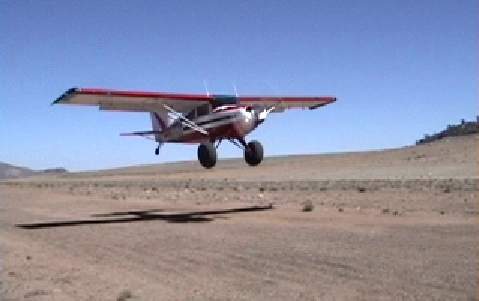
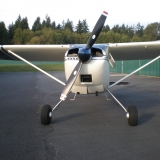
The Goodyear 26 inch tires were made (and are still made) as tubeless tires for the blimps. Goodyear just saw the opportunity to market them to a different niche. On the blimps, they run wheels that permit them to be run without tubes.
On conventional aircraft, you have to run them with tubes, and you use the Goodyear 8.50 x 6.00 tubes. Note that not all 8.50 tires and tubes are the same size. Goodyear stuff is pretty consistent. Use their tubes if possible. Tubes in this size are expensive as well.
The tires are treadless, so they throw less junk at your tail, which is good.
The sidewalls DO NOT flex well, which is one of the big differences between these tires and BW tires. Really, there is no comparison between these and BW, and it's not just a price thing.
Bushwheels are lighter, they are larger, and they flex MUCH better.
They also cost an arm, two legs, and your pet collie, Max.
The Goodyears can spin if run at too low a pressure. I always ran them no lower than 12 pounds to be conservative. Remember that when you go from a warm hangar to outside at 30 degrees, the air inside those tires changes pressure, so monitor them carefully, and set pressure for ambient where you are landing.
Put slippage marks on the tires and rims as well, to permit you to know when a tire has moved. This is essential. If it moves much, you'll shear the valve stem, and there you are.
These things work fine, but they aren't bushwheels.
As to the baby bushwheel tailwheel, it is a wonder, and it is far superior to the competition. The older modified tailwheel has very little clearance between the tire and fork, and this can be (will be) problematic.
Alaska Bush Wheels now manufactures a complete line of replacement parts for the Scott tailwheels, and their stuff is first quality.
MTV