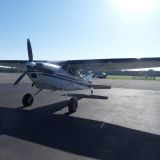
I took off for New Mexico at 0500, well before the sun rose. After letting myself through Jeffco’s airspace and getting permission to pass through Centennial’s, I was finally free of controllers and airspace worries for a while. I took some of the cruise time before dawn to eat a healthy breakfast (chocolate doughnut) and tweak my rudder trim. The bungee trim system on older Stinsons with newer engines is not ideal, and never really feels ‘dead on’ to my feet. As the morning light slowly came on, I found myself unsure whether the white ground cover below was snow, or an early morning fog layer. Increasing light proved it was just snow on the plateaus, which was a small relief. Regardless, the sun made its appearance just as I crossed the border. It was perfect timing, as I had lovely terrain below to gaze at in the morning light. I spotted Mt. Dora and some of the more distant, western peaks in the amber light. Clayton, the first airport of the day, beckoned.
Starting here in the northeast corner of the state, my plan was to zig-zag north to south a total of 6 times as a method of visiting each of NM’s many airports. The north-south oriented mountain ranges shaped the locations of the state’s cities, which in turn shaped the location of their airports into nice, semi-orderly lines. The few airports I skipped (AXX, SAF, ABQ, GNT, and E98) I had already visited on previous work and travel adventures, and each has plenty of memories. I smoked the brakes of a Citation in SAF when our thrust reversers were out (“the book said we could do it…”). I was stuck in the middle of the night at Mid-Valley by a snowstorm, and rescued by an extremely kind local who took me in for the night. Grants has a cool display showing the old air mail arrows in the area, as well as super neat volcanic terrain to the west. Angel Fire has great summer hiking. And Albuquerque…is fine.
Back at Clayton, I fueled up and wandered into the FBO building for a bathroom break. I poached a NM chart from the desk in case my iPad died, and found a nice kitchen and dance hall area in the back. Perhaps a local community gathering place? Regardless, the sign on the wall stated “All events end at midnight.” Perhaps there is a story there. I started back up and took off for Tucumcari. Along the way was the Ute Reservoir and a private airport called Runway Bay. It was a pretty neat looking spot to land, but also had the look of a gated community built around a golf course in the desert. Not my scene. Tucumcari seemed adequate from the air and the ground, and I gave it a touch and go landing before moving on southeast.
Part of my routine between airports usually went something like this: I take off and get on heading/altitude for the next airport. Once established in cruise, I review my notes and notams about the upcoming field so as to be refreshed on the details. Then I listen to the weather if they have it, and plan my pattern. This usually ends up with a cross midfield to spot the windsock regardless, followed by a downwind to the appropriate runway. Clovis Regional was next, and with it came an AWOS and an interesting notam—the grass runway 8/26 was closed, but only Monday—Friday. I might be a pilot, be even I can understand that such a restriction leaves weekends open! I gave the strip a low approach, then a drag, and finally a full stop landing. It was in great shape! A few gopher holes here and there, some little bumps now and then, but it still made some of Colorado’s strips look downright abandoned. An airport Ops vehicle was on frequency driving around, so I asked them about it. Word is, management doesn’t like how much upkeep the little strip needs, and wants to close it. Thus, the notam. I gave him my glowing review, and was on my way, though not before expressing my hopes that they’d hang onto it a little longer. Compared to repaving, crack filling, and other pavement related costs, mowing and leveling dirt seems downright cheap to me…
I flew on to Portales, my next fuel stop, but not before attempting to check in with Cannon AFB. I’d be passing real close to their airspace, and since the drones the chart warned me about don’t have real eyes, I thought it’d be prudent. To my surprise, they were closed! The field, tower, all of it. No drones today. Oddly enough, my marker beacon decided to go off at full volume as I passed…despite not exactly being on the ILS 31 course. Strange.
I moseyed on to a windy-gusty landing at Portales. I self-served, visited their bathroom facilities, and was about to leave when I noticed an Air Tractor. They were working a field just west of the airport, making nice sweeping turns back and forth. I decided to depart south on the crosswind runway so as not to be in their way. This turned out to be a fun decision, as the windy-gusty conditions I mentioned earlier had me wrangling poor Betsy like a bronco before getting airborne. This would be the first of many such experiences with the wind.
I followed a highway south out of town, dodging the local wind turbines. It occurred to me just how unbelievably flat things were getting. For the first time all day, I couldn’t see mountains or buttes in any direction. How depressing. The next airport on my list was Tatum, a small single runway field in what could be charitably described as “between the middle of nowhere and the edge of civilization.” Foreflight comments called it “abandoned” and I couldn’t dispute that for a second. Grass grew in runway cracks, and it thrived on the ramp. I spooked an owl of some sort out of one of the four empty looking hangars. At least someone was making use of them. Tatum also had the first missing wind sock of the trip. I wondered how long its crossing runway had been closed, and how long its main one would hold out. I moved on.
Lea County / Zip Franklin Memorial was the first of three “Lea” airports. While I think “Lovington” for the town next door or simply “Zip” would be fine, the name was the only memorable part. Lea County Regional (Hobbs) was the first towered field I’d land at, and was kind enough to allow my brief touch and go visit to 22. Finally, I made it to Lea County / Jal, which I decided to just call “Jal.” It was the most memorable of the three, as the crosswind runway was short enough to be interesting and pointed me west towards my next destination on departure. All three of these airports were some variety of “windy-gusty” which made both landings and cruising between them draining. I took advantage of the longer cruise leg to Carlsbad to enjoy my lunch: peanut butter sandwich, goldfish crackers, and a homemade brownie. Yum.
Carlsbad, or Cavern City Air Terminal if you’re a Marketing type, was determined to give me the full experience. The most convenient runway for a refuel was 14L/32R, but it and the north half of the ramp were closed. Another friendly Skyhawk was enjoying the pattern on 8, so I fell in with them for a landing and headed for the fuel pumps. After filling back up, I pushed Betsy out to a safe corner of the ramp and walked into the terminal. And surprise, surprise—it really was set up like an airline terminal! Contour apparently operates jet flights to Albuquerque and Denver from here. Signs on the door stated that only Authorized Personnel were allowed on the ramp, but I felt authorized enough not to worry about it. I started up just in time to avoid a Contour jet, back taxied over to runway 21, and gave the Skyhawk a score on his latest short field landing before blasting off northbound.
Artesia Municipal doesn’t seem like much on the surface. Two crossing runways, in good shape, and an AWOS. But just north of the field is a large training center for Federal Agents—complete with multiple fun-looking driving courses and three 727s! Neat! I made my landing on 13 to get a better look at the jets, then moved on to Roswell. Their ATIS stated that arrivals should contact approach first, which I found odd for a Class D airport. But both they and Tower were in great moods, and I enjoyed talking to each before coasting in for a landing. Of course, there’s a boatload of jets parked out in the boneyard to eyeball from the pattern as well. No alien spacecraft on the ramp, however, so I moved on.
Fort Sumner had one of the more interesting Foreflight comments of the trip, with 8/26 being described as a “goat ranch.” Naturally, I had to investigate. I set up for 26, and bounced along in the gusty, choppy winds. I pleasantly surprised to see that aside from grasses growing through the cracks, the runway was perfectly usable. Now I’m rolling along on 8.50 size tires, so certainly an RV or similar on hockey pucks would have a worse time. But comments like these, saying “the farm field next door is in better shape” always annoy me, because it adds unnecessary stress and drives away pilots from perfectly usable facilities. Oh and NASA had a big hangar there too, which was neat. Apparently they’re putting on a Scientific Balloon Program from the airport.
As I passed Lake Sumner, fatigue was starting to set in. I was getting real tired of bouncing my head off the ceiling, and with my next stop at Santa Rosa reporting gusts in the 30 knot range, I knew it was only a matter of time before I started making mistakes. I decided to cut my day slightly short and, after visiting Santa Rosa, continue on to Las Vegas (still New Mexico!) before ending my day at Conchas Lakes. I was technically ahead of schedule and had wanted to knock out Raton and Springer before returning to Conchas to camp for the night. But the wind and turbulence were brutal. I struggled through a landing at Santa Rosa, where winds were variable between 170 and 300 degrees at 20 gusting 30. A local law enforcement vehicle was stopped at the airport fence, and must’ve had quite the show as I wiggled down the runway on between one and two wheels.
I then fought the headwinds directly on the “short” hop over to Vegas. Though recent visitors commented about not having fuel, the NOTAM had been lifted and I was able to get self-serve without issue, as well as take a momentary shelter from the wind. The last leg of my day had undoubtedly the best groundspeed, touching 140 knots on my easterly heading. I passed a spectacular looking ranch airstrip on a mesa, with a long, paved runway and incredible views in every direction. Ironically, the FAA remarks stated “owner desires airport not to be charted” despite it being very prominent on the sectional. It wasn’t long before I found myself over Conchas Lake, and joining a downwind for runway 27.
Conchas Lake airport is in good shape. The runway slopes slightly uphill to the west, and at the end has a large area with chains for tying down. However, the problems began before I even shut down. The wind had not abated since leaving Vegas, and I found that turning away from it was challenging. Upon getting out to tie down, I had to immediately grab a strut and hold on for dear life, lest my airplane visit the next county! In between gusts I was able to spin Betsy around to park tail into the wind, with the flaps locked down per Stinson-guru guidance. Once chocked, I went to use the provided chains, only to find that they had no hooks! Perhaps you, the reader, know how to make use of chains like this, but I was stressed and tired and clueless. While pondering, Betsy jumped her chocks and I had to chase down her tail and struggle back into the wind toward the tie downs. This time I parked her into the wind, stick tied back and used my own ropes to secure her to the earth. This seemed to be holding for the moment, but every gust of wind rocked her wings against the ropes and had me bracing for another chase.
The plan had originally been to ride my folding bike about a mile from the ramp to the local park campground, and pay the $10 for a site. But it became immediately obvious I couldn’t go that route. Not only was I not confident in my windy-weather tent erecting skills, but I knew every gust would have me picturing Betsy breaking free of her ropes and ending upside-down in a ditch. I broke out the folding bike and went riding, looking for a place safe from the wind that I could tie down in. As luck would have it, one of the airport residents was out and about. After a few phone calls, it was determined I could use an empty quonset hangar for the night. Initially I wasn’t feeling any better about this than my previous location, as the hangar lacked real tie downs and instead had very spread-out D-rings on either side. I was forced to rely on a pair of ratchet straps for one wing and two of my ropes for the other, with no option for the tail.
After some tweaks, however, this system proved effective. I had been considering taking back off for Albuquerque, where the wind was less than 10 knots and hangars abound (for a price). But the idea of bouncing around for hours, directly into the headwinds I had just ridden on to get there, sounded exhausting. As night fell and the sun went down, the winds also subsided to a meager 15 knots. I elected to make camp in the quonset next to Betsy, and enjoyed dinner with views of the starry sky outside. I then gave Betsy an oil refill, repacked what gear I could, and nodded off in my tent for some rest before another full day.
Enormous thanks to the folks at Conchas for saving my bacon! They found me a haven from the wind, helped me tie, untie, and move the airplane, and even gave me some drinks for the road. The aviation community is a good one.
Day One Stats: 846nm, 11 hours of flying, and 15 landings.