Flyer,
Jeremy can tell you the range I'm talking about. You won't find it in the POH or on the tach. I think the 4 cyl. engine just runs a little rough in this range just above idle and the shaking I believe is bad on the mufflers. Now I'm not sure of this, and it's no real big deal, just one of those things that some of the experienced people will tell you to do that will save you money in the long run.
I've been wondering about the alcohol and auto fuel myself. There are so many people out there that burn auto fuel and auto fuel without alcohol is getting hard to find, so one has to assume there are a lot of people burning auto fuel with alcohol in it. So far I haven't heard of a single accident attributed to alcohol in the fuel, but I haven't looked either. I'm looking for a little airplane to knock around in and I will burn auto fuel in it.
Anyone out there ever flown a Maule?
Mon Sep 17, 2007 6:39 pm
Just to add to the locked Brake portion of this thread.
IMPORTANT that the pilot check TWICE the brakes before landing and then there is NO reason the pilot will not know if the brakes are locked.
Jeremy
IMPORTANT that the pilot check TWICE the brakes before landing and then there is NO reason the pilot will not know if the brakes are locked.
Jeremy
- maules.com offline
- Posts: 561
- Joined: Mon Jan 09, 2006 9:35 pm
- Location: west coast
Tue Sep 18, 2007 9:18 am
180 vs. 235
I own an MX7-180C. I looked at quite a few with the 235 and talked to even more owners. The most I have ever burned in mine is 12 gph. I can indicate 130 mph burning 8.5 gph. I never heard any owners of the 235 say that they can come close to that. I agree that the 180 loads out the rear CG easily. I have to watch who sits where carefully if I have 4 seats occupied. Unless you are doing some serious back country short field/off airport flying the 180 should do just fine.
Next subject. Brakes. Specifically parking brake set on landing. Jeremy just posted that you should check the brake twice prior to landing. I agree it should be checked. One member recently told me that his aircraft was just damaged on landing due to a parking brake that was set. Further, it was set due to the parking brake cable being somehow kicked/hooked/pulled by the operators foot. My question is: Since the brake peddles need to be depressed when the cable is tensioned for the parking brake clips to click into the detent and it takes two feet to do that, how exactly does this occur? I'm not disputing that it did, I just can't figure out how. Is it possible, considering the cabin vent and parking brake knobs are very close together, that the problem is the operator pulls the brake knob in error thinking that he/she was actually selecting cabin air which puts tension on the spring and then prior to landing does the brake check by depressing the peddles which allows the now tensioned parking brake cable to set the clips into the detent and sets the brakes? Even if the error is subsequently recognized by observation of the parking brake knob being pulled and it is pushed back in the brakes will not release unless the peddles are subsequently depressed firmly. Now I know that I'm going to get a response that any good pilot will check that his/her hand is on the correct control and check that the expected event occurs when that control is actuated. Understood/acknowledged etc. However, 29 years and 18K+ hours into this endeavor I have seen on numerous occasions very experienced pilots (yes, including me) operate the wrong switch/control/lever/button. It happens. Most times it is corrected immediately by recognition that the desired effect did not take place and some other undesired effect did. This parking brake error is very subtle. No glaring problem till touchdown, then it may be too late. I would suggest, strictly from a human factors engineering standpoint, that Maule consider relocating the left cabin vent knob to a position in close proximity to the right cabin vent knob. Food for thought.
Next subject. Brakes. Specifically parking brake set on landing. Jeremy just posted that you should check the brake twice prior to landing. I agree it should be checked. One member recently told me that his aircraft was just damaged on landing due to a parking brake that was set. Further, it was set due to the parking brake cable being somehow kicked/hooked/pulled by the operators foot. My question is: Since the brake peddles need to be depressed when the cable is tensioned for the parking brake clips to click into the detent and it takes two feet to do that, how exactly does this occur? I'm not disputing that it did, I just can't figure out how. Is it possible, considering the cabin vent and parking brake knobs are very close together, that the problem is the operator pulls the brake knob in error thinking that he/she was actually selecting cabin air which puts tension on the spring and then prior to landing does the brake check by depressing the peddles which allows the now tensioned parking brake cable to set the clips into the detent and sets the brakes? Even if the error is subsequently recognized by observation of the parking brake knob being pulled and it is pushed back in the brakes will not release unless the peddles are subsequently depressed firmly. Now I know that I'm going to get a response that any good pilot will check that his/her hand is on the correct control and check that the expected event occurs when that control is actuated. Understood/acknowledged etc. However, 29 years and 18K+ hours into this endeavor I have seen on numerous occasions very experienced pilots (yes, including me) operate the wrong switch/control/lever/button. It happens. Most times it is corrected immediately by recognition that the desired effect did not take place and some other undesired effect did. This parking brake error is very subtle. No glaring problem till touchdown, then it may be too late. I would suggest, strictly from a human factors engineering standpoint, that Maule consider relocating the left cabin vent knob to a position in close proximity to the right cabin vent knob. Food for thought.

Tue Sep 18, 2007 10:25 am
Re: 180 vs. 235
Mr. Ed wrote:
Since the brake peddles need to be depressed when the cable is tensioned for the parking brake clips to click into the detent and it takes two feet to do that, how exactly does this occur?
I would suggest, strictly from a human factors engineering standpoint, that Maule consider relocating the left cabin vent knob to a position in close proximity to the right cabin vent knob. Food for thought.
Agreed 100% on this one...on our model the P-brake knob is located right next to the carb heat knob. They are the same color and everything so it is easy to see how a pilot could inadvertently pull the wrong one.
I have wondered myself how the brake could be set with inadvertent foot action, but I can tell you that there is significant wear on the air duct located on the firewall directly behind the P-brake cable. The cable does not touch this duct during normal operation, so it has been speculated that it is caused by hitting it with the feet. It is all Monday morning quarterbacking, and the only thing we know for sure is that the brakes were not activated by pulling the lever, the pilot confirms that he pumped the brakes prior to landing, the brakes were locked on landing, and there is significant wear on the duct behind the cable, . We are just going to disable the P-brake while it is down and do away with the problem entirely. We have never (intentionally) set the parking brake since we have owned it anyway.
Jeremy-
No disagreements with you on adding the brakes to the GUMP list. I do it myself and have not ever had a problem with the brakes. I also learned tailwheel flying in a Supercub so I fly with my toes on the bottom of the pedals (heel brakes in the SC) until I need to slide them up for brakes. This is different from my partners foot placement as he uses the entire pedal all the time. Not that my way is better, just different.
As I stated earlier I was not in the aircraft when this event happened, just passing on information from the pilot concerning the chain of events that seem to have contributed to the problem. As with most problems, if we remove any one item in the chain of events, the problem could have been avoided. In our case, a firmer push during the pre landing brake check may have disengaged the P-brake, ensuring foot placement on the pedals may have prevented inadvertent P-brake engagement, landing on grass may have prevented nose over, etc. etc. The easiest fix in our case is to just disable the P-brake since we have never had a reason to use it and it will eliminate the problem entirely.
"To most people, the sky is the limit. To a pilot, the sky is home."
Tue Sep 18, 2007 10:37 am
Re: 180 vs. 235
Mr. Ed wrote:The easiest fix in our case is to just disable the P-brake since we have never had a reason to use it and it will eliminate the problem entirely.
I don't use mine either. In fact the cable housing slips in the clamp so if you tried to set the parking brake it won't set. I was going to fix it but I think I'll let it go now...

Last edited by retired user on Tue Sep 18, 2007 11:46 am, edited 1 time in total.
- retired user offline
- Posts: 710
- Joined: Sat Oct 01, 2005 7:07 am
Tue Sep 18, 2007 11:16 am
Yeah, I came THIS close to having a similar incident.
I was doing a medium speed taxi test, just fast enough to lift the tail for some checks, after the annual last year. It was dusk and windy and I had no intention to go flying. It took full left rudder and a stab of brake to get everything lined up. The taxi test was ok and rudder response was normal. I set the tailwheel down and turned off at the intersection. As I glanced down through my WONDERFUL patroller doors, I saw that the left brake disk was incandescent. It wasn't just red, it was bright yellow and sparks were flying off! I freaked out since it had been only a couple of weeks since a Cirrus had burned up from overheated brakes. I kept that big 78 in fan blowing on the wheel and that kept me in motion. I subsequently found the lock plate engaged on the left brake. The P brake had never been set and the knob was against the panel.
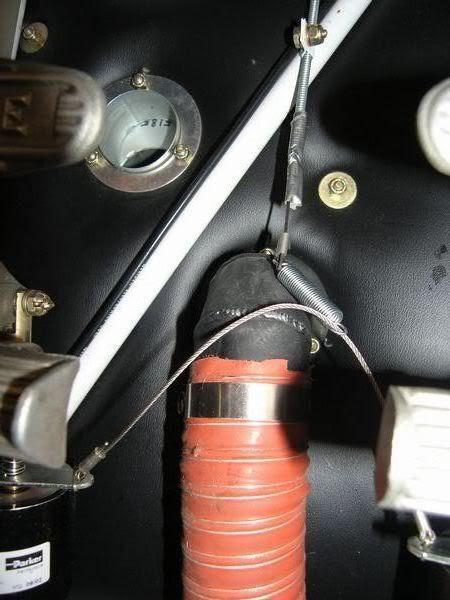
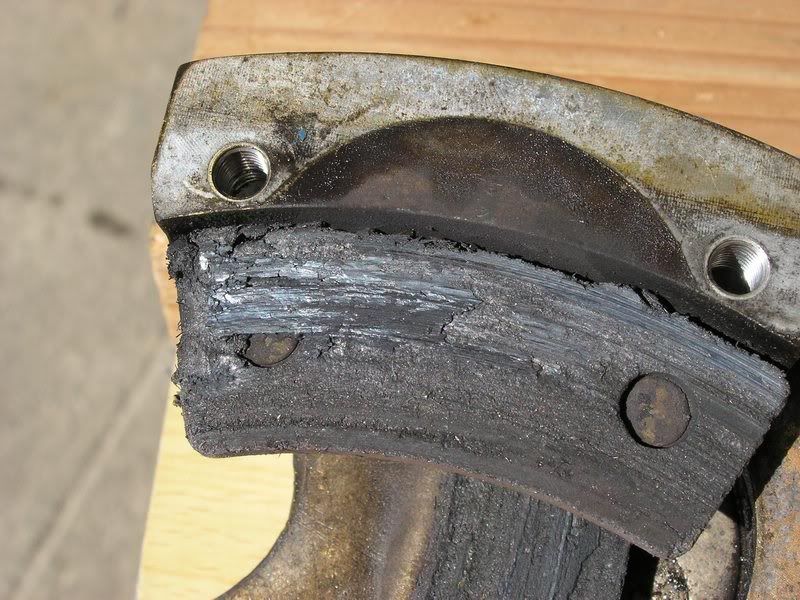
Initially, I had a hard time picturing what had happend and then, one day, a few weeks later, I had occassion to apply left brake and rudder as I turned off the runway and the same thing happened, to a much lesser degree. I taxied back to the hangar and disabled the P brake. Here's the area of interference on the heater duct and the results of the cooked brake linings. I got off lucky... no seals were melted, just a few bucks for new linings. If I had gone flying, the whole thing would probably fused into a locked wheel and I would have had an "extended" annual on landing.
I now have a small set of aluminm wheel chocks in the seat pocket.
YB
I was doing a medium speed taxi test, just fast enough to lift the tail for some checks, after the annual last year. It was dusk and windy and I had no intention to go flying. It took full left rudder and a stab of brake to get everything lined up. The taxi test was ok and rudder response was normal. I set the tailwheel down and turned off at the intersection. As I glanced down through my WONDERFUL patroller doors, I saw that the left brake disk was incandescent. It wasn't just red, it was bright yellow and sparks were flying off! I freaked out since it had been only a couple of weeks since a Cirrus had burned up from overheated brakes. I kept that big 78 in fan blowing on the wheel and that kept me in motion. I subsequently found the lock plate engaged on the left brake. The P brake had never been set and the knob was against the panel.
Initially, I had a hard time picturing what had happend and then, one day, a few weeks later, I had occassion to apply left brake and rudder as I turned off the runway and the same thing happened, to a much lesser degree. I taxied back to the hangar and disabled the P brake. Here's the area of interference on the heater duct and the results of the cooked brake linings. I got off lucky... no seals were melted, just a few bucks for new linings. If I had gone flying, the whole thing would probably fused into a locked wheel and I would have had an "extended" annual on landing.
I now have a small set of aluminm wheel chocks in the seat pocket.
YB
- Yellowbelly offline

- Posts: 355
- Joined: Wed Apr 27, 2005 9:03 pm
- Location: Beautiful southern Utah
Maule M-7-235C
I'm lost
but I'm not afraid
I'm lost
but I'm not afraid
Tue Sep 18, 2007 11:50 am
Yellowbelly wrote:I would have had an "extended" annual on landing.
YB,
I'll have to remember that phraseology. Hopefully I won't need to use it describing one of my own incidents...
- retired user offline
- Posts: 710
- Joined: Sat Oct 01, 2005 7:07 am
Tue Sep 18, 2007 10:33 pm
It is very easy to pull heater or vent knob instead of brake and vica-versa but the point I'm trying to make is that you must press the pedals TWICE.
The first time could inadvertantly set the brakes on by mistake and the reason for the 2nd press is to check it.
If this is done the pilot WILL KNOW if the brakes are on before landing.
It nis no different importance than the checks done in an amphibian or retract.
The brake being locked on and the pilot not knowing, is a direct fault of the pilot. Poor maintainance can cause the locking to happen but there is no excuse for the pilot not knowing.
Jeremy
The first time could inadvertantly set the brakes on by mistake and the reason for the 2nd press is to check it.
If this is done the pilot WILL KNOW if the brakes are on before landing.
It nis no different importance than the checks done in an amphibian or retract.
The brake being locked on and the pilot not knowing, is a direct fault of the pilot. Poor maintainance can cause the locking to happen but there is no excuse for the pilot not knowing.
Jeremy
- maules.com offline
- Posts: 561
- Joined: Mon Jan 09, 2006 9:35 pm
- Location: west coast
Mon Sep 24, 2007 3:32 pm

"To most people, the sky is the limit. To a pilot, the sky is home."
Mon Sep 24, 2007 6:50 pm
- maules.com offline
- Posts: 561
- Joined: Mon Jan 09, 2006 9:35 pm
- Location: west coast
Mon Sep 24, 2007 9:44 pm
 Ha Ha...now that's funny right there.
 "To most people, the sky is the limit. To a pilot, the sky is home."
DISPLAY OPTIONS
Who is online
Users browsing this forum: No registered users and 1 guest
Latest Features
-
Live to Tell
A Minnesota pilot is surprised to learn that the sudden asymmetric drag of an out-of-rig ski can…Read More -
Creators
Working in some of the Yukon's most beautiful and remote environments, photographer Simon Blakesley captures aircraft in…Read More -
Aircraft Ownership and Maintenance
Upgrading to big tires can make a huge difference in backcountry performance, but with those gains come…Read More -
Tales from Yesteryear
In this tale from bush flying yesteryear, Don Cogger signs up to help Atlee Dodge Jr recovery…Read More


Latest Knowledge Base
-
Destinations
A regional guide with ideas for winter camping destinations in California, Nevada, New Mexico, and Arizona.Read More -
Aircraft
Finding an affordable aircraft that can handle the backcountry for $80K or less? A challenge for sure, but with the…Read More -
Aircraft
01.29.2018 - Zane - Updated tire diameter graphic to add 8.50x10 Guide to tires for use in the backcountry and off-airport landing…Read More -
Pilots
12.22.2013 - Initial article format Operating aircraft on skis and negotiating a snow-covered landscape is an entirely unique skillset and environment.…Read More


