907Pilot wrote:
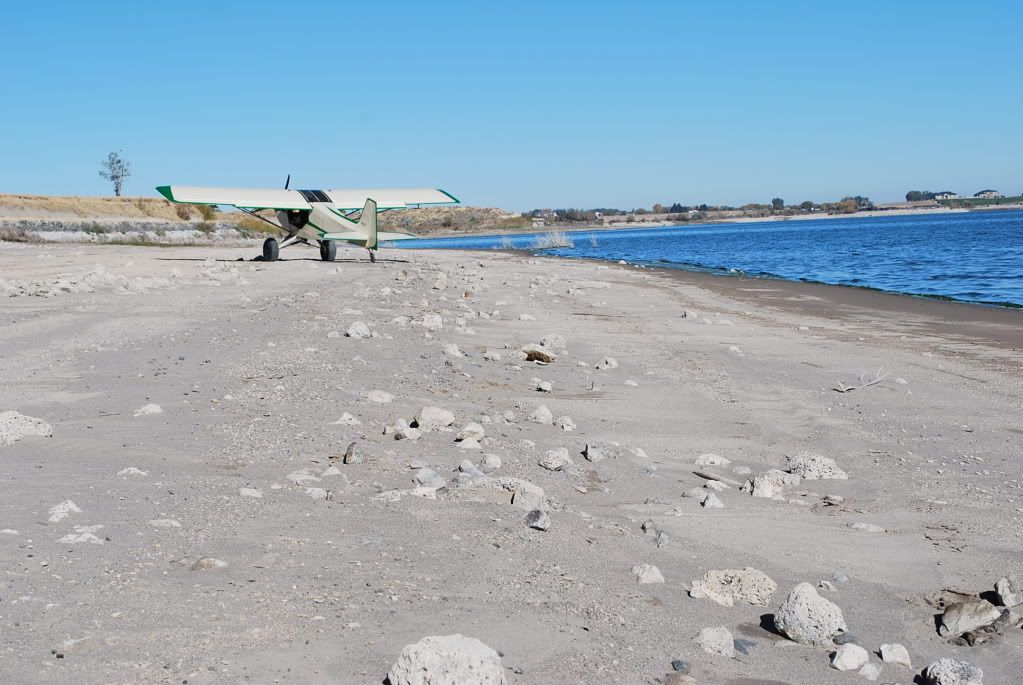
You can see the waves just off the beach. The shiny stuff is water-saturated sand. That is the place you want to be. The dark stuff to the right and above that is still hard, but losing it's water and becoming softer. The light stuff is where not to land. It is soft.
Me landing on that just a minute later. I dragged for a bout 200 feet before commiting, but admittedly was going way to fast for a beach landing in this picture. It was also my first one ever.
Montague Island, San Juan Bay in Prince William Sound. Nice hard sand when it is wet, but when it dried and when I was taxiing aboove the tide line, I had to keep my yoke forward to keep the tailwheel from anchoring me.
Not sure what your tie-down plan is, but this is what I did.

Learn the area, put your toe in a LITTLE bit at a time, and whatever you do, don't get that tail as high as in the photo of that 170 posted earlier unless you absolutely know the beach is solid.
Roll those wheels on a little at a time....lightly on the first pass, slightly more pressure on the second pass, etc, until you're comfortable that you've explored it well.
Then, land in your tracks!! I can't emphasize that enough. If you pioneer a landing zone with your tires, then come around and land five feet to one side of those tracks you put down, it can be a whole new ball game. Land on what you pioneer.
 . If you have a problem you are committed to landing, and you will!
 , so are all the rest that are in between! Everyone of these landings are a different program. There is never a (just a right way to do it, fits all procedure!).
 !!??
!!??mtv wrote:The wet sand is not always the best bet on ocean beaches. Like most off airport operations, conditions vary considerably, depending on where you operate.
Out on the Alaska Peninsula, for example, bull kelp washes up frequently, then is covered by sand, leaving big balls of decaying kelp, covered by sand. These are next to impossible to see from the air, and they can provide a real surprise when you find one with a wheel. Landing high on the beaches puts you in the dry stuff, which tends to have more visible surprises, meaning you can avoid them. Loose dry sand isn't a problem IF the airplane is properly equipped with appropriate flotation type tires.
But, as I noted earlier, every area has it's hazards and safer areas. You really need to learn the beaches in the area you're working. On Kodiak, for example, the entire place is a huge rock, and beaches tend to be really solid, and nice landing sites, except many of them are pretty steep. But, on the south end of the island, there are a couple of pretty sandy beaches near the mouth of the Red River.
Learn the area, put your toe in a LITTLE bit at a time, and whatever you do, don't get that tail as high as in the photo of that 170 posted earlier unless you absolutely know the beach is solid.
Roll those wheels on a little at a time....lightly on the first pass, slightly more pressure on the second pass, etc, until you're comfortable that you've explored it well.
Then, land in your tracks!! I can't emphasize that enough. If you pioneer a landing zone with your tires, then come around and land five feet to one side of those tracks you put down, it can be a whole new ball game. Land on what you pioneer.
MTV
Users browsing this forum: No registered users and 1 guest