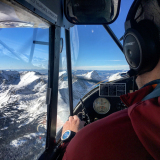
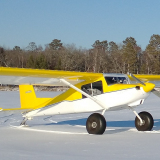
My infatuation with de Havilland’s masterpiece started as a small boy vacationing in Nestor Falls, Ontario, every summer for family fishing vacations. Northwest Flying Service was based on the same lake as the camp we stayed at, so we saw Beavers, Otters, 180’s and 185’s, Beech-18’s and even a Mallard coming and going all day long. Grandpa would usually spring for one or two fly-in trips every year and usually those would be in a Beaver. That’s me mugging for the camera from the rear window of the Beaver below saying “I’m going to be a Beaver pilot when I grow up!”

Fast-forward a few years, and I am flying for the Navy, stationed north of Seattle at NAS Whidbey Island. In addition to a permanent stiff neck from watching all the Kenmore Air Harbor Beavers go back and forth to the San Juan Islands, I made friends with a fella who was a corporate pilot in Seattle for a gentlemen who owned one of the nicest Beavers I’ve ever seen. My buddy would take me along in the right seat when he needed some proficiency flying and give me some yoke time every now and then.

As a student at the U.S. Naval Test Pilot School, I had the opportunity to fly the school’s two Beavers and piston Otter, learning flight test techniques as well as towing gliders with the Beaver.

Towards the end of the year-long TPS syllabus, a pilot with the U.S. Forest Service in Ely, MN flew one of their Beavers on Edo amphibs down to the school in Patuxent River, Maryland, and gave rides to all of the student test pilots, along with a logbook entry for 1.0 of amphib dual in the Beaver.

My last assignment in the Navy was in Anchorage (another story in itself) and I was stationed on JBER and working for a 3-star Air Force General. I was required to live on base for the 3 years I was there. Not a bad gig considering the base has a gravel strip next to a freshwater lake where you could tie-down your private aircraft for (at the time at least) no fee. I kept my Super Cub there and was also a member of the Elmendorf Flying Club getting time in their 185 and working on my single-engine CFI add-on. The CAP was in the same hangar as the Flying Club and they had a Beaver on wheels. I got to know one of the instructors who was also a CAP member and he recruited me to fly the Beaver since they were having problems finding folks qualified to fly it. No brainer there…

Post-retirement, I was lucky enough to get on with Rust’s Flying Service on Lake Hood flying Beavers and 206’s for a summer.

My wife and I moved to Kodiak next and I flew Beavers full time for two years with Andrew Airways. The Beaver is the perfect airplane for that island and I learned something everyday I was there.

I was then hired as a Beaver pilot for the U.S. Forest Service in Ely, MN where I have been for the last six years. We have three Beavers and fly year-round on floats, wheels and skis. Our mission set includes scooping and dropping water on wildland fires, shuttling firefighters, flying SAR/MedEvac/Body Recovery in the Boundary Waters Canoe Area Wilderness, stocking fish, tree seeding, aerial telemetry and wildlife surveys, as well as several other natural resources missions. I am currently serving as the Chief Pilot and program supervisor.


Zane was kind enough to publish a story I did on the program here on the website. A quick promo video below as well.
https://backcountrypilot.org/features/category/pilot-spotlights/dhc-2-beaver-ultimate-boundary-waters-bush-flying
I love flying the Beaver for its smoothness, power, load carrying capability, its look and sound, and the shear fun of it. Below is a photo flying the USFS Beaver at Test Pilot School in 1998 and then as the Chief Pilot in front of the same aircraft 23 years later. The term “Full Circle” comes to mind…


asa, thanks for starting the Beaver thread. Looking forward to reading about other's experiences.
Henny