Backcountry Pilot • Cessna 180/185 trim runaway

Cessna 180/185 trim runaway

Have problems with your aircraft? Maybe just questions about how best to tune or adjust something? Regs or maintenance? Need to know the best way to do something?
16 postsPage 1 of 1

Cessna 180/185 trim runaway

Looking for information on how to avoid uncontrolled trim runaway in a Cessna 185. After talking to a couple of people who have had this happen to them on more than one occasion I take it this is not an entirely uncommon occurrence. Going from a 150kt descent into a vertical climb in an instant :shock: is a manoeuvre I would like to avoid at all cost!
So other than maintenance issues what characteristics of the flight envelope causes this to happen all of a sudden? :?
Descending flight, speed, turbulence, light weight, heavy, c of g position?
Has this happened to you? what caused it and how did you recover from it?
Sounds like a strong arm and a seat stain clean afterwards are mandatory.
NZMaule offline
User avatar
Posts: 215
Joined: Sat May 07, 2011 2:23 pm
Location: New Zealand
Aircraft: Cessna A185F

Re: Cessna 180/185 trim runaway

I've had the pin break securing the trim wheel to the shaft, which can be a handful depending on how you're configured. Is that what they mean? Cure for that is to just return to flap setting you were using and go slow until you land and replace the pin.

On edit... A quick Google search shows that the tail can or will zoom up or down if that pin shears. Sounds like lots of muscle and finding a flap setting to reduce some of the pressure is the in the air fix. Not fun.

My experience was I just couldn't roll trim to neutral when I changed flap settings, and it wanted to pitch nose up real hard. I had been on a CAMP flight in CA, and had been orbiting for quite a while at slow speed with a couple notches of flap out, and when it was time to head for the barn I dumped the flaps, added power for cruise, and started rolling nose down trim. Pin broke, and I was stuck nose up.

Gump
GumpAir offline
User avatar
Posts: 4557
Joined: Wed Feb 14, 2007 9:14 am
Location: Lost somewhere in Nevada
Aircraft: Old Clunker

Re: Cessna 180/185 trim runaway

As I understand it, a lot of 180 folks put a piece of notched rubber screwed under the trim wheel cover and riding on the wheel itself. it takes a little experimentation to get the right stiffness and thickness but seems to truly fix the runaway trim issue. Not a certified fix though.
flyingzebra offline
User avatar
Posts: 479
Joined: Sat Jan 24, 2009 4:53 am
Location: Northwest Washington state
Aircraft: Cessna Skylane 182 N3440S, Aviat Husky N2918L

Re: Cessna 180/185 trim runaway

When I was doing Skydive Ops in the 185 and descents were fast, I had an old fashioned rubber door stop that I would jam down the side of the trim wheel so it couldn't move, just as a back up. I have heard stories of disasters with trim runaway. I always kept cables properly tensioned etc, etc, but just wanted to be sure. Had pins break more than once, but thankfully not in the descent. Also replaced shaft at least once. Trim wheel did get a lot of use.
scott185 offline
User avatar
Posts: 37
Joined: Wed Aug 28, 2013 2:01 am
Location: christchurch

Re: Cessna 180/185 trim runaway

In descent after drop, smooth air, trim runaway now would be not something I would like to experience!

Image

Not sure why photo didn't come up, thought I had [url] etc right?
Last edited by Zzz on Tue Nov 05, 2013 3:48 pm, edited 1 time in total.
Reason: Changed URL to IMG
scott185 offline
User avatar
Posts: 37
Joined: Wed Aug 28, 2013 2:01 am
Location: christchurch

Re: Cessna 180/185 trim runaway

In descent after drop, smooth air, trim runaway now would be not something I would like to experience!


Too right and yet this scenario has happened, something I don't want to experience and it sounds like a few pilots have their own tricks - hand holding trim wheel, rubber stoppers etc.
Perhaps more prone in rapid descent, light weight - but that sounds like 50% of your flying when doing drops :?
NZMaule offline
User avatar
Posts: 215
Joined: Sat May 07, 2011 2:23 pm
Location: New Zealand
Aircraft: Cessna A185F

Re: Cessna 180/185 trim runaway

I've nevber heard of runaway trim except with an autopilot that went haywire. I guess if something failed (like the pin that Gump mentioned) anything's possible. I have heard of trim creep with the early C180's, which Cessna addressed by adding a rachet / detent sort of mechanism to the trim wheel to the 1958 180A.
hotrod180 offline
Supporter
User avatar
Posts: 10534
Joined: Wed Jan 26, 2005 11:47 pm
Location: Port Townsend, WA
Cessna Skywagon -- accept no substitute!

Re: Cessna 180/185 trim runaway

It's good to take out that rinky dink pin and replace it with a strong bolt and lock nut. May have to drill out the hole just a little I think.
55wagon offline
Posts: 283
Joined: Sat Oct 06, 2012 3:35 pm

Re: Cessna 180/185 trim runaway

I remember taking my cousin to Omaha on a very turbulent day and every time we hit an updraft(can't remember for sure) the trim would go to nose up. Never had it happen any other time except that one day back in 1995. I generally don't fly if it is that rough but he had an appointment.
180Marty offline
Supporter
User avatar
Posts: 2313
Joined: Mon Jan 02, 2006 11:59 am
Location: Paullina IA

Re: Cessna 180/185 trim runaway

55wagon wrote:It's good to take out that rinky dink pin and replace it with a strong bolt and lock nut. May have to drill out the hole just a little I think.

My thoughts exactly. Certified or not, Cessna's designers got that one wrong IMHO.
Battson offline
Knowledge Base Author
User avatar
Posts: 1810
Joined: Wed May 09, 2012 11:19 pm
Location: New Zealand
Aircraft: Bearhawk 4-place
IO-540 260hp

Re: Cessna 180/185 trim runaway

From what I understand it's not always about the trim wheel pin failure (although this does appear to be a weak link) - rather the stabilizer going randomly into instantaneous aft trim, and whereby folowing eventual recovery the trim system works as per usual.
There is some good info on the Skywagon Forum about trim pin wear and slogging etc but I'm thinking more about the random trim runaway/slippage (call it what you will) situation.
Seems it was detected early on and the problem "solved" by adding the friction device ratchet mechanism - but from recent accounts it appears it can still happen :shock: .


As the airplanes aged in rough service, we received reports of stabilizer slippage in high-speed letdowns. To our amazement the two "irreversible" jack screws that supported the stabilizer were slipping in an airplane-nose-up direction. In production flight tests at redline speed, this produced an alarming "g" load, pitching the nose up vertically. On one occasion the test pilot blacked out momentarily and the wings received a permanent set of 50 at the strut/wing juncture. We were unsuccessful in reworking the jack screw tolerances, and the decision was made to add a friction device to the longitudinal trim wheel mechanism. This produced a "ratcheting" noise in the cockpit and increased the force required to make trim changes. However, it solved the stabilizer slippage problem, and the device remained on the C-180/185's throughout the production run.

NZMaule offline
User avatar
Posts: 215
Joined: Sat May 07, 2011 2:23 pm
Location: New Zealand
Aircraft: Cessna A185F

Re: Cessna 180/185 trim runaway

So for avoidance of doubt, in the situation you are talking about the trim wheel basically "free wheels" for many turns at very high speed, as the h-stab repitches to full aft trim?
And the common factor reported by most victims seems to be a high speed descent in that case?

Thinking out loud,
The difference in trim configuration at a high speed descent is the trim is a lot further forward, maybe the furtherest forward it can go during normal flight. Practically, this means the h-stab is has much lower angle of incidence to the oncoming airflow, maybe getting very close to a neutral angle. The whole system will have been designed with a negative angle of incidence in mind, meaning that a downward force should be acting on the jack screw at all times. In other words the jacking screw is always supplying a force to stop the h-stab moving to the full aft position, under normal flight conditions.

Now, if you were trimmed full forward during a high speed descent in turbulence, a small change in oncoming airflow due to turbulence could result in the stabiliser momentarily going into a positive angle of attack - this would unload the stabilisers completely and reverse the force on the jacking screw - a bit like unloading the disc on a helicopter I suppose.

Once unloaded, the h-stabiliser's jack screw is no longer operating the way it does for 99.99% of the time. It could have greatly reduced friction (momentarily) compared to the normal flight loading. Friction is directly proportional to the force applied by the h-stab. That loss of friction might just be enough to get the screw moving, under certain circumstances, and once it's started free-wheeling it could keep going because the coefficient of dynamic friction is ALWAYS less than the coefficient of static friction (in other words, there's less resistenace once it's started moving...).

I've no idea if that could acutally be the cause, but it's a thought. Worth what you paid for it etc.
Battson offline
Knowledge Base Author
User avatar
Posts: 1810
Joined: Wed May 09, 2012 11:19 pm
Location: New Zealand
Aircraft: Bearhawk 4-place
IO-540 260hp

Re: Cessna 180/185 trim runaway

From memory the trim was only slightly forward of centre for descent, maybe 6-8 mm which was about the same place as on final jump run, once weight gone from back, nose comes down, and speed quickly builds to about 170/175 Kts, angle isn't that great.
I have had the trim take off on final, when iv'e just flicked it back a bit and it's zipped away on it's own. Not bad because no speed.
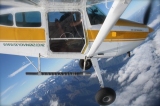
Aircraft angle in photo is just after door shut, and can only be maintained for a few seconds. Power was kept at 2300 rpm and 23 squared at lower altitude right down to final approach.
scott185 offline
User avatar
Posts: 37
Joined: Wed Aug 28, 2013 2:01 am
Location: christchurch

Re: Cessna 180/185 trim runaway

The trim jack screws are a wear item. Folks do not like to replace them because they are expensive. If the jackscrew acme screw is worn, then a pulsing up and down on the stabilizer will cause the screw to turn. If you replace this unit when it wears, then it will not happen. I do believe there are a few service bulletins covering this. Being cheap is a leading cause of preventable accidents.

I have had my trim wheel roll pin break, well it wasn't exactly a roll pin. The lads in Honduras had used a finishing nail instead of a roll pin. Anyhow, it broke at cruise setting, making the landing a feat of strength.

The later design ratchet mechanism does help in keeping the condition from starting, but your stab trim should be rather stiff, if it is easy to move, then your jackscrews may need replacing. I was pleased when I noted my 185 had just had them replaced before I bought it.
dogpilot offline
Took ball and went home
Posts: 902
Joined: Sun Feb 19, 2012 10:20 pm
Aircraft: Cessna 206H Amphib, Caravan 675 Amphib

Re: Cessna 180/185 trim runaway

The two 185s I had on skydive ops were maintained to Air Transport standards, as a requirement of the parachute organization we belonged to. With new CAA rules in place, Rule Part 115, this is now standard. The jackscrew inspection bulletin has been around for some time and I had to replace one in my last 185. I agree the whole system should be reasonably firm, and can see how worn jackscrews could cause the problem.

Image
scott185 offline
User avatar
Posts: 37
Joined: Wed Aug 28, 2013 2:01 am
Location: christchurch

Re: Cessna 180/185 trim runaway

I disassembled the entire empenage of my '80 185 to see what I had.
I replaced a couple bearings and sprockets on the jackscrews along with one cable and chain.
Now that I have cleaned up things back there and keep the jackscrews well greased, occasionally I get a slight trim noseup movement during a higher (than cruise speed) desent in turbulence.
My machine has 6600 hours and the ratchet/spring trimwheel mechanism has wear on it.
I might disassemble the mecanism and stretch the spring to apply more pressure to the trim system, but my jackscrews are not worn and I do experiense this problem.
I did not experiense this problem when the the trim system required service... which creates the dilemma... no service equals no problems ??
Personally, I don't like operating 40 to 50 year old airplanes near VNE. or new ones for that matter, so I'll tolerate a little nuisance trim movement knowing my trim system is servicable.
Hope this helps.
Mark
SkyTruck offline
User avatar
Posts: 491
Joined: Sun Aug 27, 2006 4:48 pm
Location: KVCB, KBZN, NIN(AK)
'80 A185F

DISPLAY OPTIONS

16 postsPage 1 of 1

Who is online

Users browsing this forum: No registered users and 14 guests

Latest Features

Latest Knowledge Base