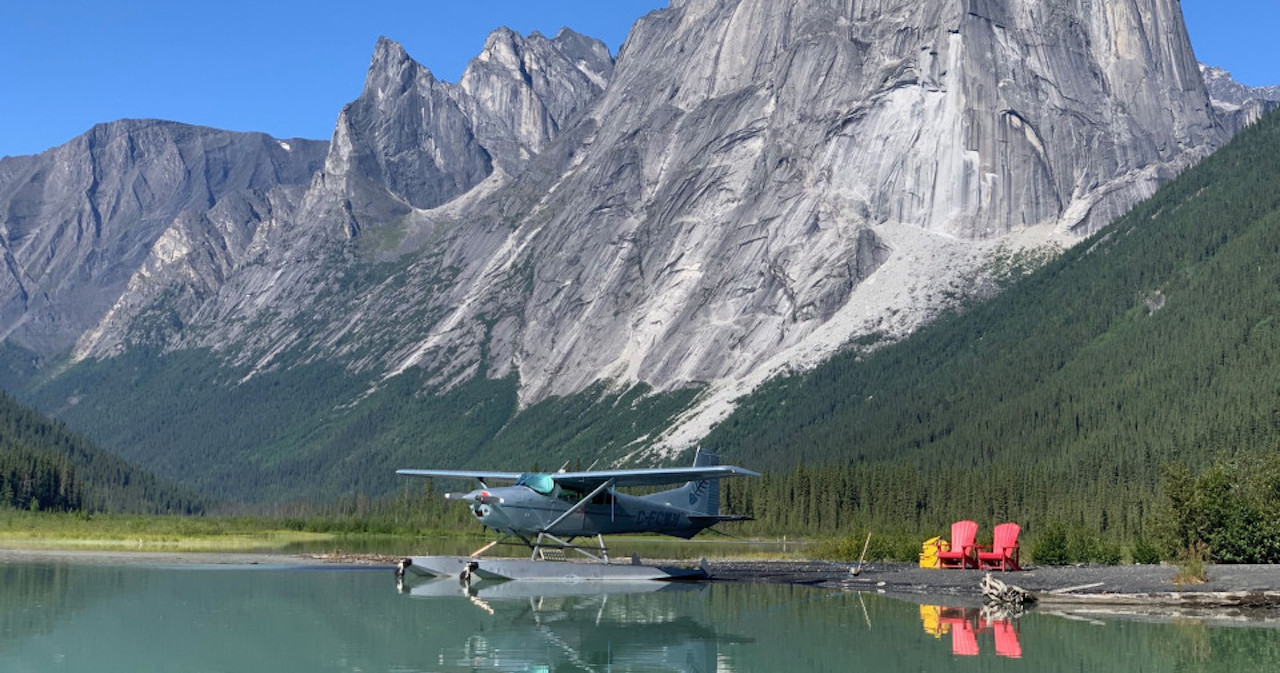
Hello All, wife (pilot) and I are taking Champ (100HP & 22" Dessers) from Erie, CO (27 NNW of Denver) to McCall, ID area. We'll each be trading off flying Champ and driving pickup/40' 5th wheel camper and route will basically be Denver-Laramie, WY; I 80 to Salt Lake; I 84 NW to Boise, ID & N to McCall. 1-2 weeks for travel and McCall area and then 2 weeks in Coeur d'Alene/Spokane area with friends before returning. May have a more capable backcountry plane by departure; depending what we find before than.
Looking for suggestions regarding fly-ins; routes; overnights; etc.
Also, is there a good site for finding "Wilderness Area" restrictions other than Foreflight or paper charts?
Thanks
Jack
BTW, flew Champ to PHX for most of winter and have been able to pretty much hang with Huskys landing in soft desert creeks. Having a blast. Husky can land full stop AND TO in measured 400' while I full stop in 450'; taxi back and TO. Still he puts up with me-also slows to 90 mph.
Champ trip to ID
Mon Mar 04, 2019 8:57 am
- flyingjack offline

- Posts: 350
- Joined: Thu May 19, 2016 8:21 am
- Location: Erie
- Aircraft: Husky/T206H
Mon Mar 04, 2019 10:59 am
Re: Champ trip to ID
Get the Fly Idaho book...it'll tell you all you need to know about the various airstrips. While there are some options open to the Champ, most of the wilderness airstrips are not going to be real viable unless you want to land at dawn and take off an hour later...a practice contrary to their intended use when they were grandfathered into the wilderness area, and one which will illicit strong opinions from both sides. Just a heads up on that. 
Most Idaho flying is actually pretty low altitude. You can cover most of the state at 8,500 msl. What gets people is the fairly high-altitude landing fields, and the VERY high DA, combined with operating in the bottom of deep canyons. The canyon flying is no joke...it's a completely different flying environment. The visual is foreign to most pilots, the approaches and departures are non-standard, and it's a unique microcosm of air currents. Canyon winds are amplified by orographic heating and the cooling effect of the rivers, and they will play absolute hell with anyone who doesn't understand them intimately. Even wide-open airstrips like Garden Valley can baffle pilots not used to flying close to canyon walls and descending towards trees and rocks and water. Many airstrips require descending below any reasonable go-around before the airstrip is even in sight.
Runway length is NOT a indication of whether a airstrip is acceptable to any given pilot if it's in the bottom of a canyon. That people regularly run out of runway at Johnson Creek (3,400 x 150 feet of perfectly manicured grass) is proof enough of that. Getting in and out of canyon strips requires discarding everything you know about standard patterns and approaches, as well as careful fuel management.
The magenta line on the GPS isn't even close to what your actual flight path will be, so don't believe the numbers it gives you. It's not uncommon for the actual flight path to be twice as far as the straight-line flight path, and that's in clear weather. Valley fog can be common in the summer, often closing McCall and Cascade in the mornings, which is severely inconvenient if you need to land there for fuel because you just came out of the backcountry with minimal fuel on board. On the other hand, you can't use many of the backcountry strips if you're carrying an extra ten gallons of fuel in a Champ...
The only way to deal with the DA and the canyon winds is to fly early. By noon winds in the canyons are SERIOUS for a low-powered airplane and unfamiliar pilot. Don't pay any attention to what the charter guys consider good flying hours...they've forgotten more about the wind currents than most people ever knew. Tied down and drunk by 10AM is the standard for private pilots in the backcountry, and 9:30 is better.
Even in summer it's not uncommon to have freezing conditions overnight, so you need to be able to pre-heat your engine in order to get out before the DA and winds make it too dangerous. My normal departure routine is to get up before dawn and start heating the engine so I can get out well before the canyon walls start warming up. To be fair that isn't always necessary, but in a Champ it probably is.
Also keep in mind that Idaho backcountry roads can be BAD. You probably could get your 5th wheel to Johnson Creek or Warren or Big Creek, but you won't enjoy it...at all. I'd highly recommend parking that thing before venturing onto any of Idaho's dirt roads. I always carried two full sized spare tires for my pick-up in Idaho, and was thankful I did on more than one occasion.
Stay light, fly early, and manage your fuel carefully, and a number of Idaho backcountry and sidecountry strips are within the capability of a properly flown Champ. Just be extra-careful... No matter how many hours you might have doing "regular" flying, Idaho is a unique flying environment where most other hours don't count for much.
Have fun!
Most Idaho flying is actually pretty low altitude. You can cover most of the state at 8,500 msl. What gets people is the fairly high-altitude landing fields, and the VERY high DA, combined with operating in the bottom of deep canyons. The canyon flying is no joke...it's a completely different flying environment. The visual is foreign to most pilots, the approaches and departures are non-standard, and it's a unique microcosm of air currents. Canyon winds are amplified by orographic heating and the cooling effect of the rivers, and they will play absolute hell with anyone who doesn't understand them intimately. Even wide-open airstrips like Garden Valley can baffle pilots not used to flying close to canyon walls and descending towards trees and rocks and water. Many airstrips require descending below any reasonable go-around before the airstrip is even in sight.
Runway length is NOT a indication of whether a airstrip is acceptable to any given pilot if it's in the bottom of a canyon. That people regularly run out of runway at Johnson Creek (3,400 x 150 feet of perfectly manicured grass) is proof enough of that. Getting in and out of canyon strips requires discarding everything you know about standard patterns and approaches, as well as careful fuel management.
The magenta line on the GPS isn't even close to what your actual flight path will be, so don't believe the numbers it gives you. It's not uncommon for the actual flight path to be twice as far as the straight-line flight path, and that's in clear weather. Valley fog can be common in the summer, often closing McCall and Cascade in the mornings, which is severely inconvenient if you need to land there for fuel because you just came out of the backcountry with minimal fuel on board. On the other hand, you can't use many of the backcountry strips if you're carrying an extra ten gallons of fuel in a Champ...
The only way to deal with the DA and the canyon winds is to fly early. By noon winds in the canyons are SERIOUS for a low-powered airplane and unfamiliar pilot. Don't pay any attention to what the charter guys consider good flying hours...they've forgotten more about the wind currents than most people ever knew. Tied down and drunk by 10AM is the standard for private pilots in the backcountry, and 9:30 is better.
Even in summer it's not uncommon to have freezing conditions overnight, so you need to be able to pre-heat your engine in order to get out before the DA and winds make it too dangerous. My normal departure routine is to get up before dawn and start heating the engine so I can get out well before the canyon walls start warming up. To be fair that isn't always necessary, but in a Champ it probably is.
Also keep in mind that Idaho backcountry roads can be BAD. You probably could get your 5th wheel to Johnson Creek or Warren or Big Creek, but you won't enjoy it...at all. I'd highly recommend parking that thing before venturing onto any of Idaho's dirt roads. I always carried two full sized spare tires for my pick-up in Idaho, and was thankful I did on more than one occasion.
Stay light, fly early, and manage your fuel carefully, and a number of Idaho backcountry and sidecountry strips are within the capability of a properly flown Champ. Just be extra-careful... No matter how many hours you might have doing "regular" flying, Idaho is a unique flying environment where most other hours don't count for much.
Have fun!


Mon Mar 04, 2019 11:46 am
Re: Champ trip to ID
Good stuff to hear; thanks for the info.
- flyingjack offline
- Posts: 350
- Joined: Thu May 19, 2016 8:21 am
- Location: Erie
- Aircraft: Husky/T206H
Mon Mar 04, 2019 11:53 am
Re: Champ trip to ID
Hammer wrote:Get the Fly Idaho book...it'll tell you all you need to know about the various airstrips. While there are some options open to the Champ, most of the wilderness airstrips are not going to be real viable unless you want to land at dawn and take off an hour later...a practice contrary to their intended use when they were grandfathered into the wilderness area, and one which will illicit strong opinions from both sides. Just a heads up on that.
Most Idaho flying is actually pretty low altitude. You can cover most of the state at 8,500 msl. What gets people is the fairly high-altitude landing fields, and the VERY high DA, combined with operating in the bottom of deep canyons. The canyon flying is no joke...it's a completely different flying environment. The visual is foreign to most pilots, the approaches and departures are non-standard, and it's a unique microcosm of air currents. Canyon winds are amplified by orographic heating and the cooling effect of the rivers, and they will play absolute hell with anyone who doesn't understand them intimately. Even wide-open airstrips like Garden Valley can baffle pilots not used to flying close to canyon walls and descending towards trees and rocks and water. Many airstrips require descending below any reasonable go-around before the airstrip is even in sight.
Runway length is NOT a indication of whether a airstrip is acceptable to any given pilot if it's in the bottom of a canyon. That people regularly run out of runway at Johnson Creek (3,400 x 150 feet of perfectly manicured grass) is proof enough of that. Getting in and out of canyon strips requires discarding everything you know about standard patterns and approaches, as well as careful fuel management.
The magenta line on the GPS isn't even close to what your actual flight path will be, so don't believe the numbers it gives you. It's not uncommon for the actual flight path to be twice as far as the straight-line flight path, and that's in clear weather. Valley fog can be common in the summer, often closing McCall and Cascade in the mornings, which is severely inconvenient if you need to land there for fuel because you just came out of the backcountry with minimal fuel on board. On the other hand, you can't use many of the backcountry strips if you're carrying an extra ten gallons of fuel in a Champ...
The only way to deal with the DA and the canyon winds is to fly early. By noon winds in the canyons are SERIOUS for a low-powered airplane and unfamiliar pilot. Don't pay any attention to what the charter guys consider good flying hours...they've forgotten more about the wind currents than most people ever knew. Tied down and drunk by 10AM is the standard for private pilots in the backcountry, and 9:30 is better.
Even in summer it's not uncommon to have freezing conditions overnight, so you need to be able to pre-heat your engine in order to get out before the DA and winds make it too dangerous. My normal departure routine is to get up before dawn and start heating the engine so I can get out well before the canyon walls start warming up. To be fair that isn't always necessary, but in a Champ it probably is.
Also keep in mind that Idaho backcountry roads can be BAD. You probably could get your 5th wheel to Johnson Creek or Warren or Big Creek, but you won't enjoy it...at all. I'd highly recommend parking that thing before venturing onto any of Idaho's dirt roads. I always carried two full sized spare tires for my pick-up in Idaho, and was thankful I did on more than one occasion.
Stay light, fly early, and manage your fuel carefully, and a number of Idaho backcountry and sidecountry strips are within the capability of a properly flown Champ. Just be extra-careful... No matter how many hours you might have doing "regular" flying, Idaho is a unique flying environment where most other hours don't count for much.
Have fun!
Seems like KB material. Thanks for the great post!
- CamTom12 offline

- Posts: 3705
- Joined: Sun Jul 08, 2012 1:08 pm
- Location: Huntsville
- FindMeSpot URL: https://share.delorme.com/camtom12
- Aircraft: Ruppe Racer
Experimental Pacer
home hand jam "wizard"
Mon Mar 04, 2019 12:28 pm
Re: Champ trip to ID
What he said. Champs are fine in the Idaho backcountry with the proper expectations of what strips are feasible, proper respect for the weather, and really....the flying at the crack of dawn is pretty important. The strips used to be capably accessed with Jennies and Tiger Moths and the like, but very early in the day and by familiar drivers. Plenty of strips are available in almost every corner of the area that will afford a careful person a great introduction with a low powered plane.
Mon Mar 04, 2019 4:06 pm
Re: Champ trip to ID
Many years ago, one of our sons took our 85HP Champ to Idaho while we flew along in the Skywagon. It did very well at Chamberlain, Big Creek and the like. It was only flown solo (200 lb pilot) since after assessing it's performance we felt that adding a passenger wouldn't leave much margin. He also followed all the advice above such as starting early and getting back at a reasonable time.
- geoedgerton offline
- Posts: 11
- Joined: Mon Mar 01, 2010 12:56 pm
- Location: Redding
Mon Mar 04, 2019 9:20 pm
Re: Champ trip to ID
geoedgerton wrote:Many years ago, one of our sons took our 85HP Champ to Idaho while we flew along in the Skywagon. It did very well at Chamberlain, Big Creek and the like. It was only flown solo (200 lb pilot) since after assessing it's performance we felt that adding a passenger wouldn't leave much margin. He also followed all the advice above such as starting early and getting back at a reasonable time.
Yup...I wouldn't take a 100hp Champ with two people and enough fuel to get back to a pump into Chamberlain. It doesn't look like much, but the rising terrain on all sides provides very little orographic lift, and it rises a lot steeper than it appears when you're coming in. Lots of traps in Idaho because the airstrip lengths lure people into thinking they're easy. I've seen more balled up airplanes at the long strips than I have at the short ones, though of course a lot more people are trying to use the long ones.
Just because you can get off the ground in half the length of the airstrip doesn't mean you'll clear terrain or trees a couple miles away. Bruce Meadows is CRAZY long (5000 feet) and wide open with very gentile rising terrain, but if you don't have the climb performance it's still a trap:
https://www.youtube.com/watch?v=OVM3RRd1vf0
Now imagine what that would have looked like in a deep river canyon...
Mon Mar 04, 2019 9:26 pm
Re: Champ trip to ID
would have really helped if he would have leaned that engine.
- soaringhiggy offline
- Posts: 711
- Joined: Tue Dec 13, 2005 8:22 pm
- Location: Kimberly, ID
48 Stinson 108-3
Mon Mar 04, 2019 9:41 pm
Re: Champ trip to ID
soaringhiggy wrote:would have really helped if he would have leaned that engine.
Well, it wouldn't have hurt, but I doubt if it would have saved him.
Mon Mar 04, 2019 9:53 pm
Re: Champ trip to ID
could be, however, at that DA on that day the extra 10 or 15% would not hurt. I know my 165 going out of Bruce Meadows makes a lot of difference. There were other things as well, load, time of day.
I know you understand all of this, but in general mistakes were not forgiven this day.
I know you understand all of this, but in general mistakes were not forgiven this day.
- soaringhiggy offline
- Posts: 711
- Joined: Tue Dec 13, 2005 8:22 pm
- Location: Kimberly, ID
48 Stinson 108-3
Tue Mar 05, 2019 2:00 am
Re: Champ trip to ID
Flyingjack,
Sound advice for flying in Idaho should always include fly in the early morning, fly as light as safety allows, and know your aircraft and your own limits. This applies to any aircraft into pretty much any strip. Fly Idaho is a great resource for information on public and a few private airstrips and is worth its cost and nominal weight in your airplane.
As far as “wilderness area rules” suffice it to say pack it in pack it out leave no trace camping at the wilderness strips (there are garbage cans at Johnson creek if you choose that as a base camp) and no mechanized devices of any kind (think mountain bikes, chainsaws, etc) and that’s hardly scratching the surface. If you have a specific activity or question feel free to post it here as there are many knowledgeable folks who can probably answer your specific concern or at least point you in the right direction.
If you are familiar with density altitude in Colorado and Arizona then you likely already have a pretty good idea of its effect on the performance of your champ. If you are already comfortable in landing your plane consistently in 500 feet at those DAs do you feel confident that you could duplicate that performance during a blind or turning approach to short final? Would you feel comfortable landing in 500 to 1000 feet if it meant the difference between a crash and a safe landing depended on it? How comfortable do you feel with flying in proximity (1-2 wing spans ) to terrain and obstacles like canyon walls and trees? Do you feel confident in using the champs excellent forward slip capability to make steep approaches? As you answer these questions, it should lead you towards narrowing which strips provide the level of difficulty commensurate with your comfort level with your champs performance.
I took my first trip to the Idaho backcountry in an L16 (champ) with some similar questions to yours. As a point of reference, my champ was kept as light as possible (no electric, handheld radio only), prop pitched for climb performance, a stroker C-85, aux wing tanks, and 26” airstreak bushwheels. I had about 850 hours in type, so I was more than comfortable with its handling characteristics but the vast majority of that time was at or near sea level and to mountain strips at or below 3,000 feet MSL.
The performance I experienced with my first stop in Cascade matched my expectations, as did my late evening arrival into Johnson Creek. My early morning departure from J.C. and flight to Big Creek exceeded my expectations with concern to performance. I was frankly blown away with how well it performed and spent the next 4 years flying into and exploring all the public strips under 2,000 feet long in the Idaho backcountry except mile hi and Simonds with that champ. In full disclosure, I never attempted to operate out of anything under 1,200 feet in length over 1,150 lbs G.W. , I always flew early, and always finished my flying by 11am. Obviously at those weights I was solo and consider the aircraft to be a single seater at those elevations and those environments. The aux tanks allowed me 11 gallons of additional fuel that eased my fuel planning issues although with a support vehicle at Johnson Creek you could easily keep extra fuel on hand and keep fuel loads light for day trips out of Johnson Creek.
Compare your expectations of performance with what you’re actually experiencing climbing out of McCall. Then try Johnson Creek, Big Creek, head to Sulpher Creek for breakfast. These are enjoyable short flights that present real but manageable challenges to the new Idaho backcountry aviator. If you have that feeling in your stomach that says you feel uncomfortable or a voice in your head that says I’m not sure about this, then don’t do it. There will be another time or circumstance that will make for a safer more enjoyable experience.
Good luck. I hope you find your champ to be as enjoyable a backcountry machine as I did.
Sound advice for flying in Idaho should always include fly in the early morning, fly as light as safety allows, and know your aircraft and your own limits. This applies to any aircraft into pretty much any strip. Fly Idaho is a great resource for information on public and a few private airstrips and is worth its cost and nominal weight in your airplane.
As far as “wilderness area rules” suffice it to say pack it in pack it out leave no trace camping at the wilderness strips (there are garbage cans at Johnson creek if you choose that as a base camp) and no mechanized devices of any kind (think mountain bikes, chainsaws, etc) and that’s hardly scratching the surface. If you have a specific activity or question feel free to post it here as there are many knowledgeable folks who can probably answer your specific concern or at least point you in the right direction.
If you are familiar with density altitude in Colorado and Arizona then you likely already have a pretty good idea of its effect on the performance of your champ. If you are already comfortable in landing your plane consistently in 500 feet at those DAs do you feel confident that you could duplicate that performance during a blind or turning approach to short final? Would you feel comfortable landing in 500 to 1000 feet if it meant the difference between a crash and a safe landing depended on it? How comfortable do you feel with flying in proximity (1-2 wing spans ) to terrain and obstacles like canyon walls and trees? Do you feel confident in using the champs excellent forward slip capability to make steep approaches? As you answer these questions, it should lead you towards narrowing which strips provide the level of difficulty commensurate with your comfort level with your champs performance.
I took my first trip to the Idaho backcountry in an L16 (champ) with some similar questions to yours. As a point of reference, my champ was kept as light as possible (no electric, handheld radio only), prop pitched for climb performance, a stroker C-85, aux wing tanks, and 26” airstreak bushwheels. I had about 850 hours in type, so I was more than comfortable with its handling characteristics but the vast majority of that time was at or near sea level and to mountain strips at or below 3,000 feet MSL.
The performance I experienced with my first stop in Cascade matched my expectations, as did my late evening arrival into Johnson Creek. My early morning departure from J.C. and flight to Big Creek exceeded my expectations with concern to performance. I was frankly blown away with how well it performed and spent the next 4 years flying into and exploring all the public strips under 2,000 feet long in the Idaho backcountry except mile hi and Simonds with that champ. In full disclosure, I never attempted to operate out of anything under 1,200 feet in length over 1,150 lbs G.W. , I always flew early, and always finished my flying by 11am. Obviously at those weights I was solo and consider the aircraft to be a single seater at those elevations and those environments. The aux tanks allowed me 11 gallons of additional fuel that eased my fuel planning issues although with a support vehicle at Johnson Creek you could easily keep extra fuel on hand and keep fuel loads light for day trips out of Johnson Creek.
Compare your expectations of performance with what you’re actually experiencing climbing out of McCall. Then try Johnson Creek, Big Creek, head to Sulpher Creek for breakfast. These are enjoyable short flights that present real but manageable challenges to the new Idaho backcountry aviator. If you have that feeling in your stomach that says you feel uncomfortable or a voice in your head that says I’m not sure about this, then don’t do it. There will be another time or circumstance that will make for a safer more enjoyable experience.
Good luck. I hope you find your champ to be as enjoyable a backcountry machine as I did.
Tue Mar 05, 2019 7:10 am
Re: Champ trip to ID
the Idaho Transporation Department used to publish the "Idaho Airport Facility Directory". Lots of good information. They do not publish the paper book any longer, however, they do have it for down load to apple or android devices.
There is a youtube video on what it is as well.
https://itd.idaho.gov/aero/
https://www.youtube.com/watch?v=1jU4tmW ... e=youtu.be
With the others on light and early. Start with the easy ones and work in. There are very knowable people on this site who are trying to stress that this not flying with normal visual queues or patterns.
Have fun
There is a youtube video on what it is as well.
https://itd.idaho.gov/aero/
https://www.youtube.com/watch?v=1jU4tmW ... e=youtu.be
With the others on light and early. Start with the easy ones and work in. There are very knowable people on this site who are trying to stress that this not flying with normal visual queues or patterns.
Have fun
- soaringhiggy offline
- Posts: 711
- Joined: Tue Dec 13, 2005 8:22 pm
- Location: Kimberly, ID
48 Stinson 108-3
Tue Mar 05, 2019 10:15 am
Re: Champ trip to ID
Thanks to all for positive info. Started flying 65HP Champ in 1981 in CO mtns; SOP DA at KEIK home airport is 8-10K' summer and canyons I played in were DA 14-15K'. Still use ridge lift for T210 when available. Camper will probably never leave the asphalt as will home base in McCall RV resort= no issues there. After literally 40 yrs of pulling 25+K lb trailers with 3/4 ton pickup (no CDL); I have no interest in off-roading with camper.
Had a really nice visit with Galen (Fly Idaho); very nice man and got the 3rd edition.
If anybody else wants to PM or email; please do: [email protected] and thanks to those of you who sent PM with great info.
Thanks again BCPers.
67 yrs old Jack that just loves to fly.
Had a really nice visit with Galen (Fly Idaho); very nice man and got the 3rd edition.
If anybody else wants to PM or email; please do: [email protected] and thanks to those of you who sent PM with great info.
Thanks again BCPers.
67 yrs old Jack that just loves to fly.
- flyingjack offline
- Posts: 350
- Joined: Thu May 19, 2016 8:21 am
- Location: Erie
- Aircraft: Husky/T206H
Tue Mar 05, 2019 8:39 pm
Re: Champ trip to ID
Good airplane, Jack, that goes slow enough to use God given lift. I agree that natural lift is useful in the 210 as well.
- contactflying offline
- Posts: 4972
- Joined: Wed Apr 03, 2013 7:36 pm
- Location: Aurora, Missouri 2H2
Download my free "https://tinyurl.com/Safe-Maneuvering" e-book.
Tue Mar 05, 2019 9:33 pm
Re: Champ trip to ID
Another very valuable resource is the Idaho Aviation Association (IAA). In particular, this Airstrip Network page has all kinds of goodies for flight planning including access to airstrip webcams and pireps:
https://idahoaviation.com/idaho-airstrip-network
And for a reasonable $45 you can help support the efforts to keep these beautiful places open for your next visit.
Andrew
https://idahoaviation.com/idaho-airstrip-network
And for a reasonable $45 you can help support the efforts to keep these beautiful places open for your next visit.
Andrew
Wed Mar 06, 2019 7:21 am
Re: Champ trip to ID
Second this...
jasimmons wrote:Another very valuable resource is the Idaho Aviation Association (IAA). In particular, this Airstrip Network page has all kinds of goodies for flight planning including access to airstrip webcams and pireps:
https://idahoaviation.com/idaho-airstrip-network
And for a reasonable $45 you can help support the efforts to keep these beautiful places open for your next visit.
Andrew

Thu Mar 07, 2019 7:57 am
Re: Champ trip to ID
And, joining gets you a list of places that discount your fuel, etc., which easily will cover & surpass the membership fee. Plus, they put out a good monthly newsletter, and seem like a group of truly dedicated aviation enthusiasts.jasimmons wrote:Another very valuable resource is the Idaho Aviation Association (IAA). In particular, this Airstrip Network page has all kinds of goodies for flight planning including access to airstrip webcams and pireps:
https://idahoaviation.com/idaho-airstrip-network
And for a reasonable $45 you can help support the efforts to keep these beautiful places open for your next visit.
Andrew

DISPLAY OPTIONS
Who is online
Users browsing this forum: No registered users and 7 guests
Latest Features
-
-
Featured Bush Planes
As one of the undisputed legends of bush flying, the Cessna 180 hauls a…Read More -
Aircraft Ownership and Maintenance
9 modification mistakes aircraft owners make when trying to "bush out" their birds—why some…Read More -
Live to Tell
A Minnesota pilot is surprised to learn that the sudden asymmetric drag of an…Read More


Latest Knowledge Base
-
Destinations
Canada offers some of the most spectacular backcountry flying on the continent. Here's what you need to know before you go.Read More -
Safety and Survival
Hope that you never have to use your survival vest but knowing you have it and knowing how to use…Read More -
Destinations
A regional guide with ideas for winter camping destinations in California, Nevada, New Mexico, and Arizona.Read More -
Aircraft
Finding an affordable aircraft that can handle the backcountry for $80K or less? A challenge for sure, but with the…Read More