For some reason I can't get the embedded player to work so you can watch it here: https://youtu.be/7-AfoWrIfvc
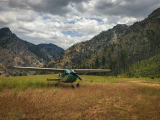
I went down to the bustling metropolis of Likely BC the other day to practice techniques for flying into short gravel strips at high density altitude. Likely is 3225' asl and at 29C (which it was that day) its denisty altitude is about 5500' which significantly taxes aircraft performance. Gross weight takeoff run at sea level is supposed to be 775', I was about 400 lbs under gross and my takeoff runs were consistently about 1200' (interestingly enough it was about the same distance as in Prince George, 1000' lower, on pavement, and not trying to avoid basting the thing with gravel). At 3200' in length Likely is not overly short, leaving some extra room for developing skills. There is also somewhat challenging terrain to deal with around the airport which makes it a great spot to practice.
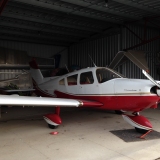
The Piper Cherokee is no one's idea of a bush plane. It has a low aspect ratio wing with a laminar flow airfoil and simple plain flaps. This design does have some advantages, however good handling characteristics on the back side of the drag curve, adequate drag for steep approaches, and low speed elevator authority are not among them.
Despite these limitations a Cherokee will perform a better its reputation would lead one to expect if the airplane is kept light and some techniques are employed to mitigate some of the disadvantages. A hershey bar Cherokee will sink like a rock if you let it get slow. This can actually be used to your advantage to set up a slow, (relatively) steep, stable approach to a runway using a touch of power or a gentle slip to control the approach path. When coming in very slow, however a burst of power (nothing extreme, a few hundred rpm) must be used in order to flare. These early Cherokees had a narrow stabilator and a serious lack of pitch authority at low speed. The landing at 3:40 was a royal screw up. The video really doesn't do justice to how...firm it was. I was definitely checking the ELT afterwards. I neglected to pull on the last notch of flaps and as I was wounding out it was really sinking hard. I tried to give it a fist full of power to cushion the impact, but only got a little (thankfully enough to flare somewhat). I had the throttle friction on so tight that I couldn't get it on quickly enough (I do believe that I realized a problem in time that I could have either salvaged the landing or gone around if I could have given it enough gas) and once I was on the ground I started to accelerate again because I couldn't get it off fast enough. There is a reason for this: When I was in initial training I had a throttle vibrate partway out on me, got shit from my instructor, and since then I've developed a subconscious habit of tightening the throttle friction every time I adjust the throttle. I've never, ever had that issue before. I must have tightened it more than usual in that particular instance. Lesson learned, it's something I'll be on the lookout for going forward. It's also a testament to Piper's oleo gear that I came in that hard without a bounce or accidental ELT activation.
I drew heavily from this article: http://www.backcountrypilot.org/stol-tips/stol-tips-attitude-flying There is some really good stuff in there. The only problem is that it puts a lot of weight in referencing the angle of the wing with the angle of the horizon. Try that in a low wing airplane! Despite my lack of a wing-horizon reference, I was able to to put together a good picture of what a proper short field approach should look like and had good success using it.
This flight was excellent practice for me, I learned a lot about how to handle my airplane at the very bottom of the envelope and about dealing with less than ideal runway and terrain conditions. I feel much better prepared now for exploring some off the beaten path places this summer.
Oh, in addition to all that it was a hell of a lot of fun!
Food's good at the stabilator cafe too: