
Chicken Strip
Wed Aug 01, 2012 10:38 am
Re: Chicken Strip
Like wise!
Wed Aug 01, 2012 11:04 am
Re: Chicken Strip
My comments submitted!....now I hope I get to land there someday.
'05 7GCBC High Country Explorer
The faster I go , the farther behind I get.
The faster I go , the farther behind I get.
Wed Aug 01, 2012 11:15 am
Re: Chicken Strip
hicountry wrote:My comments submitted!....now I hope I get to land there someday.
Hope to land there, too.
Wed Aug 01, 2012 11:54 am
Re: Chicken Strip
For what it's worth here's my letter (one of five this year) to the NPS regarding the Chicken Strip. Some of the comments are in reference to NPS pilots who felt that the Chicken Strip was "dangerous". Lord knows your comments don't need to be this long or dry, but PLEASE LET YOUR VOICE BE KNOWN.
thanks,
hammer
Dear Superintendent Craighead,
I am writing to voice my opinions and observations on the Saline Valley Management Plan, specifically the part concerning the Chicken Strip Airstrip.
As I understand it, the NPS is primarily concerned with the potential liability they incur for having a minimally developed airstrip within the park boundaries. I would like to address some of those concerns from a pilot's perspective. Frankly, I cannot see any reason that the park is any more liable for the consequences of an accident at the Chicken Strip than they are for an accident anywhere else in the park. If anything, I see the NPS as being less liable for any damages resulting from an aircraft accident than they are from a vehicle accident, snake bite, campground stabbing, lost hiker, burro trampling, etc.. The Federal Aviation Regulations which govern every aspect of aircraft operation specifically state that the pilot in command is the ultimate authority to, and the person directly responsible for every action or omission regarding the operation of the aircraft. Simply put, there is a legally binding code of conduct governing the operation of aircraft which unequivocally states that it is the pilots' responsibility to operate their aircraft safely and within that individual pilot's abilities. No such code of conduct exists for other activities within the park.
If the pilot attempts to take off or land with too much wind, the FAR's state the pilot is at fault.
If the pilot attempts to take off or land without seeing an obstruction or erosion on the runway surface, the FAR's state that the pilot is at fault.
If the pilot is unable to keep the aircraft on the developed part of the airstrip and they run into the brush, the FAR's state the pilot is at fault.
If the pilot flies into rising terrain or looses control of his/her aircraft while maneuvering over the Chicken Strip, the FAR's (you guessed it) state the pilot is at fault.
Where exactly is the increased liability here? How is an experienced pilot landing at the Chicken Strip more dangerous than the plethora of inexperienced drivers who venture into the Saline Valley in every conceivable type of land vehicle? It just doesn't make sense to assume that because an aircraft is involved there is some elevated level of danger or liability.
This is America, which means that you can get sued for waking up in the morning. As a law enforcement officer I've been sued three times in seven years, all without merit. It's just a part of our social fabric. The only way you can avoid being sued for what happens in the park is if you fence the park off and close it up. It's not a reasonable solution. Closing the Chicken Strip because you are afraid of the liability is not a reasonable solution either.
While there seems to be an elevated level of sensationalism any time an aircraft gets bent, the fact of the matter is that flying a plane is as everyday an experience for a pilot as driving a car is for most folks. The exposure to physical injury a pilot faces while flying into the Chicken Strip is trivial compared to the exposure a motorist faces driving there. An aircraft landing at the Chicken Strip touches down at around 40 to 50 mph and is stopped within six to seven hundred feet. It's not a stunt, a trick, or even anything terribly noteworthy. It's just landing an aircraft... something that has to happen every time anyone goes flying.
The Chicken Strip is NOT a difficult or hazardous strip. It's a completely reasonable, well laid out and plenty long a piece of property to land an airplane on. I landed there in a tail wheel airplane with less than 80 hours of total flight time under my belt. Compared to dozens of the backcountry airstrips in Idaho and Utah which see regular use, the Chicken Strip is one of the easiest backcountry strips there is.
The approach (how you position the aircraft prior to landing) is as obstruction-free and wide open as any on earth. Unlike some airstrips where you cannot even see the airstrip until you are committed to landing, a pilot can make multiple passes over the Chicken Strip to assess winds, surface conditions, etc.. Wind direction and velocity is easily interpreted via the windsock. If the windsock is not functioning, the palm trees at the springs show the wind. If the pilot cannot determine whether the wind conditions are favorable for landing, they are obligated not to land and to divert to a different field where conditions are within the pilot's skill level.
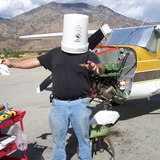
Once on final approach to the Chicken Strip, the pilot has the option of continuing the approach to landing or adding power and "going around". This is an elementary procedure taught to all student pilots whereby they elect to keep flying rather than attempt a landing from an approach they don't like. The terrain at the Chicken Strip allows a pilot of almost any aircraft to initiate a go-around at any point in the approach short of actually touching the ground. Compare that to dozens of airstrips in Idaho and Utah, some of which are routinely used by commercial air carriers, which have no potential for a go-around. At those strips once the pilot turns towards the airstrip (which they often cannot even see) they are completely committed to landing regardless of their approach. Pilots land at these strips day in and day out, year after year. Get used to that sort of flying and you can land at the Chicken Strip with a paper bag over your head.
The take-off from the Chicken Strip is as easy as falling off a log. Once you get five feet off the ground there's nothing to hit for about ten miles.
The surface and length and width of the Chicken strip is generous for virtually all general aviation aircraft. It would take a very large plane indeed to run out of space if properly flown.
Simply put, there is no "trap" inherent in the Chicken Strip. It does not represent and invitational hazard and any pilot who bends a plane at the strip is going to be extremely hard pressed to convince anyone that the fault is anything but theirs.
Will pilots occasionally bend an aircraft at the Chicken Strip? Sure. Even the best pilots eventually make a mistake. Will a loss of control at the Chicken Strip be fatal? Probably not. The most likely scenario is a pilot tries to land in too much wind and looses control of the aircraft as it touches the ground, resulting in damage to the aircraft and possibly minor injury to the pilot. Sort of like getting in a fender-bender on the freeway, except the law explicitly states that the pilot is always responsible for the outcome of the flight. From a liability perspective, what exactly is the big deal about that???
For comparison, how many people have died within the borders of DVNP in the past ten years? Now how many of those deaths were at the Chicken Strip? How many even involved an aircraft? Based on these numbers, how exactly can the NPS justify closing the Chicken Strip?
Another point to consider is how much publicity the NPS wants to draw to the Chicken Strip. Prior to the closure of the strip in 2011 I never landed at the strip when another aircraft was there, and it was rare to have an aircraft land while we were camped there. The publicity created by the closure changed that. After the strip was reopened I've never landed at the Chicken Strip without other aircraft being parked there. I'd say there was a 200% increase in the use of the strip. Why? Mostly because the publicity of trying to get it reopened brought it to the attention of hundreds of people who never even knew it was there. I think that over the next couple years the increase in use will stabilize or decline, but some "damage" has been done. What was once a pretty obscure gem known to a handful of loyal users is now known far and wide.
It's a forgone conclusion that if the Chicken Strip is closed there will be a lawsuit to reopen it. Pilots tend to have deep pockets when it comes to their privilege being threatened, and I guarantee there are a hundred pilots out there who are willing to pony up a thousand dollars each to reopen the strip. The AOPA and the RAF have pretty good publicity machines, and they will not stand idly by while the only airstrip in California that serves as a wilderness trailhead is closed. Frankly, if the Chicken Strip had never been threatened in the first place the NPS would have a lot fewer people using it and a lot fewer potential problems. If the NPS closes the Chicken Strip and that closure is subsequently overturned in the courts, the use of the strip is going to skyrocket.
As I've pointed out in other communications, flying into the Chicken Strip is the most environmentally responsible way to access the Saline Valley. Aircraft at the Chicken Strip have a minimal impact on the Springs, and aircraft users are among the most minimalist and low impact users of the valley. Aircraft provide access to people who would otherwise be unable to visit the Saline Valley, and they provide an important service to all users of the area.
Rather than worrying that the DVNP is the only lower-48 national park with a airstrip that serves as a wilderness trailhead, why isn't the park administration championing this ultra efficient, low impact, environmentally friendly access to other national parks? Instead of trying to close the Chicken Strip, why isn't the administration recognizing the attributes of air access and looking for additional places to place airstrips? At what point did uniformity and banality become more desirable than innovation and excellence?
I must admit to a sense of frustration and futility while I write this letter. It's an oppressive feeling to try and convince a gigantic, impersonal bureaucracy not to take away yet another one of the things that makes life worth living. Why exactly must we submit to the obtuseness of committee thinking? Why must we be protected from ourselves? Why must we all be held to the level of the lowest common denominator? Prior to being in law enforcement I was a travel photographer. I spent ten years traveling the world, seeking out the most remote and beautiful places on our earth. With every place I've been and everything I've seen, I've never found anything even close to the Saline Valley. It's as unique as it is spectacular. Despite the length of this letter, I'm simply without words to express what a treasure it is, and what a crime it would be to take it away from those that love it.
I do not envy your task of drafting the Saline Valley Management Plan. I suspect that no matter what you do, someone will be displeased. But from my perspective the Saline Valley works pretty well right now as is. The springs, Lee, and the Chicken Strip combine to create something truly worth protecting for current and future generations to enjoy. Isn't that the mandate of the park service in the first place?
Sincerely,
thanks,
hammer
Dear Superintendent Craighead,
I am writing to voice my opinions and observations on the Saline Valley Management Plan, specifically the part concerning the Chicken Strip Airstrip.
As I understand it, the NPS is primarily concerned with the potential liability they incur for having a minimally developed airstrip within the park boundaries. I would like to address some of those concerns from a pilot's perspective. Frankly, I cannot see any reason that the park is any more liable for the consequences of an accident at the Chicken Strip than they are for an accident anywhere else in the park. If anything, I see the NPS as being less liable for any damages resulting from an aircraft accident than they are from a vehicle accident, snake bite, campground stabbing, lost hiker, burro trampling, etc.. The Federal Aviation Regulations which govern every aspect of aircraft operation specifically state that the pilot in command is the ultimate authority to, and the person directly responsible for every action or omission regarding the operation of the aircraft. Simply put, there is a legally binding code of conduct governing the operation of aircraft which unequivocally states that it is the pilots' responsibility to operate their aircraft safely and within that individual pilot's abilities. No such code of conduct exists for other activities within the park.
If the pilot attempts to take off or land with too much wind, the FAR's state the pilot is at fault.
If the pilot attempts to take off or land without seeing an obstruction or erosion on the runway surface, the FAR's state that the pilot is at fault.
If the pilot is unable to keep the aircraft on the developed part of the airstrip and they run into the brush, the FAR's state the pilot is at fault.
If the pilot flies into rising terrain or looses control of his/her aircraft while maneuvering over the Chicken Strip, the FAR's (you guessed it) state the pilot is at fault.
Where exactly is the increased liability here? How is an experienced pilot landing at the Chicken Strip more dangerous than the plethora of inexperienced drivers who venture into the Saline Valley in every conceivable type of land vehicle? It just doesn't make sense to assume that because an aircraft is involved there is some elevated level of danger or liability.
This is America, which means that you can get sued for waking up in the morning. As a law enforcement officer I've been sued three times in seven years, all without merit. It's just a part of our social fabric. The only way you can avoid being sued for what happens in the park is if you fence the park off and close it up. It's not a reasonable solution. Closing the Chicken Strip because you are afraid of the liability is not a reasonable solution either.
While there seems to be an elevated level of sensationalism any time an aircraft gets bent, the fact of the matter is that flying a plane is as everyday an experience for a pilot as driving a car is for most folks. The exposure to physical injury a pilot faces while flying into the Chicken Strip is trivial compared to the exposure a motorist faces driving there. An aircraft landing at the Chicken Strip touches down at around 40 to 50 mph and is stopped within six to seven hundred feet. It's not a stunt, a trick, or even anything terribly noteworthy. It's just landing an aircraft... something that has to happen every time anyone goes flying.
The Chicken Strip is NOT a difficult or hazardous strip. It's a completely reasonable, well laid out and plenty long a piece of property to land an airplane on. I landed there in a tail wheel airplane with less than 80 hours of total flight time under my belt. Compared to dozens of the backcountry airstrips in Idaho and Utah which see regular use, the Chicken Strip is one of the easiest backcountry strips there is.
The approach (how you position the aircraft prior to landing) is as obstruction-free and wide open as any on earth. Unlike some airstrips where you cannot even see the airstrip until you are committed to landing, a pilot can make multiple passes over the Chicken Strip to assess winds, surface conditions, etc.. Wind direction and velocity is easily interpreted via the windsock. If the windsock is not functioning, the palm trees at the springs show the wind. If the pilot cannot determine whether the wind conditions are favorable for landing, they are obligated not to land and to divert to a different field where conditions are within the pilot's skill level.
Once on final approach to the Chicken Strip, the pilot has the option of continuing the approach to landing or adding power and "going around". This is an elementary procedure taught to all student pilots whereby they elect to keep flying rather than attempt a landing from an approach they don't like. The terrain at the Chicken Strip allows a pilot of almost any aircraft to initiate a go-around at any point in the approach short of actually touching the ground. Compare that to dozens of airstrips in Idaho and Utah, some of which are routinely used by commercial air carriers, which have no potential for a go-around. At those strips once the pilot turns towards the airstrip (which they often cannot even see) they are completely committed to landing regardless of their approach. Pilots land at these strips day in and day out, year after year. Get used to that sort of flying and you can land at the Chicken Strip with a paper bag over your head.
The take-off from the Chicken Strip is as easy as falling off a log. Once you get five feet off the ground there's nothing to hit for about ten miles.
The surface and length and width of the Chicken strip is generous for virtually all general aviation aircraft. It would take a very large plane indeed to run out of space if properly flown.
Simply put, there is no "trap" inherent in the Chicken Strip. It does not represent and invitational hazard and any pilot who bends a plane at the strip is going to be extremely hard pressed to convince anyone that the fault is anything but theirs.
Will pilots occasionally bend an aircraft at the Chicken Strip? Sure. Even the best pilots eventually make a mistake. Will a loss of control at the Chicken Strip be fatal? Probably not. The most likely scenario is a pilot tries to land in too much wind and looses control of the aircraft as it touches the ground, resulting in damage to the aircraft and possibly minor injury to the pilot. Sort of like getting in a fender-bender on the freeway, except the law explicitly states that the pilot is always responsible for the outcome of the flight. From a liability perspective, what exactly is the big deal about that???
For comparison, how many people have died within the borders of DVNP in the past ten years? Now how many of those deaths were at the Chicken Strip? How many even involved an aircraft? Based on these numbers, how exactly can the NPS justify closing the Chicken Strip?
Another point to consider is how much publicity the NPS wants to draw to the Chicken Strip. Prior to the closure of the strip in 2011 I never landed at the strip when another aircraft was there, and it was rare to have an aircraft land while we were camped there. The publicity created by the closure changed that. After the strip was reopened I've never landed at the Chicken Strip without other aircraft being parked there. I'd say there was a 200% increase in the use of the strip. Why? Mostly because the publicity of trying to get it reopened brought it to the attention of hundreds of people who never even knew it was there. I think that over the next couple years the increase in use will stabilize or decline, but some "damage" has been done. What was once a pretty obscure gem known to a handful of loyal users is now known far and wide.
It's a forgone conclusion that if the Chicken Strip is closed there will be a lawsuit to reopen it. Pilots tend to have deep pockets when it comes to their privilege being threatened, and I guarantee there are a hundred pilots out there who are willing to pony up a thousand dollars each to reopen the strip. The AOPA and the RAF have pretty good publicity machines, and they will not stand idly by while the only airstrip in California that serves as a wilderness trailhead is closed. Frankly, if the Chicken Strip had never been threatened in the first place the NPS would have a lot fewer people using it and a lot fewer potential problems. If the NPS closes the Chicken Strip and that closure is subsequently overturned in the courts, the use of the strip is going to skyrocket.
As I've pointed out in other communications, flying into the Chicken Strip is the most environmentally responsible way to access the Saline Valley. Aircraft at the Chicken Strip have a minimal impact on the Springs, and aircraft users are among the most minimalist and low impact users of the valley. Aircraft provide access to people who would otherwise be unable to visit the Saline Valley, and they provide an important service to all users of the area.
Rather than worrying that the DVNP is the only lower-48 national park with a airstrip that serves as a wilderness trailhead, why isn't the park administration championing this ultra efficient, low impact, environmentally friendly access to other national parks? Instead of trying to close the Chicken Strip, why isn't the administration recognizing the attributes of air access and looking for additional places to place airstrips? At what point did uniformity and banality become more desirable than innovation and excellence?
I must admit to a sense of frustration and futility while I write this letter. It's an oppressive feeling to try and convince a gigantic, impersonal bureaucracy not to take away yet another one of the things that makes life worth living. Why exactly must we submit to the obtuseness of committee thinking? Why must we be protected from ourselves? Why must we all be held to the level of the lowest common denominator? Prior to being in law enforcement I was a travel photographer. I spent ten years traveling the world, seeking out the most remote and beautiful places on our earth. With every place I've been and everything I've seen, I've never found anything even close to the Saline Valley. It's as unique as it is spectacular. Despite the length of this letter, I'm simply without words to express what a treasure it is, and what a crime it would be to take it away from those that love it.
I do not envy your task of drafting the Saline Valley Management Plan. I suspect that no matter what you do, someone will be displeased. But from my perspective the Saline Valley works pretty well right now as is. The springs, Lee, and the Chicken Strip combine to create something truly worth protecting for current and future generations to enjoy. Isn't that the mandate of the park service in the first place?
Sincerely,


Wed Aug 01, 2012 3:56 pm
Re: Chicken Strip
Wow Hammer. That's awesome. Mine was short and sweet 
Wed Aug 01, 2012 4:33 pm
Re: Chicken Strip
58Skylane wrote:Wow Hammer. That's awesome. Mine was short and sweet
Yes he has a way with words doesn't he

- Glidergeek offline

- Posts: 1937
- Joined: Sat Sep 06, 2008 8:02 pm
- Location: Hesperia
- Aircraft: 1968 P206C
DG 400
Wed Aug 01, 2012 9:35 pm
Re: Chicken Strip
GREAT stuff Hammer.
Keep it up guys, ONLY "5" more days to get your two-cents in so make it count. Be sure and get all your friends to comment too.
Rick
Keep it up guys, ONLY "5" more days to get your two-cents in so make it count. Be sure and get all your friends to comment too.
Rick
- pacerpilot offline
- Posts: 199
- Joined: Mon Feb 23, 2009 10:48 pm
- Location: Kernville, calif.
- Aircraft: PA-22/20
Thu Aug 02, 2012 2:14 am
Re: Chicken Strip
Hammer,
Very well put. Succinct and informative. I want Sept/Oct here already so I can finally fly out there for the first time. Of course off-roading in and camping right next to the springs is good for me too.
Very well put. Succinct and informative. I want Sept/Oct here already so I can finally fly out there for the first time. Of course off-roading in and camping right next to the springs is good for me too.
Thu Aug 02, 2012 10:20 am
Re: Chicken Strip
Done
Fri Aug 03, 2012 10:24 am
Re: Chicken Strip
Bump.
Get er done! Only two days left. Use the online form and it takes about three minutes.
http://parkplanning.nps.gov/document.cf ... ntID=47178
Click on the "COMMENT ON DOCUMENT" box to the left of the picture of the pool and fill in the blanks.
Thanks,
hammer
Get er done! Only two days left. Use the online form and it takes about three minutes.
http://parkplanning.nps.gov/document.cf ... ntID=47178
Click on the "COMMENT ON DOCUMENT" box to the left of the picture of the pool and fill in the blanks.
Thanks,
hammer
Fri Aug 03, 2012 8:38 pm
Re: Chicken Strip
Done!
Sun Aug 05, 2012 12:22 pm
- Glidergeek offline
- Posts: 1937
- Joined: Sat Sep 06, 2008 8:02 pm
- Location: Hesperia
- Aircraft: 1968 P206C
DG 400
Mon Aug 06, 2012 7:02 am
Re: Chicken Strip
Today is the LAST day. If you havent commented Please do.
Direct Link: http://parkplanning.nps.gov/commentForm ... ntID=47178
Rick
Direct Link: http://parkplanning.nps.gov/commentForm ... ntID=47178
Rick
- pacerpilot offline
- Posts: 199
- Joined: Mon Feb 23, 2009 10:48 pm
- Location: Kernville, calif.
- Aircraft: PA-22/20
Mon Aug 06, 2012 6:20 pm
Re: Chicken Strip
COMMENTS OPEN UNTIL MIDNIGHT MOUNTAIN TIME, four more hours to work the keyboard.
it's easy, painless, and free.
and it feels good to tell the man what's on your mind.
Did I mention it's free?
it's easy, painless, and free.
and it feels good to tell the man what's on your mind.
Did I mention it's free?
Tue Aug 07, 2012 7:39 am
Re: Chicken Strip
My Thanks to everyone that commented in an effort to keep the Chicken Strip open.
As this thing goes over the next few months and longer, I’ll do my best to keep you all informed. There will be one more public comment period after they, the National Park Service, come up with a proposed plan. You’ll here about it as soon as I do.
Rick
Calif. RAF Liaison
As this thing goes over the next few months and longer, I’ll do my best to keep you all informed. There will be one more public comment period after they, the National Park Service, come up with a proposed plan. You’ll here about it as soon as I do.
Rick
Calif. RAF Liaison
- pacerpilot offline
- Posts: 199
- Joined: Mon Feb 23, 2009 10:48 pm
- Location: Kernville, calif.
- Aircraft: PA-22/20
Tue Aug 07, 2012 3:13 pm
Re: Chicken Strip
I looked at the website for saline preservation assoc shown above. There are a couple threads discussing this NPS stuff. Discussion seems populated by long term regular users.
Interesting thing is there is not one mention of the strip pro or con.
Interesting thing is there is not one mention of the strip pro or con.
Tue Aug 07, 2012 3:52 pm
Re: Chicken Strip
It’s a small world. As it turns out I just had a very positive conversation with john Dukes an officer on the board of the Saline Preservation Association “SPA”. He stated that he and his group see the Chicken strip as a positive for the valley and are working in there way to make sure it stays in place. I offered my help to support his effort and he offered his help to us, the pilot community. I have also had the pleasure of speaking with some of the SPA members and every one likes the chicken strip and sees it as an asset. This is a wonderful thing for us as it gives us an ally to negotiate with the Park Service over the coming months ahead.
Rick
I offered my help to support his effort and he offered his help to us, the pilot community. I have also had the pleasure of speaking with some of the SPA members and every one likes the chicken strip and sees it as an asset. This is a wonderful thing for us as it gives us an ally to negotiate with the Park Service over the coming months ahead. Rick
- pacerpilot offline
- Posts: 199
- Joined: Mon Feb 23, 2009 10:48 pm
- Location: Kernville, calif.
- Aircraft: PA-22/20
Tue Aug 07, 2012 5:07 pm
Re: Chicken Strip
pacerpilot wrote:It’s a small world. As it turns out I just had a very positive conversation with john Dukes an officer on the board of the Saline Preservation Association “SPA”. He stated that he and his group see the Chicken strip as a positive for the valley and are working in there way to make sure it stays in place.
Rick
All kidding aside, it would be nice to have a better, larger tie down area and a semi developed camping area.
Tue Aug 07, 2012 5:10 pm
Re: Chicken Strip
Ok, now can I rally the troops for Monache Meadows, it’s my turn!
Tue Aug 07, 2012 6:28 pm
Re: Chicken Strip
172heavy wrote:Ok, now can I rally the troops for Monache Meadows, it’s my turn!
Please do!
- OregonMaule offline
- Posts: 6977
- Joined: Fri Sep 01, 2006 9:44 pm
- Location: Orygun
My SPOT page
"They who can give up essential liberty to obtain a little temporary safety, deserve neither liberty nor safety". Ben Franklin
http://en.wikiquote.org/wiki/Benjamin_Franklin
"They who can give up essential liberty to obtain a little temporary safety, deserve neither liberty nor safety". Ben Franklin
http://en.wikiquote.org/wiki/Benjamin_Franklin
DISPLAY OPTIONS
Who is online
Users browsing this forum: No registered users and 1 guest
Latest Features
-
Live to Tell
A Minnesota pilot is surprised to learn that the sudden asymmetric drag of an out-of-rig ski can…Read More -
Creators
Working in some of the Yukon's most beautiful and remote environments, photographer Simon Blakesley captures aircraft in…Read More -
Aircraft Ownership and Maintenance
Upgrading to big tires can make a huge difference in backcountry performance, but with those gains come…Read More -
Tales from Yesteryear
In this tale from bush flying yesteryear, Don Cogger signs up to help Atlee Dodge Jr recovery…Read More


Latest Knowledge Base
-
Destinations
A regional guide with ideas for winter camping destinations in California, Nevada, New Mexico, and Arizona.Read More -
Aircraft
Finding an affordable aircraft that can handle the backcountry for $80K or less? A challenge for sure, but with the…Read More -
Aircraft
01.29.2018 - Zane - Updated tire diameter graphic to add 8.50x10 Guide to tires for use in the backcountry and off-airport landing…Read More -
Pilots
12.22.2013 - Initial article format Operating aircraft on skis and negotiating a snow-covered landscape is an entirely unique skillset and environment.…Read More


