Meat,
I really don't get out much

What I mean is I don't know a whole heck of a lot of night flyers, but then again I guess there really isn't a whole heck of a lot of night flyers.... I've probably worked with or know something in the neighborhood of 40 or so folks that spray at night. Out of that group I have never met anyone that uses or has experience with NVGs. That, in and of itself really doesn't mean much though, because night ag is kind of becoming a lost art... I don't think more than 2 or 3 people in that group are younger folks, the vast majority of these folks started night spraying long before the days of really good aircraft worthy NVGs. Consequently, they have long ago adapted other methods that work, and stood the test of time. Most of these folks don't even have a radio, getting them to try out NVG's is probably an exercise in futility

My thoughts;
The extent of my NVG experience ended with my active duty a few decades ago
so please take any comments or observations I make with respect to NVG use in our application with a huge grain of salt. I really have no way to speak intelligently with regard to todays NVG use. How it might work in the night ag environment on the other hand... well I have opinions. Perhaps someone like yourself or stearmann4, another Army gone ag member here could shed a better light.
My personal opinion is that NVG's even the most cutting edge technology, probably still do not posses the precision necessary to facilitate an ag op. In fact, I *think* the lack of precision is across the board and not just one facet. Looking at the pictures you posted, I'm not certaing I'd get a rotor that close to a tree, or a wing that close to a highline with the field of view limitations afforded by NVG's.

Would you be able to pick out that last guy wire that was hidden in the bushes? I don't really know? Speaking of wires, how do they translate under NVG's? I suspect they are seen pretty much as they would be under 'day vision'. I'm sure you know that one of the positive elements of night ag is that the wires are tremendously easier to pick up. The only fly in the ointment there is that you pick them up on very short notice ~ 300'
Color? What's your take on that aspect? Shades of green... that's the first indicator of whether you're in the arugula (the stufff I never knew so many people like
) or in the mustard greens... or just AFU and over in the Kale
One golden rule for me (a good tip for a budding pilot like Luke) ;
What color is the juice? On a busy night with multi airplanes on the pad, the wrong load has made it into the wrong airplane on more than one occasion... Putting the Lorsban from Joe's alfalfa work onto your next field of Manex on romaine is going to be an extremely expensive mistake... was that load red and clear or yellow and milkshake thick? Or is it the nice new blue Lannate that was mis delivered?
'Waterlines' no not plumbing, but where the irrigation stopped in the field... waterlines are usually your first indicator of where they want to start/stop a partial spray job. Could you pick that up with NVG's?
Definition? can you really see texture well at todays ag speeds? head lettuce vs romaine... both green, albiet sometimes an ever so slight difference in shade, but texture is a dead give away. Is the 'texture' good at 150MPH?
Fog/Dust? How do they do when you are tasked with spraying a field right next to a dry field being disced, a wheat field being harvested, or the feed lot not running their sprinklers at night? All of these make dust storms that rival the mid east. Night work with lights suck here, I suspect NVGs would be a huge asset here, but honestly have no clue.
External interference? In the next valley over much of their work is next to highways, or in town
I am somewhat aware of the ATG technology, but being able to diminish the effects of external light sources well enough to take off and land, and being able to diminsh those effects on an aircraft working at ag speeds in a critical environment don't seem to compare to me? Is it really that good? I honestly don't know.
Failure modes? With half a dozen sunshine bright lights my most likely failure mode is a birdstrike on a single light... pretty benign, even when it happens in the field. Are there many contingencies plans for NVG failure?
Anyways... these are just personal thoughts from someone truly ignorant of todays NVG capabilities... Thoughts on your end?
Take care, Rob

 Only difficulty with your cat skinning is I see is holding the ends from that height? My turn to say not being critical but trying to learn. I think people think we are off our rockers working in the little fields we do, but I would be absolutely scared to death trying to fly around those wind turbines. Hats off to you folks.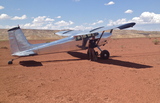


 and thanks for the tip! I just may try it. But as you know, most of the spraying occurs 'on the fly' so to speak, so probably not going to be a very effective tactic.
 I'm sure you'll agree that the vast majority are not nicely planted on the edge of a field, but rather planted such that makes logistical sense to the infrastructure, in other words a maze to the aerial applicator... A moving maze with the moving blossom eating up a tremendously large amount sky. You can get under them just fine, it's the turns that will get you. Remeber the Thrush that got knocked out of the sky near you a couple years ago?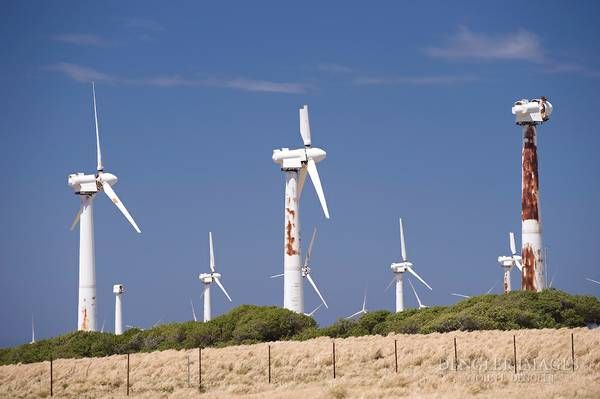
 For me, this alone makes night ag in IA an impossibility...

 It just takes longer. Can't say I'm not sad remembering what it use to be like to fly the same field.
 I'm gonna go back to lurking. Thanks for the thread and for making me very happy I don't have to work around any wind farms!


