Big Rocks and Long Props Vol. 1 (2005 GSM Machine&Tool)
Running time: 47 minutes + extras
Price: $29.95 + shipping
In seemingly divine response to my flying video prayers, I have the privilege of writing yet another review of a bush flying DVD. I guess I can't complain anymore about not having some good rainy day Lazy Boy flying inspiration, as I have now added Big Rocks and Long Props Vol 1 to my collection. While the DVD was actually released several months ago, and many of you have already bought your copies on faith alone(for some, the sight of bushwheels is all it takes...I'll take it!!), without benefit of a review, I'm sure there are a few of you out there who need an extra push to take the plunge. Please continue reading.
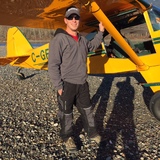
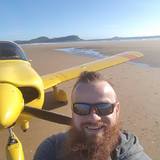
[imgwrap=left]https://www.backcountrypilot.org/i/screenshots/brlp.pilots.jpg[/imgwrap]Greg Miller and Loni Habersetzer are both Pacific Northwest pilots who, after years of honing their craft, decided that the world needed to witness just how slow a light airplane can fly and just how short it can land. That demonstration could be accomplished at any safe asphalt-surface airport though, and if one was going to need such short takeoff and landing performance, it would likely not be on such a pristine surface, but rather some really short river bars that are made up of rocks the size of basketballs and located deep within a heavily wooded canyon. Yes, now we're talking about something that is worthy of being committed to video, and that is exactly the premise of Big Rocks and Long Props Volume 1: 2 guys with very specialized airplanes doing exactly what a bush flying enthusiast wants to see an airplane do.
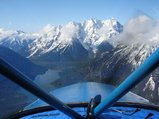
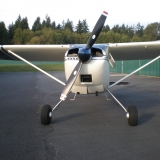
[imgwrap=right]https://www.backcountrypilot.org/i/screenshots/brlp.scenic.jpg[/imgwrap]I feel like there is kind of a commonly held belief that real bush flying only occurs in Alaska, due to the necessity of airplanes to get to the great hunting and fishing locations. But what about the Lower 48? In my opinion, the Pacific Northwest offers some of the most beautiful flying locations in the world, and of course everybody loves Idaho. The lush, overgrown, greenery of western Oregon and Washington terrain are particularly close to my heart though, and for that reason I really fell in love with the scenery in this video right away. I'm not sure exactly what river(s) the flying took place on, and Greg and Loni will probably remain tight-lipped about that detail to avoid any attention from interest groups who don't understand just how light a footprint a tiny airplane leaves behind. The Alaskan Bushwheels Greg and Loni run are huge, lightly inflated, and give way to any obstacle up to the size of a Toyota Prius. There are a few slow motion shots that show the wheels rolling over ENORMOUS rocks, and banks that look like motocross jumps, and neither the rock nor the airplane seem to care. What a great promo for bushwheels!
[imgwrap=left]https://www.backcountrypilot.org/i/screenshots/brlp.bigrocks.jpg[/imgwrap]The video gets down to business pretty quickly. Loni introduces himself and Greg, then they take off from a really nice grass strip(in about 200 feet) and head out to do some "rock crawling." The format of the movie, with the exception of the beginning, is pretty much all landings and takeoffs at different locations. In fact this how the chapters are defined, with each chapter corresponding to a different location, with names like Rock Creek, Petrified, Washout, Shorty, and Paradise, etc. I don't think you'll find any of these names on a map, as they're pet names given by the guys to to very short, rough sections of marginally flat(not necessarily smooth) ground in river canyons that no sane person would identify with a landing strip. That's the genius of this video though -- The shock value. At first viewing, a pilot familiar with what standard sized airplane tires are capable of rolling over, simply cannot believe what he is seeing. That, combined with a slew of techniques I've only read about in books on bush flying legends, make for a rather sensational demonstration of superior piloting, especially the ground handling on rough surfaces. If ever there was an argument for the tailwheel aircraft, this is it. Power up, stick forward to lift the tail, differential braking to bring it around. This is hard enough on asphalt or grass, but try it on a minefield of head-sized rocks and logs. It's almost painful to watch the poor little tailwheel get thrashed about, but a nosewheel aircraft would last approx 3 seconds on this kind of surface before either getting stuck or having a propstrike.
[imgwrap=right]https://www.backcountrypilot.org/i/screenshots/brlp.rockcreek.jpg[/imgwrap]I promised Greg that I would try to avoid adjectives like "crazy", "insane", or "circus clown" but it's getting tough. The margin for error in what these crazed clowns are doing is very, very slim. The opportunity to lose a $100,000 aircraft looms around every corner of the river. To their credit though, they are very on the their game, with many years of this type of flying under their belts. They are equipped with adequately powered aircraft, huge tires, an intimate understanding of the flight envelope of their airplanes, and a lot of recon information about the landing sites. Greg comments that he never lands one of these sites the first time, given the extremely dynamic nature of the river bar topography. A site that he's landed many times before may have been completely reshaped by the river and therefore require a different approach or technique. A bloopers section is included in the extras, but I was kinda disappointed. The bloopers are pretty much limited to a little submarining during a water ski-to-land attempt(successful) and some rough rollouts on a few landings. They are nothing serious, no damage to aircraft or pilot, just a little extra pucker factor that only a pilot who knows how easy it is to nose-over a taildragger or drag a wingtip would pick up on. I'm not sure what I was expecting, as I certainly don't want to see carnage, so I'm glad the blooper reel was short and uneventful. The scene to the right is a landing made by Loni at Rock Creek that made me have to dig the couch cushion out of my Levis...I can't speak for his seat cushion. Greg later explains in the video that there is a pretty solid lip in the transition from water to bar that changes with water level. The lower the river, the more extreme the bank, and the more exciting the rollout. These guys are crazy. Sorry Greg.
[imgwrap=left]https://www.backcountrypilot.org/i/screenshots/brlp.cockpit.jpg[/imgwrap][imgwrap=right]https://www.backcountrypilot.org/i/screenshots/brlp.paradise.jpg[/imgwrap]I have to give credit to the directors for utilizing multiple shots and angles. Landing after landing and takeoff after takeoff can get a little tedious after a while, no matter how extraordinary it is, so they mix it up a little with some great in-cockpit footage, and even some picture-in-picture action like the shot to the left. They give you both the in-cockpit and a strip-level view of the landing. Some of the landings are even captured during an overhead fly-by, which really makes for a great perspective.
The topic of flying low down a river has been discussed on this site from a safety point of view, but there is no denying the sheer exhilaration one gets from following these canyons below tree level. For most of us, that thrill should remain relegated to watching this video, as the dangers of such operations are obvious. Besides, I'm sure Greg or Loni could land on a pile of sticks if they did encounter an engine problem. They're just damn good pilots and they know what they're doing. I had a brief daydream about landing my C170 on one of these river bars, but it ended in me removing the wings and shelling out a few grand for air-crane service. If a guy did have an engine failure in harsh terrain, and all that was available was a rockpile in the middle of a river canyon, you now know that it's possible to survive, though your glory will only be recorded in your mind unless you're packing a video camera.
While some other videos are careful to avoid any kind of dialog that may be considered instructional, Big Rocks and Long Props does this to just the right extent. Greg narrates the entire video with the exception of the intro, and it's a nice touch. It's not overtly instructional, merely an explanation of the technique that works for him, as well as some words of caution. If you get sick of his voice, you can simply turn the commentary off and fire up Ride of the Valkyries by Wagner(from the chopper scene in Apocalyse Now in case that whistled through your hair.)
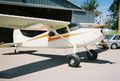
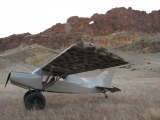
[imgwrap=right]https://www.backcountrypilot.org/i/screenshots/brlp.waterskiing.jpg[/imgwrap]A note about the aircraft: Loni flies a 160 HP PA-18 with extended gear, and Greg flies an experimental Maule with a whole bunch of trick parts he fabricated himself. The whole time I was watching, I was hoping for more information about his airplane, and low and behold, the extras have a short section of him describing his modifications.
I am eagerly awaiting Volume 2 of Big Rocks and Long Props. Greg alludes to the fact that the next installment will be shot with higher quality cameras, but that is not to say the cameras he used were poor quality. In fact, I was really impressed with the sharpness of the video and quality of the editing. But, I won't complain if the next one is even better.
While Big Rocks and Long Props is definitely a jaw dropper for pilots, I have to issue the same warning that I did with Idaho Exposed: Your non-pilot friends will either fall asleep or be fidgeting with restlessness while you force them to watch. I showed my entire family the video after Christmas Eve dinner, and actually all of the men, most of whom were not pilots, really stayed glued. The women however, quickly moved on to other things(like the dishes
 ...I'm gonna get slapped for that one.)
Big Rocks and Long Props runs 47 minutes plus extras, and can be purchased for $29.95 plus shipping from http://www.bigrockslongprops.com.


 Minor nit: they always seem to plow right thru the fishing hole.