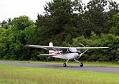
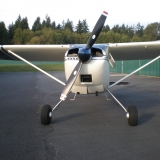
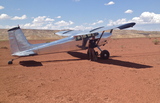
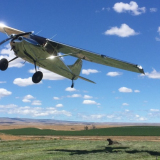
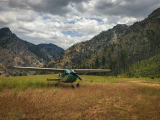
I have been dreaming since childhood of one day owning a 180. Long story short, I looked at a lot of planes over the span of about a year and a half. Along the way I tried to talk myself into other perfectly wonderful backcountry-capable airplanes (PA-18; PA-22; Maules M-4,5, and 7; Cessnas 170 and 182; etc.). However, the 180’s reputation as a sweet-flying load-hauler kept drawing me back. My wife grew tired of my talk and encouraged action: go find a 180! (I love that woman…) A good, clean, well-maintained 60-year old airplane is hard to find and I owe a great deal of gratitude to several BCP members who helped me ask the right questions and guided me through the pre-buy and purchase process. Finally, I found one that felt right even through the three photos posted online. Conversations with the owner and mechanic fortified my interest, and I jumped on an airliner to Oregon.
Pretty much love at first sight. This plane looked better in person than it did in the photos, which is a first in my experience, and the owner and I hit it off. He and I agreed on a price, and I fired off a deposit. Folks in the community helped me keep as level a head as possible under the circumstances and navigate the next steps in the purchase process.
A long month passed as I made arrangements to pay for the plane and undertake transition training. Finally, with everything in line, I bought a one-way ticket to Portland, optimistic that I wouldn't need the return leg and still not fully comprehending the fact that I was soon to be a Skywaggon owner.
With just 300 hours of time under my belt and essentially all of it in my family’s J-3, I was apprehensive of the training that lay ahead and amazed by my insurance company’s confidence in me. I fully expected a 15-25 hour dual requirement, but all they asked for was a CFI checkout. My instructor had over 7,500 hours of tailwheel time and had worked as a FAA Designated Pilot Examiner for years, so I was at least confident that my checkout would be thorough and by-the-book.
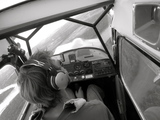
The different sight picture, blue knob, cowl flaps, red knob, starter, avionics, and flaps all came at me fast and mercilessly. To complicate things, the comm panel in the plane began to malfunction, necessitating a couple of visits to the mechanic to try and track down a devious electrical gremlin. The resolution of that is a story on its own.

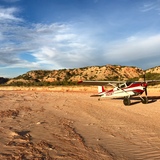
This narrow 1,400ft private grass strip would have made for an easy landing with the Cub, but I was still on the steep portion of the learning curve with the 180.
I really enjoyed flying through the Willamette Valley, though most of the time I was getting worked over by my patient instructor and forgiving plane. “More bounce per ounce,” he routinely consoled me after laps of the pattern at Corvallis, McMinnville, or Independence. Finally, though, on my third day of training things began to click. We flew the Columbia Gorge to Hood River, where my instructor is a volunteer pilot with the Western Antique Aircraft and Auto Museum. I made a decent landing on the grass at Hood River, and I could see my instructor looking over at me with an expression that seemed like a mix of pride and disbelief at not having to intervene to save man and machine.

Entering the Columbia River Gorge.
We toured the museum (incredible – if you haven’t been there, go!) and had lunch at the Twin Peaks Diner overlooking the airport.

The last remaining Stearman M-2 at the WAAAM. Just one of hundreds of immaculately maintained flying antique airplanes at the museum.
Returning to Independence, we climbed up and over the Cascades alongside a Mount Hood shrouded in clouds. I couldn’t believe the way the 180 went right to the point in the sky where I pointed it. To get to 10,500 in the Cub with two people aboard would require patience and ridge lift. Not so with an O-470 purring up front!

Mount Hood providing the scenery.
As we descended back into the Willamette Valley my instructor told me that if I could show him some consistency in my landings he would send me home on my own. As we approached Independence we saw it was a direct crosswind of about 8 knots. “Great,” I thought, but I surprised us both with another landing from which we not only walked away, but the plane was also reusable. My instructor hopped out. “You’ll want to save the money you’d pay me to fly home with you tomorrow for a new comm panel,” he said. “So shoot some landings and get comfortable.”
The next morning I returned my rental car in Salem and met my instructor and plane at the Salem Airport. I dropped him off in Independence, and headed east solo.
On crossing the Cascades I stayed above scattered cumulus until the tops of the clouds grew above my willingness to climb. Then, I descended into the bumps and jogged around storms and a fire TFR. I landed in Ontario, Oregon for fuel and got to chatting with the owner of the FBO, Tom Frazier. I asked for recommendations on forward routing, and we both began to review the weather. Walls of storms associated with a passing low covered southern Idaho. To the south, Nevada and Utah airports were reporting surface winds of 20-30 knots. Hmmm. Tom offered me a courtesy car and a motel recommendation, and I agreed that was the best plan. Already in the first leg of my trip home I’d flown farther than my longest cross country to date. He also offered me a place in his hangar to keep the 180 for the night nestled between his two Bushwheel-equipped Super Cubs. I declined that generous offer as the local forecast included just a little rain overnight and I hoped to get an early start the next morning.

Scattered thunder storms in Eastern Oregon.
Returning to the airport in the pre-dawn, I pre-flighted by headlamp. Sitting in the plane to escape the morning chill, I filed my flight plan and waited for daylight. After takeoff I headed east and climbed up and over the northern reaches of the Boise Class C. The mountains had gotten fresh snow, and Craters of the Moon was covered in fog. I felt like the luckiest person alive to be flying my plane through such an amazing scene.

Preparing for the next leg.

Idaho at daybreak.
The approach and landing into Kemmerer, Wyoming was uneventful, but after opening my door at the fuel pump I immediately made for the baggage compartment and pulled on all of my warm layers. The 10-knot wind sent needles of cold air through my jacket even so. Again full of fuel, I departed Kemmerer and enjoyed the tailwinds over southern Wyoming. Another couple of fire TFRs to consider along the CO/WY border, and a leisurely turn to the south put home on the nose. Thirty minutes out, I texted my wife and told her I’d be landing soon at the Boulder airport. She arrived as I finished topping the tanks and helped me push the plane into the hangar.

At the fuel pump in Boulder.
I wish I could have met up with members of the BCP community along the way, but time was not on my side this trip. But, with a 180 now at my disposal I am looking forward to many flying adventures and seeing you all in the Backcountry!