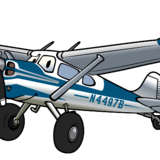
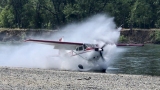
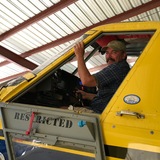
So Sunday morning when we lifted off to the SE, leaving one last curling trail of white playa dust behind us, we turned right crosswind, stayed very low and proceeded to KSVE for a little petrol. Our flight would take us directly over the Sierra Army Depot. I have flown over this massive weapons storage area and it’s associated Amadee Army Airfield, 10,000-foot long runway. From 37,000 in the cockpit of my Alaska Airlines 737, it looks like one of those military locations that I have no desire to ever visit, let alone be stationed at. But down at 500 feet, flying around the area was great. We passed well to the SE of Restricted-2530. Ahead and to the left were numerous rail lines, each terminating along the dozens of huge warehouses full of war materials. Directly ahead and to the right were hundreds of ammunition bunkers. We quickly climbed to 1,000’ AGL as we approached the complex. There was no reason to make them nervous. It was then we were surprised by something I never realized was at this facility. Acres and acres of tanks, artillery and trucks were parked below. Sierra Army Depot is home to one of TACOM’s, Tank-automotive and Armaments Command, units. The Command’s job is to manage the life cycle of these weapon systems. Much like the USAF’s boneyard at Davis-Monthan AFB, in Arizona, I suspect that Sierra is a resting place for weapons that are in long-term storage. Susanville is right on the eastern slopes of the Sierra’s, with a valley containing small farm fields, pine trees starting to appear amongst the sagebrush and a small friendly town. Traffic was light so we set up for a right base entry to runway 29. Just before turning base we realized the dirt runway would lead us directly to the fuel pumps! Plus, I wasn’t ready to have to start landing on pavement again. We pulled up to the FBO, as the lone attendant was finishing fueling a -180 that was also leaving the fly-in. Thank you to Susanville Aviation for their support of the fly-in and fuel discount they gave to all participants. If you are in the area, stop by grab some fuel, use the courtesy car or just socialize. While fueling, the attendant found out we were from Washington and told us about a great fishing lodge he flies into in British Colombia that has a huge grass strip and is less than 2 hours from the Puget Sound area. We grabbed a brochure; it looks like a great destination for those in the area. Check out tsuniahlakelodge.com.
With the tanks full, we took one last look at the weather and winds. We were forecasted to have strong winds aloft from the south! Initial long-range forecasts of winds up to 80kts and the turbulence that would be associated with it were still several hours away. We could expect 20-30 knots of tailwind and mostly smooth rides! We lifted off from runway 11, after admiring the beautiful Aercoupe that had been flying patterns. At 400 feet I turned left towards home and turned the airplane over to my “autopilot”, my brother. I slid my seat back, reclined my chair and relaxingly watched the world go by. Mike cruised climbed us to 8,500’ where we enjoyed a strong tailwind giving our little Cessna Businessliner-Lite a 136KTS GS! With a course set towards John Day, Oregon, navigation was easy as the 9,900 foot Eagle Peak of the South Warner Wilderness Area in NE CA would pass just off the right wing. A low saddle north of the peak allowed us to easily shift to the east side of the range and pass over Cedarville and up the dry lake beds to Fort Bidwell and the NV/OR/CA border. Back in the PNW! Hart Mountain was our next visual landmark 40 miles north. At the west base of this 8000’ mountain were dozens of manmade dams, securing the ever-vital water that flows off the mountains in the area each winter and spring. Many of the low berm dams were several miles across. As Burns, OR and the Ponderosa Ranch once again slid past, we were still carrying a very nice tailwind. It was obvious we didn’t need to land in John Day for fuel. So at John Day we once again intersected Hwy 395 and started following it north towards Pendleton, OR. The terrain had changed from the flat desert of the NV area back to the high plateau mountains of NE Oregon. The road below provided a safe landing spot in the event of unexpected problems. The tailwind had decreased slightly by now, but we still had clear skies, smooth air and 115KTS across the ground. Did I mention how well my “autopilot” was working? We weren’t sure if the tailwinds were going to continue with us, but as we neared PDT they started to pick up again, pushing us towards home at 120KTS. It quickly became evident that we had enough fuel plus reserves to go all the way home non-stop. This time we stayed up at altitude across the farm fields riding the southerly flow. We set up a descent into Othello, WA – S70. Topping off the tanks at Othello, just 20 miles from where I would drop my brother off at Fred Meise Int’l airport would give me all the gas I needed to get home over the Cascade Mountains plus several hours reserve if I needed to pick my way around weather or delay. Othello is a great easy in/out fuel stop, unfortunately, today the fuel pumps were out of order and no NOTAM had been posted. When I talked to the airport manager on Monday, he said that the day before our arrival, someone had smashed the Emergency Shut-off button, disabling power to the pumps. This was a great lesson for my brother, a newly minted private pilot. Always land with enough fuel to make it to another fuel stop if need be. I have again talked to the manager, they are awaiting parts, and yes, a NOTAM has now been issued. We still had 2 hours of gas to make it 8 minutes so we were good. Growing up flying with my Dad on the farm it was common practice to buzz the house. My Mom always hated when we did that. So my brother and I were both a little surprised when we received a text message from our mother asking us to fly by the house on the way to Fred’s. We looked at each other and laughed; simultaneously announcing that Mom wants us to buzz the house. Well we didn’t really buzz it, but we did give it a good crop-duster fly-by, waving at her down below on the back porch. I think she just wanted to see that her two boys were safely home and having fun. Love You Mom. Six miles later and we passed over the private waterski lake with water nearly the same color as Lake Tahoe and slipped the wheels onto Fred’s 20’ wide runway a half mile to the north. Before we left HSF, the good boys at Crop Jet Aviation in Gooding, ID gave my brother and I, two of their cropdusting company’s hats. George Parker, and his crew are friend’s of Fred and they couldn’t pass up the opportunity to rub it in, that Fred didn’t make it down. His excuse was he had to leave on Monday for Pennsylvania to pick up a C-185 he just bought. Needless to say, Fred busted out laughing when we climbed out of the airplane next to his fuel pumps wearing our new Crop Jet Aviation Swag! Fred, swears he will be at HSF 2017.

While I topped off the tanks, my brother unloaded his gear and told Fred to put the fuel on his account. I love the way the agricultural world works. Looking to the west, I could see the mid-level clouds coming into the Puget Sound area and Cascade Mtns. METARS and wx cameras showed I should have no problem completing the last 1.5 hours home. Airborne I reversed my first leg’s path back over the Colombia River and Wenatchee, followed the Wenatchee River past Leavenworth and proceeded along Hwy 2 up Stevens Pass. As I approached Leavenworth, there was a dark rain cloud just south over the Chiwawa River drainage.

It wasn’t very nice looking wx, but knowing the area and that my route we just to the north of that area I comfortably proceeded.
Five miles later as the rain slid past my left wing with only a few light drops displaying on my windscreen the skies brightened and I could easily see the remaining 60 miles to Snohomish.

The snowslide prone areas of the mountains are home to deciduous trees and bushes that were ablaze with color. They looked like a waterfall of orange and yellow.

The early snow at the top of Stevens Pass Ski Resort teased me with the fun of winter that would soon be upon us. I was fortunate to still have a slight tailwind on the westward leg so I again stayed high until just before S43, Harvey Field, slid below my nose. A high-speed descent onto the 45 entry, coordinated with the further out inbound traffic, followed by an aggressive slip and short landing had me shut down at my hanger in time to watch a nice landing flown by the classic taildragger behind me. I have been to Oshkosh, Sun-n-Fun, AOPA, and other fly-ins. The High Sierra Fly-In by far has been the most enjoyable, rewarding and resulted in the best new friendships from folks around the US. While most of the airplanes were sporting several of the more poplar backcountry mods; tires/vg’s/STOL cuffs etc, the lake is more than safe for anything from small business jets to the powered parachutes flying around each morning and evening. You don’t have to be a highly experienced backcountry or high DA pilot to safely fly there, but I guarantee you will leave with valuable experience and wonderful memories. Mark your calendars for Oct 2017! The exact dates aren’t set yet, but I will be there! Special thanks to Kevin Quinn, all the other volunteers that helped make this such a great event and the wonderful companies that sponsor it.
Jughead