How to prepare for reduced performance flying in mountains?
Mon Apr 28, 2025 8:42 am
How to prepare for reduced performance flying in mountains?
Mountain flying can really challenge aircraft performance. How do you plan ahead and adjust during flight to remain with your personal limits? Whether it’s a calculation, a technique you rely on, or a hard-earned lesson, I’m curious to hear how you tackle this.
Last edited by Class E on Mon Apr 28, 2025 10:37 am, edited 5 times in total.

Mon Apr 28, 2025 9:15 am
Re: How to prepare for reduced aircraft performance in mount
Well, experience certainly helps, no doubt.
That said, the biggest key is dedicating oneself to avoiding painting your aircraft into any corners that it may not be able to come out of. That applies to canyons, ridges and runways, universally.
But, in non mountainous terrain, you can practice minimum radius turns in your aircraft. Frankly, most pilots have no idea how small a radius they can safely turn their aircraft. Bomber patterns at airports demonstrate that daily. So, you need to get out there with your plane in open country, find some ground references, like roads, powerlines, lakeshores, or??? to help you "measure" your minimum radius turn. And, by the way, this doesn't have to be (and shouldn't be) done at low level. And, you need to practice turning to the point where altitude and airspeed do not vary in the turn. Yes, basic private pilot stuff.....which many of us couldn't pass today if we had to.
Now, you can find an uncontrolled runway, and practice landings and takeoffs. ALWAYS choose your touchdown spot, and do your best to land beyond but just barely, the "approach end" of that runway. If you can't hit your spot EVERY time within reason, stay out of the back country. You can use the side markers to estimate your distances, which helps if you have a passenger/CFI along. The point is to learn what YOUR landing and takeoff capabilities are in that airplane.
You can practice all this stuff on a hot day, and calculate the density altitude for those conditions. Comparing early, cool morning performance against late afternoon hot day performance will give you a little idea.
But, with the knowledge and skills to both turn and land/takeoff your airplane at decent proficiency, you are now better equipped to fly at higher density altitude. You know how long your landings are, so choose a runway with plenty of length. Then pay attention to how much of that runway you actually used.
Same with canyons: Go into a canyon that seems comfortable for your skills, and try it out. Then, mentally adjust accordingly.
Frankly, I suspect that most folks that go into the mountains really have no idea of the actual capabilities of their aircraft, because they've never actually spent much time practicing and evaluating PERFORMANCE data for their aircraft.
Oh, that was a smooooth landing--but did you touch down at your intended spot, and how much runway did you use in rollout? In my world, EVERY landing is a practice exercise....after all, we only get so many landings in a lifetime of flying.
So, to me, the keys are proficiency in your airplane, which you can establish as a baseline wherever you live. Then, when you do get into higher country, the differences should be obvious.
But, if you can't fly your airplane proficiently, it's best to spend some avgas changing that.
That said, the biggest key is dedicating oneself to avoiding painting your aircraft into any corners that it may not be able to come out of. That applies to canyons, ridges and runways, universally.
But, in non mountainous terrain, you can practice minimum radius turns in your aircraft. Frankly, most pilots have no idea how small a radius they can safely turn their aircraft. Bomber patterns at airports demonstrate that daily. So, you need to get out there with your plane in open country, find some ground references, like roads, powerlines, lakeshores, or??? to help you "measure" your minimum radius turn. And, by the way, this doesn't have to be (and shouldn't be) done at low level. And, you need to practice turning to the point where altitude and airspeed do not vary in the turn. Yes, basic private pilot stuff.....which many of us couldn't pass today if we had to.
Now, you can find an uncontrolled runway, and practice landings and takeoffs. ALWAYS choose your touchdown spot, and do your best to land beyond but just barely, the "approach end" of that runway. If you can't hit your spot EVERY time within reason, stay out of the back country. You can use the side markers to estimate your distances, which helps if you have a passenger/CFI along. The point is to learn what YOUR landing and takeoff capabilities are in that airplane.
You can practice all this stuff on a hot day, and calculate the density altitude for those conditions. Comparing early, cool morning performance against late afternoon hot day performance will give you a little idea.
But, with the knowledge and skills to both turn and land/takeoff your airplane at decent proficiency, you are now better equipped to fly at higher density altitude. You know how long your landings are, so choose a runway with plenty of length. Then pay attention to how much of that runway you actually used.
Same with canyons: Go into a canyon that seems comfortable for your skills, and try it out. Then, mentally adjust accordingly.
Frankly, I suspect that most folks that go into the mountains really have no idea of the actual capabilities of their aircraft, because they've never actually spent much time practicing and evaluating PERFORMANCE data for their aircraft.
Oh, that was a smooooth landing--but did you touch down at your intended spot, and how much runway did you use in rollout? In my world, EVERY landing is a practice exercise....after all, we only get so many landings in a lifetime of flying.
So, to me, the keys are proficiency in your airplane, which you can establish as a baseline wherever you live. Then, when you do get into higher country, the differences should be obvious.
But, if you can't fly your airplane proficiently, it's best to spend some avgas changing that.


Mon Apr 28, 2025 10:07 am
Re: How to prepare for reduced aircraft performance in mount
As usual, MTV with the sage advice. Something I'll add is always having a plan A-B-C-D-E. Regarding routing--sometimes the mountain pass you had planned to use is too windy or bumpy or covered in clouds, despite the forecast. Plan B might be another pass, Plan C might be taking the long way around (as in crossing into the next state) and plan D is going home. With an airplane, many things are possible if you're willing to plan ahead and take your time. Of course this also applies to everything else, like landing sites, refuel options, etc.

Mon Apr 28, 2025 10:20 am
Re: How to prepare for reduced performance flying in mountai
Thanks for the great tips. Great point about always having multiple plans ready.
When you're planning a trip in the mountains, aside from calculating performance from the book, which uses max gross as the worst case example at each altitude, how do you figure on stacking the odds in your favor? Omit fuel? Pax? Gear? How far under max gross to get the margin that's wide enough, especially in marginally powered airplanes?
A rule of thumb? Or just stick your nose in and try it?
When you're planning a trip in the mountains, aside from calculating performance from the book, which uses max gross as the worst case example at each altitude, how do you figure on stacking the odds in your favor? Omit fuel? Pax? Gear? How far under max gross to get the margin that's wide enough, especially in marginally powered airplanes?
A rule of thumb? Or just stick your nose in and try it?
Mon Apr 28, 2025 10:44 am
Re: How to prepare for reduced performance flying in mountai
Always be wind aware, even if your panel calculates winds, always be looking for signs on the ground and the sky, be visualizing where you’re going to get a boost and where you’re going to sink.
If you have 25kts of wind at the peaks or clouds close to the peaks, airmet etc, exercise caution
Fuel wise if there is nearby fuel or fuel at destination I plan to land with 1hr fuel, anything under is not wise, anything over is a performance loss, especially if you default to topping long range tanks.
Like MTV said go out and experiment with climb and turns in a controlled environment at different weights, one good one to play with, figure you’ll lose about 1” of MP for every 1,000 MSL
Another good one to play with, calculate your true airspeed on landing & apprch at any high altitude airports you are going to be landing at, shoot a approach back home at that speed, obviously your wing will preform better down low, but still a good visual to experience in practice before actual
You can also go to a nice big runway and practice taking off at simulated DA by changing the MP as mentioned above, pick plot out how long the strip you’d be landing at would be, nice safe way to first experience it
Also aggressive ground leaning for taxi
Also also remember you may need to do a full power static runup to get your mixture right talking off at high elevations, just the same going “full rich” for landing can be problematic up in the thin air
If you have 25kts of wind at the peaks or clouds close to the peaks, airmet etc, exercise caution
Fuel wise if there is nearby fuel or fuel at destination I plan to land with 1hr fuel, anything under is not wise, anything over is a performance loss, especially if you default to topping long range tanks.
Like MTV said go out and experiment with climb and turns in a controlled environment at different weights, one good one to play with, figure you’ll lose about 1” of MP for every 1,000 MSL
Another good one to play with, calculate your true airspeed on landing & apprch at any high altitude airports you are going to be landing at, shoot a approach back home at that speed, obviously your wing will preform better down low, but still a good visual to experience in practice before actual
You can also go to a nice big runway and practice taking off at simulated DA by changing the MP as mentioned above, pick plot out how long the strip you’d be landing at would be, nice safe way to first experience it
Also aggressive ground leaning for taxi
Also also remember you may need to do a full power static runup to get your mixture right talking off at high elevations, just the same going “full rich” for landing can be problematic up in the thin air
- NineThreeKilo offline
- Retired
- Posts: 1678
- Joined: Thu Dec 31, 2009 8:16 pm
- Location: _
Mon Apr 28, 2025 11:47 am
Re: How to prepare for reduced performance flying in mountai
Load up your plane to max gross, on a hot day, then go out and see how much less the performance is, obviously at a place with long enough runway. Run it at full power, then limit your manifold pressure a couple inches and try again, repeat that until you are down 20". It won't simulate the lack of lift, but will simulate the lack of engine power.
The first day I bought my 180 the instructor said we were going to simulate high DA, we were already at about 5000msl. He said "you have all the controls except the throttle. I think he gave me about 18"mp, we cleared the end of the runway at about 20'.
I think I saw in my Owners manual something to the effect of, use enough power for the situation, not every take off needs full power.
The first day I bought my 180 the instructor said we were going to simulate high DA, we were already at about 5000msl. He said "you have all the controls except the throttle. I think he gave me about 18"mp, we cleared the end of the runway at about 20'.
I think I saw in my Owners manual something to the effect of, use enough power for the situation, not every take off needs full power.
- StillLearning offline

- Posts: 463
- Joined: Mon Nov 05, 2018 6:22 pm
- Location: Salmon
- Aircraft: Cessna 180 Skywagon 1953
Mon Apr 28, 2025 4:09 pm
Re: How to prepare for reduced performance flying in mountai
All really good points, the ones that have affected me are not remembering to lean for best power when taking off from high altitude.
Then you need to adjust what your seeing when landing or taking off, your groundspeed may need to be quite a bit faster than what you are used to so visual clues will be wonky.
Then you need to adjust what your seeing when landing or taking off, your groundspeed may need to be quite a bit faster than what you are used to so visual clues will be wonky.
Tue Apr 29, 2025 8:27 pm
Re: How to prepare for reduced performance flying in mountai
NineThreeKilo wrote:Always be wind aware, even if your panel calculates winds, always be looking for signs on the ground and the sky, be visualizing where you’re going to get a boost and where you’re going to sink.
If you have 25kts of wind at the peaks or clouds close to the peaks, airmet etc, exercise caution
Fuel wise if there is nearby fuel or fuel at destination I plan to land with 1hr fuel, anything under is not wise, anything over is a performance loss, especially if you default to topping long range tanks.
Like MTV said go out and experiment with climb and turns in a controlled environment at different weights, one good one to play with, figure you’ll lose about 1” of MP for every 1,000 MSL
Another good one to play with, calculate your true airspeed on landing & apprch at any high altitude airports you are going to be landing at, shoot a approach back home at that speed, obviously your wing will preform better down low, but still a good visual to experience in practice before actual
You can also go to a nice big runway and practice taking off at simulated DA by changing the MP as mentioned above, pick plot out how long the strip you’d be landing at would be, nice safe way to first experience it
Also aggressive ground leaning for taxi
Also also remember you may need to do a full power static runup to get your mixture right talking off at high elevations, just the same going “full rich” for landing can be problematic up in the thin air
Good advice, except please DO NOT do full power runups on ANYTHING but clean pavement.....ever. I've seen several props destroyed by power run ups on gravel/grass.
Wed Apr 30, 2025 4:52 pm
Re: How to prepare for reduced performance flying in mountai
StillLearning +1: I'm located in Denver area, I take Husky and fill it with sand bags and full fuel for a gross weight. Then go out on hot days with DAs of 10K and practice at 3-4K AGL= slow flight & turns, stalls and short spot landings. That performance basically becomes my "worst case performance" default. I am not any kind of instructor and this exercise, which is probably wrong is not intended as actual advise; just what I do.
- flyingjack offline
- Posts: 348
- Joined: Thu May 19, 2016 8:21 am
- Location: Erie
- Aircraft: Husky/T206H
Thu May 01, 2025 10:47 am
Re: How to prepare for reduced performance flying in mountai
flyingjack wrote:StillLearning +1: I'm located in Denver area, I take Husky and fill it with sand bags and full fuel for a gross weight. Then go out on hot days with DAs of 10K and practice at 3-4K AGL= slow flight & turns, stalls and short spot landings. That performance basically becomes my "worst case performance" default. I am not any kind of instructor and this exercise, which is probably wrong is not intended as actual advise; just what I do.
Sounds like great advice to me, Jack!
Sat May 03, 2025 12:39 pm
Re: How to prepare for reduced performance flying in mountai
Interesting thread. Reading the responses I found myself trying to compare my experiences with the thread topic and if I have anything to contribute to the discussion. I can’t due to where I fly. The air is always thick, don’t have to deal with high altitude density. Most of my winter flying the altitude density is well below sea level. Summer time hardly ever see 70 degrees. The only thing I’d like to add to the discussion is what I focus on when flying through the mountains is wind speed and direction. Finding the altitude wherein I’m not exposed to wind rolling down a mountain side or wind pushing me into the mountain side. That and flying at a right angle to valleys aligned with the wind.
Sat May 03, 2025 3:59 pm
Re: How to prepare for reduced performance flying in mountai
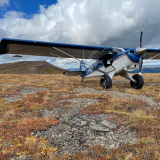
Is that Lake Clark Pass?
- Belloypilot offline
- Posts: 121
- Joined: Thu Dec 24, 2015 10:45 pm
- Location: Grande Prairie
- Aircraft: Husky A-1B, Bonanza V35B, AcroSport II
Sat May 03, 2025 5:25 pm
Re: How to prepare for reduced performance flying in mountai
You live in a beautiful place, Mark. Nice pics.
Sun May 04, 2025 6:51 pm
Re: How to prepare for reduced performance flying in mountai
Yup Lake Clark Pass. I’ve flown it at 50 feet when the wind is really howling the down length of the valley. Don’t have pictures of that…Sometimes it’s to chitty through the pass and go over the top.
-
- Mount Redoubt
Mon May 12, 2025 8:41 am
Re: How to prepare for reduced performance flying in mountai
Appreciate all the insights! It's really helpful to read through how all of you approach performance and decision-making in the mountains. Lots of useful takeaways here. Thanks for taking the time to share.
Mon May 12, 2025 11:50 am
Re: How to prepare for reduced performance flying in mountai
This isn’t a particularly new concept, but it’s a useful analogy for pilots who may not be familiar with how terrain influences wind and turbulence:
Visualize the air moving over mountains the same way water flows over rocks, it behaves in much the same way. Know the wind direction, then ask yourself: where would eddies form? Where would there be waves or rolling air? Where might the wind speed up or slow down? Increased caution is warranted when wind speeds at ridge level exceed 20-25 knots.
One of the biggest concerns (especially for lower-performance aircraft) is the potential for downdrafts, which can result not only from wind flowing over terrain but also from thermal differences caused by sun and shadow.
Visualize the air moving over mountains the same way water flows over rocks, it behaves in much the same way. Know the wind direction, then ask yourself: where would eddies form? Where would there be waves or rolling air? Where might the wind speed up or slow down? Increased caution is warranted when wind speeds at ridge level exceed 20-25 knots.
One of the biggest concerns (especially for lower-performance aircraft) is the potential for downdrafts, which can result not only from wind flowing over terrain but also from thermal differences caused by sun and shadow.
DISPLAY OPTIONS
Who is online
Users browsing this forum: No registered users and 11 guests
Latest Features
-
-
Featured Bush Planes
As one of the undisputed legends of bush flying, the Cessna 180 hauls a…Read More -
Aircraft Ownership and Maintenance
9 modification mistakes aircraft owners make when trying to "bush out" their birds—why some…Read More -
Live to Tell
A Minnesota pilot is surprised to learn that the sudden asymmetric drag of an…Read More




Latest Knowledge Base
-
Destinations
Canada offers some of the most spectacular backcountry flying on the continent. Here's what you need to know before you go.Read More -
Safety and Survival
Hope that you never have to use your survival vest but knowing you have it and knowing how to use…Read More -
Destinations
A regional guide with ideas for winter camping destinations in California, Nevada, New Mexico, and Arizona.Read More -
Aircraft
Finding an affordable aircraft that can handle the backcountry for $80K or less? A challenge for sure, but with the…Read More



