Fri Aug 07, 2015 10:53 am
You’ve got to crawl before you can walk. Even if you have that thousand-pound useful, sub 800 foot airplane, it’s going to be many, many, many…many hours before you can utilize it for that.
I’ve got a big engine Cessna 170 with a STOL kit which is just about perfect for the backcountry flying my wife and I do, and I’m really glad it wasn’t my first airplane.
There are lots of right ways do do things and I guess everyone’s partial to the way they did it, but a new pilot is going to be doing a WHOLE lot of front-country flying before they start doing any backcountry flying.
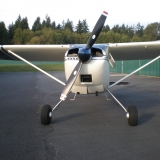
I’ve never wanted to fly anywhere but in the backcountry. I live at high density altitude and have to cross the Sierra Nevada Mountains to get anywhere worth going, so naturally my first airplane was a… Cessna 140? This was not my first choice for a two-person backcountry airplane, but finances and circumstances conspired to make it the best choice I had at the time. I didn’t know it then, but starting off in an underpowered, short-legged airplane was the absolute BEST thing I could have ever done.
Underpowered airplanes teach you what the air is doing. You can’t just pull back on the yoke or add more throttle… hell, a lot of the time you can’t even turn on course until you figure out where the air is rising so you can gain some altitude. You have to use the air, and to use it you have to understand it. Getting that education in the relatively open spaces of the front-country is a very good idea. Taking off and discovering that you can only climb 100 feet without orographic lift is best done with some maneuvering space.
There are lots of pilots, including high-time pilots, who never really figured out how air moves over and around the land just like water in a river moving over and around boulders. They never had to, until they went into the backcountry where the effect is greater, the margins are tighter, and the stakes are higher. It doesn’t work out too well for some of them. Successful piloting is about knowledge, decision making, experience, and skill, not about hardware. There’s no amount of aircraft performance that will make it possible for an underprepared pilot to successfully fly the backcountry, and if a pilot doesn’t have a keen understanding of how air moves, they are underprepared.
Flying across Sierra’s and then across the Great Basin in a 182 requires little more than making sure the tanks are full and picking an altitude. The same flight in a C140 with 22 gallons of fuel, negligible climb performance, and a zero-wind cruise speed around 100mph requires real planning and commitment. It’s a hell of a lot more fun, too.
The endless pattern work, private pilot flight maneuvers, and the ham-fistedness of new pilots is flat out hard on an engine. Smaller engines generate a lot less heat and tolerate the abuse of a new pilot and the training environment better than larger engines. They also typically have cheaper parts.
Small airplanes burn less fuel, hold less oil, and have lower insurance rates and thus cost much less per hour than larger planes. When you start out you’re trying to build hours of experience, not put miles behind you. Why drone around the pattern burning 10gph when you can do it at 4gph? If and when you do step up to a larger plane you’re doing more cross country flying than pattern work and your insurance premiums are lower because you have some hours under your belt.
Buy the right plane and you won’t lose money. We paid $30K for an expertly restored 1948 Cessna 140 in premium condition and sporting a Lycoming engine, and we kept it in premium condition. I learned to fly a tail wheel in it, and my wife earned her private pilot license in it. After we put 630 tac-hours and four sets of tires on her (lots and lots of touch n goes in those hours) we sold it, for $30K. During our ownership we also went through 25 oil filters, 173 quarts of oil, 12 air filters, 8 spark plugs, 4 brake pads, one cylinder overhaul, one starter overhaul, one generator overhaul and approximately 3,300 gallons of fuel. Add all that up and it’s not cheap, but it’s a hell of a lot cheaper than it would have been with a thousand-pound-useful-and-sub-800-foot airplane.
And while we were limited to mostly front-country airstrips, we had more fun in that plane than any two people deserve. We made dozens of trips from our base in California to Idaho, Wyoming, Oregon, Nevada, Utah, and Arizona. There’s a lot of decision making flying cross country in a little plane like that, and it all adds up. There were also some decisions we didn’t have to make: I was never tempted to try out strips that were above my head because “well, I sure as hell have enough airplane”. That’s a trap a lot of people fall into. If there’s anything more humiliating than cracking up an airplane, it’s cracking up a STOL airplane on a non-STOL strip. Huskies at Johnson Creek come to mind…
And finally, little airplanes are just flat out fun! I’ve got a friend with more money than some small countries. He’s got multiple hangars full of airplanes, including several of the most desirable backcountry STOL planes ever built. But if you ask him what’s the last plane he’d ever part with he replies without hesitation “my Cessna 120”. It’s the first airplane he ever owned and the last one he’ll ever part with.
Again, there’s a lot of right ways to do things, but starting off in a small, anemic airplane was the single best thing I ever did for my flying education.