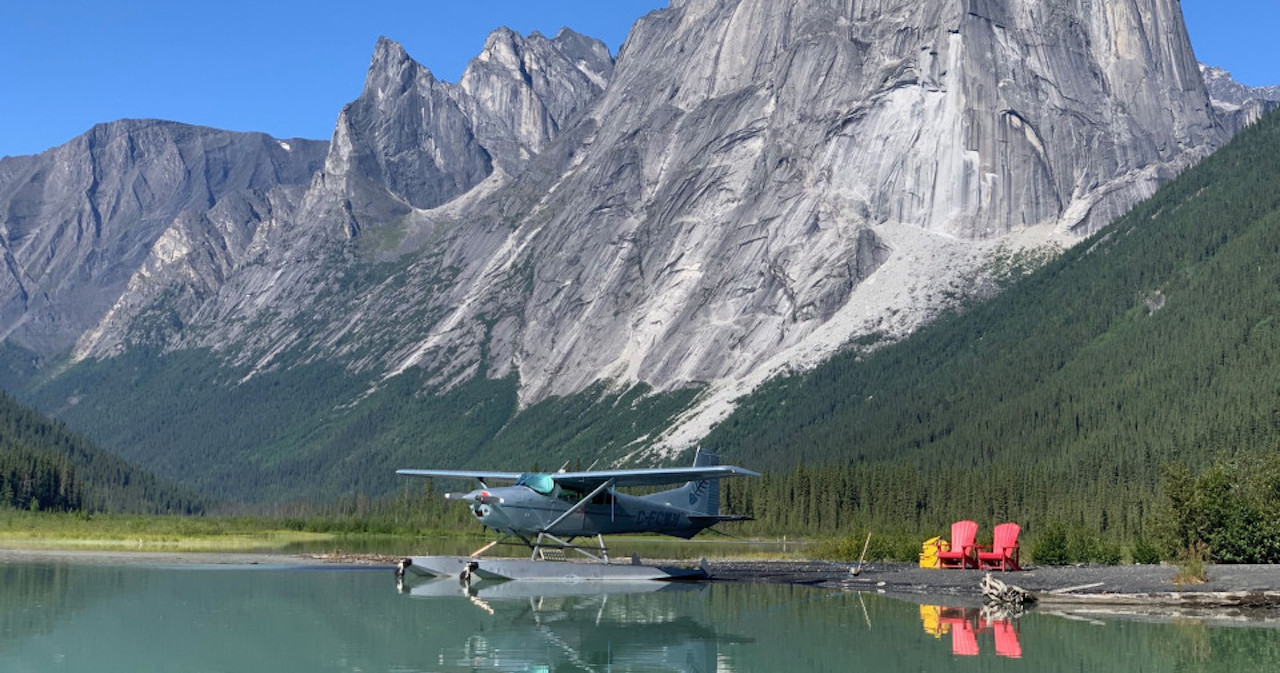
I haven't gotten into any real backcountry flying yet, but a bunch af grass strips. All of them have been in areas that are open on one or both sides to fly a pattern for landing. Most of my flight are just for fun and practice, and I usually end all trips with three to five t&g's. I almost always pull back to idle on keypoint and try to glide in to land as close to the threshold as possible. For the sake of margin, I try and be a little to high and never to low. So sometimes I have to pull full flaps or slip to get down in time. A lot of the time I balloon over where I want to set it down. Naturally, if I ever glide so far down the runway that I'm the slightest uncertaint about stopping in time, I go around.
I practice this, because my reasoning is that it's honing a skill I will need if my engine die. So if it ever dies on me, I am as prepared for an emergency landing as possible. Or just in general depend on as few things as possible, that could break or stop, when I am on final.
The thing is, if I allow myself to come in a little low and I use the engine actively, I land with much more precision! I don't like it one bit, since I know that if the engines gives in at this point, my options are very few. Rotax jokes aside, I don't have any reason to think the flailing Austrian in the nose will give up on me. He's kept in good health. I just think it might be better practice to do it the safe way and not depend on the engine, rather than depending on the engine and set my self up for a bad scenario the day something happens.
I have talked to local instructors who have experience with backcountry flying about this, but I was wondering what you guys think about this?
Idle at keypoint, or come in hanging by the prop?
Mon Sep 11, 2023 5:49 am
Mon Sep 11, 2023 7:52 am
Re: Idle at keypoint, or come in hanging by the prop?
“ I just think it might be better practice to do it the safe way and not depend on the engine”
Sometimes the “safe way” for landing in the backcountry requires engine use for precision on the touchdown.
Sometimes the “safe way” for landing in the backcountry requires engine use for precision on the touchdown.
Mon Sep 11, 2023 9:26 am
Re: Idle at keypoint, or come in hanging by the prop?
The idea is to achieve an angle of attack that allows you the slowest forward movement over the ground, and that can be accomplished via two main techniques:
1. Higher, steeper more level pitch attitude approach
2. Lower, shallower more positive pitch attitude approach with more power.
They end up the same as far as the wing is concerned, both require attentive power usage, but one is safer and more effective with better visibility and recoverability should the engine hiccup or other factors require necessitate even more power.
Have you read the STOL Tips series here? https://backcountrypilot.org/stol-tips
1. Higher, steeper more level pitch attitude approach
2. Lower, shallower more positive pitch attitude approach with more power.
They end up the same as far as the wing is concerned, both require attentive power usage, but one is safer and more effective with better visibility and recoverability should the engine hiccup or other factors require necessitate even more power.
Have you read the STOL Tips series here? https://backcountrypilot.org/stol-tips

Mon Sep 11, 2023 10:10 am
Re: Idle at keypoint, or come in hanging by the prop?
If you didn't rely on the engine it would be pretty hard to leave the ground in the first place.
Sure, if the engine quits it's very important to have a sharp skillset on flying power off.
Most of the time the engine doesn't quit though, and the reason I operate backcountry capable planes is to get in and out of short places. So it's also very important to have sharp skills for flying power on.
My partner just solod in a 172 last week. Her patterns are a bit bigger than I typically fly. At this point, that might be safer as it gives her some more time to get things configured and hit her numbers. To be clear, we're not talking B52 big, and definitely over ground where she's got options if the engine quits(more important than pattern size IMO). As her skills develop and she explores the airplane's envelope, I expect those patterns might shrink. Safety is sometimes relative.
So - do I practice power on or power off approaches? Yes.
Sure, if the engine quits it's very important to have a sharp skillset on flying power off.
Most of the time the engine doesn't quit though, and the reason I operate backcountry capable planes is to get in and out of short places. So it's also very important to have sharp skills for flying power on.
My partner just solod in a 172 last week. Her patterns are a bit bigger than I typically fly. At this point, that might be safer as it gives her some more time to get things configured and hit her numbers. To be clear, we're not talking B52 big, and definitely over ground where she's got options if the engine quits(more important than pattern size IMO). As her skills develop and she explores the airplane's envelope, I expect those patterns might shrink. Safety is sometimes relative.
So - do I practice power on or power off approaches? Yes.
- DreadPirateWill offline

- Posts: 129
- Joined: Wed Dec 06, 2017 10:40 am
- Location: Spokane
Mon Sep 11, 2023 10:33 am
Re: Idle at keypoint, or come in hanging by the prop?
Zzz wrote:…
I had forgotten about that series! Thanks! I thought using altitude for energy management and not the engine, was the safer option. The risk of using the engine probably isn`t very high, if you are low and slow enough. But that sounds like something that requires a level of experience and skill in a way that a controlled final doesn`t.
Squash wrote:Sometimes the “safe way” for landing in the backcountry requires engine use for precision on the touchdown.
I don`t doubt it, but I can`t think of one. Could you elaborate?
DreadPirateWill wrote:If you didn't rely on the engine it would be pretty hard to leave the ground in the first place.
I didn`t mean that there was no place for shallow finals using the engine. But my thinking is to rely as little as possible on things that can go wrong in the critical phases. Same reason for getitng up to a certain altitude after take off. But as I said, and you point out, the engine usually work fine.
I am not saying or suggesting that people should never do anything but the sensible thing. I don`t have the experience to pass judgement on others. People can take their own calculated risks if they feel confident in making a good calculation. I don`t, so I ask to learn from you

Mon Sep 11, 2023 11:02 am
Re: Idle at keypoint, or come in hanging by the prop?
Varanger wrote:Zzz wrote:…DreadPirateWill wrote:If you didn't rely on the engine it would be pretty hard to leave the ground in the first place.
I didn`t mean that there was no place for shallow finals using the engine. But my thinking is to rely as little as possible on things that can go wrong in the critical phases. Same reason for getitng up to a certain altitude after take off. But as I said, and you point out, the engine usually work fine.
I am not saying or suggesting that people should never do anything but the sensible thing. I don`t have the experience to pass judgement on others. People can take their own calculated risks if they feel confident in making a good calculation. I don`t, so I ask to learn from you
My apologies, forgot the sarcasm tags on that line. I'm not really in a spot to pass much judgment myself.
I guess one of my sticking points is the fixation on engine out. Of course we all need skills for flying power off in case the engine quits. And they need to be fresh so response is nearly automatic, especially if you like to fly low and slow. But - there's a lot that can go wrong in an airplane, and a lot of it doesn't relate to engine out. Bottom line - the answer I usually arrive at for more safety is more practice in all phases/configurations of flight.
- DreadPirateWill offline
- Posts: 129
- Joined: Wed Dec 06, 2017 10:40 am
- Location: Spokane
Mon Sep 11, 2023 11:21 am
Re: Idle at keypoint, or come in hanging by the prop?
First let me state that while I firmly believe in 'training' for the worst case scenarios, I almost never 'fly' for the worst case scenarios. The day I fly my airplane in fear of what-if's is the day the fun is no longer on the top of the reasons I fly. and that would be a deal breaker for me.
Next I feel it important to point out, as Zzz has alluded to, energy management is just that. It is not engine management. And that is the reason I elect to hang my hat on the energy management camp. Unfortunately, flying like that takes far more seat time than most young 'up and comers' want to invest, and the smarter the individual, the more that is exasperated. You simply can't build skill or talent by reading how to's. Learn to manage the energy, the wing doesn't care where it came from, it just wants you to have some to keep making lift.
I personally use my engine for 99.9% of all powered aircraft landings. It is easier to make magical things happen (yes that means I am lazy) and it is kinder on the engine. Engines of any sort, turbine, recip, diesel, gas, NA, boosted, it just plain doesn't matter, they all like steady controlled heat exchanges, and they all have a finite amount of times they're going to tolerate going from hot to cold or vice versa. Some may be more tolerant, some go as far as to have 'cycle' limits, but none will do it forever, worried about it's reliability? be kind to it, in this case going from cruise heat to descent at idle, is not kind.
Next I feel it important to point out, as Zzz has alluded to, energy management is just that. It is not engine management. And that is the reason I elect to hang my hat on the energy management camp. Unfortunately, flying like that takes far more seat time than most young 'up and comers' want to invest, and the smarter the individual, the more that is exasperated. You simply can't build skill or talent by reading how to's. Learn to manage the energy, the wing doesn't care where it came from, it just wants you to have some to keep making lift.
I personally use my engine for 99.9% of all powered aircraft landings. It is easier to make magical things happen (yes that means I am lazy) and it is kinder on the engine. Engines of any sort, turbine, recip, diesel, gas, NA, boosted, it just plain doesn't matter, they all like steady controlled heat exchanges, and they all have a finite amount of times they're going to tolerate going from hot to cold or vice versa. Some may be more tolerant, some go as far as to have 'cycle' limits, but none will do it forever, worried about it's reliability? be kind to it, in this case going from cruise heat to descent at idle, is not kind.
Last edited by Rob on Mon Sep 11, 2023 11:22 am, edited 1 time in total.
Mon Sep 11, 2023 11:21 am
Re: Idle at keypoint, or come in hanging by the prop?
Having said all that, here is what an old Commercial Glider PTS has to say... and if you are already getting it shut down in 100' with or without an engine, I say kudos to you, you're probably golden and far ahead of this thread;
Q. TASK: LANDINGS - NORMAL AND CROSSWIND LANDING
NOTE: If a crosswind condition does not exist, the applicant's knowledge of
crosswind elements shall be evaluated through oral testing. REFERENCES: FAA-H-8083-13; Glider Flight Manual. Objective. To determine that the applicant:
1. Exhibits knowledge of the elements related to a
normal and crosswind approach and landing procedures.
2. Adjusts flaps, spoilers, or dive brakes, as appropriate.
3. Maintains recommended approach airspeed, ±5 knots.
4. Maintains crosswind correction and directional control throughout the
approach and landing.
5. Makes smooth, timely, and positive control application during the
roundout and touchdown.
6. Touches down smoothly within the designated landing area, with no
appreciable drift, and with the longitudinal axis aligned with the desired landing path, stopping short of and within 100 feet of a designated point.
NOTE: The applicant shall touchdown and roll to a point designated by the examiner stopping within 100’ without rolling past the designated point. The point should be far enough away from the touchdown point that is should not require more than light-medium braking to come to a stop within the required distance.
7. Maintains control during the after-landing roll.
8. Completes appropriate checklists.
FAA-S-8081-23
Take care, Rob
Q. TASK: LANDINGS - NORMAL AND CROSSWIND LANDING
NOTE: If a crosswind condition does not exist, the applicant's knowledge of
crosswind elements shall be evaluated through oral testing. REFERENCES: FAA-H-8083-13; Glider Flight Manual. Objective. To determine that the applicant:
1. Exhibits knowledge of the elements related to a
normal and crosswind approach and landing procedures.
2. Adjusts flaps, spoilers, or dive brakes, as appropriate.
3. Maintains recommended approach airspeed, ±5 knots.
4. Maintains crosswind correction and directional control throughout the
approach and landing.
5. Makes smooth, timely, and positive control application during the
roundout and touchdown.
6. Touches down smoothly within the designated landing area, with no
appreciable drift, and with the longitudinal axis aligned with the desired landing path, stopping short of and within 100 feet of a designated point.
NOTE: The applicant shall touchdown and roll to a point designated by the examiner stopping within 100’ without rolling past the designated point. The point should be far enough away from the touchdown point that is should not require more than light-medium braking to come to a stop within the required distance.
7. Maintains control during the after-landing roll.
8. Completes appropriate checklists.
FAA-S-8081-23
Take care, Rob
Mon Sep 11, 2023 11:28 am
Re: Idle at keypoint, or come in hanging by the prop?
The reason I posted the above is because in modern history, without research or stretching my brain cells to thin, I can think of two airline scenarios with failed engines and well over 100 pax on board. In both of those cases every passenger survived. One boeing, one scarebus, the common thread? Both captained by high time glider pilots. Like your reason for the OP, their engine(s) quit, and I'd say the Hudson is pretty 'backcountry' in an A320 
Take care, Rob
Take care, Rob
Mon Sep 11, 2023 11:32 am
Re: Idle at keypoint, or come in hanging by the prop?
Patrick's near level attitude approach get you slow enough to sink enough that the need for power will bring the throttle into dynamic play. The throttle, when neither open nor closed, is the absolute best control for exact glide angle and rate of descent management. If the engine quits, you are high enough to pitch down a bit to lengthen the glide to the landing zone.
Also, using the apparent rate of closure Wolfgang talks about at the top of page 304 in Stick and Rudder, and with a dynamic throttle, you can adjust (with pitch for speed and power for glide angle) exactly where you will touchdown. It is like using the apparent rate of closure with the stop sign at an intersection when driving. It will not be comfortable for you at first. You are not going to stop, not going to stall. Coming into ground effect where Vso no longer has any meaning, the touchdown spot is going under the cowl and you are using a new spot a bit further down (not the end of the runway.) You might get with a STOL guy or crop duster on this, but it works at any glide angle that will actually make the field.
Concerning getting up quickly so as to be at a safe altitude if the engine quits, three second startle at Vx or Vy is generally fatal. Also, why have we given up thousands of feet of free level in low ground effect acceleration energy. Something to think about. Too many fatal stalls that hit available but unused runway.
There are lots of guys and gals here that can help you with the low altitude orientation and technique that will help you manage the backcountry safely. Have fun but remember what my Dad always said, "When a lot of the boys are having fun, look around. Something is going to happen."
I see Rob got in here ahead of me. He is the crop duster to go to for really good energy management information. Or find someone like him to fly with. He makes a zillion dollars an hour spreading poison, so may not have the time.
Also, using the apparent rate of closure Wolfgang talks about at the top of page 304 in Stick and Rudder, and with a dynamic throttle, you can adjust (with pitch for speed and power for glide angle) exactly where you will touchdown. It is like using the apparent rate of closure with the stop sign at an intersection when driving. It will not be comfortable for you at first. You are not going to stop, not going to stall. Coming into ground effect where Vso no longer has any meaning, the touchdown spot is going under the cowl and you are using a new spot a bit further down (not the end of the runway.) You might get with a STOL guy or crop duster on this, but it works at any glide angle that will actually make the field.
Concerning getting up quickly so as to be at a safe altitude if the engine quits, three second startle at Vx or Vy is generally fatal. Also, why have we given up thousands of feet of free level in low ground effect acceleration energy. Something to think about. Too many fatal stalls that hit available but unused runway.
There are lots of guys and gals here that can help you with the low altitude orientation and technique that will help you manage the backcountry safely. Have fun but remember what my Dad always said, "When a lot of the boys are having fun, look around. Something is going to happen."
I see Rob got in here ahead of me. He is the crop duster to go to for really good energy management information. Or find someone like him to fly with. He makes a zillion dollars an hour spreading poison, so may not have the time.
- contactflying offline
- Posts: 4972
- Joined: Wed Apr 03, 2013 7:36 pm
- Location: Aurora, Missouri 2H2
Download my free "https://tinyurl.com/Safe-Maneuvering" e-book.
Mon Sep 11, 2023 11:39 am
Re: Idle at keypoint, or come in hanging by the prop?
We have Rain/Fog/TFR starting soon so I have some time to pontificate.
The best thing I ever did for STOL operations was to go to Chandler AZ and get 5 hours of Spin/Stall/Aerobatic stall. You can burn all the fuel you want doing touch and gos but until you are comfortable going past and recovering from the edge you will most likely always be landing to fast or without proper control!! You don't know what you don't know and doing bad habits at practice only makes it worse.
The more skills you have the better your chances of not breaking something. So being capable of both the inferior power off landing and the superior power on landing is important (did that sound bias?) My preferred landing is a steep power on approach it is simple once you learn how. Don't confuse it with a low dragging it in approach. A sharp dive approach can be used to punch through turbulence at treetop but now you have to clean it up and get rid of all that speed so it is landing area dependent. Low cloud deck or sever turbulence above 30 ft means you may have to drag it in with power, I prefer not to do that but training to get a site picture of the touchdown spot is important because you won't see it over the nose. Throw in some training landing with a tailwind if you fly enough it will happen either by mistake or on purpose, not a big deal if you are ready for it.
All CFI's teach the power off approach because you have to do it for the check ride!! However pulling power to idle and true engine failure are to different things (go try it at altitude) Your pattern should always be small enough to make the runway if the power quits it is pretty simple. While we are on the topic what about the one hour flight over national forest with NO good landing area or runway you just flew over? How come you trusted the motor for that but not the last mile? Training to make a power off landing on the numbers at your home strip every landing is fine but it is not going to help that big sinker at a strange strip pushing you into the brush. Reality is your going to want some excess energy until you know you will have a decent place to crash then think about maybe even flying the plane another day. In the engine failure drill did the CFI talk about landing on midfield/taxi way/open parking ramp?
One of the best ways to cause a carb ice is to pull power and make a steep approach quickly cooling the exhaust that is supplying carb heat. Keeping power on also makes the carb heat more effective, the engine is ready for a small burst to help with the flare or a power go around. A steep approach can be done with power on 1200-1400 rpm with Flaps/Slips/nose high attitude. The key is to get the plane slowed down before short final. Attitude for speed, power for altitude. Where and how you start your final glide is important, that comes with training once you have the basics mastered.
Now we come to the major reason people have issues off field. They tried to land at a site without the proper skill level!! You really have to look hard at where you want to land and all the factors for that day at the that strip including your skill level. Some days due to conditions it may be unwise to land a any given strip, go home have a beer live to fly another day. Just things to ponder.
DENNY
The best thing I ever did for STOL operations was to go to Chandler AZ and get 5 hours of Spin/Stall/Aerobatic stall. You can burn all the fuel you want doing touch and gos but until you are comfortable going past and recovering from the edge you will most likely always be landing to fast or without proper control!! You don't know what you don't know and doing bad habits at practice only makes it worse.
The more skills you have the better your chances of not breaking something. So being capable of both the inferior power off landing and the superior power on landing is important (did that sound bias?) My preferred landing is a steep power on approach it is simple once you learn how. Don't confuse it with a low dragging it in approach. A sharp dive approach can be used to punch through turbulence at treetop but now you have to clean it up and get rid of all that speed so it is landing area dependent. Low cloud deck or sever turbulence above 30 ft means you may have to drag it in with power, I prefer not to do that but training to get a site picture of the touchdown spot is important because you won't see it over the nose. Throw in some training landing with a tailwind if you fly enough it will happen either by mistake or on purpose, not a big deal if you are ready for it.
All CFI's teach the power off approach because you have to do it for the check ride!! However pulling power to idle and true engine failure are to different things (go try it at altitude) Your pattern should always be small enough to make the runway if the power quits it is pretty simple. While we are on the topic what about the one hour flight over national forest with NO good landing area or runway you just flew over? How come you trusted the motor for that but not the last mile? Training to make a power off landing on the numbers at your home strip every landing is fine but it is not going to help that big sinker at a strange strip pushing you into the brush. Reality is your going to want some excess energy until you know you will have a decent place to crash then think about maybe even flying the plane another day. In the engine failure drill did the CFI talk about landing on midfield/taxi way/open parking ramp?
One of the best ways to cause a carb ice is to pull power and make a steep approach quickly cooling the exhaust that is supplying carb heat. Keeping power on also makes the carb heat more effective, the engine is ready for a small burst to help with the flare or a power go around. A steep approach can be done with power on 1200-1400 rpm with Flaps/Slips/nose high attitude. The key is to get the plane slowed down before short final. Attitude for speed, power for altitude. Where and how you start your final glide is important, that comes with training once you have the basics mastered.
Now we come to the major reason people have issues off field. They tried to land at a site without the proper skill level!! You really have to look hard at where you want to land and all the factors for that day at the that strip including your skill level. Some days due to conditions it may be unwise to land a any given strip, go home have a beer live to fly another day. Just things to ponder.
DENNY
DENNY
Mon Sep 11, 2023 12:18 pm
Re: Idle at keypoint, or come in hanging by the prop?
DreadPirateWill wrote:My apologies, forgot the sarcasm tags on that line.
No worries. I thought I had said something that made it sound along the lines of «I am doing smart. Why you do dumb?»
Rob wrote:
contactflying wrote:
DENNY wrote:
It was pretty much as I thought, I am somewhere in the first squiggles of the Dunning Kruger curve.
You all make excellent points! Lots of advice and tips and take aways. I have played around with flying behind the power curve at altitude, haven`t really crossed my mind that it could be a good tool. The problem I have with power off landings is that I «have» to be a little high/fast for it to be a true and safe power off. So wheels on the ground early is difficult. Playing with shallower power on landings can be more fun and mich more precise, but as a low time pilot it feels like I am being naughty. I should have come to the natural conclusion that there is a third way.
Gotta look into taking classes in the US as an EU citizen with an LSA license that is only valid in Norway, and other EASA countries on application. If there`s an instructor in the left seat I suppose there shouldn`t be a problem. Would have been a dream vacation.
Mon Sep 11, 2023 12:44 pm
Re: Idle at keypoint, or come in hanging by the prop?
Low timer here with mainly backcountry flying time. Personally I can’t imagine not using a bit of power with a positive AOA whenever possible to hit a precise landing spot. And when coming in over those cold water rivers on short final you can normally expect a bit of sink so power is your friend. Sure practice the power off stuff, but good luck finding much of a good choice in true backcountry areas/terrain. Best best is the river as opposed to rocks and trees.
Mon Sep 11, 2023 1:27 pm
Re: Idle at keypoint, or come in hanging by the prop?
Backcountry flying knowledge and skills are developed to deal with variability that is not encountered in environments that are highly groomed for aircraft operations. When preparing for the variability that will be encountered, it is best to have more than one tool sharpened up.
The backcountry approach environment will almost always present you with situations that cannot be handled with one technique that has been perfected at your home base.
Considering this, mastery of both the steep power at idle scrub energy through aircraft control and the drag and drop approach techniques is better than dependence on one. The real world exists between and up to the limits of either. My recommendation is to alternate between the two when you practice.
Rob's advice about taking care of your engine by limiting extreme changes in power settings is also on point.
The backcountry approach environment will almost always present you with situations that cannot be handled with one technique that has been perfected at your home base.
Considering this, mastery of both the steep power at idle scrub energy through aircraft control and the drag and drop approach techniques is better than dependence on one. The real world exists between and up to the limits of either. My recommendation is to alternate between the two when you practice.
Rob's advice about taking care of your engine by limiting extreme changes in power settings is also on point.
- Scolopax offline
- Posts: 1718
- Joined: Tue Sep 27, 2005 5:02 pm
- Location: Nottingham
- FindMeSpot URL: http://share.findmespot.com/shared/face ... 4aYqSexnZC
Mon Sep 11, 2023 2:04 pm
Re: Idle at keypoint, or come in hanging by the prop?
Having given it more thought, I think I am mainly in a steep decent (500fpm type) with a few degrees of positive AOA and just use a bit of power to keep my aimpoint in the spot on the windscreen. I typically need a burst of power to arrest the decent rate in lieu of a typical airport flare.
Mon Sep 11, 2023 2:19 pm
Re: Idle at keypoint, or come in hanging by the prop?
Unexpected gusts of an extreme nature are to be expected. especially near rivers or deep ravines. I have been caught numerous times by them in the mountains.
- Moss farmer offline
- Posts: 101
- Joined: Wed Feb 05, 2014 5:44 pm
- Location: Enumclaw
- Aircraft: Cessna 1963 Cessna 182f
Mon Sep 11, 2023 3:20 pm
Re: Idle at keypoint, or come in hanging by the prop?
Like Moss Farmer says, you are probably going to have to use your throttle as a dynamic control anyway. Why not just slow down with full flaps and pitch attitude enough to sink enough to bring it into play as the only accurate glide angle and rate of descent control you have. Round out and hold off causes us to become a passenger until deceleration in ground effect. Why can't the PIC decelerate before the desired touchdown spot? When engines, and especially carburetors, were less reliable, experienced pilots got it down on the spot without power and without round out and hold off. Again, listen to Wolfgang, "The 'stall-down' landing requires that you blend the approach glide, the flare-out, and the slowing up of the airplane all into one maneuver so that, when you arrive at ground level, you arrive in three-point attitude, all slowed up and ready to squat." Stick and Rudder page 302. It takes incredible skill, and ignorance of total energy management, to close the throttle and hit the numbers every time. My zero time Ag students, however, could show up on Sunday, solo on Wednesday, and arrive three times at ground level in a three point attitude all slowed up and ready to squat. They were using elevator, on short final, to keep the rate of closure from speeding up past what appeared to be a brisk walk and they were using throttle dynamically to maintain exact glide angle and stabilized rate of descent. They also were using dynamic proactive rudder, walking the rudder pedals, to dynamically yaw lock the centerline between their legs. The nose cannot come off target, the start of ground loop, if we nail the target actively with rudder. The wing cannot bank if we continuously yaw lock the target. Part of that slow flight and stall practice is to teach us that aileron is not a primary control when as slow as we should be on short final. It has a secondary only function to stabilize bank to prevent drift. We cannot hold the centerline between our legs with aileron. In a crab we direct our butt to the target with rudder only, and keep the wing level at the same time. Backcountry strips and spray strips and roads and levees are narrow.
- contactflying offline
- Posts: 4972
- Joined: Wed Apr 03, 2013 7:36 pm
- Location: Aurora, Missouri 2H2
Download my free "https://tinyurl.com/Safe-Maneuvering" e-book.
Tue Sep 12, 2023 6:42 am
Re: Idle at keypoint, or come in hanging by the prop?
Given the safety comparison of hanging on the prop on takeoff to hanging on the prop (power/pitch approach) on short final landing, I choose the later. Hanging on the prop on takeoff, even at Vy, is rapidly making the stall/fall more fatal. Hanging on the prop on short final is rapidly entering ground effect where Vso is no longer relevant. There is a lot of fear of stall in the landing phase, but compare fatalities to the takeoff phase. We takeoff too slow and land too fast. Statistical data says that is problematic on both ends. Backcountry demands better pilot technique than that, on both ends. Normal operations accept the loss on takeoff and worry a lot about stall on landing to the extent of causing plenty of LOC fatalities with excess airspeed. The two really dangerous speeds in aviation are too little on takeoff and too much on landing.
- contactflying offline
- Posts: 4972
- Joined: Wed Apr 03, 2013 7:36 pm
- Location: Aurora, Missouri 2H2
Download my free "https://tinyurl.com/Safe-Maneuvering" e-book.
Tue Sep 12, 2023 6:58 am
Re: Idle at keypoint, or come in hanging by the prop?
contactflying wrote:Given the safety comparison of hanging on the prop on takeoff to hanging on the prop (power/pitch approach) on short final landing, I choose the later. Hanging on the prop on takeoff, even at Vy, is rapidly making the stall/fall more fatal. Hanging on the prop on short final is rapidly entering ground effect where Vso is no longer relevant. There is a lot of fear of stall in the landing phase, but compare fatalities to the takeoff phase. We takeoff too slow and land too fast. Statistical data says that is problematic on both ends. Backcountry demands better pilot technique than that, on both ends. Normal operations accept the loss on takeoff and worry a lot about stall on landing to the extent of causing plenty of LOC fatalities with excess airspeed. The two really dangerous speeds in aviation are too little on takeoff and too much on landing.
Nailed it
<need a like button>
Tue Sep 12, 2023 8:35 am
Re: Idle at keypoint, or come in hanging by the prop?
contactflying wrote:Given the safety comparison of hanging on the prop on takeoff to hanging on the prop (power/pitch approach) on short final landing, I choose the later. Hanging on the prop on takeoff, even at Vy, is rapidly making the stall/fall more fatal. Hanging on the prop on short final is rapidly entering ground effect where Vso is no longer relevant. There is a lot of fear of stall in the landing phase, but compare fatalities to the takeoff phase. We takeoff too slow and land too fast. Statistical data says that is problematic on both ends. Backcountry demands better pilot technique than that, on both ends. Normal operations accept the loss on takeoff and worry a lot about stall on landing to the extent of causing plenty of LOC fatalities with excess airspeed. The two really dangerous speeds in aviation are too little on takeoff and too much on landing.
I cringe when watching pilots perform Vx climbs to hundreds of feet agl. It is a clear demonstration of poor energy management.
Personally, I like to separate the takeoff and initial climb phase. Getting the plane off of the ground, onto the wing and into low ground effect as soon as it will do so is the takeoff phase. On rough, soft, variable, gravelly or debris strewn surfaces, you are minimizing potential damage by spending as little time as possible on the ground during the takeoff roll.
Once on the wing, lower the nose and build some zoom reserve in low ground effect and then climb to maximize flight energy and engine cooling.
I have never put myself in a position where I needed to perform a Vx climb to clear an obstacle. That necessity would trigger a "no go" for me.
In my opinion, the FAA does pilots a disservice in teaching this as a good technique.
- Scolopax offline
- Posts: 1718
- Joined: Tue Sep 27, 2005 5:02 pm
- Location: Nottingham
- FindMeSpot URL: http://share.findmespot.com/shared/face ... 4aYqSexnZC
DISPLAY OPTIONS
Who is online
Users browsing this forum: No registered users and 3 guests
Latest Features
-
-
Featured Bush Planes
As one of the undisputed legends of bush flying, the Cessna 180 hauls a…Read More -
Aircraft Ownership and Maintenance
9 modification mistakes aircraft owners make when trying to "bush out" their birds—why some…Read More -
Live to Tell
A Minnesota pilot is surprised to learn that the sudden asymmetric drag of an…Read More


Latest Knowledge Base
-
Destinations
Canada offers some of the most spectacular backcountry flying on the continent. Here's what you need to know before you go.Read More -
Safety and Survival
Hope that you never have to use your survival vest but knowing you have it and knowing how to use…Read More -
Destinations
A regional guide with ideas for winter camping destinations in California, Nevada, New Mexico, and Arizona.Read More -
Aircraft
Finding an affordable aircraft that can handle the backcountry for $80K or less? A challenge for sure, but with the…Read More