I am about to install a JPI FS 450 fuel flow meter, and while my mechanic was checking out the engine to get all the right fittings he remarked that I have the mechanical fuel pump and need to buy the fuel pump transducer instead of the gravity fed one.
Prior to purchase, I called JPI and asked specifically what model of the JPI FS450 fuel flow meter I should buy for my 170B with Avcon 0-360 A1A conversion. They said that I should get the gravity fed transducer one.
Before I call JPI and try to exchange the transducer, I wanted to check with you guys to see what have you done.
JPI Fuel flow meters on AVCON 180hp
Wed Jan 30, 2013 12:07 pm
Wed Jan 30, 2013 12:47 pm
Re: JPI Fuel flow meters on AVCON 180hp
I have the old "BUSH" conversion with a Delair exhaust conversion.
The Bush conversion ends up with both a mechanical and an electrical boost pump that had to
"come along" with the engine.
I had the JPI-800 something with all the bells and whistles.
Still only able manually to use the EGT and fuel flow functions.
Do not fly often enough to remember all the other stuff.
Also getting too old to learn all that digital shit, but do like and use the EGT and fuel flow.
Do not remember being asked about gravity or force fed Xtucer.
Will ask my Mechanic-AI in the next few days if ya wish.
Best to ya
Chris C
The Bush conversion ends up with both a mechanical and an electrical boost pump that had to
"come along" with the engine.
I had the JPI-800 something with all the bells and whistles.
Still only able manually to use the EGT and fuel flow functions.
Do not fly often enough to remember all the other stuff.
Also getting too old to learn all that digital shit, but do like and use the EGT and fuel flow.
Do not remember being asked about gravity or force fed Xtucer.
Will ask my Mechanic-AI in the next few days if ya wish.
Best to ya
Chris C
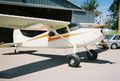
53 C-170-B+
It is better to be late in this world, than early in the next.
It is better to be late in this world, than early in the next.
Wed Jan 30, 2013 12:55 pm
Re: JPI Fuel flow meters on AVCON 180hp
Sounds like you have the same setup I do - mechanical and electric boost pump.
I'm just surprised at the discrepancy between what the JPI tech told me and what my IA is telling me.
If you could let me know that would be great.
I'm just surprised at the discrepancy between what the JPI tech told me and what my IA is telling me.
If you could let me know that would be great.
Wed Jan 30, 2013 1:24 pm
Re: JPI Fuel flow meters on AVCON 180hp
I used the gravity one mainly because it has a larger opening and if any of my fuel pumps quit, the bigger opening will deliver more fuel using gravity alone to keep me flying... IMHO.

Ben Haas
www.haaspowerair.com
www.haaspowerair.com
Wed Jan 30, 2013 3:26 pm
Re: JPI Fuel flow meters on AVCON 180hp
I have one as well, but not sure which transducer....it was installed a LONG time ago.
Just call JPI, ask for Ottis (that's spelled right, by the way) and tell him you have an O-360 with a mechanical fuel pump and electric backup, mounted in a high wing airplane.
He'll get you the straight story.
I'm kinda inclined to recall that I used the gravity flow model as well, but not absolutely certain.
MTV
Just call JPI, ask for Ottis (that's spelled right, by the way) and tell him you have an O-360 with a mechanical fuel pump and electric backup, mounted in a high wing airplane.
He'll get you the straight story.
I'm kinda inclined to recall that I used the gravity flow model as well, but not absolutely certain.
MTV


Wed Jan 30, 2013 3:37 pm
Re: JPI Fuel flow meters on AVCON 180hp
Cool, thanks for all the replies.
Called JPI and the answer was easy - the gravity flow is for all installations and the pressure is specific for pressure systems.
They said the gravity will work fine.
Called JPI and the answer was easy - the gravity flow is for all installations and the pressure is specific for pressure systems.
They said the gravity will work fine.
Thu Jan 31, 2013 4:55 pm
Re: JPI Fuel flow meters on AVCON 180hp
Anyone ever heard of one of these Avcon (or any Lyc 180) conversions in 172/170/175 that do not use the fuel pumps? It would sure be nice to just use the gravity feed system (that the plane was designed for) and get rid of the pumps. 2 less things to leak or fail and less weight. I think that is also why you can't get the cargas STC on these planes. Why cant they be set up like a 180/182? Just increase the fuel line size to the same as the 180.
- westerncolorado offline
- Posts: 11
- Joined: Tue Jun 22, 2010 1:04 pm
- Location: Glenwood Springs
Thu Jan 31, 2013 7:35 pm
Re: JPI Fuel flow meters on AVCON 180hp
westerncolorado wrote:Anyone ever heard of one of these Avcon (or any Lyc 180) conversions in 172/170/175 that do not use the fuel pumps? It would sure be nice to just use the gravity feed system (that the plane was designed for) and get rid of the pumps. 2 less things to leak or fail and less weight. I think that is also why you can't get the cargas STC on these planes. Why cant they be set up like a 180/182? Just increase the fuel line size to the same as the 180.
Any liquid will gain .43 psi for every 1 foot of drop..... A average high wing plane has the fuel tanks roughly 2/12 foot above the carb.. In level flight that 1.075 psi ( might) be adaquate for 150 hp.. MAYBE..
 ..
..Get a higher HP motor, in a nose high attitute like a steep take off and a gravity system will not be able to deliver enough fuel to make decent power
 ..... IMHO..
Ben Haas
www.haaspowerair.com
www.haaspowerair.com
Thu Jan 31, 2013 7:53 pm
Re: JPI Fuel flow meters on AVCON 180hp
Have a 1961 Cessna 175 since 1977 and installed the Avcon conversion 0-360 in 1979 and the electric fuel pump "came along" with the installation. Always turned it on, (you could hear it clicking) for take off and turned it off after that. Well, left the cold of Kansas and am out in the desert of California for the winter at sea level and the electric fuel pump now decides to not turn on. Been watching the fuel pressure gauge and although it always reads about the low red line, .5 lbs I think, and below the high red line, 8 lbs I think, some take offs it reads way below the green and some take offs it reads way OVER the green - near the high red line of 8 lbs. It always stabilizes after 15 to 30 minutes of flight into the green area. So what's up with that?

Pat
Pat
Thu Jan 31, 2013 8:28 pm
Re: JPI Fuel flow meters on AVCON 180hp
The 175 with 180 lyc works fine without fuel pump, fuel flow is nearly identical to GO300 175 hp. Haven't checked to see if the 172 fuel lines are the same, betting they are. The Avcon conversion requires the fuel pump so your stuck.
- bush master offline
- Posts: 108
- Joined: Wed Feb 04, 2009 8:15 pm
- Location: Hay Springs, ne
Fri Feb 01, 2013 8:34 am
Re: JPI Fuel flow meters on AVCON 180hp
I know of several AVCON converted airplanes in northern AK that were field approved to remove the electric fuel pump. To do so, however, either on the 170 or 172, required the removal and replacement of the section of fuel line that runs from the fuel selector forward to the gascolator with a larger diameter line. That line, in original configuration, cannot provide sufficient fuel flow to meet the certification requirements without being boosted by a fuel pump.
I can't recal whether they removed BOTH fuel pumps (mechanical and electric), but I believe they did in these conversions. They went to a pure gravity feed system.
The fellow who was field approving these offered to write me up a FA, but I never saw all that much benefit to doing so, so never took him up on it.
The ELECTRIC fuel pump in these installations is purely a BACK UP to the mechanical fuel pump. The only reason you would ever actually USE the electric pump is in the event that the mechanical pump failed....a rare instance.
The reason you're admonished to energize the electric pump for takeoff and landing is that if, while close to the ground, the mechanical pump were to fail, you won't have very long to energize that electric pump and get fuel moving again. Frankly, with these setups, I doubt the engine would flat quit if the pump failed, but it probably woulnd't make full power, so especially on a challenging takeoff, that could be ugly. So, we energize the electric pump prior to takeoff and any time operating close to the ground. You shouldn't notice any change in fuel pressure, and for intents and purposes, you wont' know whether the electric pump is running or not, at least in flight.
MTV
I can't recal whether they removed BOTH fuel pumps (mechanical and electric), but I believe they did in these conversions. They went to a pure gravity feed system.
The fellow who was field approving these offered to write me up a FA, but I never saw all that much benefit to doing so, so never took him up on it.
The ELECTRIC fuel pump in these installations is purely a BACK UP to the mechanical fuel pump. The only reason you would ever actually USE the electric pump is in the event that the mechanical pump failed....a rare instance.
The reason you're admonished to energize the electric pump for takeoff and landing is that if, while close to the ground, the mechanical pump were to fail, you won't have very long to energize that electric pump and get fuel moving again. Frankly, with these setups, I doubt the engine would flat quit if the pump failed, but it probably woulnd't make full power, so especially on a challenging takeoff, that could be ugly. So, we energize the electric pump prior to takeoff and any time operating close to the ground. You shouldn't notice any change in fuel pressure, and for intents and purposes, you wont' know whether the electric pump is running or not, at least in flight.
MTV
DISPLAY OPTIONS
Who is online
Users browsing this forum: No registered users and 0 guests
Latest Features
-
Live to Tell
A Minnesota pilot is surprised to learn that the sudden asymmetric drag of an out-of-rig ski can…Read More -
Creators
Working in some of the Yukon's most beautiful and remote environments, photographer Simon Blakesley captures aircraft in…Read More -
Aircraft Ownership and Maintenance
Upgrading to big tires can make a huge difference in backcountry performance, but with those gains come…Read More -
Tales from Yesteryear
In this tale from bush flying yesteryear, Don Cogger signs up to help Atlee Dodge Jr recovery…Read More


Latest Knowledge Base
-
Destinations
A regional guide with ideas for winter camping destinations in California, Nevada, New Mexico, and Arizona.Read More -
Aircraft
Finding an affordable aircraft that can handle the backcountry for $80K or less? A challenge for sure, but with the…Read More -
Aircraft
01.29.2018 - Zane - Updated tire diameter graphic to add 8.50x10 Guide to tires for use in the backcountry and off-airport landing…Read More -
Pilots
12.22.2013 - Initial article format Operating aircraft on skis and negotiating a snow-covered landscape is an entirely unique skillset and environment.…Read More


