Apparently, nobody read the criteria that ravi spelled out in his original post. Did anybody notice the Density Altitudes he mentioned?????
A Cessna 150??? Good grief!
I worked at this sort of mission for over 30 years. At one point, we ran a comparison and evaluation test of several of the aircraft mentioned here.
We compared a Maule M-7 235, a Husky model A-1, a Scout, and a Super Cub. We wound up with two Scouts in the fleet, seven Husky model A-1B's in the fleet, and six Super Cubs in the fleet. The Maule got excessed.
Here are some thoughts on your proposed missions:
1. Hand held FLIR is going to be iffy in any of these aircraft, due to stabilization issues. I doubt if you'll be able to do much with it, but perhaps.
2. Night vision will work, but you'll want Gen III goggles=around $10 K per pop. Bear in mind the aircraft also has to be modified to be compatible with NV as well. This isn't terribly expensive, but it adds up.
3. The observation mission at high DA is a demanding one. True speeds are high, which equates to a high work load on the pilot. Find a plane that has absolutely the best FLYING characteristics, and the BEST performance characteristics.
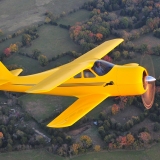
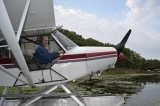
If it was me, it would be an A-1B Husky. The airplane far outperforms all the others described in the high DA environement. It has phenomenal range, and superb climb capability, even at very high DA's.
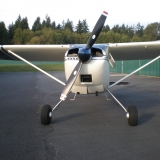
The Scout is a great airplane, but as the man said, they are sorta trucklike in handling, and they do not perform all that well at high DA. Scouts have a relatively high stall speed, and the stall characteristics, while not ugly, aren't the most friendly, either.
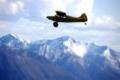
The Super Cub is a great airplane, but again, at high DA, you won't have the performance in climb to work it as well. This would be my number two choice, preferably with a 180 hp engine for the high DA environment.
The Maule would work as well, but for the little difference in price, I'd stick with the 235 engine Maules. The 180 is not going to have enough zoot to do what you are talking about, in my opinion. You are not concerned about range as much, so the bigger engine burns more gas--that may be a cost issue, but....performance is a HUGE deal in low level observation work.
The Border Patrol doesnt' have any Huskys. They got rid of theirs back in 1989, due to a couple accidents and the fact that they were transitioning to helicopters.
By the way, you do realize that you can acquire "free" helicopters from the military and operate them as Public Aircraft, right??? OH-58 and OH-6 aircraft are readily available surplus. They'll take some money to get them useable for your work, though.
Don't think too small--there's a lot of grant monies around for this kind of work nowadays. Some of these pots of money may be drying up, but there's a lot of money around for drug interdiction/homeland security.
The Husky is a fantastic performing airplane in this environment. It would (and was) my first choice of an airplane for these missions. It requires that the pilot learn to fly it (something the Border Patrol found out the hard way), but it is honest, fast, and powerful.
Finally, even if you operate on a shoestring, get some flight time in with someone who does this kind of work for a living, and get some flight time with someone like Rich Stowell, so you know something more about low speed/high angle of attack performance.
Also, remember that whatever you acquire is going to be used as a work airplane, not a recreational toy. It needs to have dispatch reliability, and offer a safe and solid work platform for your missions.
I get really nervous when I hear of agencies using "volunteers" to fly missions for them. This can be done well, as the State of Montana does it, by providing training and flight training and certification, mind you, but there's no way I'm getting in a plane with a private pilot and going out to fly a low level mission.
Send me a PM if you want more info on our comparison trials.
MTV
 .
.