MAF Wheel Landing Technique
Mon Jun 09, 2008 8:03 pm
wheelies
I prefer wheel landings on pavement without runway length concerns>Every afternoon it seems to be 5kts gust to 20 and very variable around here. In the dirt I prefer 3 points............Tail low wheelies work good for me also.Each landing is different with wind, terrain,lenght ect.......Full flaps always, unless the wind sock is going in circles and I don't really want to land that bad the first try.The lost art of the go around......If you have enough fuel why not keep trying until its good?.I have had plenty of "this is the one" while flying jumpers in the 185 with 1.1 loads of fuel on board.It's almost funny what you can pull out your a$$ when you are on fumes and nobody on board to land with you (Almost)

vail
Mon Jun 09, 2008 9:00 pm
I've always felt the decision which is best depended on a whole bunch of factors. A very important factor is type of airplane. I owned a 170 for about 17 years before I bought my present 180. I almost always 3 pointed the 170 mostly because it just seemed to want to and it felt right. The 180, I almost always wheel land. My 180 will fly quite nicely in the 3 point attitude which results in almost no braking at initial touch down. It just kind of skitters along. I used to fly freight in DC-3s and they tell me if you try to 3 point one of those, you'll only do it once. I can't say because the company I flew for forbid the use of 3 point in their airplanes.
Wayne
Wayne
Tue Jun 10, 2008 1:33 pm
1SeventyZ wrote:I approached, rolled out level, kind of started to flare like a 3-point, but just gently set the mains on and relaxed the yoke forward a tad. The tail was definitely lower than what I would consider a "normal" wheel landing prior to leveling the pitch attitude right after touching mains down. It felt great though.
You've just described my 180 technique perfectly! I'm not really thinking about the attitude much, but about the feeling of almost, but not quite, arresting the sink, whether it happens at the end of the flare, or after flying level for a second or two to slow down a little more. Of course, perfect airspeed control on final makes it a lot easier.
Sometimes I am slow enough that I do hit three point without really trying, but I just relax the yoke a little and pick the tail back up. At any rate, the last time I tried a "standard" wheel landing, pasting it on at nearly the final approach speed, it went rather badly! I won't do THAT again!

Perhaps the only difference between the 170 and my (somewhat heavy) 180 is that I almost always carry a couple hundred RPM above idle power until I feel the mains touch, as long as I am not trying to land as short as possible. It just makes it easier to feel for the runway if your speed is not bleeding off quite so fast.
Usually I will three point it in the dirt, not necessarily because of runway length but because of the uneveness of the surface and less certain braking effectiveness. I want to touch as slow as possible and slow to taxi speed sooner.
Rocky

Tue Jun 10, 2008 2:57 pm
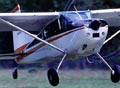
To benefit most from the tail low wheel landing technique, carry just a touch of power right to the touch. Two advantages:
1. This slight bit of power allows the airplane to fly at a slower speed. Remember, power on stall speed is slower than power off, sometimes substantially.
2. By minutely adjusting the power you're carrying into the flare, you can easily adjust your touchdown point, and control it very precisely. Get the tail down, slowed down, and when you are at your point, close the throttle, touch, push. Done, and VERY slow arrival.
I almost always wheel land my 170. Other than the Super Cub, the 170 is probably the easiest airplane to wheel land I've ever met.
MTV
1. This slight bit of power allows the airplane to fly at a slower speed. Remember, power on stall speed is slower than power off, sometimes substantially.
2. By minutely adjusting the power you're carrying into the flare, you can easily adjust your touchdown point, and control it very precisely. Get the tail down, slowed down, and when you are at your point, close the throttle, touch, push. Done, and VERY slow arrival.
I almost always wheel land my 170. Other than the Super Cub, the 170 is probably the easiest airplane to wheel land I've ever met.
MTV


Tue Jul 29, 2008 10:14 pm
Great discussion you have going here! I almost always used wheel landings with the 170, even on short strips. ( Mine is 1800 feet). It there is any wind at all it will cancel most of the "extra runway" requirement, and if the wind is gusty it's much easier to control. Yes, you can 3 point it pretty short when the wind is calm or steady down the runway. Zane mentioned that he thought he had the tail too low, but that's just one of the variables that you can throw into the landing to reduce speed when the wind is good. The trick with a cessna is to let the tail up (or push the control fwd, depending how you are trimmed) immediately that you feel the wheels touch. If you delay, the spring gear will bounce you back up. A cub doesn't have this problem as bad which is why many thing they are easier to wheel land.
The other thing is flaps. When you get to the place that you can do a wheel landing with 40 degrees of flap, and the tail low, it doesn't take much runway. But start with 20 degrees. You don't have much time with full flap.
The other benefit is the brakes. If you are on grass and need brakes - which is often on a 'dragger, a wheel landing gives the wheels much better traction. In a 3 point, the wings are carrying significant weight until you slow down. Happy flying!
The other thing is flaps. When you get to the place that you can do a wheel landing with 40 degrees of flap, and the tail low, it doesn't take much runway. But start with 20 degrees. You don't have much time with full flap.
The other benefit is the brakes. If you are on grass and need brakes - which is often on a 'dragger, a wheel landing gives the wheels much better traction. In a 3 point, the wings are carrying significant weight until you slow down. Happy flying!
Airspeed, Altitude, Brains. You need 2 of the 3!
The Oldtech
The Oldtech
Wed Jul 30, 2008 1:37 pm
"enough speed to bring the tail up when the brakes are stomped on and put max weight on the mains. Plus it just looks cool to see an airplane moving slowly, and balancing on the mains. " Quote 1Seventy.
Don't ya love Hangar Flying?
When I was a kid working my way though college as a line boy, back in the mid/late 60s....I often observed the finest demonstration of handling a taildragger imaginable.
Tony Hulman(Who owned the Indianapolis 500 racetrack) had a beautiful, polished, silver Twin Beech. The aircraft was a museum piece, which only flew about 100 hours each year.
His pilot had flown the airplane since it was manufactured new in the late 40s or early 50's. Anyhow....when Lloyd would land the Beech he would apply a bit of braking, carry a bit of power...keeping the tail in the air. He would countinue this way, with the tail up, as he cleared the runway and taxied to his hanger. When he taxied up on the hangar ramp.....he would swing the tail around, still up in the air.....add more power and braking....bring the airplane to a complete stop.... then slowly reduce power and gently lower the tail to the ground!!
I thought that it was the coolest thing that I had ever seen and couldn't wait to try it one day. A couple years later I got my first real flying job, patrolling pipelines in a Citabria. Pretty soon I had Lloyds technique down. I could land, taxi and park with the tailwheel in the air....just like Lloyd.
Then one day, while showing off to my wife....I let go of the stick to wave at her. Huh??? Dumb.... right? My boss bought a new prop for the Citabria that very day.
No....he wasn't mad. He was a dog lover. I told him that a stray ran across in front of me and I stomped on the brakes causing the nose over. A pioneer aviator.... from the silk scarf and leather helmet days....I doubt that I fooled him. But he never complained. I stopped taxing with the tail up ever after.
Bob
p.s. I see Hulman's old Twin Beech at OSH KOSH sometimes. Don't know who owns it now. It still has the original N# painted in the old style under the wings... N 500.
Don't ya love Hangar Flying?
When I was a kid working my way though college as a line boy, back in the mid/late 60s....I often observed the finest demonstration of handling a taildragger imaginable.
Tony Hulman(Who owned the Indianapolis 500 racetrack) had a beautiful, polished, silver Twin Beech. The aircraft was a museum piece, which only flew about 100 hours each year.
His pilot had flown the airplane since it was manufactured new in the late 40s or early 50's. Anyhow....when Lloyd would land the Beech he would apply a bit of braking, carry a bit of power...keeping the tail in the air. He would countinue this way, with the tail up, as he cleared the runway and taxied to his hanger. When he taxied up on the hangar ramp.....he would swing the tail around, still up in the air.....add more power and braking....bring the airplane to a complete stop.... then slowly reduce power and gently lower the tail to the ground!!
I thought that it was the coolest thing that I had ever seen and couldn't wait to try it one day. A couple years later I got my first real flying job, patrolling pipelines in a Citabria. Pretty soon I had Lloyds technique down. I could land, taxi and park with the tailwheel in the air....just like Lloyd.
Then one day, while showing off to my wife....I let go of the stick to wave at her. Huh??? Dumb.... right? My boss bought a new prop for the Citabria that very day.
No....he wasn't mad. He was a dog lover. I told him that a stray ran across in front of me and I stomped on the brakes causing the nose over. A pioneer aviator.... from the silk scarf and leather helmet days....I doubt that I fooled him. But he never complained. I stopped taxing with the tail up ever after.
Bob
p.s. I see Hulman's old Twin Beech at OSH KOSH sometimes. Don't know who owns it now. It still has the original N# painted in the old style under the wings... N 500.
Living the Dream
Fri Aug 01, 2008 12:27 pm
mtv wrote:But EVERY airplane is a little different as well.
As long as this thread is waking back up, I'll toss in my two cents --
When I started shopping for a plane a couple years ago, I was looking for a Pacer. (Wound up with a Tri-Pacer "Rusty", but am thinking of converting it to TW next year. Wings are being recovered as we type.)
I tapped all the experienced folks I knew for advice. One friend advised that every original PA-20 he'd flown was easy, every 22/20 conversion was squirrelly. Another advised that he'd installed a conversion on someone's -22 and it was handful. Got out the measuring tapes and found one gear leg was cocked as received from the maker (Univair? Whoever.). Got out the torch and cheater bar and put it to the right geometry and it made all the difference in the world.
The other tip was to be sure to have a landing on pavement demonstrated since off-pavement landings can hide a world of sins.
Also, for Portland area folks, there's an outfit at Scappoose (SPB) that's now instructing in Pacers (as of Spring 2008). I'm a little apprehensive about converting mine since I've only got about 30 hrs TW time, and that split between a Champ and a Citabria several years ago. Getting five hours in a rental Pacer would go a long way toward helping me make up my mind (and cover the insurance req!)
Benton 1aug08
Tue Sep 23, 2008 7:37 pm
As with any airplane, there is no easy answer regarding crosswind landings. Each is different. We have debated this one extensively on the Husky web site. First, we make the distinction between "three point," "wheel," and "tail-low wheel" landing techniques. If I can interpret what I think the consensus opinion is (and I almost hesitate to do that) it would be as follows: although some prefer them, full speed, kiss the runway conventional wheel landings are generally avoided. There is just too much energy to dissipate and hence prolonged opportunity for ground loop.
On the other hand, the three-point occurs with the lowest energy possible and is preferred by many.
However, the hybrid tail-low wheel landing where you land in "almost" a three point configuration and then immediately push forward on the stick while closing the throttle seems to be the preferred method in crosswinds and is in fact the way that I generally do it as well. You are landing with minimum energy (almost a three point), but by pushing the Husky up on its mains, you can see better where you are going and can get more effective breaking as well. The main thing you don't want to do here is to make a tail low landing but not push up on your mains OR pull back on the stick to plant the tailwheel. In this case you are neither fish nor fowl in that your rudder is not high enough in the air to be effective nor is it on the ground where the tailwheel is steerable. In this case you are susceptible to weather vanning into the wind because your rudder/tailwheel becomes ineffective.
In all events, thought, as with any airplane, keep your upwind wing down, and maintain down the runway directional control with your rudder (or breaks if things go bad, or full power if you can and come back around for another try.)
Having said all that, there also seems to be the general agreement that no single landing technique is appropriate for all situations. Gusting winds and other factors must be weighed, and then you use whichever is most appropriate for that situation.
Having said all that, I hope it doesn't spark another raging debate on the subject on this site. My time in the Husky is not near as deep as many, but what I have posted here is my best interpretation of what I think the consensus has been on our Husky site.
Hope this helps more then confuses.
Nizina

On the other hand, the three-point occurs with the lowest energy possible and is preferred by many.
However, the hybrid tail-low wheel landing where you land in "almost" a three point configuration and then immediately push forward on the stick while closing the throttle seems to be the preferred method in crosswinds and is in fact the way that I generally do it as well. You are landing with minimum energy (almost a three point), but by pushing the Husky up on its mains, you can see better where you are going and can get more effective breaking as well. The main thing you don't want to do here is to make a tail low landing but not push up on your mains OR pull back on the stick to plant the tailwheel. In this case you are neither fish nor fowl in that your rudder is not high enough in the air to be effective nor is it on the ground where the tailwheel is steerable. In this case you are susceptible to weather vanning into the wind because your rudder/tailwheel becomes ineffective.
In all events, thought, as with any airplane, keep your upwind wing down, and maintain down the runway directional control with your rudder (or breaks if things go bad, or full power if you can and come back around for another try.)
Having said all that, there also seems to be the general agreement that no single landing technique is appropriate for all situations. Gusting winds and other factors must be weighed, and then you use whichever is most appropriate for that situation.
Having said all that, I hope it doesn't spark another raging debate on the subject on this site. My time in the Husky is not near as deep as many, but what I have posted here is my best interpretation of what I think the consensus has been on our Husky site.
Hope this helps more then confuses.
Nizina
Nizina

Tue Sep 23, 2008 7:59 pm
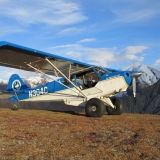
For further clarification, I guess I am saying that the consensus seems to be the MAF method for the Husky in a crosswind, some with 20 degrees of flaps, but most with 30 degrees ... a little power all the way to touchdown. ... but once again there is not unanimous agreement on this.
Nizina
Nizina
Nizina
Tue Sep 23, 2008 8:38 pm
1SeventyZ wrote:
Anyway, yesterday I vowed to change it up and do some wheelies, which I have always been squeemish about because of the little extra airspeed you carry to "fly it on."
No reason to carry extra speed to wheel land, that is an urban legend. A fun practice is take a friend and on short final he can say wheel or three point.
Throttle control is key
Tue Sep 23, 2008 10:37 pm
mr scout wrote:1SeventyZ wrote:
Anyway, yesterday I vowed to change it up and do some wheelies, which I have always been squeemish about because of the little extra airspeed you carry to "fly it on."
No reason to carry extra speed to wheel land, that is an urban legend. A fun practice is take a friend and on short final he can say wheel or three point.
Throttle control is key
I'm not sure if it's best practice or not, but I've recently started carrying just a hint of throttle into the flare. It seems to help quite a bit if I'm approaching slower and have a greater descent rate-- I just ease on about 200-300 rpm above idle upon the roundout. It makes it especially easy to smoothly transition into that tail-low attitude.
- Zzz offline


- Posts: 2855
- Joined: Fri Oct 08, 2004 11:09 pm
- Location: northern
- Aircraft: Swiveling desk chair
Half a century spent proving “it is better to be thought a fool than to open your mouth and remove all doubt.”
Tue Sep 23, 2008 10:50 pm
Wed Sep 24, 2008 2:11 pm
I thought Nizina's description on the three landing techniques above was the best synopsis of the differences I've read.
In my Super Cub I prefer to tail-low wheel land and, if off airport, put on the brakes to hold the tail up and pull the stick back if needed. In a lightweigt Cub like mine (about 1100 pounds with big tires) the tire spin-up will decrease the angle of attack on touchdown and there isn't a need to push forward stick. This technique allows for some very short landings.
The big advantages are visibility over the nose and letting the big tires and main gear soak up the rough surface, not the airframe and tail wheel.
As the speed drops lower, in the teens, there is more danger of going up on the nose because the elevator looses effectiveness but the brakes don't. So most of the heavier braking should be done initially. Once the tail comes down its full back on the stick if it isn't already there and if the tail starts to come back up a blast of power should put it back down and of course the brakes released if using them.
On a paved runway I use a conventional wheel landing without brakes almost always. The only time I three-point is if I think the surface may be soft.
In my Super Cub I prefer to tail-low wheel land and, if off airport, put on the brakes to hold the tail up and pull the stick back if needed. In a lightweigt Cub like mine (about 1100 pounds with big tires) the tire spin-up will decrease the angle of attack on touchdown and there isn't a need to push forward stick. This technique allows for some very short landings.
The big advantages are visibility over the nose and letting the big tires and main gear soak up the rough surface, not the airframe and tail wheel.
As the speed drops lower, in the teens, there is more danger of going up on the nose because the elevator looses effectiveness but the brakes don't. So most of the heavier braking should be done initially. Once the tail comes down its full back on the stick if it isn't already there and if the tail starts to come back up a blast of power should put it back down and of course the brakes released if using them.
On a paved runway I use a conventional wheel landing without brakes almost always. The only time I three-point is if I think the surface may be soft.
making 'em spin. . .
Sun Dec 20, 2009 5:43 pm
Re: MAF Wheel Landing Technique
my opinion is to do power off approachs on every landing, unless you need to land short. it's great training, you can always slip to lose altitude, you don't rely on power to make the runway. my old time mentor drilled it into my head to fly by the seat of your pants, know your machine, feel the pressure in the controls. try it, you might wish you did when that engine quits, on a 1 mile final, dragging it in with power!!!!!!!!!!!!!
Sun Dec 20, 2009 5:59 pm
Re: MAF Wheel Landing Technique
Panzl,
You're missing the point with the tail low wheel landing. It is NOT a mile long drag it in super low approach.
MTV
You're missing the point with the tail low wheel landing. It is NOT a mile long drag it in super low approach.
MTV
Sun Dec 20, 2009 6:32 pm
Re: MAF Wheel Landing Technique
i wanted to reply to another post with my reply, sorry for the confusion!
You're missing the point with the tail low wheel landing. It is NOT a mile long drag it in super low approach.
MTV[/quote]
You're missing the point with the tail low wheel landing. It is NOT a mile long drag it in super low approach.
MTV[/quote]
Sun Dec 20, 2009 6:33 pm
Re: MAF Wheel Landing Technique
panzl7 wrote:my opinion is to do power off approachs on every landing, unless you need to land short. it's great training. my old time mentor drilled it into my head to fly by the seat of your pants, know your machine, feel the pressure in the controls.
I guess I'm gonna have to learn to fly by the seat of my pants. If that engine quits I'm going to die, since the only thing giving me feel of the aircraft is the throttle...
I really can't think of any reason I'd want to subject my airplane engine to a power off approach.
Gump
Sun Dec 20, 2009 7:23 pm
Re: MAF Wheel Landing Technique
damn good point, gump! i/m not gonna shut off my 540 on approach for any reason...cooling your motor off too fast just ain't good...

jomac
Tue Sep 28, 2010 8:19 am
Re: MAF Wheel Landing Technique
Good thread...wheel landings are choice 95% of the time with the tail low.
Last edited by aktahoe1 on Sun Oct 30, 2011 8:09 am, edited 1 time in total.
- aktahoe1 offline
- Posts: 2052
- Joined: Sun Jul 13, 2008 8:22 am
- Location: Alaska and Lake Tahoe = aktahoe
If it looks smooth, it might be. If it looks rough, it is...www.bigtirepilot.com ...www.alaskaheliski.com
DISPLAY OPTIONS
Who is online
Users browsing this forum: No registered users and 2 guests
Latest Features
-
Live to Tell
A Minnesota pilot is surprised to learn that the sudden asymmetric drag of an out-of-rig ski can…Read More -
Creators
Working in some of the Yukon's most beautiful and remote environments, photographer Simon Blakesley captures aircraft in…Read More -
Aircraft Ownership and Maintenance
Upgrading to big tires can make a huge difference in backcountry performance, but with those gains come…Read More -
Tales from Yesteryear
In this tale from bush flying yesteryear, Don Cogger signs up to help Atlee Dodge Jr recovery…Read More


Latest Knowledge Base
-
Destinations
A regional guide with ideas for winter camping destinations in California, Nevada, New Mexico, and Arizona.Read More -
Aircraft
Finding an affordable aircraft that can handle the backcountry for $80K or less? A challenge for sure, but with the…Read More -
Aircraft
01.29.2018 - Zane - Updated tire diameter graphic to add 8.50x10 Guide to tires for use in the backcountry and off-airport landing…Read More -
Pilots
12.22.2013 - Initial article format Operating aircraft on skis and negotiating a snow-covered landscape is an entirely unique skillset and environment.…Read More


