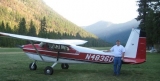
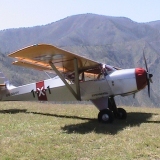
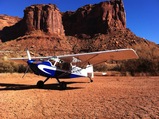
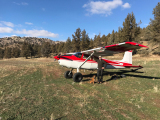
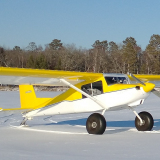
I agree with Cary and others about C-172 and C-182. My wife is from Evergreen and we taught on the Navajo Reservation fourteen years. I have flown Cary's VMC route from Jeffco-down front range-across La Veta Pass-La Manga Pass-Cumbres Pass-Gallup many times in Ercoupe, 90 hp Champ, 150 hp Tri-Pacer, 145-175 hp C-172s, and others. I also flew pipelines in the area with the 160 hp C-172. All worked well using thermal and oregraphic ridge lift at least equally as much as excess engine thrust for climb.
As an instructor, if worries me that most pilots ask, "What airplane do I need?" I wonder if they have first considered, "What techniques do I need." Find an instructor who will answer the what if questions without falling back on the idea that good judgement will keep you from being there. If you are going to commute, you will find yourself "there" from time to time. If pulling back will not make the airplane go up, try lowering the nose a bit. If that doesn't help, turn down drainage without trying to maintain altitude. The Rockies give us lots of vertical space to work with if we use it in an emergency. And the airplane cannot possibly stall itself.
I have found even Comanche and C-182 to occasionally have insufficient excess engine thrust for climb in the southern Rockies. VFR weather is much better in the mountains than the midwest, but I also agree with Cary's 50% if dependent on engine power alone. On the pipeline I covered 3500 miles each week 99% of the time, but I chose the days I flew. The problem with commuting is you have a need to get there at a certain hour on a certain day. That increases the danger. Also, on the line, I knew the route back out without having to make dangerous GPS legs over terrain I had not memorized should things deteriorate.
Tailwheel can be easily learned, especially if you are young and have few nosewheel habits. Using thermal and oregraphic (wind) energy in low powered airplanes can be easily learned. However, the best ridge lift is very near the ridge. And remember that heat is what produces the thermals. On hot afternoons they are much more powerful than our engine and attempting to maintain altitude will produce a significant loss of ground speed and altitude. We gotta fly slow in up air and fast through down air. Energy management, no load factor, turns are critically necessary to safely get going back down drainage when insufficient ridge lift is found.
Shoot me an e-mail at
[email protected] and I will attach my e-book covering all this stuff.
 I suffer from that problem like most of us do, I am now in tailwheel rehab.



 will bother you the entire time you own the airplane.