Those whining about $500, haven't had to go through the STC process, I'd guess.
JH
New STC Manual Flap Cessna / Piper
Sat Aug 15, 2009 8:40 am
- hardtailjohn offline
- Posts: 924
- Joined: Thu Mar 16, 2006 7:06 pm
- Location: Marion, Montana
God put me here to accomplish a certain amount of things...right now I'm so far behind, I'll never die!!
Sat Aug 15, 2009 12:23 pm
Re: New STC Manual Flap Cessna / Piper
As an STC/PMA holder I would like to wish EZFlap good luck on his endeavors. But, I would also like to give EZ a little advice. I checked your website and have not seen any indication that you are a PMA holder. Without the PMA it would be illegal for you to send your product across your hometown for installation on an aircraft, let alone anywhere else in the country. Check your FAR's, and get your PMA.....Call me if you need help.
Brian
Brian
- Brian-StevesAircraft offline

- Posts: 759
- Joined: Tue Dec 13, 2005 1:13 pm
- Location: Beagle (White City) Oregon
Sat Aug 15, 2009 3:15 pm
Re: New STC Manual Flap Cessna / Piper
I didn't whine, I think the STC holder would sell a lot more of there products at cheaper prices and get more exposure with more units in more planes. I see $15 worth of materials $25 worth of welding and I'm sure a shit load of time and expense dealing with the FAA.
- Glidergeek offline

- Posts: 1937
- Joined: Sat Sep 06, 2008 8:02 pm
- Location: Hesperia
- Aircraft: 1968 P206C
DG 400
Sat Aug 15, 2009 4:32 pm
Re: New STC Manual Flap Cessna / Piper
1) Glidergeek I see $12,000 in aluminum and another $10,000 in labor in a brand new Cessna. Go tell them to make it cheaper. There's 20 cents in food and $1 in labor in the lunch you paid $10 for today. I don't know who you are or were in soaring, but if we met back in the days when I was in flying competition, and I said something stupid that pissed you off... congratulations we're even.
2) "Brian at Steve's" thank you for your offer of help, I appreciate it. I had and have no intention of screwing with the PMA rules. I have not accepted any money from anyone yet. The PMA is in process and should be finalized within a week or so. The one unit that IS certified and IS STC'd is what I'm sending to Austin NV, mounted in another airplane because I have to be here finalizlng the PMA.
3) Hardtail John, nice to see you here old buddy... And I thought the T-craft crowd was rough!
4) Steve Pierce, bless your heart with gold stars for having something good to say in the midst of this attempted gang rape... The Pacer and Tri-Pacer will be added very soon but I have to get the Super Cub locked down first. That is nearly done but there are a couple of extra steps... it's a crowded installation between the trim crank and the pilot's left leg as mentioned previously. I have a milk-stool here on the airport that I will be using for final conformity inspection. Will definitely make this known over on shortwing when it is ready.
5) MTV if you think electric flaps solved anything and are the least bit desirable in the back country you're in for quite a lashing from other back country pilots. Considering the reception I've gotten here with a simple $500 bolt-on device, I'd be hiring someone to start your car for you if you are gonna say Cessna solved the flap issue with a $2500 electric motor and transmission
6) WW Hunter or JK, you kind dear soul... for being the first here to disagree with the nay-sayers, I will gladly give you a significant discount on one ! Per a previous post I cannot send it to you until the PMA approval is on it of course . I can't give it to you freebie but I'll do you right for having the balls to not throw stones
2) "Brian at Steve's" thank you for your offer of help, I appreciate it. I had and have no intention of screwing with the PMA rules. I have not accepted any money from anyone yet. The PMA is in process and should be finalized within a week or so. The one unit that IS certified and IS STC'd is what I'm sending to Austin NV, mounted in another airplane because I have to be here finalizlng the PMA.
3) Hardtail John, nice to see you here old buddy... And I thought the T-craft crowd was rough!
4) Steve Pierce, bless your heart with gold stars for having something good to say in the midst of this attempted gang rape... The Pacer and Tri-Pacer will be added very soon but I have to get the Super Cub locked down first. That is nearly done but there are a couple of extra steps... it's a crowded installation between the trim crank and the pilot's left leg as mentioned previously. I have a milk-stool here on the airport that I will be using for final conformity inspection. Will definitely make this known over on shortwing when it is ready.
5) MTV if you think electric flaps solved anything and are the least bit desirable in the back country you're in for quite a lashing from other back country pilots. Considering the reception I've gotten here with a simple $500 bolt-on device, I'd be hiring someone to start your car for you if you are gonna say Cessna solved the flap issue with a $2500 electric motor and transmission
6) WW Hunter or JK, you kind dear soul... for being the first here to disagree with the nay-sayers, I will gladly give you a significant discount on one ! Per a previous post I cannot send it to you until the PMA approval is on it of course . I can't give it to you freebie but I'll do you right for having the balls to not throw stones

.
Sat Aug 15, 2009 5:48 pm
Re: New STC Manual Flap Cessna / Piper
E-Z Flap : You picked a winner with WWHUNTER , he a straight shooter !! I have known him a few years and he will treat you right. Some of the nay-sayers on this site are quick to shoot down something new unless it was their idea to start with !!
Where spring comes July3 and winter starts July5 th. Snow in May is normal.
Sat Aug 15, 2009 5:58 pm
Re: New STC Manual Flap Cessna / Piper
Thank you, I sent him a private message with an offer that reflects his courage and open mindedness.
.
Sat Aug 15, 2009 9:34 pm
Re: New STC Manual Flap Cessna / Piper
That just looks too EZ. Can you build a version that uses a Remington 870 stock?
I know at least one guy you've made very happy.

In all seriousness, it is a problem I think about every time I takeoff or land with my shoulder harness all sloppy, so good for you for building a solution.
I wouldn't get bent out of shape due to criticism though. This is an internet forum, and you're presenting a commercial product with a reasonably high price tag as your first post. Expect opinions.
I know at least one guy you've made very happy.
In all seriousness, it is a problem I think about every time I takeoff or land with my shoulder harness all sloppy, so good for you for building a solution.
I wouldn't get bent out of shape due to criticism though. This is an internet forum, and you're presenting a commercial product with a reasonably high price tag as your first post. Expect opinions.
- Zzz offline


- Posts: 2854
- Joined: Fri Oct 08, 2004 11:09 pm
- Location: northern
- Aircraft: Swiveling desk chair
Half a century spent proving “it is better to be thought a fool than to open your mouth and remove all doubt.”
Sat Aug 15, 2009 9:51 pm
Re: New STC Manual Flap Cessna / Piper
Everybody to there own opinion,
But I do know that Kurt was real short, like 5'4 on a good day, and One of the best damn glacier pilots around anywhere. He was trying to get the turboed 185 to fly at 12,500' on the Cathedral Glacier in Kluane Park after picking up a couple of stranded climbers that had lost there gear and food.(they had been there for 5 days) He ran into a little trouble on take off and slipped his shoulder harness off to work the flaps to try and make it fly.
Well it didn't work and we got the climbers out of the crevasse where the plane ended up the next day. Bill had a broken collar bone and a skull fracture, Andy had 4 broken vertebrae,
Kurt Died of head injury's, I had to tell his eleven year old daughter that her Dad wasn't coming home.
$500 bucks, I'll tell you right now I would have gladly paid $50,000 not to have gone thru that.
Oh ya, he had about 12,000 hrs in Cessna's and about 5000 in the one he wrecked!
Lost one of my best friends and a great mentor,he taught me alot.
Ezeflap good onya for thinkin about it and then doing something instead of just talking.
Don't worry about the experts out there, everyone has an opinion just like everyone has an AH.
If you don't push the envelope, you'll never find the edge!
My $.02
GT
But I do know that Kurt was real short, like 5'4 on a good day, and One of the best damn glacier pilots around anywhere. He was trying to get the turboed 185 to fly at 12,500' on the Cathedral Glacier in Kluane Park after picking up a couple of stranded climbers that had lost there gear and food.(they had been there for 5 days) He ran into a little trouble on take off and slipped his shoulder harness off to work the flaps to try and make it fly.
Well it didn't work and we got the climbers out of the crevasse where the plane ended up the next day. Bill had a broken collar bone and a skull fracture, Andy had 4 broken vertebrae,
Kurt Died of head injury's, I had to tell his eleven year old daughter that her Dad wasn't coming home.
$500 bucks, I'll tell you right now I would have gladly paid $50,000 not to have gone thru that.
Oh ya, he had about 12,000 hrs in Cessna's and about 5000 in the one he wrecked!
Lost one of my best friends and a great mentor,he taught me alot.
Ezeflap good onya for thinkin about it and then doing something instead of just talking.
Don't worry about the experts out there, everyone has an opinion just like everyone has an AH.
If you don't push the envelope, you'll never find the edge!
My $.02
GT
- M6RV6 offline
- Posts: 2313
- Joined: Mon Feb 25, 2008 5:52 pm
- Location: Rice Wa. 82WN Magee Creek AERODROME
- FindMeSpot URL: http://share.findmespot.com/shared/face ... sWKXuhKlg2
Have as much Fun as is Safe, and Keep SMILIN! GT,
Sun Aug 16, 2009 8:58 am
Re: New STC Manual Flap Cessna / Piper
Some folks seem to be forgetting a basic and very important component on ANY airplane, at least in my opinion: GOOD, FUNCTIONAL shoulder harnesses. I parked a 185 on a mountainside after a crankshaft failed, which ended up not pretty at all for the airplane. I came out of that accident without even strap rash, largely due to the presence and use of BAS shoulder harnesses. Take a look at the BAS web site for a few photos of airplanes whose pilots owe their lives to BAS harness systems, including mine.
If you don't have a GREAT harness system, no modification to the flap actuator is going to save your life in a bad accident. Period. Having to slip a shoulder harness off to do ANYthing on takeoff or landing suggests to me an inadequate and frankly dangerous harness system, and THAT is where I'd start off by spending my money FIRST. Been there, done that. BAS harness went into MY airplane the week after the aforementioned 185 accident. See BAS testimonial page at: http://www.basinc-aeromod.com/
As to electric flaps vs manual, I don't have a dog in that fight. I've flown most of the small airplane flap arrangements, and frankly, I don't much care what type I'm using--it's simply a matter of learning to use what the airplane has. I have a few thousand hours in each flavor of Cessna, Piper, Aviat and aircraft with hydraulically actuated flaps. Much of that was off airport and/or back country type operation. I was handed the keys to a refurbished Cessna 206 some time after the 185 accident, because a "committee" selected that as a replacement airplane for the 185. After something over 4 or 5 thousand hours in 180/185 airplanes, I really didn't want to switch to the 206, one reason being the electric flaps. I had one vote on the committee, and the group chose the 206. Nevertheless, the 206 turned out to be a GREAT backcountry airplane in almost every conceivable way. Frankly, with few exceptions, I'd MUCH rather work a 206 (note the operative term "work" here) than I would a 185, PARTICULARLY in the back country. Want to dump flaps on landing? In the 206, initiate the flare, and reach over and flip that little switch to the "up" position. Touch, stand on the brakes. Finis. Even I can look pretty good landing short in a 206.
Take a look at what Cessna airplanes are working the back country on a daily basis....most are 206/207 as opposed to 185s. Why would that be? Tthe cargo door is a big seller, but if the plane wouldn't perform, the operator could do without the big door. I can show you operators in AK who routinely go in and out of serious backcountry landing sites with 206 airplanes, operators who USED to work 185s, yet they seem to go the same places for the most part that the 185s did.
I currently own a Cessna 170, and I almost never dump flaps on landing. If I feel that I would have to do so to make a landing work out, I go somewhere else. I am NOT working the airplane. I also rarely dumped flaps in the 180/185 airplanes, even when working, until the airplane was down and straight. The 180/185 airplanes can get sorta busy on the ground at speed, so maybe the EZFlap gizmo would be a good deal if you really NEED to dump flaps on landing. But even with an EZFlap gizmo, you are going to have to find the lever, and move some body parts to make it work, including that all important right hand coming off the throttle. All that involves a distraction from job one in these airplanes, which is keep it in the tracks. With an early 172/182, the slight distraction of dumping the flaps is really no big deal, with the docile handling of these airplanes. I never found it that distracting to dump flaps in a Super Cub or Husky on landing, but again, those are pretty gentle airplanes. And, again, it's a rare instance where you really HAVE to dump flaps.
I agree that $500 isn't much money in aviation these days. Heck, our government seems to think that if you add enough trillions onto the deficit you'll be talking some real money....But consider this: $500 would buy 125 gallons of avgas at $4.00 per gallon. In an airplane that burns say 10 gph in the pattern (and that's a lot) , that would provide roughly 12 HOURS of landing/takeoff practice. Okay, so go find an instructor who really knows how to fly your type airplane in the back country, and hire him/her for a couple hours, and make it 2 hours of dual and 5 or 6 hours of practice, some of it in real backcountry landing zones.
I would argue that this might be a better investment of $500 dollars. In looking at the numbers of hours many privately owned aircraft are flown in a year, I firmly believe this approach would SERIOUSLY improve safety for many of us. The single best thing you can do for your safety in flying the back country is to FLY the plane, learn to fly it WELL, and fly it regularly.
To me, that's the better investment, but it's your money. I'll stick with what I've got, and focus on keeping it straight after touchdown.
But, whatever you do, if you don't have a GREAT shoulder harness installed in your airplane--do not hesitate, put a GREAT shoulder harness system on your list of MUST-HAVE safety equipment. Again, take a look at http://www.basinc-aeromod.com/ for some examples of why. I don't work for BAS, nor do I have any stake in their business. Their harnesses are not cheap, either. How much is your face worth?
MTV
If you don't have a GREAT harness system, no modification to the flap actuator is going to save your life in a bad accident. Period. Having to slip a shoulder harness off to do ANYthing on takeoff or landing suggests to me an inadequate and frankly dangerous harness system, and THAT is where I'd start off by spending my money FIRST. Been there, done that. BAS harness went into MY airplane the week after the aforementioned 185 accident. See BAS testimonial page at: http://www.basinc-aeromod.com/
As to electric flaps vs manual, I don't have a dog in that fight. I've flown most of the small airplane flap arrangements, and frankly, I don't much care what type I'm using--it's simply a matter of learning to use what the airplane has. I have a few thousand hours in each flavor of Cessna, Piper, Aviat and aircraft with hydraulically actuated flaps. Much of that was off airport and/or back country type operation. I was handed the keys to a refurbished Cessna 206 some time after the 185 accident, because a "committee" selected that as a replacement airplane for the 185. After something over 4 or 5 thousand hours in 180/185 airplanes, I really didn't want to switch to the 206, one reason being the electric flaps. I had one vote on the committee, and the group chose the 206. Nevertheless, the 206 turned out to be a GREAT backcountry airplane in almost every conceivable way. Frankly, with few exceptions, I'd MUCH rather work a 206 (note the operative term "work" here) than I would a 185, PARTICULARLY in the back country. Want to dump flaps on landing? In the 206, initiate the flare, and reach over and flip that little switch to the "up" position. Touch, stand on the brakes. Finis. Even I can look pretty good landing short in a 206.
Take a look at what Cessna airplanes are working the back country on a daily basis....most are 206/207 as opposed to 185s. Why would that be? Tthe cargo door is a big seller, but if the plane wouldn't perform, the operator could do without the big door. I can show you operators in AK who routinely go in and out of serious backcountry landing sites with 206 airplanes, operators who USED to work 185s, yet they seem to go the same places for the most part that the 185s did.
I currently own a Cessna 170, and I almost never dump flaps on landing. If I feel that I would have to do so to make a landing work out, I go somewhere else. I am NOT working the airplane. I also rarely dumped flaps in the 180/185 airplanes, even when working, until the airplane was down and straight. The 180/185 airplanes can get sorta busy on the ground at speed, so maybe the EZFlap gizmo would be a good deal if you really NEED to dump flaps on landing. But even with an EZFlap gizmo, you are going to have to find the lever, and move some body parts to make it work, including that all important right hand coming off the throttle. All that involves a distraction from job one in these airplanes, which is keep it in the tracks. With an early 172/182, the slight distraction of dumping the flaps is really no big deal, with the docile handling of these airplanes. I never found it that distracting to dump flaps in a Super Cub or Husky on landing, but again, those are pretty gentle airplanes. And, again, it's a rare instance where you really HAVE to dump flaps.
I agree that $500 isn't much money in aviation these days. Heck, our government seems to think that if you add enough trillions onto the deficit you'll be talking some real money....But consider this: $500 would buy 125 gallons of avgas at $4.00 per gallon. In an airplane that burns say 10 gph in the pattern (and that's a lot) , that would provide roughly 12 HOURS of landing/takeoff practice. Okay, so go find an instructor who really knows how to fly your type airplane in the back country, and hire him/her for a couple hours, and make it 2 hours of dual and 5 or 6 hours of practice, some of it in real backcountry landing zones.
I would argue that this might be a better investment of $500 dollars. In looking at the numbers of hours many privately owned aircraft are flown in a year, I firmly believe this approach would SERIOUSLY improve safety for many of us. The single best thing you can do for your safety in flying the back country is to FLY the plane, learn to fly it WELL, and fly it regularly.
To me, that's the better investment, but it's your money. I'll stick with what I've got, and focus on keeping it straight after touchdown.
But, whatever you do, if you don't have a GREAT shoulder harness installed in your airplane--do not hesitate, put a GREAT shoulder harness system on your list of MUST-HAVE safety equipment. Again, take a look at http://www.basinc-aeromod.com/ for some examples of why. I don't work for BAS, nor do I have any stake in their business. Their harnesses are not cheap, either. How much is your face worth?
MTV


Sun Aug 16, 2009 10:48 am
Re: New STC Manual Flap Cessna / Piper
I wasn't trying to start any shit about the price only give my opinion and we all know what that's worth especially after that ass chewing I got for my comment. I recently replaced the control rod balls (where the Yoke control rod goes through the panel on a C180) Cessna had them for $93 each these are a 1" ball of Teflon with a 1/2" hole drilled through them. I told them that's way too much he agreed. I found the same damned thing at McFarland for $35 for a PAIR with a STC much more reasonable. That gave me $150 more to spend on wheat ever I needed to. Bet you they (McFarland) sells a whole lot more of those in a year then Cessna does in 5 years. You took this as a personal attack and it wasn't meant that way.
- Glidergeek offline
- Posts: 1937
- Joined: Sat Sep 06, 2008 8:02 pm
- Location: Hesperia
- Aircraft: 1968 P206C
DG 400
Sun Aug 16, 2009 4:39 pm
Re: New STC Manual Flap Cessna / Piper
I had not known about the tragedy involving the glacier pilot. I know there have been many other similar accidents. Perhaps either a BAS inertia reel or even my EZ Flap gizmo would have made a difference.
The word from experienced pilots is that some inertia reels can "lock up" when you don't want them to, either in turbulence or if you just happen to lean forward too fast.
When the BAS unit came on the market, there were probably people who said "why the hell do you need THOSE expensive automotive parts on an airplane... a thousand dollars a pair!!!... buy XYZ gallons of gas with the same money!!!" Now BAS apparently has a whole website full of testimonials that it saves people's lives. GOOD FOR THEM !! I hope they become multi-millionaires for saving those lives.
Why can't some of you guys give me the benefit of that doubt too?
For the life of me I can't understand why some people are defending the extra effort that is required to use the OEM Cessna flap handle, with or without an inertia reel shoulder harness. I'm not claiming the OEM Cessna system is impossible to use... it is not impossible at all, and (as mentioned) y'all have been doing it for 60 years. But the simple fact is that I came up with something that makes the flaps a little easier to use, and puts a little more of the pilot's attention back on flying the airplane.
You can hire the greatest instructor in the history of bush flying, Noel Wien or Sparky Imeson (RIP) or Paul Claus or "Cub Driver 749ER" or whoever is the big celebrity bush driver this week... and the fact is that big old fat tundra tires are still worth buying and putting on your airplane in the wilderness. You can spend your money on a thousand gallons of fuel, but a good working GPS for $500 is still worth having on board no matter where you fly. Good piloting skills are supremely important whether you are flying back country or not... but having good equipment is also important.
How many of you understand and agree with the validity of the McFarlane Cessna trailing edge flap "bulb" extrusions for a couple of hundred bucks? What about their improved seat rails for a hundred bucks each? What about the Atlee Dodge folding seats, or Flint extended fuel tanks or a hundred other mods that are not completely necessary but that do something worthwhile?
The EZ Flap fixes several real problems that exist because of Cessna/Piper design choices they made 60 years ago. EZ Flap is not claimed to make your airplane faster or make your pecker any bigger. But it makes your airplane safer and more enjoyable to fly.
The word from experienced pilots is that some inertia reels can "lock up" when you don't want them to, either in turbulence or if you just happen to lean forward too fast.
When the BAS unit came on the market, there were probably people who said "why the hell do you need THOSE expensive automotive parts on an airplane... a thousand dollars a pair!!!... buy XYZ gallons of gas with the same money!!!" Now BAS apparently has a whole website full of testimonials that it saves people's lives. GOOD FOR THEM !! I hope they become multi-millionaires for saving those lives.
Why can't some of you guys give me the benefit of that doubt too?
For the life of me I can't understand why some people are defending the extra effort that is required to use the OEM Cessna flap handle, with or without an inertia reel shoulder harness. I'm not claiming the OEM Cessna system is impossible to use... it is not impossible at all, and (as mentioned) y'all have been doing it for 60 years. But the simple fact is that I came up with something that makes the flaps a little easier to use, and puts a little more of the pilot's attention back on flying the airplane.
You can hire the greatest instructor in the history of bush flying, Noel Wien or Sparky Imeson (RIP) or Paul Claus or "Cub Driver 749ER" or whoever is the big celebrity bush driver this week... and the fact is that big old fat tundra tires are still worth buying and putting on your airplane in the wilderness. You can spend your money on a thousand gallons of fuel, but a good working GPS for $500 is still worth having on board no matter where you fly. Good piloting skills are supremely important whether you are flying back country or not... but having good equipment is also important.
How many of you understand and agree with the validity of the McFarlane Cessna trailing edge flap "bulb" extrusions for a couple of hundred bucks? What about their improved seat rails for a hundred bucks each? What about the Atlee Dodge folding seats, or Flint extended fuel tanks or a hundred other mods that are not completely necessary but that do something worthwhile?
The EZ Flap fixes several real problems that exist because of Cessna/Piper design choices they made 60 years ago. EZ Flap is not claimed to make your airplane faster or make your pecker any bigger. But it makes your airplane safer and more enjoyable to fly.
.
Sun Aug 16, 2009 5:54 pm
Re: New STC Manual Flap Cessna / Piper
BY THE WAY...
Those of you who were justifiably offended and sickened by the photos of an ugly mechanic's arm and the lack of proper interior carpet in the photos on my website are encouraged to take another look. The bare metal floor and the ugly mechanic have both been replaced by far more appropriate photos... of a far more appropriate nature
Visit http://www.ezflaphandle.com to decide for yourself. There are newer photos on several of the pages.
Those of you who were justifiably offended and sickened by the photos of an ugly mechanic's arm and the lack of proper interior carpet in the photos on my website are encouraged to take another look. The bare metal floor and the ugly mechanic have both been replaced by far more appropriate photos... of a far more appropriate nature
Visit http://www.ezflaphandle.com to decide for yourself. There are newer photos on several of the pages.
.
Sun Aug 16, 2009 8:07 pm
Re: New STC Manual Flap Cessna / Piper
EZFlap wrote:BY THE WAY...
Those of you who were justifiably offended and sickened by the photos of an ugly mechanic's arm and the lack of proper interior carpet in the photos on my website are encouraged to take another look. The bare metal floor and the ugly mechanic have both been replaced by far more appropriate photos... of a far more appropriate nature
Visit http://www.ezflaphandle.com to decide for yourself. There are newer photos on several of the pages.
Hey EZFlap.....I can't expand those photos of Becky pullin' the gizmo

What a worthless website-
 I'm jokin- All the best
 - SixTwoLeemer offline

- Posts: 1285
- Joined: Thu Feb 07, 2008 10:53 am
- Location: Wasatch Front
Altitude is Time…. Airspeed is Life!
Sun Aug 16, 2009 9:01 pm
Re: New STC Manual Flap Cessna / Piper
Now see here... you holster that weapon right now!
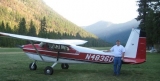
Becky is a dear friend of ours, and for some unfathomable reason it appears she is somewhat better at generating public interest than I (see photo at right). She and her hubby Ron Weiss were the first outside 'test pilots' of the EZ Flap device a few months ago.
I asked Ron to fly the airplane and see if he liked the gadget, and he said he wanted Becky (student pilot) to try it out too. When I told Ron to get in the airplane he smiled and told me to get out.
Next thing I knew my wife and I were standing there on the ground watching my airplane and two friends take off. Ron went around the patch a few times and congratulated me on a fine invention. Unfortunately he and another friend of his were lost in the crash of his Lancair last month here in the Los Angeles area. Fly safe guys, whether flying is fun or work for you. There aren't enough pilots and the loss of even one is too much. Anyone wishing to make a real difference in the future of aviation may want to visit http://www.ronweissfoundation.org and see what we're doing about it.
Becky is a dear friend of ours, and for some unfathomable reason it appears she is somewhat better at generating public interest than I (see photo at right). She and her hubby Ron Weiss were the first outside 'test pilots' of the EZ Flap device a few months ago.
I asked Ron to fly the airplane and see if he liked the gadget, and he said he wanted Becky (student pilot) to try it out too. When I told Ron to get in the airplane he smiled and told me to get out.
Next thing I knew my wife and I were standing there on the ground watching my airplane and two friends take off. Ron went around the patch a few times and congratulated me on a fine invention. Unfortunately he and another friend of his were lost in the crash of his Lancair last month here in the Los Angeles area. Fly safe guys, whether flying is fun or work for you. There aren't enough pilots and the loss of even one is too much. Anyone wishing to make a real difference in the future of aviation may want to visit http://www.ronweissfoundation.org and see what we're doing about it.
.
Sun Aug 16, 2009 10:12 pm
Re: New STC Manual Flap Cessna / Piper
EZFlap wrote:........
EZ Flap is not claimed to.... make your pecker any bigger. ......
How much more $$ to include that option?

Cessna Skywagon -- accept no substitute!
Sun Aug 16, 2009 10:40 pm
Re: New STC Manual Flap Cessna / Piper
Hotrod 150 wrote: "How much more $$ to include that option?"
Working on PMA ( Pecker Manufacturing Authority) with the FAA office as we speak.
FAA says that this modification cannot stand any taller than the required paperwork. I told them it was primarily for "bush pilots" but they said that they would never approve it for the "back country". Although I told them it would be completely manually operated, they insisted it would have to be certified for automatic deployment and retraction, and speed limited. The FAA has also demanded a tremendous amount of documentation on the lubrication requirements, as well as hydraulic pressure and the associated regulators to prevent overpressure. As an STC add-on device it is intended to be installed by any authorized Snap-On Tool retailer, although the installation must also be inspected and functionally tested by a qualified Flight Attendant from a major airline. I have proposed to the FAA that this documentation should also be included in the aircraft's Maintenance and Erection Manual...
Working on PMA ( Pecker Manufacturing Authority) with the FAA office as we speak.
FAA says that this modification cannot stand any taller than the required paperwork. I told them it was primarily for "bush pilots" but they said that they would never approve it for the "back country". Although I told them it would be completely manually operated, they insisted it would have to be certified for automatic deployment and retraction, and speed limited. The FAA has also demanded a tremendous amount of documentation on the lubrication requirements, as well as hydraulic pressure and the associated regulators to prevent overpressure. As an STC add-on device it is intended to be installed by any authorized Snap-On Tool retailer, although the installation must also be inspected and functionally tested by a qualified Flight Attendant from a major airline. I have proposed to the FAA that this documentation should also be included in the aircraft's Maintenance and Erection Manual...
.
Tue Aug 18, 2009 8:57 am
Re: New STC Manual Flap Cessna / Piper
There is a fly-in coming up this weekend in Austin, NV. It's planned to have a Cessna 182 there equipped with the prototype EZ Flap device, owned and flown by a more experienced pilot than myself. Those of you who are interested in checking it out are encouraged to be there. Feel free to check back with me directly as the time grows nearer, in case anything changes for some reason. Bill Berle victorbravo (at} sbcglobal [ dot{ net . PMA is pending but not granted as of this writing, so there will not be any units there for sale. This is solely a promotional trip so y'all can see it and try it out for yourselves.
.
Mon Aug 24, 2009 9:46 am
Re: New STC Manual Flap Cessna / Piper
Well I had a chance to take a long look at the flap mod and had a great conversation with "EZ FLAP" and all I can say is don't knock it 'till ya try it, as a safety mod or a mod of convenience no matter how you look at it, it will do what it was built to do, give the pilot a better grasp on the flap control.

Mon Aug 24, 2009 9:58 am
Re: New STC Manual Flap Cessna / Piper
edit
Last edited by 58Skylane on Wed Mar 17, 2010 9:03 pm, edited 1 time in total.
Mon Aug 24, 2009 8:06 pm
Re: New STC Manual Flap Cessna / Piper
58Skylane wrote:Hottshot wrote:Well I had a chance to take a long look at the flap mod and had a great conversation with "EZ FLAP" and all I can say is don't knock it 'till ya try it, as a safety mod or a mod of convenience depending on how you look at it, it will do what it was built to do, give the pilot a better grasp on the flap control.
I also took a good look at this product. I sat in the plane and went through all the motions. End result? I liked it!! Like Hottshot said, it will do what it was designed to do. I wouldn't mind having this item installed in my Skylane, but for now it's not on my "need" list.
Pat:
Had a hell'va good time except for the rain in the back of the pickup after coffee - I was soaked by the time we made the airport . We got back to L.A. last night after dodgeing rain for the first 100-200 miles south-followed highways at couple of hundred ft AGL. Joe was (and is) great -I'll be back next year.
Ez-Flap is in my airplane -I was hoping for a short field contest to show what it would do.
- 182 STOL driver offline
- Posts: 1529
- Joined: Tue Apr 22, 2008 8:27 pm
DISPLAY OPTIONS
Who is online
Users browsing this forum: No registered users and 0 guests
Latest Features
-
Live to Tell
A Minnesota pilot is surprised to learn that the sudden asymmetric drag of an out-of-rig ski can…Read More -
Creators
Working in some of the Yukon's most beautiful and remote environments, photographer Simon Blakesley captures aircraft in…Read More -
Aircraft Ownership and Maintenance
Upgrading to big tires can make a huge difference in backcountry performance, but with those gains come…Read More -
Tales from Yesteryear
In this tale from bush flying yesteryear, Don Cogger signs up to help Atlee Dodge Jr recovery…Read More


Latest Knowledge Base
-
Destinations
A regional guide with ideas for winter camping destinations in California, Nevada, New Mexico, and Arizona.Read More -
Aircraft
Finding an affordable aircraft that can handle the backcountry for $80K or less? A challenge for sure, but with the…Read More -
Aircraft
01.29.2018 - Zane - Updated tire diameter graphic to add 8.50x10 Guide to tires for use in the backcountry and off-airport landing…Read More -
Pilots
12.22.2013 - Initial article format Operating aircraft on skis and negotiating a snow-covered landscape is an entirely unique skillset and environment.…Read More


