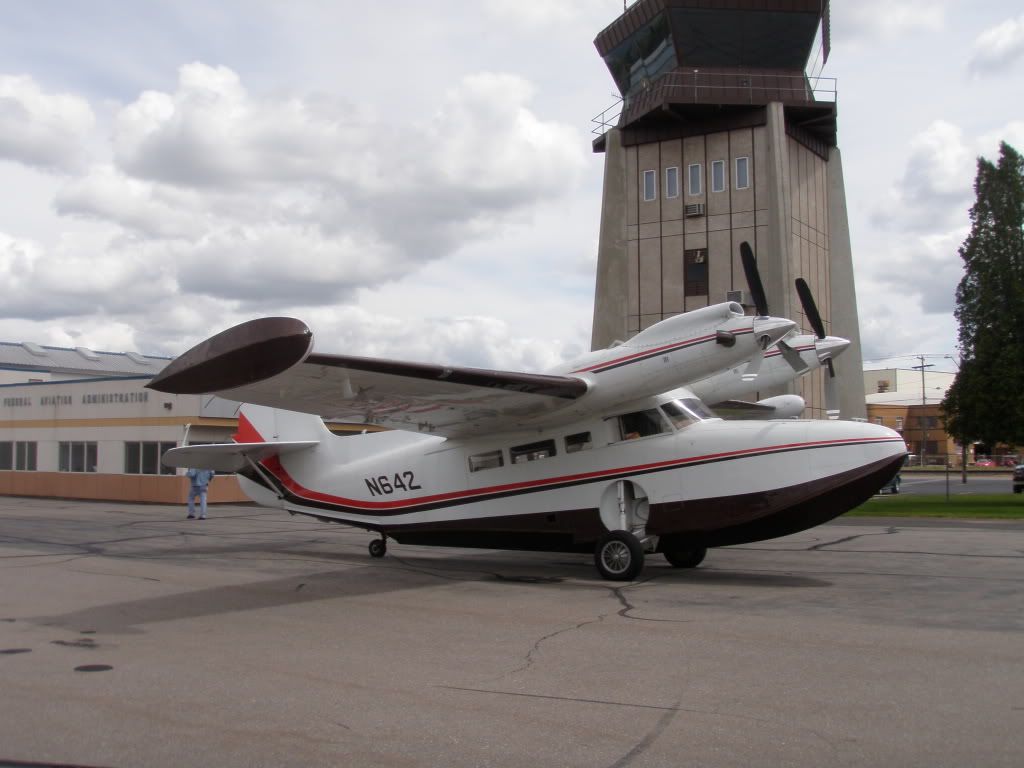
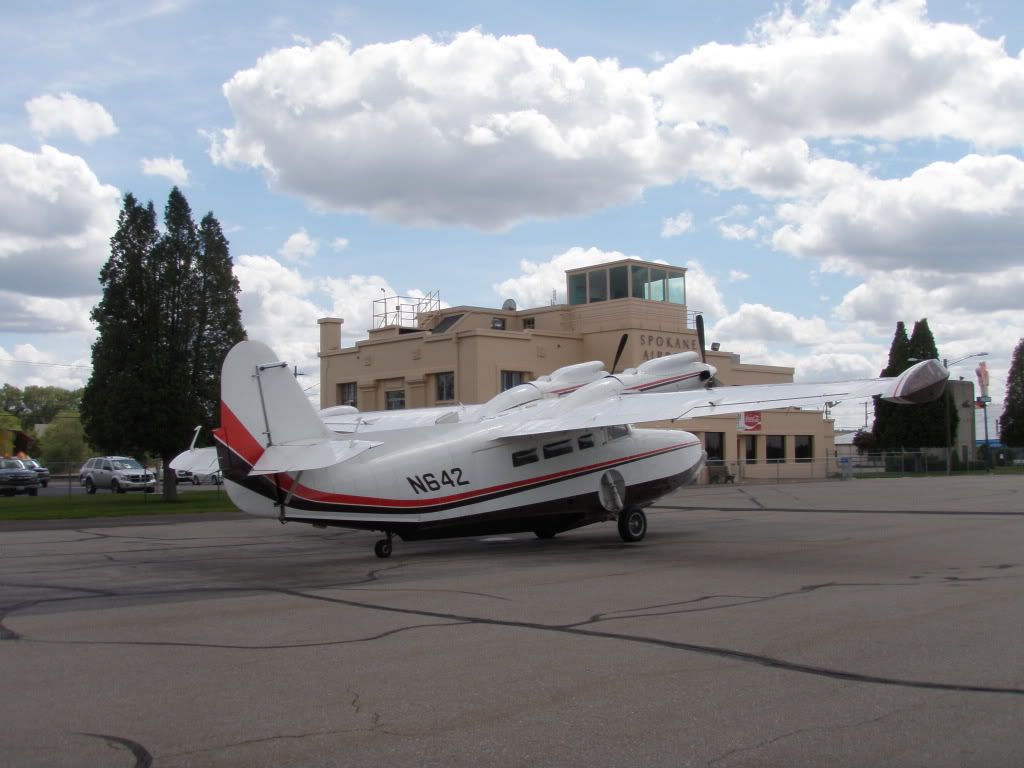
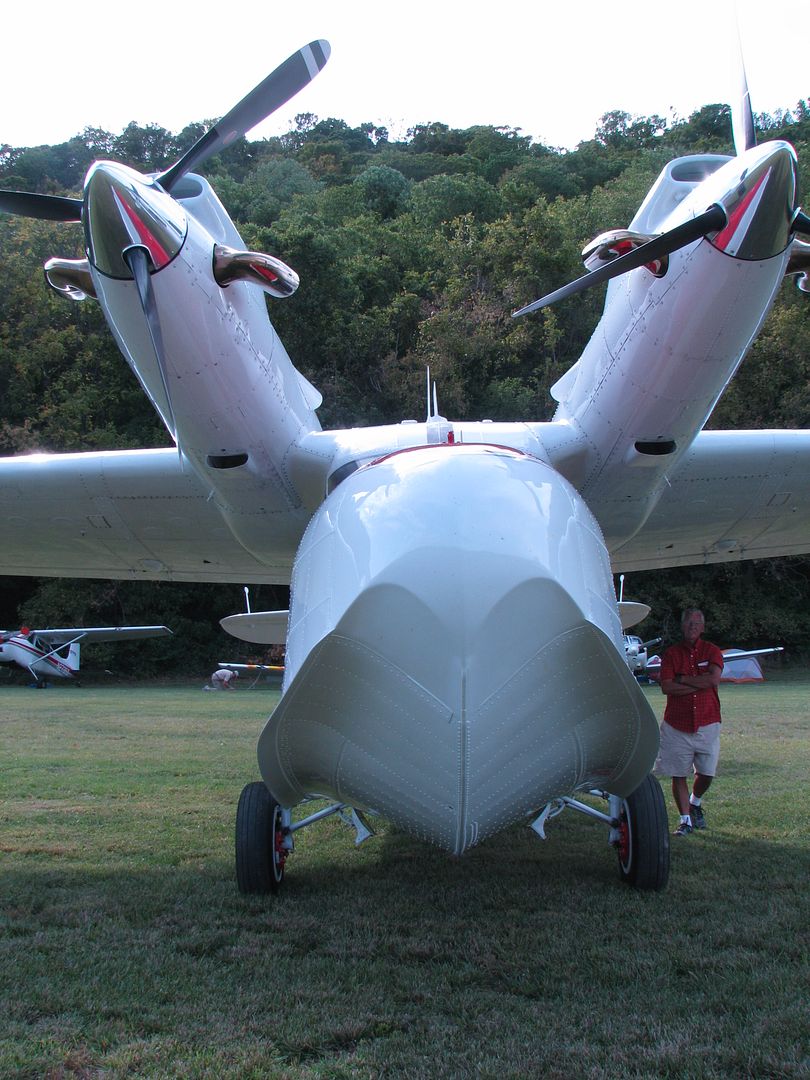
mtv wrote:N642 is a Grumman Goose that was converted with the McKinnon conversion by our old aircraft division. It uses PT-6 engines, mounted upside down to reduce water ingestion into the engine intakes during water ops.
Our maintenance folks also rebuilt another turbine goose--this one using Garrett engines--N780. That one's still flying around in South/Central America I'm told.
Last I heard, N642 was owned by a fellow in Oregon, who has it and a recip Goose, and leases both out for occasional contract work.
MTV
I'm a big fan of the Goose and especially the McKinnon conversions, so I'd like to straighten out a few facts. First of all, N642
was a "Grumman" G-21A Goose (certified under TC 654) only up until 1968 when it was converted and re-certified under a completely separate type certificate (4A24) and officially became a "McKinnon" G-21C Hybrid (i.e. turboprop conversion) but the conversion was actually done by McKinnon Enterprises Inc in Sandy, OR. If by "our old aircraft division" Mike meant either the Office of Aircraft Services (OAS) or the Fish & Wildlife Service of which he was apparently a part, that is also incorrect. McKinnon's customer in 1968 was actually the Bureau of Land Management, a different agency of the US Dept. of the Interior in Alaska. (BLM had 600 series registrations and FWS had 700 series.) He also seems to be confusing its former BLM sister ship N640 with N642. N640 is owned by a "
fellow in Oregon, who has it and a recip Goose" although Teufel sold the "recip" (N48550) to Jimmy Buffett in 2009.
N640 was also a “McKinnon” turbine conversion, done per STC SA1589WE in 1967, but unlike N642, McKinnon
never claimed to have completely re-certified it under TC 4A24. As far as he was concerned, N640 always remained a “Grumman” G-21A under TC 654, albeit a highly modified one with the notation “Turboprop” annotated on all of its official records. It didn’t “suddenly” become a supposed “McKinnon” G-21C ‘Hybrid’ and eventually a ‘G-21G’ until 2001 - five years after Teufel bought it in 1996 (as a “Grumman G-21A” according to the bill of sale) and ten years after Angus McKinnon died – and 30 years after McKinnon stopped converting airplanes (
but that’s a whole ‘nuther story!)
Mike was correct however about N780; it was converted by FWS to have Garrett TPE331 turbines. It was actually “designed” by Theron A. Smith and Jarrett L. “Jerry” Lawhorn and “built” by FWS personnel in Anchorage. Originally, they wanted it to be certified as a McKinnon model “G-21F” under TC 4A24, but the design was never officially approved or certified as such by the FAA. Instead, FWS claimed that their conversion of N780 was a substantially modified example of a “McKinnon G-21G” conversion when in fact it was
not converted
by McKinnon (according to the regs pertaining to new production under FAR 21 and to FAR 45.13(a) it would be a “McKinnon G-21G” only if it was actually converted by McKinnon, but in fact the actual “builder” was FWS.) It also never actually conformed to the model G-21G type design; FWS simply converted it directly from a Grumman G-21A into a “G-21F” and then just started calling it a
modified “McKinnon G-21G” in 1974 or so (they actually used the term “G-21G(STC)”
but all of that’s also a whole ‘nuther story.)
Also, the PT6A series engines on this and other McKinnon Gooses are not mounted “upside-down.” The engine itself is actually mounted the same as any other; all PT6A engines have annular intakes; in other words, the intake screen encompasses the entire circumference of the back section of the engine (they are mounted kinda backwards though – that’s why the exhaust ducts are near the front with only the propeller gearbox between them and the actual prop.) The engines don’t care where the intake duct is on the cowling. Originally, McKinnon did use a default-style PT6 cowling with an intake duct on the bottom. For normal landplane ops, it is better for draining water but not so for a seaplane. In 1968 (in fact up until 1992 or so) N642 had the bottom intake cowlings and 550 shp PT6A-20 engines. When Jack Mark got a hold of it, he had his maintenance guys upgrade it to 680 shp PT6A-27 engines (actually downgraded -28s) just like a McKinnon G-21E under Section III of TC 4A24 and that is when (and why) they also added the extended dorsal fin at that time.
In any case, these photos of N642 seem to have been taken during the ferry flight by which N642 was relocated from its former home in Oshkosh, WI to its new home with Doug DeVries in Everett, WA. After it was declared surplus by BLM (OAS) in 1992 or so, it was sold to warbird collector Jack Mark of Oshkosh. I believe that Jack died in June 2007 and N642 was put up for sale soon thereafter. I did a pre-buy inspection on it in May 2008 and found many things wrong with it, including the fact that the main bulkhead between the cockpit and cabin had been cut out and opened up without a single scrap of engineering analysis, DER certification, or FAA approval.
It also turned out that during McKinnon’s original conversion and re-certification in 1968, he skipped several steps in the “G-21C” part of the conversion per Section I of TC 4A24 and he skipped ahead to the “turbine” part of the conversion per STC SA1320WE. You see, a “real” McKinnon model G-21C has four 340 hp Lycoming GSO-480-B2D6
piston engines as well as numerous structural reinforcements that raised its max gross weight from 8,000 lbs to 12,499 lbs. N642 and another McKinnon conversion done at the same time (s/n 1203 which became CF-BCI and then N660PA) lacked some of those structural reinforcements as a result of which they were certified to only 10,500 lbs – and because they were nominally McKinnon models G-21C that did not “conform” to their approved or properly modified type designs, they were not technically “airworthy” from 1968 on!
The new owner plans to spend the next several years restoring it – and he’ll have his hands full with a very big job.