Good day to all, I'm a new pilot (220 hours) with just enough hours to get into trouble. Last year I purchased a PA 22/20 160 and got my tailwheel endorsement in it. Over this last summer I had the engine overhauled and while the work was being done I put VG's on my wings and tail. I like them because I have much better control on final than I had before. I live in Midcoast Maine and want to fly up to northern Maine this spring and summer to camp and fish. I would like to be able to use some of the remote strips up there. My question for anyone out there is; are there any techniques that someone would like to share about getting a Pacer in the air quicker/shorter?
I've read the POH and have tried applying the brakes and throttling up to full power, then release and apply full flaps @ 45kts. The plane left the ground in less than 400 ft, but reaching down for the flap lever and maintaining directional control was very hard to do and could be dangerous in a narrow wooded strip. Any tips that could be provided will be appreciated.
Thanks in Advance
Mike
Pacer Take Off and Landing Tips
Fri Jan 09, 2009 12:47 pm
- pacerflyer offline
- Posts: 30
- Joined: Thu Jan 08, 2009 4:11 pm
- Location: Bar harbor
- Aircraft: Piper PA12
Fri Jan 09, 2009 2:21 pm
Mike,
Sounds like a nice airplane. Try starting the takeoff run with the first notch of flaps, easier to reach. Practice on the ground (without looking) taking your right hand from the throttle and dropping it down to the flap handle without looking. Instead of looking at the airspeed, wait until you can get the tailwheel off the ground with forward yoke. When the tailwheel is about 12 inches high reach down and pull full flaps. The airplane will pop into the air, keep it within one wingspan height above the ground. NOW glance at the airspeed and slowly raise the flaps as you climb. For landings practice at altitude lots of slow flight and when comfortable carry full flaps, power, and as slow as you feel comfortable on approach. Just realize if you lose an engine on approach behind the power curve the results will be bad. I use 55 mph in the light 135 Pacer. Climb prop and light aircraft weight make lots of difference. Have fun.
Dave
Sounds like a nice airplane. Try starting the takeoff run with the first notch of flaps, easier to reach. Practice on the ground (without looking) taking your right hand from the throttle and dropping it down to the flap handle without looking. Instead of looking at the airspeed, wait until you can get the tailwheel off the ground with forward yoke. When the tailwheel is about 12 inches high reach down and pull full flaps. The airplane will pop into the air, keep it within one wingspan height above the ground. NOW glance at the airspeed and slowly raise the flaps as you climb. For landings practice at altitude lots of slow flight and when comfortable carry full flaps, power, and as slow as you feel comfortable on approach. Just realize if you lose an engine on approach behind the power curve the results will be bad. I use 55 mph in the light 135 Pacer. Climb prop and light aircraft weight make lots of difference. Have fun.
Dave

Fri Jan 09, 2009 2:39 pm
I fly a 170, not a Pacer, which I've heard are pretty squirly, so I am speaking speculatively to the technique in general, rather than as it pertains to the Pacer. I have long arms, and can keep my hand on the flap lever with the button in from the time that the brakes are released, which seems to make such an operation much smoother.
I would compare the takeoff distances applying flaps at 45 knots with having the flaps extended for the entire duration of the ground roll, and see if it's worth it to extend them after airspeed is obtained. I would also experiment with less than full-flap extension, and see if you gain anything with full flaps. Full flaps typically don't do much for increasing lift beyond half flap extension and full extension really increases the drag.
I would compare the takeoff distances applying flaps at 45 knots with having the flaps extended for the entire duration of the ground roll, and see if it's worth it to extend them after airspeed is obtained. I would also experiment with less than full-flap extension, and see if you gain anything with full flaps. Full flaps typically don't do much for increasing lift beyond half flap extension and full extension really increases the drag.
- Scolopax offline

- Posts: 1696
- Joined: Tue Sep 27, 2005 5:02 pm
- Location: Nottingham
- FindMeSpot URL: http://share.findmespot.com/shared/face ... 4aYqSexnZC
Fri Jan 09, 2009 3:28 pm
Re: Pacer Take Off and Landing Tips
pacerflyer wrote:I've read the POH and have tried applying the brakes and throttling up to full power, then release and apply full flaps @ 45kts. The plane left the ground in less than 400 ft, but reaching down for the flap lever and maintaining directional control was very hard to do and could be dangerous in a narrow wooded strip. Any tips that could be provided will be appreciated.
Thanks in Advance
Mike
An excellent question Mike; here's my two cents worth. This forum has folks with much more experience than I have so don't be surprised to see folks express different opinions or even say I'm flat wrong.
Virtually all of the POH's I've read, and most of the CFI's I've encountered over the years have a "tried and true" short field procedure which is "line up for TO, apply the brakes, set your flaps, run up to full power then release the brakes" which is close to what you described above. Adding flaps after you've reached a specific indicated airspeed would seem to imply that the flaps add significant initial drag and thus slow your ability to reach that specific airspeed if initially deployed.
While much has been written about this technique I really don't think there is a significantly demonstrable difference in the time (distance) it takes a typical light plane to accelerate to 45 kts with the flaps deployed or not; and if there is, I seriously doubt it is significant enough to warrant losing control while you're reaching for the flap handle.
I've read numerous articles which make a compelling arguments for propellers being more efficient if the plane is moving. My experience has been that to get the best short field performance set the flaps to the max perfromance climb setting indicated in the POH prior to entering onto the runway, advance the throttle as much as practical and get a "run" onto the runway; once you are aligned with the runway add the rest of the throttle in.
I found that all of the planes I've flown get off shorter if you get a "run" at it, it also helps protect your prop because a stationary aircraft at high power settings sucks up rocks and other crap off the ground. The trick is to make sure you aren't moving so fast that you have directional control issues as you make the turn onto the runway. A little practice quickly pays off here.
As for the amount of flap to add that's dependent on the aircraft. Some POH's give pretty good data on this; some don't. My old Stinson POH said for short takeoffs use flaps, otherwise don't; not very helpful when you have multiple flap settings to choose from. Logic would seem to dictate that you would want the flap setting that generates as much lift as possible while minimizing drag; most aircraft, but not all, start to generate more drag than lift with more than 20 degrees of flap deployed. You can simply go to altitude and try different flap settings for a given airspeed to determine what works best for you. One note here is that there is a diffence between short field and soft field. With a soft field and no obstacles to speak of you can fly in ground effect and pick up speed because you don't have to climb quickly. You can generally get off the ground quicker with full flaps deployed but you may not be able to fly out of ground effect until you pick up speed as you "milk" the flaps up to the "max perfromance climb setting". Depends on the airplane..In my wren when flaps are fully deployed I actually generate more lift than drag so short and or soft field takeoffs and landings are generally made with full flaps. That is not the case with most aircraft.
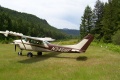
Wren 460 - Ken Foote
Fri Jan 09, 2009 3:32 pm
I had a 180hp pacer for a while. It may have had a longer prop then yours,? It didn't have that much prop clearance. I would not hold brakes and go full power on beaches and sandy places, or you will file on your prop. Big tires would help with that.
Have fun and be careful
Have fun and be careful
- patrol guy offline
- Posts: 1749
- Joined: Wed Apr 11, 2007 2:52 pm
- Location: east of the river
...remember, life is uncertain, eat desert first!
... and, those that pound their guns into plows, will plow for those who don't.
... and, those that pound their guns into plows, will plow for those who don't.
Fri Jan 09, 2009 4:07 pm
hicountry wrote:Don't know about the Pacer, check the POH for the 170 on takeoff distance with the different flap settings...it may surprize you.
HC
There is no mention of take-off with full flaps in the POH, which is actually not at all surprising, for flap settings 30 and 40 degrees are for landing only by design and listed in the limitations as such.
- Scolopax offline
- Posts: 1696
- Joined: Tue Sep 27, 2005 5:02 pm
- Location: Nottingham
- FindMeSpot URL: http://share.findmespot.com/shared/face ... 4aYqSexnZC
Fri Jan 09, 2009 9:34 pm
Thanks for all input everyone, the next day we have here that the darn wind isn't blowing 20 - 30 I'll be out trying out you suggestions. I must say I'm impressed with the number and quickness of the responses. Thanks everyone.
Mike
Mike
- pacerflyer offline
- Posts: 30
- Joined: Thu Jan 08, 2009 4:11 pm
- Location: Bar harbor
- Aircraft: Piper PA12
Fri Jan 09, 2009 11:08 pm
I'd suggest that you read about everyone's pet short-field techniques, and then go out and play around trying out all of them. The try some of them combined with each other. Somewhere in all them techniques is the one(s) that will work for you.
Simpler is quite often better, that goes for technique as well as for equipment. Have fun, and don't bend anything.
Eric
Simpler is quite often better, that goes for technique as well as for equipment. Have fun, and don't bend anything.
Eric
Cessna Skywagon -- accept no substitute!
Sat Jan 10, 2009 6:15 am
Yeah, yanking on flaps right before rotate speed is the technique to use when feet and inches count.
Here are some things to consider:
-As you've mentioned, it's easy to get distracted and veer off runway heading, especially in a crosswind.
-Pulling flaps down will cause a nose-down pitching moment, so you need to coordinate the flap pull with some up elevator.
-Full flaps is good for breaking ground but they are bad for accelerating to Vx and Vy speeds. Usually short field technique is for a short runway followed by some trees. If you pull full flaps and break ground then you need to start taking some flaps out very shortly thereafter to accelerate before you start to climb. But, taking flaps out will cause settling back down and a nose-up pitching moment. Again the elevator has to be active.
-Does full-flaps on the Pacer blank out any of the elevator authority at slow speeds?
Like Eric said, go out and play with the different techniques and find out what works for you and your plane.
Changing the topic slightly, what kind of tires do you have on your Pacer? Do you have skis? Larger-than-stock tires make for good off-airport operations on some of the rivers and lakes in N Maine. I have balloon tires (21x12) on the Kitfox and I keep up with a local Champ on skis. Let's go fly...except for that darn wind.
Here are some things to consider:
-As you've mentioned, it's easy to get distracted and veer off runway heading, especially in a crosswind.
-Pulling flaps down will cause a nose-down pitching moment, so you need to coordinate the flap pull with some up elevator.
-Full flaps is good for breaking ground but they are bad for accelerating to Vx and Vy speeds. Usually short field technique is for a short runway followed by some trees. If you pull full flaps and break ground then you need to start taking some flaps out very shortly thereafter to accelerate before you start to climb. But, taking flaps out will cause settling back down and a nose-up pitching moment. Again the elevator has to be active.
-Does full-flaps on the Pacer blank out any of the elevator authority at slow speeds?
Like Eric said, go out and play with the different techniques and find out what works for you and your plane.
Changing the topic slightly, what kind of tires do you have on your Pacer? Do you have skis? Larger-than-stock tires make for good off-airport operations on some of the rivers and lakes in N Maine. I have balloon tires (21x12) on the Kitfox and I keep up with a local Champ on skis. Let's go fly...except for that darn wind.

Sat Jan 10, 2009 11:46 am
I did loose some elevator authority when I added the VGs, but the VGs on the underside of the elevator was supposed to counter act that and it did to some extent. The gain in slow flight aileron control is worth what elevator loss there was.
Someone at the airport here suggested having the flap handle curved so that it is higher in between the seats and easier to reach. Right now I'm going to just practice what I've read in the POH and try some of the ideas suggested here.
Someone at the airport here suggested having the flap handle curved so that it is higher in between the seats and easier to reach. Right now I'm going to just practice what I've read in the POH and try some of the ideas suggested here.
- pacerflyer offline
- Posts: 30
- Joined: Thu Jan 08, 2009 4:11 pm
- Location: Bar harbor
- Aircraft: Piper PA12
Sat Jan 10, 2009 4:41 pm
As a general rule for most light aircraft, the flap setting that matches the number of degrees of deflection of an aileron at full deflection will be the flap setting that gives the most lift without excess drag.
So much for general rules because my 235 Maule's shortest T/O is with full flap IF I'm light and at low DA. The excess HP overcomes the excess drag
The ONLY reason that I can come up with to not set the flaps prior to the T/O roll is that flaps being down may block some airflow over the tail and may delay it from flying just a little bit. As has been mentioned the drag from flaps at slow airspeed is negligable. If your aircraft "pops" into the air as you pull flaps, it would have wallowed off even sooner if the flaps had been there to begin with. Nothing dynamic happens from popping flaps that makes an airplane jump into the air, if it jumps into the air, you delayed flap application for too long. Unless you know your aircraft so well that you can tell exactly when to pop flaps, your better off setting them prior to the T/O roll or just after the tail starts flying, in my opinion.
You'll think I'm crazy, but when your practicing short T/O's cover or ignore the airspeed indicator and start trying to "feel" when she is ready to fly.
So much for general rules because my 235 Maule's shortest T/O is with full flap IF I'm light and at low DA. The excess HP overcomes the excess drag
The ONLY reason that I can come up with to not set the flaps prior to the T/O roll is that flaps being down may block some airflow over the tail and may delay it from flying just a little bit. As has been mentioned the drag from flaps at slow airspeed is negligable. If your aircraft "pops" into the air as you pull flaps, it would have wallowed off even sooner if the flaps had been there to begin with. Nothing dynamic happens from popping flaps that makes an airplane jump into the air, if it jumps into the air, you delayed flap application for too long. Unless you know your aircraft so well that you can tell exactly when to pop flaps, your better off setting them prior to the T/O roll or just after the tail starts flying, in my opinion.
You'll think I'm crazy, but when your practicing short T/O's cover or ignore the airspeed indicator and start trying to "feel" when she is ready to fly.
Sat Jan 10, 2009 9:32 pm
a64pilot wrote:As a general rule for most light aircraft, the flap setting that matches the number of degrees of deflection of an aileron at full deflection will be the flap setting that gives the most lift without excess drag..................
I've never heard this one. Is that something you've discovered by experimentation, or did you hear about it somewhere? Now I'm gonna have to see where that flap setting is on my airplane, and see how it works out.
Eric
Cessna Skywagon -- accept no substitute!
Sat Jan 10, 2009 9:36 pm
a64pilot wrote:.........You'll think I'm crazy, but when your practicing short T/O's cover or ignore the airspeed indicator and start trying to "feel" when she is ready to fly.
Not crazy at all. That "rotate at 50" or whatever business is great for new students, but takeoff should be done by feel when you're farther along. On several of the airplanes I've flown, it seems like it's about to leave the ground when the tail starts flying. The 170 tail floats up by itself, the 150 takes too long to come up on it's own so you have to give it a little help.
Eric
Cessna Skywagon -- accept no substitute!
Sun Jan 11, 2009 12:23 pm
hotrod150 wrote:a64pilot wrote:As a general rule for most light aircraft, the flap setting that matches the number of degrees of deflection of an aileron at full deflection will be the flap setting that gives the most lift without excess drag..................
I've never heard this one. Is that something you've discovered by experimentation, or did you hear about it somewhere? Now I'm gonna have to see where that flap setting is on my airplane, and see how it works out.
Eric
I'm not that smart, I read it somewhere, but have no idea where. It's one of those things that makes sense, but would be hard to prove
Sun Jan 11, 2009 1:05 pm
During the checkout in my 170 a few years back, the instructor had me do a 3-point takeoff as one of the first exercises. I had never done that before in a taildragger, but it was really eye opening and different.
10 or 20 deg flaps, hold light aft stick to keep the tail on the ground, and fly it off in that 3-point attitude. The stall horn starts chirping, and it's a touchy-feely game of reducing attitude without settling too much, while trying to get closer to an attitude that lets you build airspeed quicker.
In a low HP Cessna, I don't know if it's that great of a an actual takeoff technique, but it's good practice. I think it would be a good exercise in any aircraft.
For real world soft or rough field techniques, not weighting the tailwheel too much is important, so this is the kind of thing that would help find that optimum aft stick pressure to maintain max angle of attack without ripping the tailwheel off by getting it just barely unweighted or off the ground.
10 or 20 deg flaps, hold light aft stick to keep the tail on the ground, and fly it off in that 3-point attitude. The stall horn starts chirping, and it's a touchy-feely game of reducing attitude without settling too much, while trying to get closer to an attitude that lets you build airspeed quicker.
In a low HP Cessna, I don't know if it's that great of a an actual takeoff technique, but it's good practice. I think it would be a good exercise in any aircraft.
For real world soft or rough field techniques, not weighting the tailwheel too much is important, so this is the kind of thing that would help find that optimum aft stick pressure to maintain max angle of attack without ripping the tailwheel off by getting it just barely unweighted or off the ground.
- Zzz offline


- Posts: 2855
- Joined: Fri Oct 08, 2004 11:09 pm
- Location: northern
- Aircraft: Swiveling desk chair
Half a century spent proving “it is better to be thought a fool than to open your mouth and remove all doubt.”
Sun Jan 11, 2009 1:30 pm
d.grimm wrote:Check the Tri-Pacer/Pacer Operating Handbook, the pulling full flaps on takeoff is the method described with the note that this can decrease ground roll by up to 40%.
Dave
Hmmm, mine ('57 PA-22) says, "...full flaps as take-off speed is approached will reduce the take-off run about 20%. Flaps can be pulled down before the take-off run is started but will reduce the acceleration of the plane somewhat if kept down throughout the take-off."
Which is to say, they don't give a number for how much of the gain you lose for applying the flaps before commencing the ground run. Also, I was a little startled when folks here said 'full flaps'--I've always just popped on the first notch, which certainly helps to, at least, cleanly pop off the ground, even if it doesn't shorten the roll much.
I just posted a scan of my POH, if anyone wants to have a look. Also, two more bits that are kind of interesting, perf-charts from the Australian certification (I think.) These take current conditions and available runway, and solve for how much weight you can take.
http://www.siletzbay.com/Other/
(I'm so glad I scanned that POH--I've misplaced the original during an extended annual. (Ask me about my Stewart tips!)
Benton 11jan09
Sun Jan 11, 2009 1:50 pm
As I understand it aileron deflection is limited to the point to where the drag curve starts getting steep to reduce the amount of adverse yaw.
Just for giggles have you noticed that the hinge point on almost all ailerons is offset which causes the front of the aileron to hang down into the airflow as the trailing edge comes up? And have you noticed that on some airplanes there is a difference in the amount of aileron deflection from the one that deflects up and the one that deflects down?
Just for giggles have you noticed that the hinge point on almost all ailerons is offset which causes the front of the aileron to hang down into the airflow as the trailing edge comes up? And have you noticed that on some airplanes there is a difference in the amount of aileron deflection from the one that deflects up and the one that deflects down?
DISPLAY OPTIONS
Who is online
Users browsing this forum: No registered users and 3 guests
Latest Features
-
Live to Tell
A Minnesota pilot is surprised to learn that the sudden asymmetric drag of an out-of-rig ski can…Read More -
Creators
Working in some of the Yukon's most beautiful and remote environments, photographer Simon Blakesley captures aircraft in…Read More -
Aircraft Ownership and Maintenance
Upgrading to big tires can make a huge difference in backcountry performance, but with those gains come…Read More -
Tales from Yesteryear
In this tale from bush flying yesteryear, Don Cogger signs up to help Atlee Dodge Jr recovery…Read More


Latest Knowledge Base
-
Destinations
A regional guide with ideas for winter camping destinations in California, Nevada, New Mexico, and Arizona.Read More -
Aircraft
Finding an affordable aircraft that can handle the backcountry for $80K or less? A challenge for sure, but with the…Read More -
Aircraft
01.29.2018 - Zane - Updated tire diameter graphic to add 8.50x10 Guide to tires for use in the backcountry and off-airport landing…Read More -
Pilots
12.22.2013 - Initial article format Operating aircraft on skis and negotiating a snow-covered landscape is an entirely unique skillset and environment.…Read More


