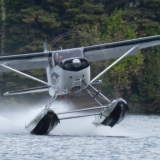
I hope I never have a bad day like those pilots whose crashes triggered this AD, but in defense of those who have ended up inverted in a floatplane, I think it is easier than some of us would like to think.
Take a look at this scene from the movie, “Motherlode,” where the Beaver went over incredibly quickly:
https://www.youtube.com/watch?v=AgHmTanno0EGranted there are a few things wrong with this landing, but the main cause was the pilot landed too flat, where the center of pressure, or point of rotation, was in front of the CG, so the aircraft had negative stability, like in a taildragger. There is an excellent description in Burke Mees’ book, Notes of a Seaplane Instructor, about yaw stability on the step. Pitching up, like we do naturally upon touching down on the water, moves the center of pressure behind the CG and the aircraft becomes positively stable. The Beaver in this movie scene, for which the crash was unplanned, landed too flat, was negatively stable, yawed left, dragged a wingtip and went over quite quickly.
I think the same thing might have happened in the Homer 206 crash that Headoutdaplane recounted, although the NTSB simply blamed it on landing with a rather strong quartering tailwind. The pilot was quite experienced, even on floats, but I believe he relied on the ATIS for an airport adjacent to the lake and the wind directions were very different. That is one of the many reasons that I always circle a lake before setting up to land. But as Burke explains in his book, downwind landings tend to pitch the plane forward and into the region of negative stability.
As Headoutdaplane also noted, lots of good pilots have ended up inverted. I brought up the issue of yaw stability on the step because I believe it is not commonly understood and it is a very easy way to “water loop” a floatplane and end up inverted, along with lots of other ways.
Also, getting out of an inverted, flooded airplane is not as easy as one might think. I went through the dunk tank training several years ago and it was a real eye opener. Highly recommended training. Of course, not being able to get the door open makes egress all that much more difficult.
Ross