Flew the junker 172 up to Oregon this last weekend and ran pretty hot oil temps up and back. At Reno I leaned for max rpmfor the takeoff, richen slightly for the climb, and by almost TOC I was redlining the oil temp. This was at 7:00am, 8500 msl, 60-70 degrees F.
No cooling in straight and level flight at 2200 rpm, so I got kinda concerned and just went full rich and 2000 rpm for about 30 min and it seemed to drop a little bit. Tough cuz it slows considerably at that power setting and I basically had to just let her descend about 6-700 feet finally to get some cooling effectiveness. After that it seemed to hold at about 85% on the oil temp guage, and I was able to climb back upu to 8500 and keep it at an acceptably warm temp.
Are high air temps just to blame? I leaned for 75 degrees rich of peak EGT, but then just chose full rich over combustion efficiency for fear of smoking something.
Tips?
Zane
Running hot, what do you do?
Sun Jul 17, 2005 4:17 pm

Mon Jul 18, 2005 10:26 pm
Zane, is the 172 powered by Continental or Lycoming? I've always hears that the Lycoming 320's run fairly cool. My experience is that the Cont C-145/O-300 is notorious for running hot in the summer. Also that oil temp gauges --especially the stock gauges with only the redline (225) temp marked on them -- are notoriously inaccurate. Like Jr said, using 50wt (W100) bumps the redline to 240, up from 225 with W80.
I wouldn't worry too much if it bumps up against the redline, just keep an eye on it. But you should take corrective action if it exceeds redline.
This is a rental/club airplane, not your own mount? Maybe squawk the gauge & ask that it be pulled & checked. I check them by dipping the sensor bulb in a pot of boiling water- remember, water boils at sea level at 212 degrees.
Also make sure the baffling & blast tubes are all in good shape.
One of my 170 cohorts has modified his airplane for Arizona op's by opening up the hole in the nosebowl that allows air to blow on the oil sump.
Eric
I wouldn't worry too much if it bumps up against the redline, just keep an eye on it. But you should take corrective action if it exceeds redline.
This is a rental/club airplane, not your own mount? Maybe squawk the gauge & ask that it be pulled & checked. I check them by dipping the sensor bulb in a pot of boiling water- remember, water boils at sea level at 212 degrees.
Also make sure the baffling & blast tubes are all in good shape.
One of my 170 cohorts has modified his airplane for Arizona op's by opening up the hole in the nosebowl that allows air to blow on the oil sump.
Eric

Mon Jul 18, 2005 10:34 pm
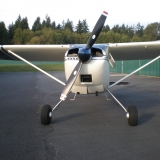
It's a '74 M model, powered by a RAM 160HP Lyc. The redline on the gauge is 245, and I was bumping right up against that. I've never redlined an engine before, does the needle go beyond the red mark? How can you tell if you're REALLY in trouble?
I was going to squawk it but I was rendered temporarily more stupid by the hot weather on the ramp. If I owned this aircraft I'd be all over it trying to cool it down, like your buddy.
Z
I was going to squawk it but I was rendered temporarily more stupid by the hot weather on the ramp. If I owned this aircraft I'd be all over it trying to cool it down, like your buddy.
Z
Tue Jul 19, 2005 12:25 pm
172's came with the Continental 0300D(145 HP) until about 1969. Then converted to the Lycoming 0320(150). Zane, if the sending unit doesn't fix it then I would be looking at the cooler. I've had a few that were partially plugged with junk.
That aside, I generally just adjust my climb airspeed to compensate for hot cylinders or oil. Pretty much any time I fly here in Texas between May and October, I will climb at 110 mph indicated with the cowl flaps open to keep the oil temp below 225.
Bill
That aside, I generally just adjust my climb airspeed to compensate for hot cylinders or oil. Pretty much any time I fly here in Texas between May and October, I will climb at 110 mph indicated with the cowl flaps open to keep the oil temp below 225.
Bill
- Squawk1200 offline
- Posts: 39
- Joined: Tue Jul 12, 2005 1:56 pm
- Location: Houston, Texas
Mon Jul 25, 2005 11:15 am
Check the oil level.
If it's the 0320 and your running on 4 quarts or so, just bumping the level up to 7 or 8 quarts will cool you down.
Not many people think of this during the summer months. But keeping your oil level up during hot summer days does make a difference.
If it's the 0320 and your running on 4 quarts or so, just bumping the level up to 7 or 8 quarts will cool you down.
Not many people think of this during the summer months. But keeping your oil level up during hot summer days does make a difference.
- Supercubber offline

- Posts: 213
- Joined: Sat Jul 16, 2005 1:18 pm
- Location: Rocky Mtns
Fly It Like You Mean It!
Tue Feb 14, 2006 11:48 pm
Whatch the MIX
Zane,
Good idea to enrich the mixture, but your really have to be careful b/c of the altitudes your flying at. 320's have a tradition of fouling plugs unless there leaned correctly (most people don't fly them out west when your at 10,000' @ cruise, so it's not a problem for them). My 172 that I fly in Idaho from a 6000' MSL strip needs a good mixture check when I run it up and at cruise, otherwise I will get a plug that will fowl, and that will usualy get your attention when it starts turning on only three jugs. With that said, a properly maintained 320 should never get anywhere close to the red line. With my experience of 1200 hrs in hawks, I have never seen them get past the mid portion of the oil temp gauge. Your situation would have definitly alarmed me, but if the oil press is staying within limits you probably have a gauge problem. The oil temp gauge on 320's are electrically routed to the gauge, unlike the oil press gauge which is mechanically linked (statistically less faults). For what it's worth, the hawk I fly in the winter in Idaho runs so cool I have to put a cardboard fitting over one of the ram air inlets (like diesel trucks) so I can at least get a little oil temp indication (don't tell the FAA)! The other problem that I've noticed over the years is that rental 172's are usually used for training and who knows what the guy before you was doing with that mixture control to effect the engine down the road.
Good idea to enrich the mixture, but your really have to be careful b/c of the altitudes your flying at. 320's have a tradition of fouling plugs unless there leaned correctly (most people don't fly them out west when your at 10,000' @ cruise, so it's not a problem for them). My 172 that I fly in Idaho from a 6000' MSL strip needs a good mixture check when I run it up and at cruise, otherwise I will get a plug that will fowl, and that will usualy get your attention when it starts turning on only three jugs. With that said, a properly maintained 320 should never get anywhere close to the red line. With my experience of 1200 hrs in hawks, I have never seen them get past the mid portion of the oil temp gauge. Your situation would have definitly alarmed me, but if the oil press is staying within limits you probably have a gauge problem. The oil temp gauge on 320's are electrically routed to the gauge, unlike the oil press gauge which is mechanically linked (statistically less faults). For what it's worth, the hawk I fly in the winter in Idaho runs so cool I have to put a cardboard fitting over one of the ram air inlets (like diesel trucks) so I can at least get a little oil temp indication (don't tell the FAA)! The other problem that I've noticed over the years is that rental 172's are usually used for training and who knows what the guy before you was doing with that mixture control to effect the engine down the road.
Wed Feb 15, 2006 4:36 pm
The 1968 172K was the first 172 with the Lycoming engine, using the O-320E2D. A bulletproof, cool running, non-plug-fowling version of the O-320. This engine was factory until the 1977 172N using the O-320H2AD. This engine is trouble. Note the last two characters "AD". Lotsofem on this engine. It fowls plugs if you don't lean almost to the point of fuel starvation during taxi.
The 172K was also the last model of the 172 utilizing the spring steel landing gear - nice for unimproved runways. It also still has the semetrical leading edge section (used through the "M" model) that still lets you spin the airplane. The "K" model is my favorite 172!
Now that I've spouted all that trivia, like everyone else said, your high oil temp indication is probably a peripheral problem if the pressure is good....
M
The 172K was also the last model of the 172 utilizing the spring steel landing gear - nice for unimproved runways. It also still has the semetrical leading edge section (used through the "M" model) that still lets you spin the airplane. The "K" model is my favorite 172!
Now that I've spouted all that trivia, like everyone else said, your high oil temp indication is probably a peripheral problem if the pressure is good....
M
Last edited by punkin170b on Wed Feb 15, 2006 5:28 pm, edited 1 time in total.
- punkin170b offline

- Posts: 210
- Joined: Fri Feb 04, 2005 4:48 pm
- Location: Northern UT
"Rule books are paper, they will not cushion a sudden meeting of stone and metal." E.K. Gann

Sun Feb 26, 2006 3:51 pm
Zane,
Too late for someone who's fallen into the 170 pit , I reckon, but the FIRST thing to do in a case like this is pull the sender unit out of the motor, put it in boiling water, and see what the gauge says. If it reads 300 degrees, you pretty much have a clue as to the culprit.
O-320's of this vintage are generally pretty cool running motors, so I was them, I'd be trying to track this down before something ugly happens.
I had an O-320 in a Cub that ran hot all the time. Checked the sender, dead on, had the cooler boiled and cleaned, no change. Turned out to be a couple of broken rings, a burned piston, and a LOT of blowby. We found it finally, by following the Lycoming guy's recommendation of using an automotive compression tester. It passed a differential compression test just fine. Failed the automotive compression test on two of four cylinders.
I've also seen at least two of these engines that had been taken off a Twin Comanche. In that application, they use a constant speed prop, and they hadn't taken the rear plug out of the crank when they converted it to fixed pitch. No oil circulation. Both these engines came out of the same aircraft rebuild outfit, by the way, and probably off the same Comanche.
Anyway, none of these are good things, and an O-320 really shouldn't run that hot.
MTV
Too late for someone who's fallen into the 170 pit
, I reckon, but the FIRST thing to do in a case like this is pull the sender unit out of the motor, put it in boiling water, and see what the gauge says. If it reads 300 degrees, you pretty much have a clue as to the culprit.
O-320's of this vintage are generally pretty cool running motors, so I was them, I'd be trying to track this down before something ugly happens.
I had an O-320 in a Cub that ran hot all the time. Checked the sender, dead on, had the cooler boiled and cleaned, no change. Turned out to be a couple of broken rings, a burned piston, and a LOT of blowby. We found it finally, by following the Lycoming guy's recommendation of using an automotive compression tester. It passed a differential compression test just fine. Failed the automotive compression test on two of four cylinders.
I've also seen at least two of these engines that had been taken off a Twin Comanche. In that application, they use a constant speed prop, and they hadn't taken the rear plug out of the crank when they converted it to fixed pitch. No oil circulation. Both these engines came out of the same aircraft rebuild outfit, by the way, and probably off the same Comanche.
Anyway, none of these are good things, and an O-320 really shouldn't run that hot.
MTV


DISPLAY OPTIONS
Who is online
Users browsing this forum: No registered users and 4 guests
Latest Features
-
-
Featured Bush Planes
As one of the undisputed legends of bush flying, the Cessna 180 hauls a…Read More -
Aircraft Ownership and Maintenance
9 modification mistakes aircraft owners make when trying to "bush out" their birds—why some…Read More -
Live to Tell
A Minnesota pilot is surprised to learn that the sudden asymmetric drag of an…Read More




Latest Knowledge Base
-
Destinations
Canada offers some of the most spectacular backcountry flying on the continent. Here's what you need to know before you go.Read More -
Safety and Survival
Hope that you never have to use your survival vest but knowing you have it and knowing how to use…Read More -
Destinations
A regional guide with ideas for winter camping destinations in California, Nevada, New Mexico, and Arizona.Read More -
Aircraft
Finding an affordable aircraft that can handle the backcountry for $80K or less? A challenge for sure, but with the…Read More



