What we have been discussing involves flying your airplane to the limits of it's performance envelope, something many pilots never do. When you do this, you become in effect a test pilot. Well, if you're going to be a test pilot, why not act like one? Here's two scenarios to illustrate the difference between you and I and a bona fide test pilot.
You and I : Well, I think I'll go out to a dirt strip I know and find out just how short I can land this thing.
I'm alone in the plane with half gas so I should get real good performance.
It's about 75 degrees and the wind is about 5 kts from the South, a quartering headwind.
I know the strip is 1400 feet long so I should get stopped in half that.
I'm going to use full flaps and power to hold about 60 mph at first, then reduce the speed for the next approach.
I'll chop the power in the flare and when I'm on the ground brake hard.
Whee!
Test pilot: Today is the 25th of March, 2007. The flight regimen is to determine the shortest landing distance for N2546Q, a 1968 C-172F, serial No. 172-34576. This aircraft has no modifications, it is loaded to gross weight of 2500 lbs, and the CG is at 36.8 inches aft datum.
It has 2487 total time and the engine was overhauled by K & S Engineering 346 hours ago. It has a cruise prop of 56 inch pitch.
The landing field is S61, in Olathe, KS. It is 1475 feet long and 50 feet wide at an elevation of 2465 feet. The runway is 03/21 and the Southwest end is 50 feet higher than the Northeast end for a 1.2% gradient. The surface is grass, mowed last week to 2 inch height. There are 12 white gallon bottles at exactly 100 foot invervals on each side of the runway starting at the threshold of Rwy 21. Joe is my ground person and we will be using 122.75 for communications.There was no dew this morning. The temperature is 64 degrees with a dewpoint of 52 for a RH of 56%. Altimeter is 30.21. Density altitude is 3975 feet. The wind is 170 at 5 gusting 8.
First landing: Approach airpeed 65 mph with full flaps, turn base at 3065 feet, 1/2 mile final at 2765 feet, aiming point 2nd set of bottles (100 feet), flare and reduce power to idle, on ground contact raise flaps, hold nose off, and apply heavy braking.
Result: 846 feet from threshold.
Second landing: same except 63 mph airspeed on final. Result: 782 feet.
Third landing: same except 60 mph airspeed. Result: 701 feet.
Fourth landing: same except 58 mph airspeed. Result: 658 feet. Aircraft is starting to feel mushy on final, needing 100 more RPM to hold glideslope.
Fifth landing: same except aiming point shifted to threshold. Result: 550 feet.
Sixth landing: same except reduce speed to 56 mph.....well, no, I was too uncomfortable on that last landing and the wind has come up to 160 at 8-10, so we'll call it a day. Best distance was 550 feet, average distance 750 feet, so I'll put 750 feet in the book.
OK, you get the picture, need I say that every single detail was written down in a permanent log and signed?
I just used numbers off of the top of my head purely for illustration, they are not accurate.
Y'all be careful out there!
Rocky

PS: Although I have never been a professional test pilot, I have met a few and read their books, and some of the operations I have been involved in were definitely in the test pilot category! I just wish the second item hadn't come before the first!
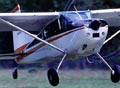
 Hey lets fly for that $100 burger at Fields. Have a burger and milk shake and see if the gross weight increase has any effect on departure.