Anyone into soaring? The bug has bitten me lately. I took a 15 min ride about 10 years agoin a sailplane in Santa Ynez, and it was so exhilarating. I've also found a new interest in paragliding, which, while not a 3-axis controlled aircraft, is still a great platform for free flying and soaring.
Anybody else here similarly afflicted?
Z
Soaring
Sun May 01, 2005 5:20 pm
Sun May 01, 2005 8:15 pm
Soaring
O.K., I'll bite that bait. I've had my glider rating since 1982. It was the first rating I earned, and I love the sport, but if you get involved enough to want to fly cross-country or compete, beware. This sort of endeavor can be very hard on a relationship if you expect your significant other to sit around a hot dusty airport for hours on end, waiting to chase you around with a glider trailer, while you're merrily scaring the crap out of yourself landing in some cow pasture a hundred miles away, then getting home at four-thirty in the morning before a work day after said hundred mile retrieve.
I came to the realization that I needed to find a better way to share my love of aviation with my wife in a more equal way in the interest of domestic harmony, so I went out and got my SEL rating in the early nineties and now we spend most of our time in that persuit of the perfect backcountry campsite and other cross-country travel intead. Now I get to scare the crap out of both of us landing at remote backcountry airstrips instead
 ... and the funny thing is that she enjoys it. I consider myself very lucky in more ways than one.
Soaring can be a very expensive habit, so I had to make a economic decision and choose my favorite tasting poison so to speak. So I'm sort of out of the sport until later in my life (I hope) or until I become wealthy (fat chance).
If you want to soar competitively be prepared to spend big bucks to be competitive. If you want to fly cross-country in a sailplane (where the real accomplishment is) then be ready for moments of stark fright once in a while - but hey, that's not much different than powered flight, you just don't get to share it with somebody else in a single place sailplane.
I came to the realization that I needed to find a better way to share my love of aviation with my wife in a more equal way in the interest of domestic harmony, so I went out and got my SEL rating in the early nineties and now we spend most of our time in that persuit of the perfect backcountry campsite and other cross-country travel intead. Now I get to scare the crap out of both of us landing at remote backcountry airstrips instead
... and the funny thing is that she enjoys it. I consider myself very lucky in more ways than one.
Soaring can be a very expensive habit, so I had to make a economic decision and choose my favorite tasting poison so to speak. So I'm sort of out of the sport until later in my life (I hope) or until I become wealthy (fat chance).
If you want to soar competitively be prepared to spend big bucks to be competitive. If you want to fly cross-country in a sailplane (where the real accomplishment is) then be ready for moments of stark fright once in a while - but hey, that's not much different than powered flight, you just don't get to share it with somebody else in a single place sailplane.
- Strata Rocketeer offline
- Posts: 504
- Joined: Sat Mar 26, 2005 11:19 am
"I've been ionized, but I'm okay now." - Buckaroo Bonzai
Sun May 01, 2005 10:38 pm
How about the best of both world's (or maybe the worse)- a motorglider? There's one based at my airport, can't recall the make, but it has a Limbaugh (VW) engine & controllable full-feathering prop. He fires up, takes off & climbs to a suitable altitude &/or thermally location, and turns the engine off & glides around for a while. Then either re-starts or just deadsticks back home.Looks like a lot of fun.
As an added bonus, from what I understand it is classified as a glider not an airplane- SEL, and you do NOT need a medical. I don't know how they got away with that one but more power to them. Kind of a pre-LSA sport pilot thing.
Eric
As an added bonus, from what I understand it is classified as a glider not an airplane- SEL, and you do NOT need a medical. I don't know how they got away with that one but more power to them. Kind of a pre-LSA sport pilot thing.
Eric
Tue May 03, 2005 6:22 am
Motorgliders
Sounds like a Grob G109. It's a pretty good sailplane with the engine off and the prop feathered - about 25:1 L/D. You can actually fly it cross country at about 115 kts. under power, but about all you can carry is a change of underwear and a toothbrush. I've always thought it a little strange also that a power rating isn't needed to fly one of these things as they can be a handful on takeoff from the adverse yaw that 16.6 meter wing can create.

- Strata Rocketeer offline
- Posts: 504
- Joined: Sat Mar 26, 2005 11:19 am
"I've been ionized, but I'm okay now." - Buckaroo Bonzai
Tue May 03, 2005 7:58 pm
Tue May 03, 2005 9:14 pm
Price
Whoa, that's a tuff one. The plane went out of production in 1985 and there are only 28 registered in the U.S. I'll take a wild stab at it and guess that you could pick one up for $40-50K depending on the condition.
I'd rather have one of these, though. Stemme S10 When you get get your check book out be prepared to put a lot of zeros on the check.

I'd rather have one of these, though. Stemme S10 When you get get your check book out be prepared to put a lot of zeros on the check.
Last edited by Strata Rocketeer on Wed May 04, 2005 7:21 pm, edited 1 time in total.
- Strata Rocketeer offline
- Posts: 504
- Joined: Sat Mar 26, 2005 11:19 am
"I've been ionized, but I'm okay now." - Buckaroo Bonzai
Wed May 04, 2005 11:37 am
S10
Yeah, that's the one. The engine is behind the cockpit with the prop drive shaft running between the seats. Almost all gliders are pretty tight in the office because low wetted area is the name of the game so they can squeeze as much performance as possible out of the design. The S10 has a 50:1 glide ratio, so if you can see it, you can get to it. The price of admission is pretty steep though. Click the link in my post above for more info about the S10.
You and Zane are in one of the greatest places on earth for soaring. The Carson valley is world famous with the soaring community and Minden airport is home to a couple of world class soaring operations. A friend and I used to go to Reno for the air races every year and we always stopped at Minden for a couple of days on the way home to rent and fly their 'fast glass'. High Country Soaring and Soar Minden have a great collection of contemporary fiberglass sailplanes that you can rent (if you're qualified) and fly the mountain wave and cross-country in. That place is absolutely fabulous. High Country even had a Schempp-Hirth Nimbus 3 for rent for about a buck a minute when we were doing this back in 1982-86. The Nimbus 3 has a 24.5 meter wing span and a 60:1 L/D. Here's a picture of the 2 place model:

IMHO sailplanes are just as sexy as fighter jets, and they are both on the bleeding edge of aeronautical engineering.
You and Zane are in one of the greatest places on earth for soaring. The Carson valley is world famous with the soaring community and Minden airport is home to a couple of world class soaring operations. A friend and I used to go to Reno for the air races every year and we always stopped at Minden for a couple of days on the way home to rent and fly their 'fast glass'. High Country Soaring and Soar Minden have a great collection of contemporary fiberglass sailplanes that you can rent (if you're qualified) and fly the mountain wave and cross-country in. That place is absolutely fabulous. High Country even had a Schempp-Hirth Nimbus 3 for rent for about a buck a minute when we were doing this back in 1982-86. The Nimbus 3 has a 24.5 meter wing span and a 60:1 L/D. Here's a picture of the 2 place model:
IMHO sailplanes are just as sexy as fighter jets, and they are both on the bleeding edge of aeronautical engineering.
- Strata Rocketeer offline
- Posts: 504
- Joined: Sat Mar 26, 2005 11:19 am
"I've been ionized, but I'm okay now." - Buckaroo Bonzai
Thu May 05, 2005 5:33 pm
Doug,
You are so right. The Sierra are world famous for soaring, and recently a guy from SF set the world (or maybe just US?) distance record along the range. I was out flying at Stead one day when a guy on the CTAF started asking about the pattern and runways, turns out he was a glider pilot that had launched from the Bay area and made it all the way to Reno.
One thing I dont understand though about this area is that it seems like the prevailing wind when a wave situation occurs is from the west. Does the lifting portion of the wave then occur on the east side of the Carson Valley? Or is the much talked about choice wave when the wind is from the east, blowing up the east face of the Sierras? Wave is usually well above the terrain anyway, so perhaps the good lifting is just west of the peaks, more over by PLacerville? FIll me in Doug, I am grasping at straws here. I need to consult my FLying the Mountains book by Fletcher Anderson.
Z
You are so right. The Sierra are world famous for soaring, and recently a guy from SF set the world (or maybe just US?) distance record along the range. I was out flying at Stead one day when a guy on the CTAF started asking about the pattern and runways, turns out he was a glider pilot that had launched from the Bay area and made it all the way to Reno.
One thing I dont understand though about this area is that it seems like the prevailing wind when a wave situation occurs is from the west. Does the lifting portion of the wave then occur on the east side of the Carson Valley? Or is the much talked about choice wave when the wind is from the east, blowing up the east face of the Sierras? Wave is usually well above the terrain anyway, so perhaps the good lifting is just west of the peaks, more over by PLacerville? FIll me in Doug, I am grasping at straws here. I need to consult my FLying the Mountains book by Fletcher Anderson.
Z
Thu May 05, 2005 6:35 pm
Mountain Wave
Zane,
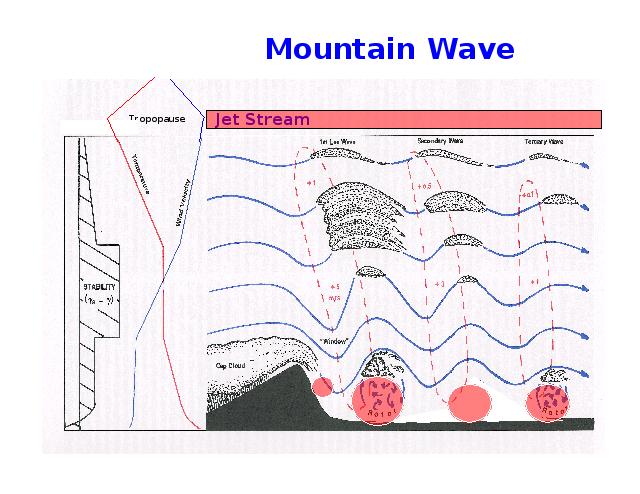
These two pictures illustrate very effectively how mountain wave works. The Sierra's are built in a way that makes them excellent wave producers - a long gentle slope with a steep drop off on the back side. They need a westerly wind perpendicular to the ridge top to generate the wave, ideally with a unstable airmass on the bottom and a stable airmass with steadily increasing winds with altitude on the top. The lower unstable airmass acts like a spring for the air flowing over the ridge to bounce off, producing a standing wave.
For a better mental picture think of water flowing over a rock in a stream. There is always a standing wave on the downstream side of the rock. Mountain wave works the same way. The moving air over the mountain functions just like a fluid in motion, and the same fluid dynamics apply.
The record distance flight that you were describing was a world record, flown in mountain wave, probably under an instrument flight plan flown entirely at the flight levels. Previous world distance records were flown in ridge lift and thermals down the Appalachian mountain chain from Pennsylvania to Tennesee (?) and back.
Recommended reading for sailplane and power pilots alike: Exploring The Monster
Excerpt from the Gliding Magazine book review - "Bob Whelan does a wonderful job of describing the thrills, and the life threatening hazards they faced, as they explored the unknown, at a time when most meteorologists just couldn't believe the stories they told. Most of the information was gathered from personal interviews with those involved. From Harland Ross soaring a Cessna 140 from 6,000 to 23,500', soaring a P-38 from 13,000 to 31,000', giving a power student an hour's lesson between 11,500 and 17,500' ALL with the engine off, tales of 'routine' turbulence of plus or minus 3g, to Bob Symons' "Do you want to set a world record today?", the meticulous preparation of the aircraft for flights in extreme conditions with temperatures frequently in the area of -70oC, and occasionally even lower in unheated cockpits, with the canopy inches deep in hoar frost on the inside, this is fascinating reading.
Any pilot considering flying in mountainous regions likely to produce lee waves would be well advised to read Larry Edgar's personal account of an encounter with a rotor cloud. The incredibly violent turbulence shook him to unconsciousness, leaving him temporarily blinded for 15 minutes, and falling with the rudder pedals wrapped round his feet, the rest of the aircraft having disintegrated around him after being subjected to forces calculated at -20 and +16g!"
Larry found himself going up while hanging in his parachute! He worried that his bail out bottle would run out of oxygen until he drifted into the downside of the rotor and took a wild ride down. I remember reading his story somewhere years ago and saying to myself "Holy S**t!" while I was reading it.
As an interesting anecdote, my glider instructor and I once flew the Sierra wave at night in a Cessna 172. We parked ourselves in the wave, pulled the throttle back to idle, and climbed in the wave to 12,500' (ahem). We sat there in serene motionlessness for a little over an hour enjoying to nightime view of the Owens Valley before allowing the wind to push us back into the down side of the wave and landing back at California City airport.


The Carson Valley is also a world class thermal producer in the warmer months (as you've no doubt experienced). But it's very unique in that the thermals tend to be very strong, sometimes 1500 fpm, and sometimes quite large in diameter with broad areas of gentle sink in between. This isn't the rule, but the local terrain and weather conditions make it a very common occurence. Occasionally, the thermals go all the way to 15,000' and even higher, especially over the White Mountains of the eastern Owens Valley. You can run down the crest of the ridge under a cloud street at the gliders redline, traveling over a hundred miles without making a turn in a thermal.
Here in AZ, thermals also tend to be pretty strong but most of the time they're closer together with what can sometimes be very ferocious sink in between them.
These two pictures illustrate very effectively how mountain wave works. The Sierra's are built in a way that makes them excellent wave producers - a long gentle slope with a steep drop off on the back side. They need a westerly wind perpendicular to the ridge top to generate the wave, ideally with a unstable airmass on the bottom and a stable airmass with steadily increasing winds with altitude on the top. The lower unstable airmass acts like a spring for the air flowing over the ridge to bounce off, producing a standing wave.
For a better mental picture think of water flowing over a rock in a stream. There is always a standing wave on the downstream side of the rock. Mountain wave works the same way. The moving air over the mountain functions just like a fluid in motion, and the same fluid dynamics apply.
The record distance flight that you were describing was a world record, flown in mountain wave, probably under an instrument flight plan flown entirely at the flight levels. Previous world distance records were flown in ridge lift and thermals down the Appalachian mountain chain from Pennsylvania to Tennesee (?) and back.
Recommended reading for sailplane and power pilots alike: Exploring The Monster
Excerpt from the Gliding Magazine book review - "Bob Whelan does a wonderful job of describing the thrills, and the life threatening hazards they faced, as they explored the unknown, at a time when most meteorologists just couldn't believe the stories they told. Most of the information was gathered from personal interviews with those involved. From Harland Ross soaring a Cessna 140 from 6,000 to 23,500', soaring a P-38 from 13,000 to 31,000', giving a power student an hour's lesson between 11,500 and 17,500' ALL with the engine off, tales of 'routine' turbulence of plus or minus 3g, to Bob Symons' "Do you want to set a world record today?", the meticulous preparation of the aircraft for flights in extreme conditions with temperatures frequently in the area of -70oC, and occasionally even lower in unheated cockpits, with the canopy inches deep in hoar frost on the inside, this is fascinating reading.
Any pilot considering flying in mountainous regions likely to produce lee waves would be well advised to read Larry Edgar's personal account of an encounter with a rotor cloud. The incredibly violent turbulence shook him to unconsciousness, leaving him temporarily blinded for 15 minutes, and falling with the rudder pedals wrapped round his feet, the rest of the aircraft having disintegrated around him after being subjected to forces calculated at -20 and +16g!"
Larry found himself going up while hanging in his parachute! He worried that his bail out bottle would run out of oxygen until he drifted into the downside of the rotor and took a wild ride down. I remember reading his story somewhere years ago and saying to myself "Holy S**t!" while I was reading it.
As an interesting anecdote, my glider instructor and I once flew the Sierra wave at night in a Cessna 172. We parked ourselves in the wave, pulled the throttle back to idle, and climbed in the wave to 12,500' (ahem). We sat there in serene motionlessness for a little over an hour enjoying to nightime view of the Owens Valley before allowing the wind to push us back into the down side of the wave and landing back at California City airport.
The Carson Valley is also a world class thermal producer in the warmer months (as you've no doubt experienced). But it's very unique in that the thermals tend to be very strong, sometimes 1500 fpm, and sometimes quite large in diameter with broad areas of gentle sink in between. This isn't the rule, but the local terrain and weather conditions make it a very common occurence. Occasionally, the thermals go all the way to 15,000' and even higher, especially over the White Mountains of the eastern Owens Valley. You can run down the crest of the ridge under a cloud street at the gliders redline, traveling over a hundred miles without making a turn in a thermal.
Here in AZ, thermals also tend to be pretty strong but most of the time they're closer together with what can sometimes be very ferocious sink in between them.
- Strata Rocketeer offline
- Posts: 504
- Joined: Sat Mar 26, 2005 11:19 am
"I've been ionized, but I'm okay now." - Buckaroo Bonzai
Fri May 06, 2005 9:06 am
WAVE
Here is an even better illustration of mountain wave. This picture shows a lennie cloud in the classic 'stacks of plates' configuration. I remember driving home from Mammoth Mountain one night during a near full moon and marveling at the lenticular clouds forming over the Owens Valley. They ran the entire length of the valley. I pulled over into a rest stop and sat there watching them for a while. The leading edge of the plates would move back and forth with the changing moisture content and wind speeds. The rotor clouds tumbled very quickly and one minute it would be dead calm where I was standing, the next minute the wind would howl when the rotor touched the ground. It was like watching the monster breath, and it was eery to say the least. Not a good night to be flying over the Sierra's.

- Strata Rocketeer offline
- Posts: 504
- Joined: Sat Mar 26, 2005 11:19 am
"I've been ionized, but I'm okay now." - Buckaroo Bonzai
Fri May 06, 2005 9:43 am
Incredible. That shot of the tall lenticular is awesome.
I trained in a nearly TBO C152 in the Santa Ynez valley, and climbout to get over the coast range to Santa Barbara was sometimes less than inspriing, even solo. So, I would fly out over Lake Cachuma, hugging the north side of the mountains, and if there was a north wind or the day was starting to heat up, I could get about a 1500 fpm climb and be over much faster.
I'm taking paragliding lessons in June, hoping to put some of my soaring theories to the test, but I would also really like to get some dual in some long wing fiberglass.
Z
I trained in a nearly TBO C152 in the Santa Ynez valley, and climbout to get over the coast range to Santa Barbara was sometimes less than inspriing, even solo. So, I would fly out over Lake Cachuma, hugging the north side of the mountains, and if there was a north wind or the day was starting to heat up, I could get about a 1500 fpm climb and be over much faster.
I'm taking paragliding lessons in June, hoping to put some of my soaring theories to the test, but I would also really like to get some dual in some long wing fiberglass.
Z
Wed May 11, 2005 8:51 pm
Zane,
Go here High Country Soaring and talk to Tom Stowers. He'll set the hook so deep you'll never be able to spit it out.
Go here High Country Soaring and talk to Tom Stowers. He'll set the hook so deep you'll never be able to spit it out.
- Strata Rocketeer offline
- Posts: 504
- Joined: Sat Mar 26, 2005 11:19 am
"I've been ionized, but I'm okay now." - Buckaroo Bonzai
Thu May 12, 2005 9:36 pm
Your Wallet
Just drop your wallet in an overnight envelope and send it now! On second thought scratch that idea...if you're like me, you've probably got less than ten dollars in it anyway. How about a good stock tip or the winning lottery numbers.
- Strata Rocketeer offline
- Posts: 504
- Joined: Sat Mar 26, 2005 11:19 am
"I've been ionized, but I'm okay now." - Buckaroo Bonzai
Mon Jan 23, 2012 3:55 am
Re: Soaring
I know this thread is ancient but it has some great photos and information. The link provided however about soaring in the Owens Valley is no longer valid. Does anyone here have information about any operators providing soaring/glider flights in the valley? Thanks.
Mon Jan 23, 2012 7:17 am
Re: Soaring
Not too much going on in Cal city rite now. Inyokern has a club I don't know if they have an instructor, Mountain Valley at Tehachapi does but is a bit far from the Sierra Wave. So. Cal Soaring at Llano get's wave when a storm comes in off of the Pacific from the south.
Sky Sailing at Warner Springs gets wave when the Pineapple express is blowing.
http://ssa.org/sport/map/map.html
Sky Sailing at Warner Springs gets wave when the Pineapple express is blowing.
http://ssa.org/sport/map/map.html
- Glidergeek offline

- Posts: 1937
- Joined: Sat Sep 06, 2008 8:02 pm
- Location: Hesperia
- Aircraft: 1968 P206C
DG 400
Mon Jan 23, 2012 7:25 am
Re: Soaring
The So. Calif. glider guys gather at the Lone Pine Airport in the Owens Valley each summer for a week here and there... they'd be able to introduce you to instructors or perhaps find an empty seat for you in a tandem glider. Soar Truckee has long been one of my favorite glider operations, also. The Minden folks are more famous, but the Sierra soaring from Truckee is stupendous. Lassen County is also a hidden soaring jewel.
I've been a glider pilot since 1991, and have been actively flying hang gliders since 1992... I'm an Advanced and Tandem HG pilot, and have some great flights in the Owens Valley and along the White Mtns., too.
I'd be curious to hear if you've been pursuing paragliding, Zane... they scare the $#!& out of me!
Been enjoying our C170B these past few years, too... but flying hang gliders is the "flyingest" flying I've yet experienced.
It's all great flying, though!
I've been a glider pilot since 1991, and have been actively flying hang gliders since 1992... I'm an Advanced and Tandem HG pilot, and have some great flights in the Owens Valley and along the White Mtns., too.
I'd be curious to hear if you've been pursuing paragliding, Zane... they scare the $#!& out of me!
Been enjoying our C170B these past few years, too... but flying hang gliders is the "flyingest" flying I've yet experienced.
It's all great flying, though!
N2865C 1954 Cessna 170B
2010 Airventure "Outstanding 170/180"
2010 Airventure "Outstanding 170/180"
Mon Jan 23, 2012 7:54 am
Re: Soaring
Rhymes wrote:... but flying hang gliders is the "flyingest" flying I've yet experienced.
It's all great flying, though!
Yes, it is. It was a lot of fun till I realized I was mortal. There are also a lot of divorces when spouses turn into 'hang drivers'.
Soaring was my favorite form of flying next to hang gliding and paragliding. I remember flying for almost an hour and a half on my first solo in a 2-33, and I was hooked. It is time consuming, you generally need a lot of friends and spare time, and $$ frankly. The culture of club flying is its own animal, and it's definitely not for everyone.
Mon Jan 23, 2012 12:36 pm
Re: Soaring
I moved to Minden, NV for the soaring, superb thermals in the summer and wave in the fall through early spring. I've owned a Stemme S10-VT, a remarkably capable motor glider that offers a lot of plusses - - but is somewhat demanding in terms of maintenance. I currently have an ASH26E (ZZ) (self launch w/ Wankel rotary) a real joy to fly.

ZZ in wave over the Carson Valley.
The local soaring FBO, "SoaringNV" (775) 782-9595, is available for glider rides, towing and instruction.
If you haven't tried it, go for an instruction flight rather than a "ride" - - you'll love it.
Disclaimer: I work for SoaringNV as a part time Pawnee tow pilot . . . I'm supposed to be their pilot of last resort when it's real busy and they can't get anyone else ('cause I really don't want to work all that much!), but I think they know I'm normally at the airport and avialable
ZZ in wave over the Carson Valley.
The local soaring FBO, "SoaringNV" (775) 782-9595, is available for glider rides, towing and instruction.
If you haven't tried it, go for an instruction flight rather than a "ride" - - you'll love it.
Disclaimer: I work for SoaringNV as a part time Pawnee tow pilot . . . I'm supposed to be their pilot of last resort when it's real busy and they can't get anyone else ('cause I really don't want to work all that much!), but I think they know I'm normally at the airport and avialable
bumper
Minden, NV
Husky A1-B
Minden, NV
Husky A1-B
Mon Jan 23, 2012 12:41 pm
Re: Soaring
Rhymes wrote:I'd be curious to hear if you've been pursuing paragliding, Zane... they scare the $#!& out of me!
This is a pretty old thread that's been resurrected (look at the date on the original post.) I did have a little fun with paragliding, but also had the crap scared out of me when I crashed on a boat tow launch. I walked away with some bruises and a little less skin, but it could have been much worse. I haven't done much to pursue soaring since then, but I'd like to at some point.
- Zzz offline


- Posts: 2857
- Joined: Fri Oct 08, 2004 11:09 pm
- Location: northern
- Aircraft: Swiveling desk chair
Half a century spent proving “it is better to be thought a fool than to open your mouth and remove all doubt.”
DISPLAY OPTIONS
Who is online
Users browsing this forum: No registered users and 16 guests
Latest Features
-
Live to Tell
A Minnesota pilot is surprised to learn that the sudden asymmetric drag of an out-of-rig ski can…Read More -
Creators
Working in some of the Yukon's most beautiful and remote environments, photographer Simon Blakesley captures aircraft in…Read More -
Aircraft Ownership and Maintenance
Upgrading to big tires can make a huge difference in backcountry performance, but with those gains come…Read More -
Tales from Yesteryear
In this tale from bush flying yesteryear, Don Cogger signs up to help Atlee Dodge Jr recovery…Read More


Latest Knowledge Base
-
Destinations
A regional guide with ideas for winter camping destinations in California, Nevada, New Mexico, and Arizona.Read More -
Aircraft
Finding an affordable aircraft that can handle the backcountry for $80K or less? A challenge for sure, but with the…Read More -
Aircraft
01.29.2018 - Zane - Updated tire diameter graphic to add 8.50x10 Guide to tires for use in the backcountry and off-airport landing…Read More -
Pilots
12.22.2013 - Initial article format Operating aircraft on skis and negotiating a snow-covered landscape is an entirely unique skillset and environment.…Read More


