Hi,
My buddy wants to strap plywood on his floats of his 172XP.
I’m looking to get comments on how to probably do it?
I guess we should cut the plywood in two and strap on the side of the floats. Is the right side preferable? Any strapping tips?
Or would it be possible to not cut the plywoods and put them under the floats where on the spreader bars?
There are only two sheets to moove so do you think it could all be done in one trip?
Thanks for your help!
Cheers
Strapping plywood to floats
Sun Jul 05, 2020 7:11 pm
Sun Jul 05, 2020 8:25 pm
Re: Strapping plywood to floats
First off, where are you located? In theLower 48 and the rest of the world, external loads are illegal. In Alaska, you just need a restricted A/W certificate and a sign off.
Second, what’s the thickness of said plywood? Plywood of different thicknesses has VERY different characteristics. Thicker is better, but thicker is also heavier.
Third, you are a poorly paid test pilot while flying external loads. Bad things can happen, and those can result in what many would call “Really bad shit” happening.
Fourth, where you strap the stuff is less important than HOW you strap it to the aircraft.
Fifth, how much seaplane experience does the prospective pilot have? Low time SES pilots have no business flying external loads. That’s my opinion, and we all know about those. That said, I’ve flown hundreds if not thousands of external loads....legally.
Sixth, how FAR do you plan to move this stuff? Are you going to have to fly over a congested area, housing, etc? Who’s going to get killed if one of these chunks gets loose?
I prefer to fly loads attached to the vertical struts. That would require you to cut the plywood lengthwise in two. In other words turn them into 2 x 8 foot pieces.
I prefer to fly loads on the pilots side so I can SEE them. That is contrary to FAA guidance, however. Their theory is in a crash, a load on pilots side may block the exit door. My theory is : Don’t crash. But I want to be able to SEE that load.
Which brings up the point of flying stuff on spreader bars. I’ve done it. The Beaver came with a lumber rack which laid lumber flat on the spreader bars. That works fine on the Beaver. On a Cessna, be very careful about center of gravity of lumber on the spreader bars. Also, by strapping stuff to the spreaders, you are effectively increasing the thickness and associated drag of the spreaders. And that flat plywood can affect airflow over the tail......and not in a good way at times. Refer back to my point three.
On smaller planes, I have strapped plywood crosswise on the floats, both to keep weight forward and to avoid disturbed airflow over the tail.
IF you’re actually going to do this, you need to make damn sure those pieces of wood are in ONE piece, and that they are SECURELY fastened to your aircraft. Your question as to whether you can carry two pieces at once is for you to decide.....ask yourself what’s the total weight of the two pieces? Will that get you ANYWHERE near gross weight? You do NOT want to fly external loads at or close to max gross weight.
Secondly, can you attach those two pieces together, then securely to the airframe? If the answer is anything other than “absolutely” then don’t even think about it.
And there are a dozen other issues involved. It can be done and safely done. But there are a lot of potential failure points. In my experience, external loads can be difficult to predict how they’ll fly.
Be careful. And remember, all the above is worth exactly what you paid for it.
MTV
Second, what’s the thickness of said plywood? Plywood of different thicknesses has VERY different characteristics. Thicker is better, but thicker is also heavier.
Third, you are a poorly paid test pilot while flying external loads. Bad things can happen, and those can result in what many would call “Really bad shit” happening.
Fourth, where you strap the stuff is less important than HOW you strap it to the aircraft.
Fifth, how much seaplane experience does the prospective pilot have? Low time SES pilots have no business flying external loads. That’s my opinion, and we all know about those. That said, I’ve flown hundreds if not thousands of external loads....legally.
Sixth, how FAR do you plan to move this stuff? Are you going to have to fly over a congested area, housing, etc? Who’s going to get killed if one of these chunks gets loose?
I prefer to fly loads attached to the vertical struts. That would require you to cut the plywood lengthwise in two. In other words turn them into 2 x 8 foot pieces.
I prefer to fly loads on the pilots side so I can SEE them. That is contrary to FAA guidance, however. Their theory is in a crash, a load on pilots side may block the exit door. My theory is : Don’t crash. But I want to be able to SEE that load.
Which brings up the point of flying stuff on spreader bars. I’ve done it. The Beaver came with a lumber rack which laid lumber flat on the spreader bars. That works fine on the Beaver. On a Cessna, be very careful about center of gravity of lumber on the spreader bars. Also, by strapping stuff to the spreaders, you are effectively increasing the thickness and associated drag of the spreaders. And that flat plywood can affect airflow over the tail......and not in a good way at times. Refer back to my point three.
On smaller planes, I have strapped plywood crosswise on the floats, both to keep weight forward and to avoid disturbed airflow over the tail.
IF you’re actually going to do this, you need to make damn sure those pieces of wood are in ONE piece, and that they are SECURELY fastened to your aircraft. Your question as to whether you can carry two pieces at once is for you to decide.....ask yourself what’s the total weight of the two pieces? Will that get you ANYWHERE near gross weight? You do NOT want to fly external loads at or close to max gross weight.
Secondly, can you attach those two pieces together, then securely to the airframe? If the answer is anything other than “absolutely” then don’t even think about it.
And there are a dozen other issues involved. It can be done and safely done. But there are a lot of potential failure points. In my experience, external loads can be difficult to predict how they’ll fly.
Be careful. And remember, all the above is worth exactly what you paid for it.
MTV


Sun Jul 05, 2020 9:09 pm
Re: Strapping plywood to floats
delete, drunk post
- Terry offline
- Posts: 1365
- Joined: Sat Nov 10, 2007 9:11 pm
- Location: Willamette Valley
- FindMeSpot URL: http://share.findmespot.com/shared/face ... 4GzPHI6t1d
Mon Jul 06, 2020 6:54 am
Re: Strapping plywood to floats
On my homebuilt PA-12-160 I've carried A FEW (10 max) 2 x 4's laid on top of the spreader bars on one side, up tight against the struts. No more than 8-footers is my rule, They are made into a single unit with the use of long deck screws with a protruding deck screw at each end to help the tie-down rope to prevent fore-and-aft movement.
I've carried SMALL pieces of plywood up against the outside of the struts. Again, make them into one unit. Bore a few holes for the tie-down ropes. I MIGHT carry 2 x 8 foot plywood that way, but I would NOT carry full sheets across the spreaders. The best advice I could get is that a small airplane gets a little "squirrely". Squirrely I don't need!
If you're building a cabin in the boonies, it's usually much more practical and safer to bite the bullet and just hire an Otter.
As I understand the Canadian rules, you can test fly an external load and, if it feels okay, you can make a logbook entry to that effect and then can carry on with as many loads as you like WITH THE SAME CONFIGUARATION. It's a pretty generous rule, so don't get carried away!
I've carried SMALL pieces of plywood up against the outside of the struts. Again, make them into one unit. Bore a few holes for the tie-down ropes. I MIGHT carry 2 x 8 foot plywood that way, but I would NOT carry full sheets across the spreaders. The best advice I could get is that a small airplane gets a little "squirrely". Squirrely I don't need!
If you're building a cabin in the boonies, it's usually much more practical and safer to bite the bullet and just hire an Otter.
As I understand the Canadian rules, you can test fly an external load and, if it feels okay, you can make a logbook entry to that effect and then can carry on with as many loads as you like WITH THE SAME CONFIGUARATION. It's a pretty generous rule, so don't get carried away!
Last edited by NunavutPA-12 on Mon Jul 06, 2020 7:52 am, edited 1 time in total.
- NunavutPA-12 offline
- Posts: 123
- Joined: Sat Feb 22, 2014 8:52 pm
- Location: Kugluktuk
Mon Jul 06, 2020 6:55 am
Re: Strapping plywood to floats
This is going to happen up north over no villages in Northern Quebec. Around 30mins flight over the bush. Only one pilot in there with low fuel.
I just gave the float rating to my friend but he wants ME to do it, I have over 1K hours on floats commercially and close to 3k total. But never did externl loadsmyself.
I’ll have to confirm but probably 5/8 marine plywood.
I am not confident with spreader bars strapping. 2X8 is what I was thinking, but not sure if I’ll take the 4 pieces in one shot. I was thinking right side for the prop flow, but I like the idea of seeing your load on the left. Now that I‘m thinking about it I might even do the right side and fly from the right seat (I’m use to it).
I’m still confident after reading that warning message. I do appreciate the importance of properly doing an external load. This is a good message.
I’d like to get more insight on how to really properly do the thing? Thanks for the input of first strapping in in one piece and then the entire one piece to the side of the airplane. That’s mostly what I want to know now... how do I properly strap that one piece to the Cessna? What do you mean exactly by crosswise? How much extra T/O distance to I APPROXIMATLY need? I guess that again it always vary from external load to the other for no clear reasons... 8 feet (2x8) is okay for a 172 (XP ISHAM with 2440)?
Thanks for your help!
I just gave the float rating to my friend but he wants ME to do it, I have over 1K hours on floats commercially and close to 3k total. But never did externl loadsmyself.
I’ll have to confirm but probably 5/8 marine plywood.
I am not confident with spreader bars strapping. 2X8 is what I was thinking, but not sure if I’ll take the 4 pieces in one shot. I was thinking right side for the prop flow, but I like the idea of seeing your load on the left. Now that I‘m thinking about it I might even do the right side and fly from the right seat (I’m use to it).
I’m still confident after reading that warning message. I do appreciate the importance of properly doing an external load. This is a good message.
I’d like to get more insight on how to really properly do the thing? Thanks for the input of first strapping in in one piece and then the entire one piece to the side of the airplane. That’s mostly what I want to know now... how do I properly strap that one piece to the Cessna? What do you mean exactly by crosswise? How much extra T/O distance to I APPROXIMATLY need? I guess that again it always vary from external load to the other for no clear reasons... 8 feet (2x8) is okay for a 172 (XP ISHAM with 2440)?
Thanks for your help!
Mon Jul 06, 2020 6:59 am
Re: Strapping plywood to floats
Thanks for your message!
« Bore a few holes » so you mean to do that in the plywood and then where exactly to you usually tie it down on the floats? Do you have any pictures?
Thanks!
« Bore a few holes » so you mean to do that in the plywood and then where exactly to you usually tie it down on the floats? Do you have any pictures?
Thanks!
Mon Jul 06, 2020 7:50 am
Re: Strapping plywood to floats
400888 wrote:Thanks for your message!
« Bore a few holes » so you mean to do that in the plywood and then where exactly to you usually tie it down on the floats? Do you have any pictures?
Thanks!
No photos, but plywood can be a little challenging to tie down. I tie it up against the struts (either side - my 'plane has a single pilot seat up front and seaplane doors). Making rope holes in the plywood pretty much guarantees that it won't get away from you, assuming you're good with knots.
Don't be that guy driving down the highway with a queen-sized mattress on the roof of his car. He always has his arm out the window "helping" to keep the load in place. (old Seinfeld joke).
Last edited by NunavutPA-12 on Mon Jul 06, 2020 10:55 am, edited 1 time in total.
- NunavutPA-12 offline
- Posts: 123
- Joined: Sat Feb 22, 2014 8:52 pm
- Location: Kugluktuk
Mon Jul 06, 2020 10:24 am
Re: Strapping plywood to floats
400888 wrote:This is going to happen up north over no villages in Northern Quebec. Around 30mins flight over the bush. Only one pilot in there with low fuel.
I just gave the float rating to my friend but he wants ME to do it, I have over 1K hours on floats commercially and close to 3k total. But never did externl loadsmyself.
I’ll have to confirm but probably 5/8 marine plywood.
I am not confident with spreader bars strapping. 2X8 is what I was thinking, but not sure if I’ll take the 4 pieces in one shot. I was thinking right side for the prop flow, but I like the idea of seeing your load on the left. Now that I‘m thinking about it I might even do the right side and fly from the right seat (I’m use to it).
I’m still confident after reading that warning message. I do appreciate the importance of properly doing an external load. This is a good message.
I’d like to get more insight on how to really properly do the thing? Thanks for the input of first strapping in in one piece and then the entire one piece to the side of the airplane. That’s mostly what I want to know now... how do I properly strap that one piece to the Cessna? What do you mean exactly by crosswise? How much extra T/O distance to I APPROXIMATLY need? I guess that again it always vary from external load to the other for no clear reasons... 8 feet (2x8) is okay for a 172 (XP ISHAM with 2440)?
Thanks for your help!
Okay, more information is good, and you're THINKING....a good practice. There need not be anything really scary about external loads, as long as you continue thinking.
I started to make pieces of wood into one piece with the advent of battery operated screw guns and sheetrock screws. Very simple and quick, and does minimum damage to the wood.
Here's one link with estimated weights of plywood sheets: http://theplywood.com/weight There are others out there. This one seems kinda close, I just remember that 3/4 plywood runs about 70 to 75 pounds per sheet.
So, according to that link, 5/8 plywood weighs about 48 pounds. I'd give it 50 pounds. So, two sheets would weigh around 100 pounds....a pretty reasonable load for one trip. And, 100 pounds on one side is going to fly fine.
Cut them into 2 x 8 sheets, screw them together, or put two of these on each side (not my favorite....remember the crash issue), and set them on the deck of the float, leaned against the vertical strut.
You may want to put some tape or?? on the vertical struts to protect the paint, but properly done, nothing’s going to move anyway.
Now the task is making the wood part of the airplane. I quit using rope a looonng time ago, too hard to cinch things up really, really tight. I use ratcheting cargo straps. Not the ones with sliders, Ratcheting straps. So, if you're putting everything on one side, you'll need two straps, one for each vertical strut.
Wrap the bitter end of the strap around the base of the strut, and hook it into itself. Then lay the wood on top of the strap. Now, bring the strap up outside the wood, and wrap the other end of the strap to the upper portion of the strut. Slide the ratchet up to take up some of the slack, then ratchet the load up tight. Like really tight. Get one kinda started, then get the other same way. Then tighten both nice and tight. Secure the bitter end of the strap someway or other....doesn't matter.
When you're done, those boards shouldn't go anywhere. If you're still nervous, take a few of those drywall screws and screw them partially into the wood stack, just forward of the front strap. If the wood tried to slide,
a) You didn't get the straps tight enough, and b) the screws should prevent the load from sliding aft. But if you got the straps tight, that load won’t move.
If you really want to fly full sheets, I secure them crossways on top of the spreader bars, laying on top of the float decks. Again, get them good an secured to each other, then slide them as far forward as possible, to keep the disturbed air as far forward as possible.
The problem with doing this is how to firmly secure the plywood to the spreader bar. I've only done this on CUbs, which are pretty narrow, and ratchet strap the plywood down to the spreader bars, again, as tight as possible. That'll bow the plywood down some in the middle if done right....plywood ends on float decks.
Then, two more ratchet straps around the load and around ONLY the forward spreader bar, and cinch that up. That keeps the load from moving aft.
Kind of a cluster, in my opinion, and frankly, cutting the sheets into 2 x 8 sheets makes a lot more sense.
I know nothing about Canadian rules, so follow the advice offered above in that regard. Mostly, this kind of stuff happens as "Don't ask, don't tell" in any case.
Done as explained above, you shouldn't have any problems.
On departures, avoid big pitch excursions. Fairly shallow climbs are preferable, same with landings. Otherwise, with that kind of load, you may forget it's even out there.
I too am comfortable in the right seat, but I just put the stuff on the left side and fly from the left seat. I have never really felt any significant difference between loads on the right or left. The FAA's concern is if you were to have an accident, the door closest to your seat might be blocked by the load. Worth considering, of course, but again, I like to be able to visualize the load. If anything feels hinkey, I'd getting it on the water ASAP in any case.
Good luck, and report back.
MTV
Mon Jul 06, 2020 12:19 pm
Re: Strapping plywood to floats
Sweet. Thanks guys for your good help!
I get it, we really want to make the wood part of the airplane. If I push my stack of wood I want the entire airplane to moove with it.
My biggest concern is to damage the wood. This wood is actually going to repair an old small boat done with plywood About 7 years ago (the wood was initially brought with an otter load). Not sure how to call those kind of boats in English (une barque..).
So preferably no holes/damage in the wood.. could I make my « one piece » with more straps in both directions?
Cheers!
I get it, we really want to make the wood part of the airplane. If I push my stack of wood I want the entire airplane to moove with it.
My biggest concern is to damage the wood. This wood is actually going to repair an old small boat done with plywood About 7 years ago (the wood was initially brought with an otter load). Not sure how to call those kind of boats in English (une barque..).
So preferably no holes/damage in the wood.. could I make my « one piece » with more straps in both directions?
Cheers!
Mon Jul 06, 2020 12:38 pm
Re: Strapping plywood to floats
400888 wrote:Sweet. Thanks guys for your good help!
I get it, we really want to make the wood part of the airplane. If I push my stack of wood I want the entire airplane to moove with it.
My biggest concern is to damage the wood. This wood is actually going to repair an old small boat done with plywood About 7 years ago (the wood was initially brought with an otter load). Not sure how to call those kind of boats in English (une barque..).
So preferably no holes/damage in the wood.. could I make my « one piece » with more straps in both directions?
Cheers!
The worst damage to the plywood in the scenario I noted above is to the edges, where the straps cross over the edges. Strap tends to crunch in, if that makes sense. You can avoid that some by use of cardboard pieces just under the straps. That'll help.
As to screw holes, just get some water proof putty or sealant, and plug those screw holes with that.
You could alternatively use some C-clamps, fore and aft. Problem there is like I noted about crimping at the edges: Those C clamps tend to bite, which of course is what you want. They'll work, though, and maybe you can put something under them to prevent them biting.
MTV
Mon Jul 06, 2020 12:53 pm
Re: Strapping plywood to floats

A photo of a couple of canoes being delivered via 185. Straps as described above holding canoes to vertical struts. Since canoes are curved, the aft strap keeps the canoe from going bye bye.

Similar load on 206.
Both these planes fly fine with two canoes aboard when lightly loaded. I only flew the 185 with two canoes and a gross weight load once. That told me everything I wanted to know about that. As I noted, sometimes loads that look like they'd be fine can fly really ugly.
Somewhere I have some photos of lumber.....
MTV
Mon Jul 06, 2020 1:02 pm
Re: Strapping plywood to floats
Same attachment method as plywood. The 206 float vertical struts are long enough to accommodate this wide a load. Flew just fine.

MTV
MTV
Tue Jul 07, 2020 1:07 am
Re: Strapping plywood to floats
I searched and read some Transport Canada rules on external loads last night. There’s a lot of info out there. I couldn’t find a consolidation, but a couple points.
Reduce your gross by twice the weight of the external load. Example: if I loaded 100 lb. external, I’d need to reduce gross by 200 lb. On my heavy 2400 lb.185, 2 hours fuel, 30 gallons, 180 lb, heavy pilot, 250 lb. 3350 gross, leaves 520 lb. for cargo. 173 lb. external and 347 gross reduction uses that up. That’s a poor proposition, and reinforces the thought to just hire an Otter.
Also, failure of any one cargo securement device cannot allow the load to shift, so extra straps are needed. Not just one at each end, but a minimum of a third strap located so that any two of the three will hold the load. Four straps might be more prudent.
Plus what NunavutPA-12 says about testing loads.
Most of what I read applied to commercial ops. I haven’t found specific allowances what private operators are permitted.
This seems reasonable, and like all aviation rules was likely written in someone else’s blood to reduce future blood spillage. I’ll do more research and seek more voices of experience before I decide to fly any dock parts to my cabin.
Reduce your gross by twice the weight of the external load. Example: if I loaded 100 lb. external, I’d need to reduce gross by 200 lb. On my heavy 2400 lb.185, 2 hours fuel, 30 gallons, 180 lb, heavy pilot, 250 lb. 3350 gross, leaves 520 lb. for cargo. 173 lb. external and 347 gross reduction uses that up. That’s a poor proposition, and reinforces the thought to just hire an Otter.
Also, failure of any one cargo securement device cannot allow the load to shift, so extra straps are needed. Not just one at each end, but a minimum of a third strap located so that any two of the three will hold the load. Four straps might be more prudent.
Plus what NunavutPA-12 says about testing loads.
Most of what I read applied to commercial ops. I haven’t found specific allowances what private operators are permitted.
This seems reasonable, and like all aviation rules was likely written in someone else’s blood to reduce future blood spillage. I’ll do more research and seek more voices of experience before I decide to fly any dock parts to my cabin.
Tue Jul 07, 2020 7:52 am
Re: Strapping plywood to floats
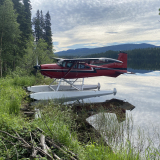
He was using a superior airplane  but...
https://backcountrypilot.org/forum/flying-plywood-maule-1799?start=20
but...https://backcountrypilot.org/forum/flying-plywood-maule-1799?start=20

Tue Jul 07, 2020 1:14 pm
Re: Strapping plywood to floats
Thanks for the Link Whee, I am not great with a computer but I can't see any of the pictures in the thread you linked, is there a trick? or are they just not available to view any longer?
thanks
Ian
thanks
Ian
- Steelroamer offline


- Posts: 119
- Joined: Fri May 09, 2014 3:10 pm
- Location: Kenora
- FindMeSpot URL: https://maps.findmespot.com/s/D8VB
- Aircraft: maule M6 on Floats
DISPLAY OPTIONS
Who is online
Users browsing this forum: No registered users and 1 guest
Latest Features
-
-
Featured Bush Planes
As one of the undisputed legends of bush flying, the Cessna 180 hauls a…Read More -
Aircraft Ownership and Maintenance
9 modification mistakes aircraft owners make when trying to "bush out" their birds—why some…Read More -
Live to Tell
A Minnesota pilot is surprised to learn that the sudden asymmetric drag of an…Read More




Latest Knowledge Base
-
Destinations
Canada offers some of the most spectacular backcountry flying on the continent. Here's what you need to know before you go.Read More -
Safety and Survival
Hope that you never have to use your survival vest but knowing you have it and knowing how to use…Read More -
Destinations
A regional guide with ideas for winter camping destinations in California, Nevada, New Mexico, and Arizona.Read More -
Aircraft
Finding an affordable aircraft that can handle the backcountry for $80K or less? A challenge for sure, but with the…Read More



