Can you guys tell me the good and bad of the BC 12-D. I have a guy that might want to work a trade on my 150. Mostly I need to know what to look for in a PREBUY. Both planes are missing logs but I have owned mine for almost 4 years so I have a good idea of what I have. I don't want to trade for another project right now because my 150 is legal and flying. Anyone know someone near Northern Utah that would have experience inspecting Taylorcrafts? I will also need a good tailwheel instructor?
The plane is a 65 hp one so I don't expect fire breathing performance. How would it compare to my 150 and could I get in and out of strips here like Mexican Mountain if it isn't 100 degrees. Is there anything I can do to this engine to get more power for little money? It has a wooden prop too, is that good or bad? I like that it is a LSA and that might be nice in the future. Any help would be appreciated. thanks
Jerry
Taylorcraft BC-12D
Wed Mar 16, 2011 11:58 am
- Jaerl offline
- Posts: 1423
- Joined: Mon Sep 01, 2008 4:59 am
- Location: Utah
- FindMeSpot URL: http://share.findmespot.com/shared/face ... Q0xkBgMvPi
Wed Mar 16, 2011 1:01 pm
Re: Taylorcraft BC-12D
Betcha Coyote Ugly can answer a few of those questions for you, since that's what he's puttin' around in until the Cub gets fixed.
Gump
Gump
Wed Mar 16, 2011 1:06 pm
Re: Taylorcraft BC-12D
No experience with a 12D, but going into Mex Mountain may be a little optimistic. I highly doubt it would perform better than your C150.
I bet CU can sure make one dance though.
I bet CU can sure make one dance though.
- mountainmatt offline

- Posts: 2803
- Joined: Sat Apr 11, 2009 2:43 pm
- Location: Colorful Colorado
FlyingPoochProductions
FlyColorado.org
FlyColorado.org
Wed Mar 16, 2011 1:19 pm
Re: Taylorcraft BC-12D
I've owned four T-crafts. Great airplane but has its limits.
Pre-buy look for:
Wing strut AD complied by X-ray or ultrasonic, or replaced with new sealed struts. It's a bullsh*t AD but it exists. If not complied, count on removing struts and having them X-rayed, and deduct $1000 from price of airplane.
Lower longeron cluster inspection AD complied with. This is a big one, because two people were lost in a T-craft when this cluster failed (corrosion). If this airplane is not a seaplane and not lived in a humid environment then you can expect it to pass inspection, but you MUST get under there and look at it for real.
Standard fabric airplane stuff, rust in lower longerons, poor fabric work, some idiot spraying shiny car enamel to hide a crappy fabric. Fresh or recent enamel paint over older fabric is a guarantee of some idiot trying to hide something. Deduct $3000 or more from the value of the airplane IMHO, knowing you need to go in and find whatever he was trying to hide.
Wing root attach fittings wear. Lift a main wheel off the ground by lifting with both hands at the same side strut-wing fittings under the wing. Have it completely quiet, and have another person listening through the inspection holes at the root whie you take the weight on and off the wheel. You are listening for a clunk-clunk noise, which is the spar fitting bolts moving back and forth inside a worn fitting (either the spar or fuselage fitting). Deduct $3000, still buy airplane if you want, and fix the fittings using the drawings and info I posted on the taylorcraft.org website.
Standard fabric airplane stuff, damage and mis-alignment of the upper fuselage cabin structure. Several sleeve patches in the upper cabin X bracing, patches where the front spar carry-thru meets the door posts, etc. Most old airplanes will have been bent up once or twice, but it has to have been fixed correctly. Deduct $1000 and buy it anyway if it flies straight and hands-off. If it has quickie trim tabs on the control surfaces or wings, or if the washout (twist) angles are different from one wing or another, then they are trying to compensate for a bent airplane. The very best way to check this out is to find an old-school free flight rubber powered model airplane builder and ask him to go look and see if the airplane is straight or not. I'm not kidding. You can also measure it with strings, but an old modeler will see things
Play and looseness in the aileron hinge brackets, where they bolt to the rear spars. You should not be able to lift or lower the ailerons (the entire aileron, not aileron "throw") relative to the wing.
The T-craft frequently gets the sheet metal cowls all butchered up, replaces with C-140 parts, stop-drilled 50 times in a row, patched up with beer cans, etc. The cowls are expensive to replace.
A 65 HP Taylorcraft, with a wooden prop, in Provo, when it's warm... will not be a rocket. In fact it may be a single place airplane. When you do the upgrade to 85HP, and put on a metal prop and VG's, it becomes a really capable airplane. But no matter what you do, the Taylorcraft will be snug for two people... maybe even more than the 150
Post a notice on the http://vb.taylorcraft.org discussion group, that you are looking for an experienced T-craft guy near you to go look at an airplane. You should be able to find someone closer to you who can look at it. How much money is this thing supposeedly worth, meaning how much money would you take for your 150?
Pre-buy look for:
Wing strut AD complied by X-ray or ultrasonic, or replaced with new sealed struts. It's a bullsh*t AD but it exists. If not complied, count on removing struts and having them X-rayed, and deduct $1000 from price of airplane.
Lower longeron cluster inspection AD complied with. This is a big one, because two people were lost in a T-craft when this cluster failed (corrosion). If this airplane is not a seaplane and not lived in a humid environment then you can expect it to pass inspection, but you MUST get under there and look at it for real.
Standard fabric airplane stuff, rust in lower longerons, poor fabric work, some idiot spraying shiny car enamel to hide a crappy fabric. Fresh or recent enamel paint over older fabric is a guarantee of some idiot trying to hide something. Deduct $3000 or more from the value of the airplane IMHO, knowing you need to go in and find whatever he was trying to hide.
Wing root attach fittings wear. Lift a main wheel off the ground by lifting with both hands at the same side strut-wing fittings under the wing. Have it completely quiet, and have another person listening through the inspection holes at the root whie you take the weight on and off the wheel. You are listening for a clunk-clunk noise, which is the spar fitting bolts moving back and forth inside a worn fitting (either the spar or fuselage fitting). Deduct $3000, still buy airplane if you want, and fix the fittings using the drawings and info I posted on the taylorcraft.org website.
Standard fabric airplane stuff, damage and mis-alignment of the upper fuselage cabin structure. Several sleeve patches in the upper cabin X bracing, patches where the front spar carry-thru meets the door posts, etc. Most old airplanes will have been bent up once or twice, but it has to have been fixed correctly. Deduct $1000 and buy it anyway if it flies straight and hands-off. If it has quickie trim tabs on the control surfaces or wings, or if the washout (twist) angles are different from one wing or another, then they are trying to compensate for a bent airplane. The very best way to check this out is to find an old-school free flight rubber powered model airplane builder and ask him to go look and see if the airplane is straight or not. I'm not kidding. You can also measure it with strings, but an old modeler will see things
Play and looseness in the aileron hinge brackets, where they bolt to the rear spars. You should not be able to lift or lower the ailerons (the entire aileron, not aileron "throw") relative to the wing.
The T-craft frequently gets the sheet metal cowls all butchered up, replaces with C-140 parts, stop-drilled 50 times in a row, patched up with beer cans, etc. The cowls are expensive to replace.
A 65 HP Taylorcraft, with a wooden prop, in Provo, when it's warm... will not be a rocket. In fact it may be a single place airplane. When you do the upgrade to 85HP, and put on a metal prop and VG's, it becomes a really capable airplane. But no matter what you do, the Taylorcraft will be snug for two people... maybe even more than the 150
Post a notice on the http://vb.taylorcraft.org discussion group, that you are looking for an experienced T-craft guy near you to go look at an airplane. You should be able to find someone closer to you who can look at it. How much money is this thing supposeedly worth, meaning how much money would you take for your 150?
Last edited by EZFlap on Wed Mar 16, 2011 1:22 pm, edited 1 time in total.

.
Wed Mar 16, 2011 1:20 pm
Re: Taylorcraft BC-12D
Jaerl wrote:It has a wooden prop too, is that good or bad?
Generally considered good- you won't have to search as far for kindling at the crash site.
Mine ran on 8:50s (and also unapproved Goodyears before I owned it), and went lots of places on 65 HP, tho at lower elevations.
Brakes would fall under the pre-buy checklist for me. In my experience few replacements are available, and I paid dearly to have my surfaces built back up to spec.
Plenty of fun to be wrung out of a BC-12D, at 3.5 GPH
- denalipilot offline


- Posts: 2789
- Joined: Mon Oct 15, 2007 4:53 pm
- Location: Denali
- Aircraft: C-170B+
Wed Mar 16, 2011 1:46 pm
Re: Taylorcraft BC-12D
EZFlap wrote:Wing strut AD complied by X-ray or ultrasonic, or replaced with new sealed struts. It's a bullsh*t AD but it exists. If not complied, count on removing struts and having them X-rayed, and deduct $1000 from price of airplane.
Is this the same AD for which the impetus was Dave Wiley's Taylorcraft strut attach failing in flight, killing him and his student? If so it seems rather valid to the extent that it should be inspected. Perhaps an x-ray is overkill. IIRC the issue was that the attachment is covered in fabric and not easy to inspect. In the seaplane configuration it can retain water more easily and thus is subject to corrosion.
- Zzz offline


- Posts: 2855
- Joined: Fri Oct 08, 2004 11:09 pm
- Location: northern
- Aircraft: Swiveling desk chair
Half a century spent proving “it is better to be thought a fool than to open your mouth and remove all doubt.”
Wed Mar 16, 2011 2:09 pm
Re: Taylorcraft BC-12D
Jaerl
Why in the hell would you ever consider trading a known commodity for a "?"
There are damned few old rag and tube planes out there that are NOT projects.
Been there - done that.
Pre-buys suck - I would not take it without a complete annual.
That gives you at least ONE legal leg to hop around on when all the "surprises" begin to pop up.
Chris C
PS: Did you ever find a small knob for that little Apollo GPS?
Why in the hell would you ever consider trading a known commodity for a "?"
There are damned few old rag and tube planes out there that are NOT projects.
Been there - done that.
Pre-buys suck - I would not take it without a complete annual.
That gives you at least ONE legal leg to hop around on when all the "surprises" begin to pop up.
Chris C
PS: Did you ever find a small knob for that little Apollo GPS?
53 C-170-B+
It is better to be late in this world, than early in the next.
It is better to be late in this world, than early in the next.
Wed Mar 16, 2011 2:28 pm
Re: Taylorcraft BC-12D
The Wiley seaplane crash was (to my understanding and the collective knowledge of the T-craft world) not the failure of the struts. To my knowledge there has never been an inflight failure of a Taylorcraft wing strut.
The Wiley tragedy was caused by corrosion in the lower longerons at the cluster where the strut fitting is. I have seen the photos of this part of the (wrecked) aircraft, and they show grave neghlect by the owner, mechanic, and any/every pilot who ever did a pre-flight on the airplane.
Any pilot doing a preflight inspection on that airplane should have been able to see the corrosion. This view is shared by the majority of the Taylorcraft community. The fuselage in that area was clearly corroded.
In flight, the struts pulled that fitting out of the longerons, causing catastrophic failure and two tragic deaths. But the struts themselves were intact.
A low life scumbag cockroach vermin piece of rat shit, who happened to have some control over the destiny of the Taylorcraft marque at that time, was in the process of trying to INVENT a factory service bulletin as a tool to raise funds for fun and profit. As I understand it, this cockroach wanted to use the Piper strut AD as a model to generate sales of millions in new wing struts. So he started notifying the FAA that "factory tests" and "factory field data" showed the need for the struts to be replaced. (There had never been a strut failure then, or now). The vomitous wretch managed to show the FAA several rusty wing struts (with no evidence they had ever been in service), and suggest that the FAA should make the factory service bulletin into an AD.
The Wiley crash happened about that time. So the rodent jumped up and said "A-HA! I TOLD YOU that Taylorcrafts need new struts!!!" and the FAA issued an AD. The AD specified one or two unusual methods of inspecting the wing struts, neither of which was as useful as a plain old X-Ray to determine if the struts were rusted. X-ray was not allowed as a means of compliance (until myself and a few others wrote a proposal for X-ray as an alternate means).The second half ot the AD was little more than an order form for $3000 worth of new struts.
Shortly after that, the FAA inspector reportedly retired.
Shortly after that, it was admitted that the strut clearly did not fail in flight, and so ANOTHER AD was released, instructing people to look at the lower longeron cluster.
The best and safest method is to X-Ray the aircraft, assembled, getting a picture of the lower struts and the lower cluster. If done right, it delivers a reliable and confidence-inspiring internal view of the structure, and it is plainly visible to an X-Ray tech whether it is safe or not.
The Wiley tragedy was caused by corrosion in the lower longerons at the cluster where the strut fitting is. I have seen the photos of this part of the (wrecked) aircraft, and they show grave neghlect by the owner, mechanic, and any/every pilot who ever did a pre-flight on the airplane.
Any pilot doing a preflight inspection on that airplane should have been able to see the corrosion. This view is shared by the majority of the Taylorcraft community. The fuselage in that area was clearly corroded.
In flight, the struts pulled that fitting out of the longerons, causing catastrophic failure and two tragic deaths. But the struts themselves were intact.
A low life scumbag cockroach vermin piece of rat shit, who happened to have some control over the destiny of the Taylorcraft marque at that time, was in the process of trying to INVENT a factory service bulletin as a tool to raise funds for fun and profit. As I understand it, this cockroach wanted to use the Piper strut AD as a model to generate sales of millions in new wing struts. So he started notifying the FAA that "factory tests" and "factory field data" showed the need for the struts to be replaced. (There had never been a strut failure then, or now). The vomitous wretch managed to show the FAA several rusty wing struts (with no evidence they had ever been in service), and suggest that the FAA should make the factory service bulletin into an AD.
The Wiley crash happened about that time. So the rodent jumped up and said "A-HA! I TOLD YOU that Taylorcrafts need new struts!!!" and the FAA issued an AD. The AD specified one or two unusual methods of inspecting the wing struts, neither of which was as useful as a plain old X-Ray to determine if the struts were rusted. X-ray was not allowed as a means of compliance (until myself and a few others wrote a proposal for X-ray as an alternate means).The second half ot the AD was little more than an order form for $3000 worth of new struts.
Shortly after that, the FAA inspector reportedly retired.
Shortly after that, it was admitted that the strut clearly did not fail in flight, and so ANOTHER AD was released, instructing people to look at the lower longeron cluster.
The best and safest method is to X-Ray the aircraft, assembled, getting a picture of the lower struts and the lower cluster. If done right, it delivers a reliable and confidence-inspiring internal view of the structure, and it is plainly visible to an X-Ray tech whether it is safe or not.
.
Wed Mar 16, 2011 2:53 pm
Re: Taylorcraft BC-12D
I'm up in Logan and have quite a bit of Taylorcraft experience. Send me a pm if you need my help.
1940 BC-65 with some mods.
1946 J3C-85
1946 J3C-85
Wed Mar 16, 2011 6:11 pm
Re: Taylorcraft BC-12D
Hey, you guys are great! I think there is more info of the BC-12D on this thread than I found on the internet. This is still a thought but the plane is not in annual. It's missing logs (like mine) and I don't think it has been annualed in a few years. It does come with a new set of struts but I am worried about the wooden Spars. I have hear they crack. The guy didn't know the hrs offhand but I will probably go up and look at it this weekend. One other thing is that it would probably be sitting outside and my 150 doesn't care much about that.
Chris, I did get a knob. I took it off an Apollo Loran I had. I still havent
't had it updated but maybe someday. Your right too, I should just keep the 150, it isn't worth much but it's a great little plane. I wouldn't consider it but these guys just keep making jokes about the little wheel being on the wrong end.
Ajfriz, thanks, I'll PM you if I get serious.
Chris, I did get a knob. I took it off an Apollo Loran I had. I still havent
't had it updated but maybe someday. Your right too, I should just keep the 150, it isn't worth much but it's a great little plane. I wouldn't consider it but these guys just keep making jokes about the little wheel being on the wrong end.
Ajfriz, thanks, I'll PM you if I get serious.
- Jaerl offline
- Posts: 1423
- Joined: Mon Sep 01, 2008 4:59 am
- Location: Utah
- FindMeSpot URL: http://share.findmespot.com/shared/face ... Q0xkBgMvPi
Wed Mar 16, 2011 6:28 pm
Re: Taylorcraft BC-12D
Where is it located? You can get a pretty good idea on the spars from the inspection holes. I do know that some areas are hard to see, but if there is any evidence of water damage, or if the spars are painted, I'd walk away. I do have quite a few parts, including a full set of cowlings, so I could hook you up if it needs anything.
1940 BC-65 with some mods.
1946 J3C-85
1946 J3C-85
Wed Mar 16, 2011 6:37 pm
Re: Taylorcraft BC-12D
It's up in Ogden. The guy is one of my brothers friends and we were just talking. Wouldn't mind looking at it but I think the 150 will probably do anything it will plus I have radios and a great heater. I found a heavy duty fork for the 150 and I can put a 6" tire on it with just a log book entry. Problem is they want $1,200 for it and I don't have it!
How stupid is that, I can put a 6" tire on the 150 but not on the 175.
How stupid is that, I can put a 6" tire on the 150 but not on the 175.
- Jaerl offline
- Posts: 1423
- Joined: Mon Sep 01, 2008 4:59 am
- Location: Utah
- FindMeSpot URL: http://share.findmespot.com/shared/face ... Q0xkBgMvPi
Wed Mar 16, 2011 7:32 pm
Re: Taylorcraft BC-12D
Jaerl wrote:Hey, you guys are great!
Shut up man, you'll wreck my image!
Jaerl wrote: I think there is more info of the BC-12D on this thread than I found on the internet.
No way, go over to taylorcraft.org and you will be amazed.
Jaerl wrote: It does come with a new set of struts but I am worried about the wooden Spars. I have hear they crack.
Yeah, at about 8G's. On an airplane that has been not taken care of, and left outside, and in real dry weather, then you might find some cracks but they will likely not be in any place you can see through an inspection hole.
Jaerl wrote: One other thing is that it would probably be sitting outside and my 150 doesn't care much about that.
Probably shouldn't buy it. A Taylorcraft, like all older fabric airplanes that have survived 60+ years, deserves a decent home. If you cannot hangar it, and you cannot keep it covered well from all that sunshine and heat up there, the airplane will likely go to sh*t if it has not already.
Have ajfriz or anyone else with T-craft experience go with you and look at it. Over and above the things you can inspect, how it has been taken care of the last several years will speak loudly about those things that you cannot see on a pre-buy.
Also, a stock 65HP T-craft will not perform much better (maybe not as good) as your 150 if the 150 is healthy. A healthy 85HP T-craft will outperform an average 150, especially in STOL takeoff. But getting into a short strip in gusty winds... the 150's great big flaps will let you do it safer and easier.
.
Wed Mar 16, 2011 7:44 pm
Re: Taylorcraft BC-12D
Bill, I doubt there is anything I could say that would change the way people think of you around here.  The Taylorcraft might be a fun plane but I think the 150 would be better for me to keep. Nothing like flying into SLC and having them guide you in and chock your wheels in a 150. Plus I found this:
"Beginning with s/n 61640 (a midyear 1966 150F) doublers were installed as standard equipment on the firewall at the engine mount attachment points. these were made of about .125 thick aluminum and added several rivets and provided a substantial improvement in strength. These doublers first appeared in mid 1964 (150D) on aircraft equipped with the heavy duty nose gear, which is nothing more than a Cessna 206 piston and fork assembly installed in a standard 150 strut cylinder. The fork uses a 6.00x6 wheel and tire and the fork, strut cylinder and steering collar are installed with the torque links facing forward."
Maybe I will get to use the 206 fork after all! Now I just need a Franklin 125hp engine. They bolt right to the motor mount and the exhausts fit in the holes. Too bad no one sells or STC's them for 150's. They were $8,900 brand new.
http://www.ultraligero.net/Descargas/Ma ... in/plz.htm
The Taylorcraft might be a fun plane but I think the 150 would be better for me to keep. Nothing like flying into SLC and having them guide you in and chock your wheels in a 150. Plus I found this:"Beginning with s/n 61640 (a midyear 1966 150F) doublers were installed as standard equipment on the firewall at the engine mount attachment points. these were made of about .125 thick aluminum and added several rivets and provided a substantial improvement in strength. These doublers first appeared in mid 1964 (150D) on aircraft equipped with the heavy duty nose gear, which is nothing more than a Cessna 206 piston and fork assembly installed in a standard 150 strut cylinder. The fork uses a 6.00x6 wheel and tire and the fork, strut cylinder and steering collar are installed with the torque links facing forward."
Maybe I will get to use the 206 fork after all! Now I just need a Franklin 125hp engine. They bolt right to the motor mount and the exhausts fit in the holes. Too bad no one sells or STC's them for 150's. They were $8,900 brand new.
http://www.ultraligero.net/Descargas/Ma ... in/plz.htm
- Jaerl offline
- Posts: 1423
- Joined: Mon Sep 01, 2008 4:59 am
- Location: Utah
- FindMeSpot URL: http://share.findmespot.com/shared/face ... Q0xkBgMvPi
Wed Mar 16, 2011 8:41 pm
Re: Taylorcraft BC-12D
I've been having an absolute blast with the T cart I just bought.. Had to fix quite a few little bugs, but seriously it's fun. I'd love to put some vg's on to see if it would break ground just a bit sooner, but gas is much more important.. It will land short, but with the cruise prop and 65hp, it runs a bit to get off, especially with the Mrs., 24 gallons of fuel and a bunch of groceries in the back. I flew for two hours exactly the other day, and put 6.1 gal in it to fill up tho. That's 8hrs range..
It's cool tho to go back to lookin for thermals or ridge lift to get over the mts., and when ya cut the throttle, there's just not much difference, it glides like crazy. No worries about radio not working, or generators or dead batteries or stuck starter or burned out lights. Who needs headsets, intercoms, gps', or flaps... All frivolus fluff. Side by side, is really great with the Mrs., we can talk and laugh and point. I can see her face to see if she's really serious about knocking off whatever.. ha ha
I cut a piece of pvc to jam against the seat and hold the brake down while ya prop it, then stick in a couple ear plugs, and yer off for adventure. I'll take it to Johnson Creek this summer, it will do fine, I bet better than the old texas taildragger 150 we had years ago.
I doubt it will make it through the notch on takeoff tho.. ha ha
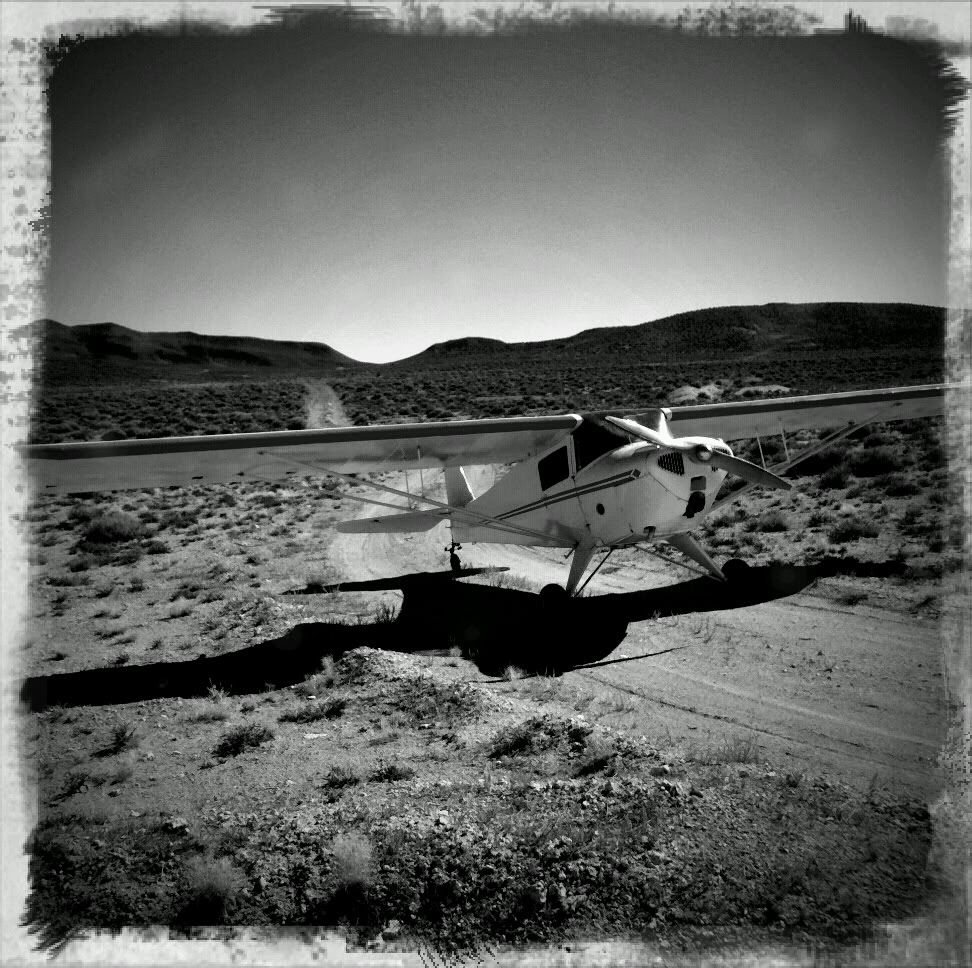
It's cool tho to go back to lookin for thermals or ridge lift to get over the mts., and when ya cut the throttle, there's just not much difference, it glides like crazy. No worries about radio not working, or generators or dead batteries or stuck starter or burned out lights. Who needs headsets, intercoms, gps', or flaps... All frivolus fluff. Side by side, is really great with the Mrs., we can talk and laugh and point. I can see her face to see if she's really serious about knocking off whatever.. ha ha
I cut a piece of pvc to jam against the seat and hold the brake down while ya prop it, then stick in a couple ear plugs, and yer off for adventure. I'll take it to Johnson Creek this summer, it will do fine, I bet better than the old texas taildragger 150 we had years ago.
I doubt it will make it through the notch on takeoff tho.. ha ha
- Coyote Ugly offline
- Posts: 897
- Joined: Thu Jan 03, 2008 9:51 pm
- Location: Middle of Nevada (Middle of Nowhere?)
Wed Mar 16, 2011 8:52 pm
Re: Taylorcraft BC-12D
"had it updated but maybe someday. Your right too, I should just keep the 150, it isn't worth much but it's a great little plane. I wouldn't consider it but these guys just keep making jokes about the little wheel being on the wrong end"
Maybe we need to start a BCP 150's annonymous club. We can call it the 180 minus 30's. I'll get things started....Hello everyone my name is Tracey and I'm a 150 driver...Wow I feel better already lol
lol
Maybe we need to start a BCP 150's annonymous club. We can call it the 180 minus 30's. I'll get things started....Hello everyone my name is Tracey and I'm a 150 driver...Wow I feel better already
lol
Dont squat with your spurs on! Good advice origionally coined by the cowboy with a sore butt!
Maule M-4 220C "project"
Maule M-4 220C "project"
Wed Mar 16, 2011 10:09 pm
Re: Taylorcraft BC-12D
I don't know if Mrs. Coyote flies that Tcraft by herself but if she does she might be interested in a cheap electric start for it. It involves a ring gear behind the prop and a cordless electric drill mounted on the inside of the firewall with a long shaft running up to the ring gear. A
T-handle goes thru the firewall into the cabin and you pull on it to start. Harold Hamp had an STC for it in a lot of the old Tcrafts, J3's, Chiefs and Champs. 65 and 75 hp. The whole thing was about 11 #'s. I read about it in a EAA newsletter. Glad you are back in the air having fun.
Hamp Aircraft Service
SafeStart Starter System
Harold, Micheal, and Carol Hamp
7350 Osborn Rd. Elwell, Mi. 48832
Tel: 989-463-1762
fax 989-466-5114
T-handle goes thru the firewall into the cabin and you pull on it to start. Harold Hamp had an STC for it in a lot of the old Tcrafts, J3's, Chiefs and Champs. 65 and 75 hp. The whole thing was about 11 #'s. I read about it in a EAA newsletter. Glad you are back in the air having fun.
Hamp Aircraft Service
SafeStart Starter System
Harold, Micheal, and Carol Hamp
7350 Osborn Rd. Elwell, Mi. 48832
Tel: 989-463-1762
fax 989-466-5114
Lynn Sanderson (Dirtstrip) passed away from natural causes in May 2013. He was a great contributor and will be missed dearly.
Thu Mar 17, 2011 6:25 am
Re: Taylorcraft BC-12D
Jaerl wrote:The Taylorcraft might be a fun plane but I think the 150 would be better for me to keep. Nothing like flying into SLC and having them guide you in and chock your wheels in a 150.
Don't give up on her just yet.
While I have never had a Tcart,
I have had waaaaaaaaaaaaaaaay more fun just playing around in a 140 I used to have and a couple of pa12's since.
Go ahead,take a look at it.
No one ever looks back at the 150 they used to fly with much affection.
I learned to fly in a 150 aerobat and I have never wanted to own one. (maybe that's just me)
But they do look back at the old J-3's, Taylorcrafts, Luscombes, etc. with many fond memories.
Just a thought
Keep the Greasy side down!
Thu Mar 17, 2011 9:41 am
Re: Taylorcraft BC-12D
You owe it to yourself to go look at that Tcraft! That's the most fun you can have for the dollar, in my opinion! I've flown a 140, 150, and Tcraft.....and bought a Tcraft. Like any other plane, it's got it's quirks, but it's a BLAST!
John
John
- hardtailjohn offline
- Posts: 924
- Joined: Thu Mar 16, 2006 7:06 pm
- Location: Marion, Montana
God put me here to accomplish a certain amount of things...right now I'm so far behind, I'll never die!!
Thu Mar 17, 2011 1:46 pm
Re: Taylorcraft BC-12D
I will go and take a look hopefully this weekend. What worries me it that the owner didn't seem to know anything about it. He has a 182 he flys and I don't think this one has been annualed in a while. Hopefully I won't be so financially challenged in the future so I would rather buy one that I know needs a rebuild than a flying project. There is one for sale right now for $2,900 without an engine and I would rather have an 85 HP anyway. The best thing I have going for the 150 is it is mine and it is cheap to own and fly. I only pay 230/yr for insurance when it is just me flying it.
I am wary of listening to Pops. He can probably do things in a 65hp Taylorcraft that I couldn't do in a Supercub. I sure would like the 3 gal/hr fuel burn though.
I am wary of listening to Pops. He can probably do things in a 65hp Taylorcraft that I couldn't do in a Supercub. I sure would like the 3 gal/hr fuel burn though.
- Jaerl offline
- Posts: 1423
- Joined: Mon Sep 01, 2008 4:59 am
- Location: Utah
- FindMeSpot URL: http://share.findmespot.com/shared/face ... Q0xkBgMvPi
DISPLAY OPTIONS
Who is online
Users browsing this forum: No registered users and 1 guest
Latest Features
-
Live to Tell
A Minnesota pilot is surprised to learn that the sudden asymmetric drag of an out-of-rig ski can…Read More -
Creators
Working in some of the Yukon's most beautiful and remote environments, photographer Simon Blakesley captures aircraft in…Read More -
Aircraft Ownership and Maintenance
Upgrading to big tires can make a huge difference in backcountry performance, but with those gains come…Read More -
Tales from Yesteryear
In this tale from bush flying yesteryear, Don Cogger signs up to help Atlee Dodge Jr recovery…Read More


Latest Knowledge Base
-
Destinations
A regional guide with ideas for winter camping destinations in California, Nevada, New Mexico, and Arizona.Read More -
Aircraft
Finding an affordable aircraft that can handle the backcountry for $80K or less? A challenge for sure, but with the…Read More -
Aircraft
01.29.2018 - Zane - Updated tire diameter graphic to add 8.50x10 Guide to tires for use in the backcountry and off-airport landing…Read More -
Pilots
12.22.2013 - Initial article format Operating aircraft on skis and negotiating a snow-covered landscape is an entirely unique skillset and environment.…Read More


