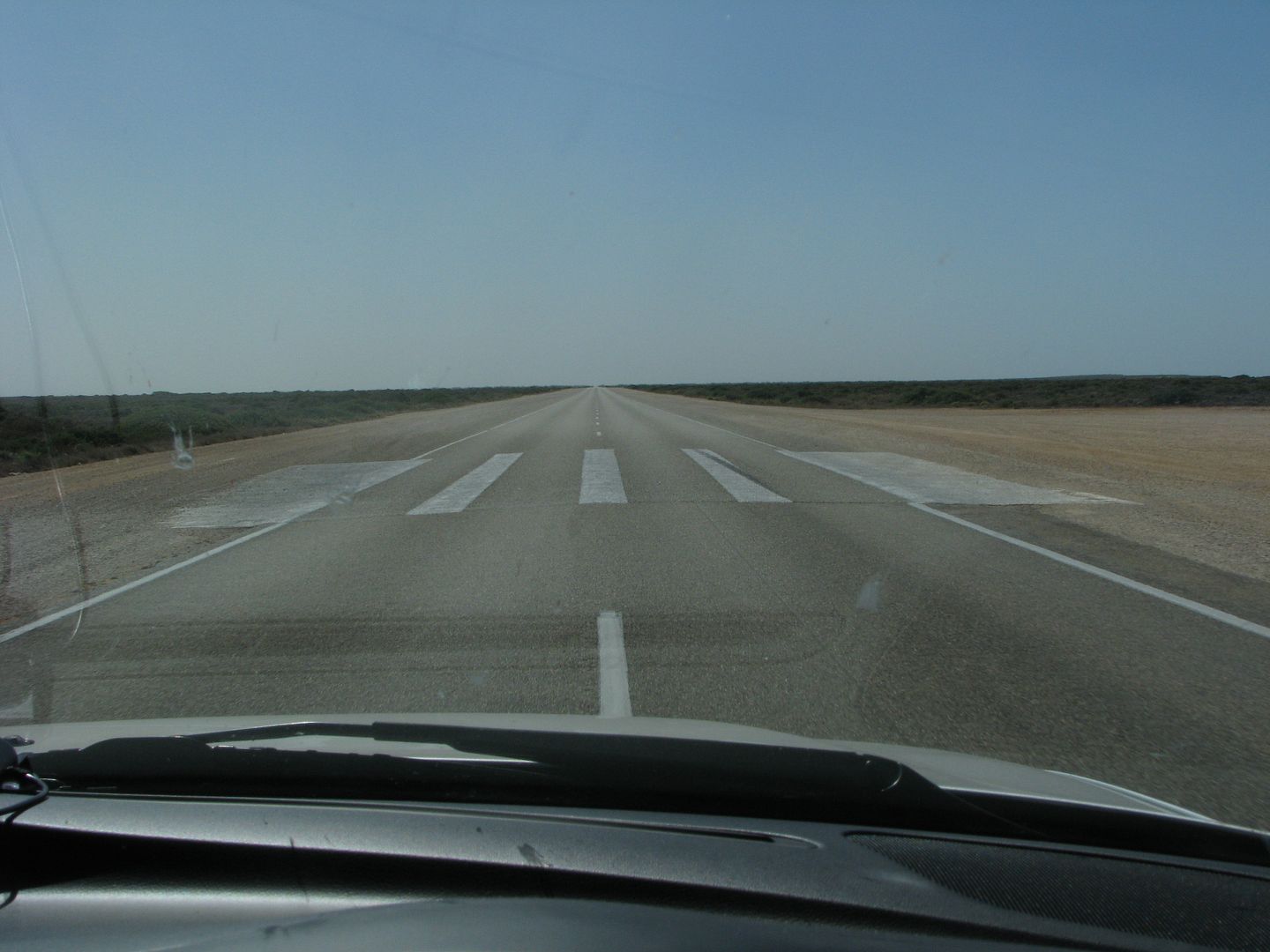
A while back, I read a true/false quiz in a magazine that said this is not true. Well, they're right. I'm not sure how this myth originated, but it's a pretty strong one across the Internet, even among pilots. Of course, for the guy who lets down on a freeway after engine failure, it's as good a runway as any.
Here's an excerpt from Richard F. Weingroff of the U.S. Dept of Transportation, circa June 2000, with a plausible theory on how the myth came to be:
http://www.tfhrc.gov/pubrds/mayjun00/onemileinfive.htm
Richard F. Weingroff, U.S. DOT, June 2000 wrote:I have no idea where the one-out-of-five claim originated. Perhaps it is giving too much credit to whoever originated this "fact" to suggest that it began with a misreading of history. Under a provision of the Defense Highway Act of 1941, the Army Air Force and the Public Roads Administration (PRA), now the Federal Highway Administration, operated a flight strip program. In a 1943 presentation to the American Association of State Highway Officials, Commissioner of Public Roads Thomas H. MacDonald explained how it worked.
"A flight strip consists of one runway, laid down in the direction of the prevailing wind, and a shelter with telephone for the custodians at the site and for itinerant flyers in an emergency. Fuel storage facilities are not provided unless airplanes are based there permanently. Instead, oil companies will keep stocks of aviation gasoline at gas stations along the highway and truck it to the flight strip as it is needed."
The flight strips were designed for easy access to public highways and to provide unmistakable landmarks that could be followed easily by a pilot. Flight strips varied in size. The smallest — 150 feet (46 meters) wide and 4,000 feet (1,220 meters) long with the length increased by 500 feet (152 meters) for each 1,000 feet (305 meters) of elevation — were designed for tactical aircraft such as medium bombers. A larger flight strip could accommodate heavy bombers such as the B-17 and B-24, while still larger strips were designed for heavier classes of aircraft.
The benefits weren't expected to be entirely military. As MacDonald explained, "The close coordination of our highways and airways is becoming a vital necessity to assist the economic growth of this country."
In that spirit, Congress considered including a flight strip program in the Federal-Aid Highway Act of 1944 — the law that authorized designation of a "National System of Interstate Highways." However, the 1944 act did not include the flight strip program.
Some references to the one-out-of-five "law" attribute it to the Federal-Aid Highway Act of 1956. The 1956 act launched the Interstate Highway Program by creating the Highway Trust Fund as a funding mechanism and by committing the federal government to build what became the 42,800-mile (68,880-kilometer) Eisenhower Interstate Highway System (now essentially complete). President Dwight D. Eisenhower fully supported the Interstate Highway System as vital to our economy, safety, relief of congestion, and defense. However, he didn't propose a one-out-of-five-mile rule, and Congress didn't include such a requirement in the 1956 Act. The one-out-of-five rule was not part of any later legislation either.








 It's done all the time up here. But then again, we don't have any interstate highways up here.....just long ones.......
  I know of one dude that has two cubs parked in his yard and the only length of room longer than 75 yards anywhere around is the highway in front of his house. ....and he is just outside of Palmer, AK where they have an airport handy.....