For the last week I have been contemplating the events of our flyin last weekend.
I am wondering what would have happened if my wife would have been on this trip with me and we had arrived on Wednesday with Burk. We would have probably joined him at the campfire and maybe we would have thought that going to Big Creek was a great idea.
What if we left at the same time and had voice comunication with Burk and he mentioned that just follow him cus he new the way. Would I have just merilly followed allong. Maybe with the 182 I would have a better climb and be higher in the canyon and have been able to make the 180 deg turn out of there.
Before we all reply with we are responsible for our own flight planning. We all know that if I saddle your horse and the cinch slips and you fall on your head it is your fault cus you should have tightened the cinch. I think that a lot of us on this forum would have followed Burk cus he has spent a lot of time up here and if he is doing it with a stock 172 then my 182 will have no problem.
Just some idle thinking.
Tim
Thought on being safe.
Sun Jun 24, 2007 7:47 pm
- qmdv offline

- Posts: 3633
- Joined: Wed Feb 15, 2006 10:22 pm
- Location: Payette
- FindMeSpot URL: http://share.findmespot.com/shared/face ... I5tqEOk0rc
- Aircraft: Cessna 182
Mon Jun 25, 2007 5:07 am
Tim,
The times that have gotten me started thinking about choices and fate were usually military and when we were getting shot at. When the guy beside you get's hit and you don't, it get's you thinking, why him and not me? It will either eat you up, or you will come to grips with it. Some people just try bravado. You know, big sky, little bullet theory. Others say it's just fate. Others, and I'm in this group, fall back on their religion to find comfort.
With flying, it could just as easily be a mechanical failure at the wrong time that can get you. Fuel pump, bearing, vacuum pump, the list is endless.
It's called risk management because it can't be risk elimination, be nice if it could be, but the most you can hope for is a reduction of the risk level to a point to where it's acceptable. Acceptable is a hard word to quantify, because it's a personal limit.
I believe that if it was performance, or a lack of that caused Berk's accident, that you would have been fine in your 182 if you had a similar load. I don't have a lot of time in either, but my impression is that a 182 is a whole lot more airplane.
The times that have gotten me started thinking about choices and fate were usually military and when we were getting shot at. When the guy beside you get's hit and you don't, it get's you thinking, why him and not me? It will either eat you up, or you will come to grips with it. Some people just try bravado. You know, big sky, little bullet theory. Others say it's just fate. Others, and I'm in this group, fall back on their religion to find comfort.
With flying, it could just as easily be a mechanical failure at the wrong time that can get you. Fuel pump, bearing, vacuum pump, the list is endless.
It's called risk management because it can't be risk elimination, be nice if it could be, but the most you can hope for is a reduction of the risk level to a point to where it's acceptable. Acceptable is a hard word to quantify, because it's a personal limit.
I believe that if it was performance, or a lack of that caused Berk's accident, that you would have been fine in your 182 if you had a similar load. I don't have a lot of time in either, but my impression is that a 182 is a whole lot more airplane.
Mon Jun 25, 2007 11:24 am
The time I flew up Quartz Creek by mistake, I was in a '62 182 and we were light. After rounding the corner from JCR to Yellow Pine, I kept climbing at Vy as I searched for the road to Profile. Since I never did see it, I just kept climbing up Quartz Creek and got up to 10k before I was able to see the whole trap, which was by then safely below. So the 182 has enough performance to fly that route--if you don't level off thinking that there's a low pass up ahead. I don't know about the 172.
I might not have kept climbing except an instructor had warned me not to try flying low through Profile. I didn't recall the reason, but the words stuck, and I'm grateful. You can get an idea of the set up by "flying" Google Earth out of JCR towards Big Creek.
Following other airplanes would make me nervous unless everyone involved has trained in formation flying and done the whole magilla on preflight briefing. There was a gaggle of Bonanzas who flew into a ridge top they couldn't outclimb a few years ago in Southern California. They apparently took their formation flying seriously, but the lead messed up and . . . . However much fun formation flying may be, I think I'll just meet cha there.
CAVU
I might not have kept climbing except an instructor had warned me not to try flying low through Profile. I didn't recall the reason, but the words stuck, and I'm grateful. You can get an idea of the set up by "flying" Google Earth out of JCR towards Big Creek.
Following other airplanes would make me nervous unless everyone involved has trained in formation flying and done the whole magilla on preflight briefing. There was a gaggle of Bonanzas who flew into a ridge top they couldn't outclimb a few years ago in Southern California. They apparently took their formation flying seriously, but the lead messed up and . . . . However much fun formation flying may be, I think I'll just meet cha there.
CAVU
Mon Jun 25, 2007 1:34 pm
There is one cardinal rule about mountain flying that would have kept Berk (and many, many others) alive that most of us know about but often break:
NEVER, NEVER, NEVER FLY UP ANY CANYON OR STEEP DRAINAGE BELOW RIDGE LEVEL!!!!!!!!!!!!!!!
Always gain altitude while flying DOWN canyon or drainage, or if that is not possible, gain sufficient altitude to see over the ridge before leaving the airport environs. This may mean circling for 15 minutes at a place like JC, but it is THE MOST CONSERVATIVE ACTION.
Anyone flying less of an aircraft than a Super Cub type or 182-180-185 type should observe this rule religiously in steep terrain, even if you are absolutely sure of your route.
I know we all break this rule in the interests of efficient routing to nearby strips, but if there is even the slightest doubt about route or turbulence, it will reduce your risk of this type of accident to nearly zero.
Many years ago while flying a glider near Aspen (7800 ft), which has had almost a dozen of this specific type of accident over the decades, I watched a Piper Cherokee or a similar somewhat underpowered aircraft depart on a downwind right up Independence Pass (12,001 ft) without any attempt to circle (that's a 5200 foot altitude gain required in about 13 miles!). When he was just east of Aspen and still well down in the canyon, I broke onto the tower frequency and told him he would crash in 5 minutes if he did not return to the airport and gain some more altitude. After an initial period of disbelief, I did get him to turn around by coaching him to fly close along the right side of the canyon and initiate a left turn. The canyon was still two miles wide at that point, so he had no problem. It was not until 10 minutes later that he radioed back that even with the additional 2000 feet he got by circling he only cleared the pass by 500 feet!
I was looking down on all this from 16,000 feet, and I have no doubt they would have been killed or severly injured if I had not said something. Aspen Tower never said a word about my hijacking their frequency for a minute or so.
Rocky
NEVER, NEVER, NEVER FLY UP ANY CANYON OR STEEP DRAINAGE BELOW RIDGE LEVEL!!!!!!!!!!!!!!!
Always gain altitude while flying DOWN canyon or drainage, or if that is not possible, gain sufficient altitude to see over the ridge before leaving the airport environs. This may mean circling for 15 minutes at a place like JC, but it is THE MOST CONSERVATIVE ACTION.
Anyone flying less of an aircraft than a Super Cub type or 182-180-185 type should observe this rule religiously in steep terrain, even if you are absolutely sure of your route.
I know we all break this rule in the interests of efficient routing to nearby strips, but if there is even the slightest doubt about route or turbulence, it will reduce your risk of this type of accident to nearly zero.
Many years ago while flying a glider near Aspen (7800 ft), which has had almost a dozen of this specific type of accident over the decades, I watched a Piper Cherokee or a similar somewhat underpowered aircraft depart on a downwind right up Independence Pass (12,001 ft) without any attempt to circle (that's a 5200 foot altitude gain required in about 13 miles!). When he was just east of Aspen and still well down in the canyon, I broke onto the tower frequency and told him he would crash in 5 minutes if he did not return to the airport and gain some more altitude. After an initial period of disbelief, I did get him to turn around by coaching him to fly close along the right side of the canyon and initiate a left turn. The canyon was still two miles wide at that point, so he had no problem. It was not until 10 minutes later that he radioed back that even with the additional 2000 feet he got by circling he only cleared the pass by 500 feet!
I was looking down on all this from 16,000 feet, and I have no doubt they would have been killed or severly injured if I had not said something. Aspen Tower never said a word about my hijacking their frequency for a minute or so.
Rocky
Last edited by RockyTFS on Sun Jul 01, 2007 2:23 pm, edited 1 time in total.

Mon Jun 25, 2007 6:40 pm
I haven't been to IDaho in my Maule since I bought it but I have gone six times in my PA 22/160. I don't remember how many times I've gone from JC to Big creek but I always circled once climbing over Yellow pine. I usually cleared the summit by about 500 ft. However, I had half tanks, which I usually have most of the time up there and survival gear and a couple fly rods. I also had a climb prop which was flattened to 53inches which gave me 2800 RPM for take off and climbed like a virtual eagle. I can't immagine even attempting Profile in a 145 HP 172 with two people without getting above the ridgelines. The PA 22 with 160 HP and a flat prop is a great performer up there, but I still climbed high enough to see the passes and drainages before I ventured further into the back country 
Mon Jun 25, 2007 8:16 pm
There is a term we use in aviation. It is a quite appropriate term, and it brings with it substantial responsibilities.
The term is Pilot In Command.
Once you assume that mantle, it is YOUR responsibility to deliver you and your passengers to the destination safely.
Following some other pilot up a canyon falls into the lemming category.
Don't be a lemming. If it doesn't look right, if you don't like it, if there's any doubt, DON'T do it.
That, in a nutshell, is what serving as Pilot In Command means.
I don't think we flight instructors emphasize to our students the solemn responsibility they are entering into when they accept a Private Pilot's license.
ah64 is also correct. There are things that can intervene that we simply cannot control.
But, as PIC, you should NEVER accept that just cause that guy up there made it over a ridge, you can.
Wear that title and responsibility honorably, and don't let your passengers and family down.
MTV
The term is Pilot In Command.
Once you assume that mantle, it is YOUR responsibility to deliver you and your passengers to the destination safely.
Following some other pilot up a canyon falls into the lemming category.
Don't be a lemming. If it doesn't look right, if you don't like it, if there's any doubt, DON'T do it.
That, in a nutshell, is what serving as Pilot In Command means.
I don't think we flight instructors emphasize to our students the solemn responsibility they are entering into when they accept a Private Pilot's license.
ah64 is also correct. There are things that can intervene that we simply cannot control.
But, as PIC, you should NEVER accept that just cause that guy up there made it over a ridge, you can.
Wear that title and responsibility honorably, and don't let your passengers and family down.
MTV


Mon Jun 25, 2007 9:30 pm
I was told...
over fifty years ago when I first took flying lessons to always remember that the Pilot In Command was responsible for the lives of everyone in the plane.
A few years back, an examiner told me he flunked several candidates saying he wasn't going to give them a "license to kill." In other words, they were not ready for the responsibility. He went on to say, that sloppy altitude and bouncy landings are nothing compared to incompetent judgement.
Berks' accident, as has been written by several, was likely a result of his misjudgement of his airplane's performance and taking the wrong route. This scenario is probably correct, however until the NTSB report comes out with the probable cause, we don't know if other factors might be involved.
I suspect some of us might be thinking, "but for the Grace of God, there go I." May I suggest, that we each, in our own way, have a "Stand Down for Safety" to review our Pilot In Command judgement skills.
A few years back, an examiner told me he flunked several candidates saying he wasn't going to give them a "license to kill." In other words, they were not ready for the responsibility. He went on to say, that sloppy altitude and bouncy landings are nothing compared to incompetent judgement.
Berks' accident, as has been written by several, was likely a result of his misjudgement of his airplane's performance and taking the wrong route. This scenario is probably correct, however until the NTSB report comes out with the probable cause, we don't know if other factors might be involved.
I suspect some of us might be thinking, "but for the Grace of God, there go I." May I suggest, that we each, in our own way, have a "Stand Down for Safety" to review our Pilot In Command judgement skills.
The truth will set you on the path to being free
Tue Jun 26, 2007 5:11 am
Years ago when we first started crew coordination training, the government bought a training package from one of the airlines to start with. It was a very good package that had actual cockpit audio from accidents that were unbelievable. One that stuck in my mind was when the co-pilot was trying to tell the captain that they wouldn't make it. The captain instead of taking him seriously asked the flight engineer what the difference was between a co-pilot and a duck. I think over a hundred died.
The other thing that stuck was that the FAA and apparently a few research facilities were given a big grant to determine why out of the blue a very experienced pilot would do something apparently stupid and could not be accounted for for any reason other than they just got a case of the dumb a**. Well a lot of money was spent and the best they could come up with was an anacronym. SLOJ, sudden loss of judgement. Apparently we are all subject to getting stupid every now and again. It usually doesn't happen that often or last that long, but let it happen at the wrong time and the results can be catastropic. Also you are much more susceptible to SLOJ when you are comfortable doing something, you know you've always done it this way and it has always worked in the past.
The other thing that stuck was that the FAA and apparently a few research facilities were given a big grant to determine why out of the blue a very experienced pilot would do something apparently stupid and could not be accounted for for any reason other than they just got a case of the dumb a**. Well a lot of money was spent and the best they could come up with was an anacronym. SLOJ, sudden loss of judgement. Apparently we are all subject to getting stupid every now and again. It usually doesn't happen that often or last that long, but let it happen at the wrong time and the results can be catastropic. Also you are much more susceptible to SLOJ when you are comfortable doing something, you know you've always done it this way and it has always worked in the past.
Tue Jun 26, 2007 1:00 pm
Profile Summit (or pass) is the low point between Yellow Pine and Big Creek. There is a road that goes over and ends just down river from the Big Cr strip, at Smith Cr. You can follow the road all the way from Yellow Pine, but sometimes it's hard to see. It is NOT the drainage just north or Yellow Pine, that's quartz cr, and is often confused with Profile, if you're following your GPS, it looks like it should take you right to Big Cr. Profile is the next drainage to the east, running north (uphill). You need ~8000' to cross, I don't remember exactly what the elev is. Going the other way, Big Creek to Yellow Pine, the pass gets pretty tight, so you'd better make sure you have the altitude to cross before you commit yourself too deep into the canyon.
Or, just fly higher, burn a little more gas, and be safe.
John
Or, just fly higher, burn a little more gas, and be safe.
John
- LowAndSlow offline
- Posts: 161
- Joined: Wed Feb 15, 2006 9:27 am
- Location: Medford, OR
Tue Jun 26, 2007 2:49 pm
Tue Jun 26, 2007 5:10 pm
John is right, I just follow the stibnite road to where it intersects big creek road and turn left. However by the time I am at the big creek road intersection I'm already about 8000 ft and still climbing. THen when you clear profile summit its a big drop into Big creek. Also not the best for your engine. CLimb hard for 15 to 20 minutes then drop for a landing. I usually decend slowly down big creek a ways past the ridge next to the strip and turn back when I'm low enough, to prevent shock cooling. 
Tue Jun 26, 2007 6:31 pm

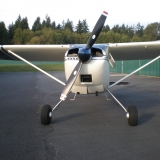
Cessna Skywagon -- accept no substitute!
Wed Jun 27, 2007 5:03 pm
Wed Jun 27, 2007 5:06 pm
DISPLAY OPTIONS
Who is online
Users browsing this forum: No registered users and 1 guest
Latest Features
-
Live to Tell
A Minnesota pilot is surprised to learn that the sudden asymmetric drag of an out-of-rig ski can…Read More -
Creators
Working in some of the Yukon's most beautiful and remote environments, photographer Simon Blakesley captures aircraft in…Read More -
Aircraft Ownership and Maintenance
Upgrading to big tires can make a huge difference in backcountry performance, but with those gains come…Read More -
Tales from Yesteryear
In this tale from bush flying yesteryear, Don Cogger signs up to help Atlee Dodge Jr recovery…Read More


Latest Knowledge Base
-
Destinations
A regional guide with ideas for winter camping destinations in California, Nevada, New Mexico, and Arizona.Read More -
Aircraft
Finding an affordable aircraft that can handle the backcountry for $80K or less? A challenge for sure, but with the…Read More -
Aircraft
01.29.2018 - Zane - Updated tire diameter graphic to add 8.50x10 Guide to tires for use in the backcountry and off-airport landing…Read More -
Pilots
12.22.2013 - Initial article format Operating aircraft on skis and negotiating a snow-covered landscape is an entirely unique skillset and environment.…Read More


