The legislative session in Oregon starts 12 January 2009.
Back in August, the Oregon House Republicans published a press release that they would introduce a bill in the 2009 session to repeal the ethanol mandate.
It is time to hold them to their promise. Please email your state representatives and ask them to support this initiative and add a section to prohibit the blending of ethanol into premium unleaded gasoline. And write to Representative Gilman (R-Medford) and remind him of his promise.
If you want information about our legislative effort to repeal the ethanol mandate and pass a law prohibiting the blending of ethanol into all premium unleaded gasoline in the state please see www.e0pc.com
Legislative action is also going to start in Washington, Montana and Idaho backed by pilots, boat owners, and classic car clubs, etc. Please join us.
Time to repeal Oregon's ethanol mandate
Sun Jan 04, 2009 12:49 pm
Fly lead free on mogas: www.flyunleaded.com
Sun Jan 04, 2009 6:30 pm
I've emailed my state & federal legislators about this E10 BS a couple times. Only 1 or 2 has responded to my specific concerns (E10)- several send me what must be their standard response to "energy issues". One actually stated that they were working on several solutions including solar & wind power. Gee, thanks for nothing.
I'll have to fire off another round to them deadbeats, urging at least mandatory E-zero premium grade gas availability if not outright repeal of the ethanol mandate.
I kind of got the runaround from the state legislators (imagine that!), at least one said that the ethanol mandate was a federal thing-- as in "it's not our fault". Is it a federal thing, or a state thing, or a federal thing that the individual states can opt (or not) to buy in to?
Eric
I'll have to fire off another round to them deadbeats, urging at least mandatory E-zero premium grade gas availability if not outright repeal of the ethanol mandate.
I kind of got the runaround from the state legislators (imagine that!), at least one said that the ethanol mandate was a federal thing-- as in "it's not our fault". Is it a federal thing, or a state thing, or a federal thing that the individual states can opt (or not) to buy in to?
Eric

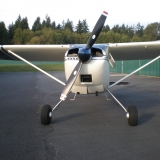
Cessna Skywagon -- accept no substitute!
Mon Jan 05, 2009 10:59 am
hotrod150 wrote:> ...
I kind of got the runaround from the state legislators (imagine that!), at least one said that the ethanol mandate was a federal thing-- as in "it's not our fault". Is it a federal thing, or a state thing, or a federal thing that the individual states can opt (or not) to buy in to?
Eric
It is both now, however the federal RFS mandate, EISA 2007, is having unintended consequences that is trumping the state laws.
In the case of Washington, you have a newly implemented state ethanol law that was passed back in 2006, before the federal law EISA 2007 was passed, that mandates a volume of ethanol be blended into your gasoline starting 1 December 2008. It requires 2% of the total volume of gasoline sold in Washington be ethanol. So the whole state could have gone E2, or 20% of the stations could have gone E10, or some combination with the E85 stations thrown in.
However, now we have EISA 2007 which is also a volume based ethanol mandate. It requires that so many billions of gallons of ethanol be put in gasoline nationwide, in an ever increasing quantity though 2022. Last year the target was 9 billion gallons, which was exceeded. This year it is 10.1 billion gallons, of which 100 million gallons must be cellulosic ethanol (good luck). Each of the major gasoline distributors is given a quota. If they don't meet the quota they are economically penalized.
If you read EISA 2007 it is clear that it is an E85 corporate welfare bill. E10 is never mentioned. But E85 isn't going to spread fast enough to use the amount of ethanol demanded in the production quota, so the gasoline distributors are taking all of the states E10 first.
Any state can pass a law controlling how ethanol is sold in their state, because there is nothing in EISA 2007 about how it is to be done. It is left up to the states to do what they want, and it even advises them that they might want to provide exemptions to certain users, like aircraft, watercraft, old cars, etc. so that they don't damage their economy. The easiest way to protect the users that need unblended gasoline is to pass a state law that prohibits the blending of ethanol into premium unleaded, like Missouri did when they passed their mandatory E10 law before EISA 2007. Of course it is interesting to note that the Missouri mandatory E10 law had an escape clause in it that dropped the mandate if ethanol got more expensive than gasoline which happened in October of last year, so the Missouri escape clause triggered last month and for the time being Missouri is not a mandatory E10 state anymore ... leaving five of us.
Fly lead free on mogas: www.flyunleaded.com
DISPLAY OPTIONS
Who is online
Users browsing this forum: No registered users and 0 guests
Latest Features
-
Live to Tell
A Minnesota pilot is surprised to learn that the sudden asymmetric drag of an out-of-rig ski can…Read More -
Creators
Working in some of the Yukon's most beautiful and remote environments, photographer Simon Blakesley captures aircraft in…Read More -
Aircraft Ownership and Maintenance
Upgrading to big tires can make a huge difference in backcountry performance, but with those gains come…Read More -
Tales from Yesteryear
In this tale from bush flying yesteryear, Don Cogger signs up to help Atlee Dodge Jr recovery…Read More


Latest Knowledge Base
-
Destinations
A regional guide with ideas for winter camping destinations in California, Nevada, New Mexico, and Arizona.Read More -
Aircraft
Finding an affordable aircraft that can handle the backcountry for $80K or less? A challenge for sure, but with the…Read More -
Aircraft
01.29.2018 - Zane - Updated tire diameter graphic to add 8.50x10 Guide to tires for use in the backcountry and off-airport landing…Read More -
Pilots
12.22.2013 - Initial article format Operating aircraft on skis and negotiating a snow-covered landscape is an entirely unique skillset and environment.…Read More


