How about some descriptions of flying the pattern(s) at Johnson Creek to include usual MSL and AGL altitudes used on downwind, base etc as you fly into Johnson Creek??
I'm not planning on making the trip this year, but have it as a goal for next year. And will probably stop and get someone to fly in with me when I go the first time.
Looks like if attempting a somewhat normal pattern that you would need to be just skimming the trees on downwind and base so as to arrive on final in good position. Have read where others make a different approach into the field but that visibility of the strip is limited until the last turn to the strip.
Just got my curiosity up --- and yep, I guess my "flat lander" is showing ..
Traffic pattern altitudes at Johnson Creek
Wed Apr 04, 2007 9:27 am
Wed Apr 04, 2007 10:36 am
Sorry Scoot, but there's no such thing as a traffic pattern at JC! There are so many ways to approach it that the word just doesn't apply.
There are however, some things that can help visualize what has to be done to make a nice no sweat landing there. If you use normal pattern altitudes of about 800, 600, and 300 for JC you are going to be way down in the canyon and had better be comfortable with flying 5 kts above your final approach speed while your right wingtip is 20-30 feet from the rocks. For me, that's no faster than 65 knots with 20 degrees flaps. It's also a VERY tight pattern that really is just a 180 on to final, and requires pretty much idle power from crosswind over the South end at about 1000 AGL. On downwind you are only about 800 feet from centerline. Try that at home a few times, it's about 1/3 the size of most folks patterns.
Cubs, Scouts, 140's, anything that can fly comfortably at less that 60 mph can do this with no problem. It's harder in a loaded 185 doing 75 kts.
What most people do is to fly over at 1000 to 1200, announce, then fly three miles North in the middle of the canyon and turn around near Yellowpine where the East Fork comes in and there's at least a mile of turning space at 800 AGL (5800 MSL). You are out of sight of the runway there, so just set up a 400 fpm descent at 65 mph until you come around the corner and can see the runway at about a mile out. Then you can judge your final descent and check for people and planes on the runway. Almost everybody ends up too high and too fast and has to slip it in or go-around the first few times in there. It is 3400 feet long so a midfield touchdown is really no problem, but it sure LOOKS small the first time. Check out the picture on Airnav.com. If it looks like that on short final you're WAY too high! Almost all landings are on 17, it takes about 15 knots of North wind before a 35 landing makes sense and nobody without lots of backcountry experience should be flying around in canyons with that much wind anyway.
It gets kinda crowded some weekends and folks do like to come out and kibitz or take pictures, so don't expect to see a completely clear runway. It is 150 feet wide, though, and we've never had anyone run over yet, so just use your landing light and land. Go-arounds below about 100 agl at the threshold can be interesting in anything with less power than a SuperCub, 180, or Scout type. If you have to go-around, jog left to get over the creek for more room.
It may look intimidating from 8000 on the way in, but all our canyon strips look that way, and JC is actually one of the largest and safest.
The key is to get way slowed up way early and get right down in the canyon. Most of us could do a 360 at 300 agl right over the airport if we used the canyon turn technique discussed earlier on BCP. It just doesn't look like it. Don't try that on a windy 90 degree afternoon though!
JC has the justly deserved reputation as the top backcountry strip in Idaho, if you call hot showers, toilets, fire pits, and acres of irrigated grass backcountry.
So come on out!
Rocky
There are however, some things that can help visualize what has to be done to make a nice no sweat landing there. If you use normal pattern altitudes of about 800, 600, and 300 for JC you are going to be way down in the canyon and had better be comfortable with flying 5 kts above your final approach speed while your right wingtip is 20-30 feet from the rocks. For me, that's no faster than 65 knots with 20 degrees flaps. It's also a VERY tight pattern that really is just a 180 on to final, and requires pretty much idle power from crosswind over the South end at about 1000 AGL. On downwind you are only about 800 feet from centerline. Try that at home a few times, it's about 1/3 the size of most folks patterns.
Cubs, Scouts, 140's, anything that can fly comfortably at less that 60 mph can do this with no problem. It's harder in a loaded 185 doing 75 kts.
What most people do is to fly over at 1000 to 1200, announce, then fly three miles North in the middle of the canyon and turn around near Yellowpine where the East Fork comes in and there's at least a mile of turning space at 800 AGL (5800 MSL). You are out of sight of the runway there, so just set up a 400 fpm descent at 65 mph until you come around the corner and can see the runway at about a mile out. Then you can judge your final descent and check for people and planes on the runway. Almost everybody ends up too high and too fast and has to slip it in or go-around the first few times in there. It is 3400 feet long so a midfield touchdown is really no problem, but it sure LOOKS small the first time. Check out the picture on Airnav.com. If it looks like that on short final you're WAY too high! Almost all landings are on 17, it takes about 15 knots of North wind before a 35 landing makes sense and nobody without lots of backcountry experience should be flying around in canyons with that much wind anyway.
It gets kinda crowded some weekends and folks do like to come out and kibitz or take pictures, so don't expect to see a completely clear runway. It is 150 feet wide, though, and we've never had anyone run over yet, so just use your landing light and land.
Go-arounds below about 100 agl at the threshold can be interesting in anything with less power than a SuperCub, 180, or Scout type. If you have to go-around, jog left to get over the creek for more room.
It may look intimidating from 8000 on the way in, but all our canyon strips look that way, and JC is actually one of the largest and safest.
The key is to get way slowed up way early and get right down in the canyon. Most of us could do a 360 at 300 agl right over the airport if we used the canyon turn technique discussed earlier on BCP. It just doesn't look like it. Don't try that on a windy 90 degree afternoon though!
JC has the justly deserved reputation as the top backcountry strip in Idaho, if you call hot showers, toilets, fire pits, and acres of irrigated grass backcountry.
So come on out!
Rocky
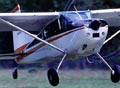

Wed Apr 04, 2007 3:06 pm
Scoot,
Check out my photo gallery. I have three photos of an approach into JC. And yes we did as Rocky said about the set to the approach. I had to slip it just at the end because I came in a little high. But I like to slip so it all worked out.
The first time I went to JC there was approximately 50 or so 180/185’s on the strip. I did not realize they were having their Fly-In that weekend. I was really nervous about screwing up my landing with all those other tail dragger pilots. But it was not as bad as I thought and we had a great time.
Check out my photo gallery. I have three photos of an approach into JC. And yes we did as Rocky said about the set to the approach. I had to slip it just at the end because I came in a little high. But I like to slip so it all worked out.
The first time I went to JC there was approximately 50 or so 180/185’s on the strip. I did not realize they were having their Fly-In that weekend. I was really nervous about screwing up my landing with all those other tail dragger pilots.
But it was not as bad as I thought and we had a great time.
God forbid we should ever be twenty years without a rebellion. ***Thomas Jefferson***
"The tree of liberty must be refreshed from time to time with the blood of patriots and tyrants." **Thomas Jefferson**
"The tree of liberty must be refreshed from time to time with the blood of patriots and tyrants." **Thomas Jefferson**
Thu Apr 05, 2007 3:47 am
EXCELLENT!!!
Rocky, I almost feel like I've been there once already. Very nice job in painting a picture.
I'll be there next year -
I've read through some posts here on who and where to get some mountain flying dual, and I'll most likely try to work that into any trip I make up into the Idaho country.
Just looks like an incredibly beautiful place
Thanks again for the time you took to offer up the tips etc., and don't be surprised if I don't try to twist your arm for some help!!
Rocky, I almost feel like I've been there once already. Very nice job in painting a picture.
I'll be there next year -
I've read through some posts here on who and where to get some mountain flying dual, and I'll most likely try to work that into any trip I make up into the Idaho country.
Just looks like an incredibly beautiful place
Thanks again for the time you took to offer up the tips etc., and don't be surprised if I don't try to twist your arm for some help!!
Thu Apr 05, 2007 10:19 pm
An idea passed to me that I used for my first time. I prefer the northbound overpass, 180 at YellowPine, and straight in. The twisty canyon back makes this approach blind until late in the game. I watch the terrain during the northbound pass and take some mental notes on terrain verses distance from the approach end of the runway. At these various places you can equate an approximate altitude above field elevation. When you are on approach, you can use your altimeter against these terrain marks as another reference.
Just one more of a thousand techniques!...
Just one more of a thousand techniques!...
- cowboypilot offline
- Posts: 13
- Joined: Thu Apr 05, 2007 9:15 pm
- Location: Phoenix,AZ
DISPLAY OPTIONS
Who is online
Users browsing this forum: No registered users and 3 guests
Latest Features
-
Live to Tell
A Minnesota pilot is surprised to learn that the sudden asymmetric drag of an out-of-rig ski can…Read More -
Creators
Working in some of the Yukon's most beautiful and remote environments, photographer Simon Blakesley captures aircraft in…Read More -
Aircraft Ownership and Maintenance
Upgrading to big tires can make a huge difference in backcountry performance, but with those gains come…Read More -
Tales from Yesteryear
In this tale from bush flying yesteryear, Don Cogger signs up to help Atlee Dodge Jr recovery…Read More


Latest Knowledge Base
-
Destinations
A regional guide with ideas for winter camping destinations in California, Nevada, New Mexico, and Arizona.Read More -
Aircraft
Finding an affordable aircraft that can handle the backcountry for $80K or less? A challenge for sure, but with the…Read More -
Aircraft
01.29.2018 - Zane - Updated tire diameter graphic to add 8.50x10 Guide to tires for use in the backcountry and off-airport landing…Read More -
Pilots
12.22.2013 - Initial article format Operating aircraft on skis and negotiating a snow-covered landscape is an entirely unique skillset and environment.…Read More


