Tuweep L50
Fri Sep 16, 2011 9:06 am
Tuweep L50
Hey is Tuweep still closed? Has anyone been there recently. Usually if I need to ask if a backcountry airstrip is closed it is.
- Desert Rat offline

- Posts: 260
- Joined: Thu Jan 19, 2006 6:10 pm
- Location: Big Pine Ca.
A government big enough to give you everything you want,is big enough to take away everything you have." - Thomas Jefferson
Fri Sep 16, 2011 9:56 am
Re: Tuweep L50
Here is what the RAF has to say about it:
http://theraf.org/news/2005/tuweep-airstrip-arizona-has-been-closed#update_tuweep
http://theraf.org/news/2005/tuweep-airstrip-arizona-has-been-closed#update_tuweep
- chrisg offline
- Airstrip Database Manager
- Posts: 220
- Joined: Tue Jan 01, 2008 9:04 pm
- Location: Coeur d'Alene, Idaho
Chris
http://www.shortfield.com - Backcountry Airstrip Database
https://discord.gg/HNHKeDE - Groundfall - Bush Flying Video Game
http://www.shortfield.com - Backcountry Airstrip Database
https://discord.gg/HNHKeDE - Groundfall - Bush Flying Video Game
Fri Sep 16, 2011 10:37 am
Re: Tuweep L50
chrisg wrote:Here is what the RAF has to say about it:
http://theraf.org/news/2005/tuweep-airstrip-arizona-has-been-closed#update_tuweep
Y'all need to read this and support RAF with $$$ of any amount!! I do and will again today. It seems the RAF has become the premier voice for backcountry strips in the country. The RAF has the history to show for it too. I don't care who does the work and I will support any group with $$ who gets the job done, to the best of my ability.
Done

From the RAF site:
Tuweep The Grand Canyon Secret
Few things are more disappointing to pilots than an enormous white “X” marking the threshold of their favorite recreational airstrip. Such is now the case at Tuweep (L50) airstrip on the north rim of the Grand Canyon.
Update: The RAF has been participating in the potential lease and reopening process of the Tuweep airstrip (near Grand Canyon) from the State of Arizona and stand ready to create a Tuweep Fund to receive tax deductible donations directed toward its future maintenance. See additional update from 17FEB06 at the bottom of this page.
Midway between the coniferous forests of the North Rim and the broiling canyon bottom, Tuweep lies at an elevation of 4600 feet on the western, red-sandstone shelf known as the Esplanade. This is high desert country with mild winters and light snows. Paiute for “barren valley,” the Toroweap valley offers a variety of plants including juniper, pinyon pine and, of course, sagebrush. Cacti and agave are more prevalent as you approach the canyon rim and during the wet years, wildflowers paint the ground and surrounding hillsides.
Wildlife is also abundant and the area offers some of the finest habitat in the nation for heavy antlered mule deer. Coyotes keep the jackrabbit population in check and the occasional rattlesnake adds excitement to day hikes.
The Toroweap Overlook of the Grand Canyon allows an experience vastly different than the south rim. Unfettered by guardrails, signs and crowded trails, there is nothing between you and a dramatic 3000 foot drop to the Colorado River below. The serpentine trail of green water is slowed by massive lava flows before it cascades over Lava Falls, the most famous rapids in the canyon. On a still day, the roar of the falls can be heard at the canyon rim.
Visiting Tuweep requires self-sufficiency and an adventuresome spirit. It’s just the type of remote destination recreational pilots look for.
Just a few years ago, nearly twenty airstrips dotted the landscape north of the Grand Canyon. They have been methodically plucked one by one from the charts and just a few remain today. The state of Arizona cites liability concerns and lack of pilot interest for these random closures. Tuweep is the most essential remaining public strip offering access to the unspoiled areas of this vast National Park.
Without History…We’re History
On January 11, 2000, a gaggle of helicopters including Marine One and four Hueys descended on the Toroweap valley. President Clinton stepped forth and announced the formation of the new Grand Canyon-Parashant National Monument. In a symbolic gesture, wearing a brown suede jacket and cowboy boots, Mr. Clinton sat at the dusty airstrip and signed four Presidential Proclamations on the kitchen table of Tuweep Ranger Clair Roberts. The section of state school-trust land containing Tuweep airstrip is also encompassed within the new National Monument.
The purpose of the executive order was to prevent mining and future development and to preserve the rich history of the area. Mr. Clinton was acting under the Antiquities Act passed by congress in 1906 to protect “objects of historic and scientific interest.”
That history should certainly include the life of John Riffey.
For 38 years, Riffey served as the NPS Ranger at Tuweep. He and his beloved Super Cub “Pogo,” aptly named for the short hops it took, served the visitors of the Arizona Strip and the Park as only a pilot and his airplane could. Aviation was important to Riffey. Not only for the enjoyment he felt while flying, but also for the access it offered to remote areas of the Park.
Ironically, just yards away from the table where the president signed the executive order, lies the grave of John Riffey. His date of birth and date of death do not appear on the gravestone. When he lived wasn’t important to him; how he lived was. The stone bears the image of his trusted “Pogo” and his epitaph: “The man who could spend a lifetime on the rim and not waste a minute.” Nothing else was necessary.
There Is Still Hope
Tuweep sees an average of three private aircraft landings per week during the busy season and has been used extensively by the Bureau of Land Management as a staging area during firefighting operations.
Mike Ebersole, former Tuweep Ranger, commercial pilot and airport manager for the Tuweep strip, contacted State Land Department Manager Chuck Hudson. When asked if it was too late to reverse the closure, Mr. Hudson stated that “they (the state) would not be averse to resurrecting the project and trying to keep the airstrip open.”
Although he was transferred to Sitka, Alaska in 2002, former Tuweep ranger Clair Roberts’ love for the Toroweap valley has never waned. Like Riffey, he also flew his own airplane out of Tuweep. Roberts believes the short-term solution to keep the strip open is by generating a grass-roots effort to mount a writing campaign on the state of Arizona and the FAA. He remains committed to spearheading this effort because he believes it is worth saving and that proper notice was not given to the public. Ultimately, a land swap may be the best long-term solution for keeping L50 open. Interest in the strip among pilots has always remained high and there has been no history of noise complaints. Encroachment into the Grand Canyon SFRA has been rare and largely unintentional.
Letters protesting the closure of Tuweep (L50) should be directed to the FAA and the Governor of Arizona, Janet Napolitano with carbon copies to ADOT Aeronautics Division (Ray Boucher) and Arizona State Land Department (Charles Hudson
- OregonMaule offline

- Posts: 6977
- Joined: Fri Sep 01, 2006 9:44 pm
- Location: Orygun
My SPOT page
"They who can give up essential liberty to obtain a little temporary safety, deserve neither liberty nor safety". Ben Franklin
http://en.wikiquote.org/wiki/Benjamin_Franklin
"They who can give up essential liberty to obtain a little temporary safety, deserve neither liberty nor safety". Ben Franklin
http://en.wikiquote.org/wiki/Benjamin_Franklin
Fri Sep 16, 2011 12:43 pm
Re: Tuweep L50
Tuweep is an active project for the RAF.
We have worked this off and on since 2005. Three years ago we invested time and money with the Arizona Pilot's Association and actually got down to document drafting for an agreement to open the airstrip when all of the sudden the Arizona State Land Department went silent on it. There was never an explanation.
But, time goes by and situations change. Now there are some different folks to work with at the Land Department, the National Park Services lease on 280 acres that includes Tulweep is up for renewal in one year (September 2012) and there is now aviation language in the Arizona Recreational Use Statute effectively silencing any objection to reopening based upon potential liability.
We have corresponded with the Arizona State Land Department in the last 30 days and hope to leverage the final results at Chicken Strip (once that document gets signed) with the NPS in Arizona.
Not sure we have the perfect plan but we are on it and trying everything we can to get Tulweep reopened.
We have worked this off and on since 2005. Three years ago we invested time and money with the Arizona Pilot's Association and actually got down to document drafting for an agreement to open the airstrip when all of the sudden the Arizona State Land Department went silent on it. There was never an explanation.
But, time goes by and situations change. Now there are some different folks to work with at the Land Department, the National Park Services lease on 280 acres that includes Tulweep is up for renewal in one year (September 2012) and there is now aviation language in the Arizona Recreational Use Statute effectively silencing any objection to reopening based upon potential liability.
We have corresponded with the Arizona State Land Department in the last 30 days and hope to leverage the final results at Chicken Strip (once that document gets signed) with the NPS in Arizona.
Not sure we have the perfect plan but we are on it and trying everything we can to get Tulweep reopened.
FLHusky
Fri Sep 16, 2011 12:52 pm
Re: Tuweep L50
Desert Rat:
Not sure your question was answered.
Yes it is still closed. Really a shame. AZ Pilot's Association and RAF have worked for years to get it going again. Hope that someday it will come to pass.
I want to echo comments on RAF. They recently facilitated the first new airport opening on Forest Service Land (Russian Flats - M42). RAF has been instrumental in helping us here in NM get liability protection for strip owners and they are working in numerous other states as well to assist other state organizations in getting liability protection. Tuweep is one of many examples of backcountry strips being eliminated. That won't stop unless we push back.
Probably preaching to the choir, but if any of you are not RAF members, should consider becoming one. Also any of the state organizations that are working to keep backcountry open (i.e ID, UT, AZ, NM, CO, etc.), need your time and talents too.
Regards, Larry
Not sure your question was answered.
Yes it is still closed. Really a shame. AZ Pilot's Association and RAF have worked for years to get it going again. Hope that someday it will come to pass.
I want to echo comments on RAF. They recently facilitated the first new airport opening on Forest Service Land (Russian Flats - M42). RAF has been instrumental in helping us here in NM get liability protection for strip owners and they are working in numerous other states as well to assist other state organizations in getting liability protection. Tuweep is one of many examples of backcountry strips being eliminated. That won't stop unless we push back.
Probably preaching to the choir, but if any of you are not RAF members, should consider becoming one. Also any of the state organizations that are working to keep backcountry open (i.e ID, UT, AZ, NM, CO, etc.), need your time and talents too.
Regards, Larry
Fri Sep 16, 2011 5:26 pm
Re: Tuweep L50
Thank you 88H and FLHUSKY. Keep us updated.
Hey guys, write a letter or make a call to get this strip opened.
Cheers...Rob
Hey guys, write a letter or make a call to get this strip opened.
Cheers...Rob
- OregonMaule offline
- Posts: 6977
- Joined: Fri Sep 01, 2006 9:44 pm
- Location: Orygun
My SPOT page
"They who can give up essential liberty to obtain a little temporary safety, deserve neither liberty nor safety". Ben Franklin
http://en.wikiquote.org/wiki/Benjamin_Franklin
"They who can give up essential liberty to obtain a little temporary safety, deserve neither liberty nor safety". Ben Franklin
http://en.wikiquote.org/wiki/Benjamin_Franklin
Sun Jul 01, 2012 12:24 pm
Re: Tuweep L50
Any updates on Tuweep/Toroweap?
Sun Aug 19, 2012 3:00 pm
Re: Tuweep L50
I visited the Toroweap campground last week. On the way out I stopped to check out the airfield. Windsock is in good condition, picnic tables/shade covers/fire rings still there, no white "x's" on the strip, and the strip itself has weeds/plants growing sparsely on it but seems to be fairly smooth and no rocks. I did take pictures but am experiencing computer evolution issues (new computer replaced old laptop) and need to get that taken care of before I can post up pics.
Sun Aug 19, 2012 6:04 pm
Re: Tuweep L50
I have a plan -L50 is do able -90 miles northeast of me as the crow flies. Have contact who owns ranch 10 miles north -near Craig Ranch --Contact me and lets get a work party. Need 4-6 healthy souls -maybe 2-3 ATV or 4wheel drive pickup(s). Guys in or near Colorado City or St. George -60 mile 1 way 4x4 road . Craig Ranch is north 6-10 miles north-- staging area . I've flown over and its got a lot of brush there but no "x" visible .I don't think we need to make it skating rink smooth but good enough for 6-7 inch mains. May get Helicopter from next door for shuttle .Arizona Pilots association could get the permits I believe if we just clean it up.Maybe a fly in BBQ ? Bar 10-1Z1 is several miles to west. Lots of commercial traffic to Bar 10.
- 182 STOL driver offline
- Posts: 1529
- Joined: Tue Apr 22, 2008 8:27 pm
Sun Aug 19, 2012 8:25 pm
Re: Tuweep L50
As you have heard Tuweep is closed!! I worked az a APA board member for 15 years to reopen Tuweep but the state land dept knew 3 words NO AND HELL NO. The RAF has the muscle to make the state listen so I am sure it will happen!!! The RAF AND APA are working hard to reopen strips in AZ tha tI have worked on, Suport your state av dept and the RAF WITH ALL YOU CAN. my 3 cents worth.
Sun Aug 19, 2012 9:19 pm
Re: Tuweep L50
Bent Prop wrote:As you have heard Tuweep is closed!! I worked az a APA board member for 15 years to reopen Tuweep but the state land dept knew 3 words NO AND HELL NO. The RAF has the muscle to make the state listen so I am sure it will happen!!! The RAF AND APA are working hard to reopen strips in AZ tha tI have worked on, Suport your state av dept and the RAF WITH ALL YOU CAN. my 3 cents worth.
I'm offering "Boots on the ground"--- I fly the Grand Canyon a LOT --probably 1/2 the hours in a year for me is over the Grand Canyon ! Back Before Mark Hawkins got killed at Red Creek in his Cessna 180 -he and I flew all the airstrips in the Arizona Strip -most are grown over now but could be reopened and made useful for pilots. If the pilots don't step up soon the only landing areas will be controlled asphalt jungles.
- 182 STOL driver offline
- Posts: 1529
- Joined: Tue Apr 22, 2008 8:27 pm
Mon Aug 20, 2012 8:32 am
Re: Tuweep L50
182 STOL:
I like your passion! I would suggest contacting Mark Spencer. Mark is the RAF rep in AZ and is listed on the RAF website under state reps.
Mark has been actively and vigorously working the Tuweep strip. He has met with political reps and State officials and is making good progress. However, I know he could use some help.
Talk to Mark and he can get you plugged into the process. As far as other strips, Mark and APA is actively engaged in reopening numerous strips. Hope you can get plugged in with them as I know they could use your help.
Regards, Larry
I like your passion! I would suggest contacting Mark Spencer. Mark is the RAF rep in AZ and is listed on the RAF website under state reps.
Mark has been actively and vigorously working the Tuweep strip. He has met with political reps and State officials and is making good progress. However, I know he could use some help.
Talk to Mark and he can get you plugged into the process. As far as other strips, Mark and APA is actively engaged in reopening numerous strips. Hope you can get plugged in with them as I know they could use your help.
Regards, Larry
Mon Aug 20, 2012 10:20 am
Re: Tuweep L50
Done! RAF donor I mean.
EB
EB
Mon Aug 20, 2012 4:02 pm
Re: Tuweep L50
88H wrote:182 STOL:
I like your passion! I would suggest contacting Mark Spencer. Mark is the RAF rep in AZ and is listed on the RAF website under state reps.
Mark has been actively and vigorously working the Tuweep strip. He has met with political reps and State officials and is making good progress. However, I know he could use some help.
Talk to Mark and he can get you plugged into the process. As far as other strips, Mark and APA is actively engaged in reopening numerous strips. Hope you can get plugged in with them as I know they could use your help.
Regards, Larry
Looked on RAF web site - no contact info on Mark -- have him send me a email . Today eyes on ground at L50 has 2 piles of trash on strip. Park service 206 is frequent visitor to L50.
- 182 STOL driver offline
- Posts: 1529
- Joined: Tue Apr 22, 2008 8:27 pm
Mon Aug 20, 2012 4:04 pm
Re: Tuweep L50
Flew through the Dragon Corridor this morn. Don't see L50 on any map. How do I find it. Saw the old strip on north rim near entrance to the park though. Shame to see those white X marks!!!
- flightlogic offline
- Posts: 616
- Joined: Wed Dec 24, 2008 2:51 pm
- Location: Prescott
Flying is dangerous. If you think otherwise, you are new at this sport. Mind the gravity not the gap.
Mon Aug 20, 2012 5:05 pm
Re: Tuweep L50
flightlogic wrote:Flew through the Dragon Corridor this morn. Don't see L50 on any map. How do I find it. Saw the old strip on north rim near entrance to the park though. Shame to see those white X marks!!!
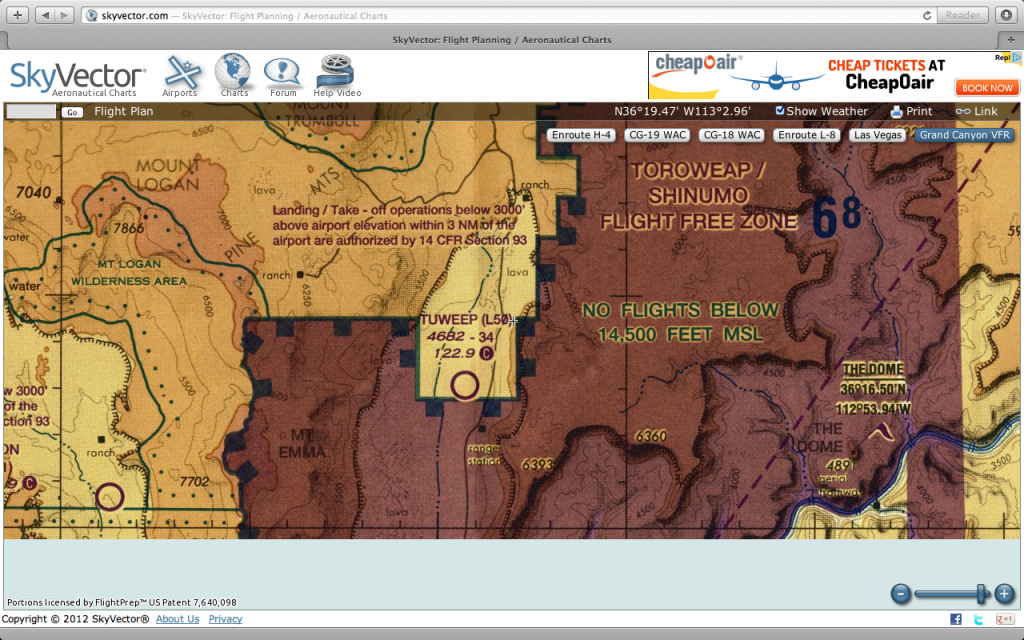
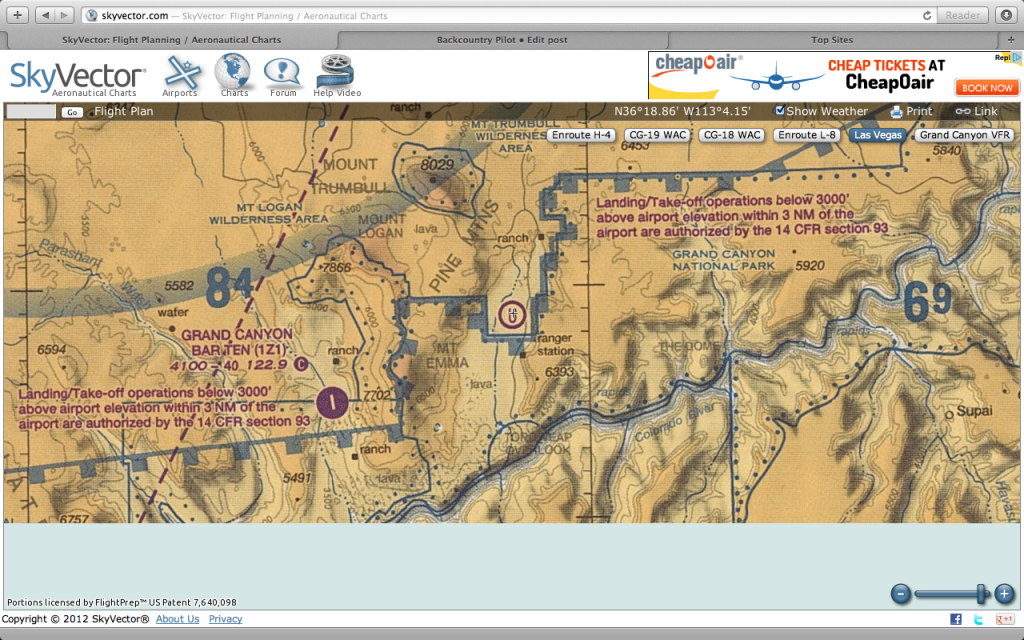
Its on the Las Vegas sectional and the Grand Canyon VFR SFRA map. Tuweep L50, just northeast from Bar 10 ranch. Not close to the Dragon Corridor. It would be in the Toroweap/Shinumo Flight Free Zone... but its notched out for the strip in particular.
- SixTwoLeemer offline

- Posts: 1285
- Joined: Thu Feb 07, 2008 10:53 am
- Location: Wasatch Front
Altitude is Time…. Airspeed is Life!
Tue Aug 21, 2012 5:41 am
Re: Tuweep L50
88H wrote:182 STOL:
I like your passion! I would suggest contacting Mark Spencer. Mark is the RAF rep in AZ and is listed on the RAF website under state reps.
Mark has been actively and vigorously working the Tuweep strip. He has met with political reps and State officials and is making good progress. However, I know he could use some help.
Talk to Mark and he can get you plugged into the process. As far as other strips, Mark and APA is actively engaged in reopening numerous strips. Hope you can get plugged in with them as I know they could use your help.
Regards, Larry
Got comm open with Mark last night. He's got a super cub and RV 8 (trying to sell his grumming tiger ) nice guy . Has a lot on his plate talking to officials who control airstrips--. Appentenly there are plans for a bunch of strips in NM and AZ to reopen soon as this fall.
- 182 STOL driver offline
- Posts: 1529
- Joined: Tue Apr 22, 2008 8:27 pm
Tue Aug 21, 2012 6:38 am
Re: Tuweep L50
Just joined, sent a contribution. Most likely won't make it down that way, but i hope that L-50 gets reopened. I strongly urge all pilots to join, and help the future of backcountry aviation.
Wed Aug 22, 2012 2:12 pm
Re: Tuweep L50
Passing over the old VT Park strip this morning. Still X ed out. Shame you can't land there for a picnic or to go visit the rim inside the park boundary.
Support the RAF. Maybe they could put this one on the wish list.
Support the RAF. Maybe they could put this one on the wish list.
Last edited by flightlogic on Thu Aug 23, 2012 5:08 pm, edited 1 time in total.
- flightlogic offline
- Posts: 616
- Joined: Wed Dec 24, 2008 2:51 pm
- Location: Prescott
Flying is dangerous. If you think otherwise, you are new at this sport. Mind the gravity not the gap.
Wed Aug 22, 2012 2:29 pm
Re: Tuweep L50
Hi All, Tuweep is located on State Trust Lands and was closed, along with all state trust land airstrips back in 2005. The primary reason was fear of liability. The APA worked very hard on trying to stop this, but the administration at the time would have no part of public use due to concerns over liability. They leased the airstrip to the National Park Service and included specific language forbiding anything but government aircraft to land. One of the first things I did in AZ, as the new RAF State Liaison, was work with the state legislature, and the Deputy State Land Commissioner to amend our Recreational Use Statute to include aviation. With the help of my friends in the APA, this was accomplished and became law in July 2011. With this in hand, and with the relationship I forged with the Deputy State Land Commissioner on the RUS work, we set up the first meeting with the State Land department and I've been driving to Phoenix for meetings with them every couple of months ever since. In our last meeting the State Land Department agreed to help us re-open Tuweep! We have one more meeting on September 18th to discuss insurance and permit requirements. Unfortunately the state will forego the protections afforded by the new RUS, by requiring us to enter into a Special Use Permit (SUP) with them for the site. This is necessary as they do not want to manage the airstrip and the SUP will place the APA and RAF on the line for this management. Basically we will be taking over the lease that the Park Service currently holds. I should tell you that the park service has been very supportive of GA using the airstrip. Thanks for supporting http://www.Backcountrypilots.org, and both the APA and the RAF if you think you'll enjoy Tuweep! Let's not piss anyone off by landing there until we finish the agreement! I'll post here, and please also watch the APA http://www.AZpilots.org and RAF http://www.theRAF.org web sites for news on this! FYI, we've also had tremendous success with the Forest Service and among others, the Grapevine airstrip, formerly E75, will now be open for recreational aviation and camping every third weekend of the month beginning the weekend of September 14th! Safety pamphlets for each airstrip we get open are available under the resource tab at the APA web site under >Resources>Backcountry. Please honor the rules associated with each airstrip as described in these brochures. These are our airstrips to lose if we do not honor the land manager's vision for them. Mark Spencer RAF AZ State Liaison [email protected]
Mark Spencer
Public Lands Liaison The RAF
VP Arizona Pilots Association
Public Lands Liaison The RAF
VP Arizona Pilots Association
DISPLAY OPTIONS
Who is online
Users browsing this forum: No registered users and 0 guests
Latest Features
-
Live to Tell
A Minnesota pilot is surprised to learn that the sudden asymmetric drag of an out-of-rig ski can…Read More -
Creators
Working in some of the Yukon's most beautiful and remote environments, photographer Simon Blakesley captures aircraft in…Read More -
Aircraft Ownership and Maintenance
Upgrading to big tires can make a huge difference in backcountry performance, but with those gains come…Read More -
Tales from Yesteryear
In this tale from bush flying yesteryear, Don Cogger signs up to help Atlee Dodge Jr recovery…Read More


Latest Knowledge Base
-
Destinations
A regional guide with ideas for winter camping destinations in California, Nevada, New Mexico, and Arizona.Read More -
Aircraft
Finding an affordable aircraft that can handle the backcountry for $80K or less? A challenge for sure, but with the…Read More -
Aircraft
01.29.2018 - Zane - Updated tire diameter graphic to add 8.50x10 Guide to tires for use in the backcountry and off-airport landing…Read More -
Pilots
12.22.2013 - Initial article format Operating aircraft on skis and negotiating a snow-covered landscape is an entirely unique skillset and environment.…Read More


