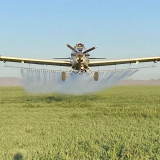
We're starting to stray a bit with the assumptions here… Perhaps I can jump in and offer some insight?
'55 is right…. sorta, MTV is right…. sorta…
Using an 802 to do this work is no different than using an 802 to do spike (a dry herbicide for pasture/rangeland that goes on at an ultra low rate). With spike even in a
400 gallon hopper, you can easily run out of fuel before you get the whole load out. Using an AT-802 is beyond overkill. But they do it all the time. So why do they do it? … economics;
The vast majority of this countries ag aircraft operate on a seasonal basis at their homebase. Now just imagine a guy in central Iowa wanting to play with the majors in the ag-av world. He basically has two major crops, corn and soybeans.
First we'll look at corn, since the vast majority of his corn work will be fungicide, and since the entire state's corn gets planted inside of a month, we can extrapolate that the majority of his corn work will need to be done inside of a month. This is due to the window of time available for the fungicide to be viable.
Now beans,
if the operator gets lucky enough to have a year where the insect population hits the economic threshold necessitating an aerial application, this scenario will almost mimic the corn 'run'. In other words, again, the majority of his beans will need to be sprayed inside of a month. Again timing dictates this.
Last we'll throw in some herbicide work, and some stragglers for another month worth of spraying. So,
there is his season…
three months +/-… This is not a guess, it's not shooting in the dark, it is my real life experience of how this business works.
Now, back to our illustrious operator… for eons, his pappy and his pappy's pappy flew cubs, then stearmans, pawnees, ag cats, and all the other wonderful piston pounding poison pushers… Life was good, and every field in Iowa had an operator or two on it. Sometimes more. If you really want to get a grip on this just look at a sectional and see how many little grass strips are in Iowa! but I digress…. back to the operator… this young fellow has seen the jet powered sprayers (who hasn't?) And he has seen what the big boys earn

… He wants to run in that league.
SO what do you do? well you just can't run an 802 three months out of the year, and expect to pay the $2mill it's going to set you back. And you can't cover the acres you need to, in order to run with the big boys $$$ wise, flying a pawnee… So at this point there are two choices. Either you get all the work you can, and then host a gaggle of outsiders who are also seasonal workers, but whose busy season happens to be offset with yours, to 'sub contract' from you. This is very popular now days, and if you ever do a search on the vast majority of the aircraft flying in any of the
'I' states, you will find out an astronomical amount of them are based somewhere else.
The other option to put it very simply, is to be the guy on the other end of that equation. You buy the big turbine, spray your season, and then network yourself into every nook and cranny you can to get the thing paid for. This is what the fellows who buy 802's in country that can't support an 802 do. In fact this is what they will do even if their home base can support an 802, because it's way easier to get by with too much work than it is with not enough. This is why you see 802's doing spike, mosquito, ad infinitum… because they have a note to pay on, and they'll keep bidding on anything that put them closer to paying off that note. So you see… in most cases, it's not the gov't asking for an 802 over a 402, it's the 802 operator bidding against that 402 guy and needing the job more. As always, there are some exceptions, and fires is indeed one of those exceptions… on fires the gov't indeed wants the bigger airplane.
Now, I used a guy in Iowa as our example, but the truth is, the vast majority of the countries ag planes are in a similar boat. Not all, but certainly most.
FWIW, We are fortunate enough to fly year round here, we have 6 turbine Trush', 3-400 gallon planes, and 3-510's (actually 7, as we try and have one in the rotation for rebuild) as well as a B206 (Jet Ranger), and an L3 (Long Ranger). We bid and do gov't work, we routinely bid against operators that fly 802's, and yet we do not own an 802, and likely never will.
Switch hitters… Since the late '90's, once on a fire contract, even the OAS can not pull a fire plane off fire duty and send it to spray. This is because prior to that, outfits like ours would spray all night and then send the planes back on the line for fire duty in the am (different pilot of course). This resulted in cases of hotseating a plane right from one job to another, which in itself is a non event until someone starts thinking too much about what is now being dropped along with the retardant into the forest

So although Mikes assumption really would make good sense, in reality it isn't supposed to occur. I say isn't supposed to because although those are the rules, they have been known to be bent by operators who could hustle up another plane in a pinch.
Converting fire planes to spray… On contract everything related to spraying comes off. Booms, spray valve, hangars, fan/pump (unless yours is hydraulic). Pretty much then whole enchilada… the good news is Mike is correct, it really doesn't take very long to do all that, most people do the majority of it switching from spray to dry, and doing both of those in a single day occurs all the time. He is also correct that most 802's going to fires are either 802F's or have been converted to 'clamshell (dump) gates' like an 802F. They are a better fire gate, you can spray with them, but
I personally don't know of a dry spreader that will work with one. Swapping gates is a PITA, and not something you want to do on a whim, so it's either going to be a fire/spray plane or a spray/dry plane. I'm sure one of the 'rice country' boys will set me straight if I am wrong on that.
Anyways… just some food for thought
Take care, Rob