https://localtoday.news/ut/utah-pilots-are-opposing-the-proposed-backcountry-flying-regulation-87503.html
Article from Local Today News, Utah:
One of the truths of aviation is that one pilot’s annoying or stupid behavior can have an impact on the rest of us. That is evident this week in Moab, Grand County, Utah, where the County Board of Commissioners listened for more than an hour to public comments on a proposed regulation that would ban motorized aircraft from taking off and landing outside of airports that operate in outdoor recreation areas , would supposedly be designed in response to noise complaints.
The proposed regulation, which would amend Title 17 of the Grand County Bylaws to prohibit aircraft take-off and landing outside of approved aircraft take-off and landing areas, reads: “No one shall take off or land an aircraft except on an approved take-off or landing area.” and landing area of aircraft. ”
An approved aircraft take-off and landing site is defined as a location or facility expressly authorized by the appropriate local, state or federal land agency for take-off and landing of the type of aircraft concerned.
The regulation defines aircraft as powered aircraft, including fixed wing aircraft, helicopters, powered paragliders and microlights. The regulation does not cover unmanned aerial vehicles, nor does it apply to temporary and occasional take-offs and landings for aviation activities performed by or on behalf of government agencies, for medical rescue or emergency purposes, for agricultural purposes, or for seismic or other purposes Oil, gas or mineral exploration, for the purpose of maintaining and repairing public utilities, for permitted commercial filming or construction purposes on backcountry airstrips for historically established purposes, or for emergency or safety landings.
Great public attention
The number of people who filled the meeting room to speak out against the proposed regulation and in favor of backcountry flying came as a pleasant surprise to Utah pilot Roy Evans II.
Evans is the President of the Utah Backcountry Pilots Association, a group with a mission focused on the preservation and protection of backcountry Utah airstrips. He said the group learned about the proposed regulation last weekend and many had bothered to attend the commissioners’ meeting on December 6 to oppose it.
Also read: President Biden's bipartisan infrastructure bill funds newly implemented water rights regulation between Navajo and Utah
“There were around 50 to 70 physically present at the meeting to express their concerns and another 30 to 40 were online via Zoom and YouTube. We have heard that over 400 written comments have also been sent to the commissioners,” he said. “We were all there to address and avoid an overblown regulation that could ban or severely restrict backcountry flying.”
The proposal would affect around 25 backcountry strips popular with pilots in the area, according to Evans, who added that he was surprised by the number of non-pilot people who also opposed the proposed regulation.
“These were upstate recreational enthusiasts who see the ordinance as a violation of freedom,” he explained.
The land is owned and managed by multiple entities, including county, state, tribal, and federal governments, with the Bureau of Land Management (BLM) holding the lion’s share of 1.8 million acres on the Colorado Plateau. The area is popular for hiking, biking, BASE jumping, horseback riding, rafting, all-terrain motorized ground vehicles, and of course, airplanes.
BLM did not immediately respond FLY is Request for comments.
This was announced by Grand County Commissioner Mary McGann FLYING that the proposed regulation “should not discourage people from flying in the hinterland as it allows take-offs and landings from established runways”. Rather, it’s an attempt to “preempt aircraft noise complaints,” which she said commissioners receive at a rate of three or four a month.
“That’s about 48 a year, which is a lot since this is a not very populated area,” she said. “Most of the complaints come from the Spanish Valley and the Castle Valley.”
According to McGann, the noise complaints often relate to helicopters dropping BASE jumpers onto large rock formations or low-flying planes conducting utility power line patrols. The rock formations amplify the noise of any motorized vehicle, she said, adding that currently most noise complaints are caused by the use of all-terrain vehicles (ATVs). “We wanted to take a proactive approach to tackling aircraft noise and we will work with various aviation groups to do that,” she said.
Flying is a privilege
After more than an hour of testimony, the commissioners decided to bring the issue up to give them time to gather more information from stakeholders to draft a letter to the BLM. Contributions from aviation groups such as the non-profit Utah Backcountry Pilots Association and the Recreational Aviation Foundation (RAF) will feature prominently.
The RAF’s mission is to maintain and protect rear airstrips across the country.
“This is a great opportunity for communication,” said RAF President John McKenna. “We have an opportunity to step forward and not be the subject of the complaint.”
McKenna urged all pilots to be good neighbors and to recognize that their aircraft make noise and it’s up to us to handle them wisely and considerately.
“We have a responsibility and share the resources with other users,” he said. “We should be considerate and polite to other users and recognize that flying is a privilege.”
Utah County proposal to ban off airport landings
Mon Dec 12, 2022 9:37 am
- PapernScissors offline
- Posts: 419
- Joined: Sun Mar 06, 2016 8:49 pm
- Location: Spokane
- Aircraft: Cessna 172
Mon Dec 12, 2022 10:38 am
Re: Utah County proposal to ban off airport landings
We're on this, fighting it as much as we can. Would set an awful precedence if it passed even partially.
Mon Dec 12, 2022 3:27 pm
Re: Utah County proposal to ban off airport landings
Good on those fighting the good fight
But best to call a spade a spade, this isn't because of a naughty pilot or two, it’s the green extremists
So one can’t even fly a powered paraglider? Those things are quieter than my lawn mower lol
But best to call a spade a spade, this isn't because of a naughty pilot or two, it’s the green extremists
So one can’t even fly a powered paraglider? Those things are quieter than my lawn mower lol
- NineThreeKilo offline
- Retired
- Posts: 1679
- Joined: Thu Dec 31, 2009 8:16 pm
- Location: _
Mon Dec 12, 2022 3:50 pm
Re: Utah County proposal to ban off airport landings
I do not believe that a poorly behaving or disrespectful pilot is to blame. 48 complaints is not a large number when you think about how many people are using the Utah backcountry. Rafters on the Colorado river complain as well, I once saw that they had set up a specific phone number to complain.
I think there are a large number of environmental extremists that complain no matter what. They don’t like our hobby, or any hobby that isn’t theirs. It’s also very easy to use class warfare to go after pilots, after all, anyone who owns an airplane is rich, right.
Good behavior and respect for others on the ground is a good thing, and everyone should.
I think there are a large number of environmental extremists that complain no matter what. They don’t like our hobby, or any hobby that isn’t theirs. It’s also very easy to use class warfare to go after pilots, after all, anyone who owns an airplane is rich, right.
Good behavior and respect for others on the ground is a good thing, and everyone should.
- StillLearning offline

- Posts: 417
- Joined: Mon Nov 05, 2018 6:22 pm
- Location: Salmon
- Aircraft: Cessna 180 Skywagon 1953
Mon Dec 12, 2022 4:18 pm
Re: Utah County proposal to ban off airport landings
StillLearning wrote:I do not believe that a poorly behaving or disrespectful pilot is to blame. 48 complaints is not a large number when you think about how many people are using the Utah backcountry. Rafters on the Colorado river complain as well, I once saw that they had set up a specific phone number to complain.
I think there are a large number of environmental extremists that complain no matter what. They don’t like our hobby, or any hobby that isn’t theirs. It’s also very easy to use class warfare to go after pilots, after all, anyone who owns an airplane is rich, right.
Good behavior and respect for others on the ground is a good thing, and everyone should.
That
Also wouldn’t surprise me if all the complaints came from one to two crazies
- NineThreeKilo offline
- Retired
- Posts: 1679
- Joined: Thu Dec 31, 2009 8:16 pm
- Location: _
Mon Dec 12, 2022 6:21 pm
Re: Utah County proposal to ban off airport landings
Good luck on the enforcement, who and how?
- courierguy offline

- Posts: 4197
- Joined: Thu Mar 31, 2005 6:52 pm
- Location: Idaho
"Its easier to apologize then ask permission"
Tex McClatchy
Tex McClatchy
Mon Dec 12, 2022 6:38 pm
Re: Utah County proposal to ban off airport landings
A bunch of us wrote letters, looks like we stemmed the tide for a while

Mon Dec 12, 2022 7:39 pm
Re: Utah County proposal to ban off airport landings
I was camping at Mineral Bottom a few of years ago and was approached by a couple of BLM Rangers.
Their concern was a party of base jumpers. They wondered if we we associated with them. Their biggest concern was the trash in and around their camp, not so much the base jumping.
Anyway, while they were there, one of the original "Flying Cowboys" came in in his Carbon Cub. He started asking the Rangers where all he could land on BLM land. The Rangers were very cool about it and basically every answer was "you can land pretty much anywhere as long as you don't cause any damage".
This guy started with roads, then washes, then any flat spot and on and on. This guy just wouldn't stop. He spent 30 minutes asking stupid questions and always getting the same answer.
After the Rangers left, I asked about where all he had landed. His answer was basically anywhere he though he could. I asked him if he ever got out to enjoy where he was. The answer was "no, just bagging landings".
I have seen some guys playing on a dry lakebed not far from here at home. I got ahold of them and asked if they knew who the property owner was. Their answer was "no". I informed them that where they were playing was a National Wildlife Area. Whoops........
Those guys are out there and it only takes a couple of them to ruin it for all of us.
Tom
Their concern was a party of base jumpers. They wondered if we we associated with them. Their biggest concern was the trash in and around their camp, not so much the base jumping.
Anyway, while they were there, one of the original "Flying Cowboys" came in in his Carbon Cub. He started asking the Rangers where all he could land on BLM land. The Rangers were very cool about it and basically every answer was "you can land pretty much anywhere as long as you don't cause any damage".
This guy started with roads, then washes, then any flat spot and on and on. This guy just wouldn't stop. He spent 30 minutes asking stupid questions and always getting the same answer.
After the Rangers left, I asked about where all he had landed. His answer was basically anywhere he though he could. I asked him if he ever got out to enjoy where he was. The answer was "no, just bagging landings".
I have seen some guys playing on a dry lakebed not far from here at home. I got ahold of them and asked if they knew who the property owner was. Their answer was "no". I informed them that where they were playing was a National Wildlife Area. Whoops........
Those guys are out there and it only takes a couple of them to ruin it for all of us.
Tom
- flynbeekeeper offline
- Posts: 372
- Joined: Fri Oct 19, 2007 8:01 pm
- Location: southern colorado
Tom
Mon Dec 12, 2022 8:18 pm
Re: Utah County proposal to ban off airport landings
Basejumping has always been legal on BLM land. Been a long time, but we never left any trash behind. BLM land might be the last bit of America remaining.
For aircraft landing stuff concede an inch and the whole game is lost. Probably be ruined soon by some city slicker AOPAeon genius running out in front of the crowd with a permitting scheme that will be the end of off airport landings.
For aircraft landing stuff concede an inch and the whole game is lost. Probably be ruined soon by some city slicker AOPAeon genius running out in front of the crowd with a permitting scheme that will be the end of off airport landings.
Mon Dec 12, 2022 8:38 pm
Re: Utah County proposal to ban off airport landings
Moab is a destination for all types. Individually you feel like your the only one around, cumulatively it turns into many. In the case of aircraft, we have seen a lot more activity around, just like all the other forms of recreation. Some are respectful and try to avoid busy areas on the ground. Some are not breaking the law and do what they want. Even if that means they are flying for hours in close proximity to neighborhoods, busy scenic hiking areas, and busy rivers. Very likely that the few will have a negative effect for all of us here.
While 500ft from people and property may be legal for fixed wing, repeated aircraft flying the river corridors makes for a lot of noise for those on the ground. Heli and paramotors have no hard number distance requirements.
I guess what I'm saying is that its no mystery that there have been some complaints. Do they have the right to shut all public land down over these undocumented complaints? No!
While 500ft from people and property may be legal for fixed wing, repeated aircraft flying the river corridors makes for a lot of noise for those on the ground. Heli and paramotors have no hard number distance requirements.
I guess what I'm saying is that its no mystery that there have been some complaints. Do they have the right to shut all public land down over these undocumented complaints? No!
Tue Dec 13, 2022 8:20 am
Re: Utah County proposal to ban off airport landings
NineThreeKilo wrote: But best to call a spade a spade, this isn't because of a naughty pilot or two, it’s the green extremists
Jesus, everything is a political game with you, isn't it...
There are plenty of republicans that want peace and quiet on their treks into the back country also. Hell, it's a republican in the other thread that is suing people for millions of dollars for flying over his land.
- rw2 offline
- Posts: 1799
- Joined: Sat Dec 22, 2012 1:10 pm
- Location: San Miguel de Allende
- FindMeSpot URL: https://share.delorme.com/LaNaranjaDanzante
- Aircraft: Experimental Maule
Follow my Flying, Cooking and Camping adventures at RichWellner.com
Tue Dec 13, 2022 10:44 pm
Re: Utah County proposal to ban off airport landings
I'd venture to guess one things for certain... If you visit this website you'd probably agree it would be a negative thing for this to pass regardless of what your political inclination...
Take care, Rob
Take care, Rob

Wed Dec 14, 2022 6:23 am
Re: Utah County proposal to ban off airport landings
gahi wrote:Moab is a destination for all types. Individually you feel like your the only one around, cumulatively it turns into many. In the case of aircraft, we have seen a lot more activity around, just like all the other forms of recreation. Some are respectful and try to avoid busy areas on the ground. Some are not breaking the law and do what they want. Even if that means they are flying for hours in close proximity to neighborhoods, busy scenic hiking areas, and busy rivers. Very likely that the few will have a negative effect for all of us here.
While 500ft from people and property may be legal for fixed wing, repeated aircraft flying the river corridors makes for a lot of noise for those on the ground. Heli and paramotors have no hard number distance requirements.
I guess what I'm saying is that its no mystery that there have been some complaints. Do they have the right to shut all public land down over these undocumented complaints? No!
If you don't think "they" have the right to shut things down, take a look at the Grand Canyon. I was flying tours out of Page when the Gov't implemented the SFAR 50 airspace. I got to see first hand how that process worked. It wasn't pretty.
I keep in contact with one of the 135 guys that operates tours over Lake Powell. He is involved right now in talks with the FAA about a future airspace restrictions over Lake Powell. Very early in the planning stages, but "they" (Navajo nation involved as well) are considering it. And Lake Powell is not a National Park.
I would wager that ALL of the National Parks will see some sort of restriction in the not too distant future.
When I was a kid, the local crop dusters used to use County roads to limit travel time back and forth from airports. One of them took out a couple of county road signs in Alamosa County. Alamosa County passed a County Ordinance banning aircraft use of County Roads.
Thanks to all that met with Grand County and got them to think a little deeper about the issue.
Tom
- flynbeekeeper offline
- Posts: 372
- Joined: Fri Oct 19, 2007 8:01 pm
- Location: southern colorado
Tom
Wed Dec 14, 2022 6:41 am
Re: Utah County proposal to ban off airport landings
Arguing, pointing fingers at the perceived enemy of your group identity, and swerving into politics only makes noise and makes others not want to work with you. There’s no further analysis needed about why this proposal has come about.
I suggest using this thread to mobilize and coordinate a response or action. It sounds like the UBPA and RAF is already on it so figure out how to follow their lead and show up when you’re needed. I assume that’s why Papernscissors posted this information.
Anymore of the usual keywords that go with political squabbling will lock this thread.
I suggest using this thread to mobilize and coordinate a response or action. It sounds like the UBPA and RAF is already on it so figure out how to follow their lead and show up when you’re needed. I assume that’s why Papernscissors posted this information.
Anymore of the usual keywords that go with political squabbling will lock this thread.
- Zzz offline


- Posts: 2854
- Joined: Fri Oct 08, 2004 11:09 pm
- Location: northern
- Aircraft: Swiveling desk chair
Half a century spent proving “it is better to be thought a fool than to open your mouth and remove all doubt.”
Wed Dec 14, 2022 12:23 pm
Re: Utah County proposal to ban off airport landings
rw2 wrote:NineThreeKilo wrote: But best to call a spade a spade, this isn't because of a naughty pilot or two, it’s the green extremists
Jesus, everything is a political game with you, isn't it...
There are plenty of republicans that want peace and quiet on their treks into the back country also. Hell, it's a republican in the other thread that is suing people for millions of dollars for flying over his land.
huh?
…NO ONE mention any political party or politician, myself included

I don’t care about any political party, to me they are all the same, it’s not a game, flying is how I feed my family as well as what I have a huge passion for.
Back on topic, I’d be very interested in how we can fight this, and if there is any group mounting a counter offensive to this push, or maybe even working on going after the frivolous complainants?
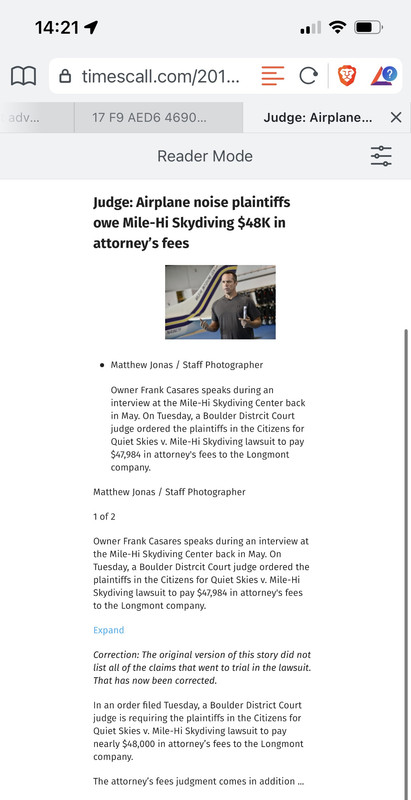
https://www.timescall.com/2015/07/29/ju ... neys-fees/
- NineThreeKilo offline
- Retired
- Posts: 1679
- Joined: Thu Dec 31, 2009 8:16 pm
- Location: _
Mon Dec 19, 2022 6:26 am
Re: Utah County proposal to ban off airport landings
This Avweb article about noise legislation in NYC is another reminder why GA and Commercial aviation can really generate some strong pushback against unappreciated noise. Avweb reported that in this recently passed NY State legislation individual crewmembers could have been sued for noisy operations had the governor of NY not vetoed the bill.
Here is a link to the New York Senate Bill passed by both houses of the New York legislature. The bill's summary unambiguously declares war on aircraft (helicopter) "noise". It's not much of a stretch to see this written to include fixed wing aircraft, drones of any sort, ad infinitum.
https://www.nysenate.gov/legislation/bills/2021/S7493?intent=oppose
The bill is an interesting read.
Here is a link to the New York Senate Bill passed by both houses of the New York legislature. The bill's summary unambiguously declares war on aircraft (helicopter) "noise". It's not much of a stretch to see this written to include fixed wing aircraft, drones of any sort, ad infinitum.
https://www.nysenate.gov/legislation/bills/2021/S7493?intent=oppose
The bill is an interesting read.
- PapernScissors offline
- Posts: 419
- Joined: Sun Mar 06, 2016 8:49 pm
- Location: Spokane
- Aircraft: Cessna 172
DISPLAY OPTIONS
Who is online
Users browsing this forum: No registered users and 0 guests
Latest Features
-
Live to Tell
A Minnesota pilot is surprised to learn that the sudden asymmetric drag of an out-of-rig ski can…Read More -
Creators
Working in some of the Yukon's most beautiful and remote environments, photographer Simon Blakesley captures aircraft in…Read More -
Aircraft Ownership and Maintenance
Upgrading to big tires can make a huge difference in backcountry performance, but with those gains come…Read More -
Tales from Yesteryear
In this tale from bush flying yesteryear, Don Cogger signs up to help Atlee Dodge Jr recovery…Read More


Latest Knowledge Base
-
Destinations
A regional guide with ideas for winter camping destinations in California, Nevada, New Mexico, and Arizona.Read More -
Aircraft
Finding an affordable aircraft that can handle the backcountry for $80K or less? A challenge for sure, but with the…Read More -
Aircraft
01.29.2018 - Zane - Updated tire diameter graphic to add 8.50x10 Guide to tires for use in the backcountry and off-airport landing…Read More -
Pilots
12.22.2013 - Initial article format Operating aircraft on skis and negotiating a snow-covered landscape is an entirely unique skillset and environment.…Read More


