wheel landings in a husky
Wed Sep 24, 2008 6:25 pm
wheel landings in a husky
what is the overall opinion of the group, let me know, i am very interested in hearing some different opinion's.
Wed Sep 24, 2008 6:59 pm
Every good landing ends up on three points. Why waste time getting there with a wheel landing. Too many things can go wrong the longer you take transitioning from flying to parking. If you are worried about visibility or hitting something you should of seen that during your downwind or inspection pass. Three points makes the shortest ground roll except for those stoppies that bring the tail up from hard braking at the alaskan shortest landing contest.

If you find yourself in a hole, the first thing to do is stop digging.
Thu Sep 25, 2008 4:55 am
I like tail low wheel landings in many tailwheel airplanes, the Husky most of all. With the new squared off larger instrument panels, it's hard for us short guys to see over the panel, so a wheel landing permits better vision ahead. And, I would point out to the previous poster that things sometimes walk ONTO a runway between the time you fly downwind and land. Also, if you land the airplane in any sort of restricted landing areas, the forward vision is really important.
The Husky wheel lands just fine. It does have very effective brakes, so use caution there, but that's true in any case.
I have a couple thousand hours in Huskys, and probably 95 % of my land landings (ie: not on floats) in the airplane were wheel landings.
They are great little airplanes.
MTV
The Husky wheel lands just fine. It does have very effective brakes, so use caution there, but that's true in any case.
I have a couple thousand hours in Huskys, and probably 95 % of my land landings (ie: not on floats) in the airplane were wheel landings.
They are great little airplanes.
MTV


Thu Sep 25, 2008 8:26 am
I think most of the Husky drivers use the tail low wheel landing. The tail low so that you are at the slowest possible landing speed, and then up on your main wheels for visual perception especially on short strips with unknown surface obstacles. But I also do a full wheel landing or three pointer depending on the landing surface, winds, and my mood at the time. The Husky lands best at slowest possible speed. Too much speed when doing conventional wheel landings translates into energy that must be dissipated and hence the pilot needs to be skillful enough to recognize attitudinal changes that need to be controlled. I like the tail low or three pointer because I can use a touch of power all the way to the ground and this gives me the lowest possible landing speed and I can better control my touch down point. Landing surface and winds may sometimes dictate which technique you chose on any particular landing.
My perception with the Husky is that in order to get the plane really slowed down for final touch down, you have to get the nose up to create drag. I think that is a result of the Fowler flaps that give great lift but not much drag. A cub or an Arctic Tern, on the other hand can get both lift and drag out of its flaps and hence can slow down very nicely but maintain that slow flight with throttle giving a nice flat attitude for seeing over the cowling. Too much nose up with the Husky gives the drag, but then power slows you down even more because you have entered the area of reverse controls. Then you find yourself doing a tail first landing that is very slow, but can really slam you down on your mains if you are not careful (and you absolutely cannot see where you are going to touch down--you just know its going to be a short one).
Of the six airplanes that I have owned, the Husky requires the most technique for performing good landings. But once you learn the technique that works best ... wow, what an airplane. I like the tail low wheel landing for the Husky, but don't shy away from three point or conventional wheel landings. I can use breaks on the three point and tail low wheel landings, but I stay away from the breaks with a full wheel landing.
Nizina
My perception with the Husky is that in order to get the plane really slowed down for final touch down, you have to get the nose up to create drag. I think that is a result of the Fowler flaps that give great lift but not much drag. A cub or an Arctic Tern, on the other hand can get both lift and drag out of its flaps and hence can slow down very nicely but maintain that slow flight with throttle giving a nice flat attitude for seeing over the cowling. Too much nose up with the Husky gives the drag, but then power slows you down even more because you have entered the area of reverse controls. Then you find yourself doing a tail first landing that is very slow, but can really slam you down on your mains if you are not careful (and you absolutely cannot see where you are going to touch down--you just know its going to be a short one).
Of the six airplanes that I have owned, the Husky requires the most technique for performing good landings. But once you learn the technique that works best ... wow, what an airplane. I like the tail low wheel landing for the Husky, but don't shy away from three point or conventional wheel landings. I can use breaks on the three point and tail low wheel landings, but I stay away from the breaks with a full wheel landing.
Nizina
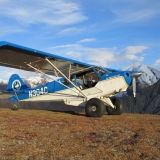
Nizina

Thu Sep 25, 2008 11:33 am
I have my second Husky, new wing now. I find what MTV and Nizina said to be true also.
I practice a technique of using 55 MIAS all the way around the pattern, from take off through short final. This is with pilot and approximately 20 gallons of fuel, about 10 pounds of stuff in the extended baggage area. Once the attitude is set, with second notch of flaps until final, power adjustments control altitude and airspeed. Elevator changes very little when I do this correctly. I always wheel land, tail low, use some moderate braking action (depending on the surface as to how much) and use stick rear pressure to balance the braking action while still maintaining tail up and forward visibility. MTV makes a true and correct statement regarding what may have entered the landing area. Last week while practicing this technique on the turf runway at Fort Worth Spinks, on short final a Coyote decided to enter the runway and void his/her bowels while stopped in the middle. Since I maintained good forward visibility, I applied a little power and flew over the top of him/her at about 10' and landed just beyond. I think that this expedited the bowel movement of said Coyote and I was able to land with plenty of room to spare.
When landing on rough stuff, if you three point you have the potential of leaving the tailwheel right where you planted it.
If you get a chance to ride with an Alaskan pro you will seldom find them landing otherwise. I have ridden with several, including Loni Habersetzer, and have confirmed that the tail low technique is preferred for off airport environment, at least in the opinion of several of these very respected pilots.
Loni calls it Energy Management when using the technique I described above. Shortest, safest landing possible with little risk of damaging the airplane.
I practice a technique of using 55 MIAS all the way around the pattern, from take off through short final. This is with pilot and approximately 20 gallons of fuel, about 10 pounds of stuff in the extended baggage area. Once the attitude is set, with second notch of flaps until final, power adjustments control altitude and airspeed. Elevator changes very little when I do this correctly. I always wheel land, tail low, use some moderate braking action (depending on the surface as to how much) and use stick rear pressure to balance the braking action while still maintaining tail up and forward visibility. MTV makes a true and correct statement regarding what may have entered the landing area. Last week while practicing this technique on the turf runway at Fort Worth Spinks, on short final a Coyote decided to enter the runway and void his/her bowels while stopped in the middle. Since I maintained good forward visibility, I applied a little power and flew over the top of him/her at about 10' and landed just beyond. I think that this expedited the bowel movement of said Coyote and I was able to land with plenty of room to spare.
When landing on rough stuff, if you three point you have the potential of leaving the tailwheel right where you planted it.
If you get a chance to ride with an Alaskan pro you will seldom find them landing otherwise. I have ridden with several, including Loni Habersetzer, and have confirmed that the tail low technique is preferred for off airport environment, at least in the opinion of several of these very respected pilots.
Loni calls it Energy Management when using the technique I described above. Shortest, safest landing possible with little risk of damaging the airplane.
Stay Cool,
Cold Duck
Cold Duck
Thu Sep 25, 2008 4:03 pm
Out here in the midwest a good set of 26" ers can run over just about any critter in the bush. We have windmills because of the winds that usually don't follow the runway. I like to get traction and stopped before mother nature decides to change that. The beasties and and washouts are minimal. Good points all because differences in lat/lon require different approaches to the same outcome. The last time I lost a tailwheel was a huge wind gust that blew me and my tailwheel off and into the weeds. Just the rudder cables holding the tw on.
If you find yourself in a hole, the first thing to do is stop digging.
Thu Sep 25, 2008 6:01 pm
Baddog
26s Goodyears are great tires and the best landing technique is the one that you are the most comfortable with. Its great that you are getting that Husky. You and your wife need to wend your way north some time soon. Sounds like there are a few Husky drivers that are considering coming up in a pack this next summer.
Nizina
26s Goodyears are great tires and the best landing technique is the one that you are the most comfortable with. Its great that you are getting that Husky. You and your wife need to wend your way north some time soon. Sounds like there are a few Husky drivers that are considering coming up in a pack this next summer.
Nizina
Nizina
Thu Sep 25, 2008 6:50 pm
Hangar flying...without the hangar,
Aviation lore is deep and wide. This discussion reminds me of ancient history reviewed in "Flying the Line". A marvelous book written about airline pilots and history going back to the dawn of commercial aviation.
Anyhow...back in the 1940s and early 50s there was a rageing debate about wheel landings or 3 point landings in the DC-3....among the pilots of Contintental Airlines. Now few of us would dare suggest that these early,pioneer, airline pilots were not "top notch" "stick and rudder" pilots. Few would debate that the DC-3 could be a "challenging" airplane or that these airmen flew them under difficult, and primative conditions.
Yet...even among that pilot group there was strenous disagreement. It seem that the CAL pilots based in Houston and flying throughtout the southwest favored the 3 point landing. The CAL pilots, who were based in the windy city of Chicago, insisted on wheel landings.
The debate ended when some Houston based captains were displaced to the Chicago domicile. Faced with winds and vis. not normally part of the sunny, southwest.....they quickly came to appreciate and understand the need to land the DC-3 on the main gear first. Eventually CAL joined the rest of the industry and made "wheel landings" mandatory.
Moral of this story is....use the technique that works for you, your airplane and the circumstance which you face at the moment.
With thousands of hours in conventional gear airplanes of many types.....I try to remain proficient in all techniques and chose the correct one for the circumstance. Sounds like that is what most experienced airmen do.
Let the debate continue forever. It is part of what makes our avocation/ vocation so much fun!
bob
p.s. The Houston based CAL pilots are the ONLY... DC-3 pilots whom I have ever encountered that practiced 3 point landings in a DC-3 or any other large tailwheel airplane for that matter.
Aviation lore is deep and wide. This discussion reminds me of ancient history reviewed in "Flying the Line". A marvelous book written about airline pilots and history going back to the dawn of commercial aviation.
Anyhow...back in the 1940s and early 50s there was a rageing debate about wheel landings or 3 point landings in the DC-3....among the pilots of Contintental Airlines. Now few of us would dare suggest that these early,pioneer, airline pilots were not "top notch" "stick and rudder" pilots. Few would debate that the DC-3 could be a "challenging" airplane or that these airmen flew them under difficult, and primative conditions.
Yet...even among that pilot group there was strenous disagreement. It seem that the CAL pilots based in Houston and flying throughtout the southwest favored the 3 point landing. The CAL pilots, who were based in the windy city of Chicago, insisted on wheel landings.
The debate ended when some Houston based captains were displaced to the Chicago domicile. Faced with winds and vis. not normally part of the sunny, southwest.....they quickly came to appreciate and understand the need to land the DC-3 on the main gear first. Eventually CAL joined the rest of the industry and made "wheel landings" mandatory.
Moral of this story is....use the technique that works for you, your airplane and the circumstance which you face at the moment.
With thousands of hours in conventional gear airplanes of many types.....I try to remain proficient in all techniques and chose the correct one for the circumstance. Sounds like that is what most experienced airmen do.
Let the debate continue forever. It is part of what makes our avocation/ vocation so much fun!
bob
p.s. The Houston based CAL pilots are the ONLY... DC-3 pilots whom I have ever encountered that practiced 3 point landings in a DC-3 or any other large tailwheel airplane for that matter.
Living the Dream
DISPLAY OPTIONS
Who is online
Users browsing this forum: No registered users and 3 guests
Latest Features
-
Live to Tell
A Minnesota pilot is surprised to learn that the sudden asymmetric drag of an out-of-rig ski can…Read More -
Creators
Working in some of the Yukon's most beautiful and remote environments, photographer Simon Blakesley captures aircraft in…Read More -
Aircraft Ownership and Maintenance
Upgrading to big tires can make a huge difference in backcountry performance, but with those gains come…Read More -
Tales from Yesteryear
In this tale from bush flying yesteryear, Don Cogger signs up to help Atlee Dodge Jr recovery…Read More


Latest Knowledge Base
-
Destinations
A regional guide with ideas for winter camping destinations in California, Nevada, New Mexico, and Arizona.Read More -
Aircraft
Finding an affordable aircraft that can handle the backcountry for $80K or less? A challenge for sure, but with the…Read More -
Aircraft
01.29.2018 - Zane - Updated tire diameter graphic to add 8.50x10 Guide to tires for use in the backcountry and off-airport landing…Read More -
Pilots
12.22.2013 - Initial article format Operating aircraft on skis and negotiating a snow-covered landscape is an entirely unique skillset and environment.…Read More


