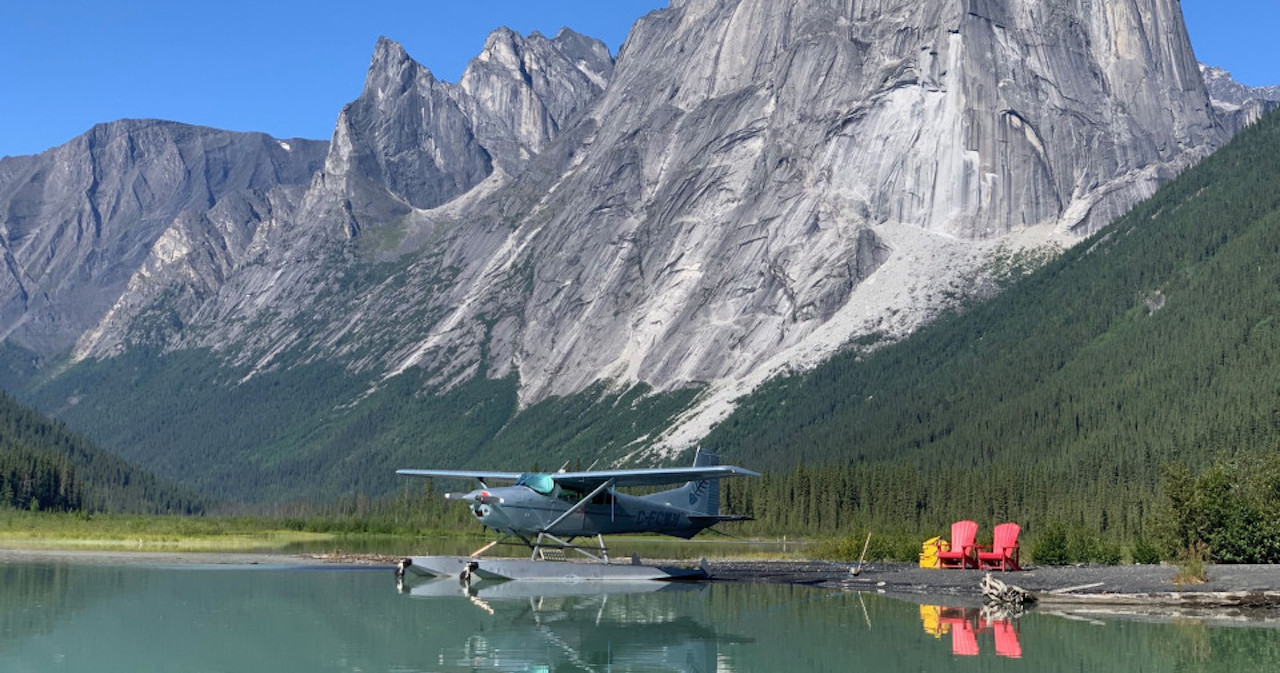
Larry Barnett
4/8/2002
I lived most of my life in Africa, where wild game wanders the savannah plains and the bush veld. This was 30 years ago, a time when we landed almost exclusively on grass strips, and a windsock was a luxury. Control towers existed only at the largest airports and there was little in the way of two-way communication.
World War II had ended 20 years before this story took place, but in Africa things change slowly.
At most outlying airfields, goosenecks - small watering cans filled with paraffin - were used for runway lighting. A wick, which protruded from the spout, would be lit. Goosenecks were placed on the left side of the runway only, and one always landed to the right of the goosenecks. Of course, there were always those who got confused and landed on the left side, creating a lot of excitement in the form of tree stumps, erosion ditches, sand, mud, open water and ant hills.
I arrived at Rand Airport in South Africa, about 10 miles southeast of Johannesburg, early on a beautiful winter day, June 30, 1965. After a cup of tea and a few words with the hangar manager, we rolled out my Bolkow Junior. I was the official agent for the aircraft in Southern Africa.
The Bolkow Junior was designed in Sweden, and produced by the German Aircraft Industry in southern Germany under license. The factory was located in Laupheim, where the Messcherschmit Me 109 was also manufactured during WWII.
Although the Bolkow had its faults, none of them were aerodynamic. It was a honey to fly, and a wonderful aerobatic airplane, as well as a good trainer. The cabin had side-by-side seating for two and excellent visibility under a clear bubble canopy. One shortcoming was inadequate cooling in the cabin, which could become like a hot house under blue African skies. But fixed tricycle landing gear made ground handling a pleasure. Droop snoot wings were placed at shoulder height just behind the cabin, offering excellent visibility above and below them.
I remember a German representative telling me with a wink that the aircraft even had hard points, meaning that racks could be fitted for carrying bombs, rockets or light machine guns. Just "sales talk," I thought to myself. The whole aircraft, with a little two-way radio and a limited instrument panel, cost the princely sum of $8,100 in 1965.
I did my preflight starting with the 50-yard check and finishing with the cockpit hinges. Oil and fuel were sufficient for the flight to my destination with an alternate. I climbed aboard.
Soon after pre-start checks, I had the engine running with oil pressure in the green. It always ran as smooth as a sewing machine and sounded like one too.
I was going to see a farm named Argyle on the border of the Kruger National Park, the huge internationally known game reserve in northeastern South Africa. From Johannesburg it was about 200 nautical miles to the Northeast, across the Drakensburg Mountains. I had made arrangements to meet the owner of the property on a little strip about six miles south of the property.
With no NDBs, my navigation technique was map reading and dead reckoning all the way. Not that I had any navigation instruments anyway. The Bolkow's panel had only a basic turn and bank indicator, a directional gyro, airspeed indicator, altimeter and compass. A single radio provided VHF line of sight communication.
Forecasted weather was typical for the time of year, clear skies with cumulus clouds forming after 4 p.m. local.
I called the tower and was cleared direct on a VFR flight plan. At that time, if you were a private VFR flight and not crossing international borders, you were not required to tell anyone where you were headed. And there was no point asking for search and rescue should it be needed because I was going to a landing strip that wasn't even on the map. I would simply fly to a point on the map near a T-junction.
I always had concern about landing in long grass in a tricycle gear aircraft. These back country strips were not usually maintained, except by the odd farmer who had a small aircraft. The Bolkow Junior's propeller had only three inches of ground clearance, and was about six inches ahead of the nose wheel, so it was a good lawn mower. But anthills were often hidden in the long grass, large enough to ruin one's day.
The man I was to meet was an accountant who knew little about the requirements of a landing strip. After a few questions, I politely briefed him. I suggested he drive his car up and down the strip to check that it was smooth, explaining that this also would leave tire tracks in the grass for me to land on.
He understood, but I still planned a low-level inspection of the area before landing, to check the surface and scare away any wild animals. What else could go wrong? Nothing I could think of. After all, I was a veteran of countless landings in the African bush, on grass, dirt and stone strips, roads, riverbeds, beaches and even saltpans.
I flew across the majestic Drakensberg Mountains and enjoyed the flying as I have always done and still do. After about 135 miles, I left the highlands for the vast, low-lying savannah plains. There, in the distance, I saw the T-junction. I knew the area elevation was about 1,700 feet msl, so I descended to 2,700 feet msl, looking for the black car the accountant was driving, and the strip.
I looked for other aircraft and even broadcast my intentions, always keeping a wary eye out for the unexpected. There was no windsock so I looked for smoke, but found none. The movement of cloud shadows offered a rough estimate of only a slight wind from the south. With the strip running north/south, I planned accordingly.
I remember thinking how very good and professional my piloting was. I did pre-landing checks and prepared for the low pass, lowering flaps to slow down. Just as I used to teach students, I kept my eyes out of the cockpit, yet I am still amazed by what was about to happen.
A large acacia - or umbrella - tree grew just short of the landing threshold, and I would have to clear it to get onto the strip. I timed my inspection flight down the strip to determine its length, which was short but adequate. I would come in low over the tree and touch down as close to the threshold as possible. Glancing at the accountant's car, I saw him watching me. With the inspection complete, I added full power and climbed to 500 feet, then turned downwind and final.
Low and slow, I watched the acacia tree as I just cleared its upper branches. Then, BANG! Something hit the underside of the aircraft. Perhaps I had hit a large bird, such as a vulture. What else could it be?
I immediately applied full power to go around. Except for a strange noise, the plane was definitely under control. By the crosswind leg I could hear a rough, rattling sound under the fuselage. Still looking for possible clues, I flew a pattern and prepared again to land. Checking my fuel, I knew I had to.
When I saw the Bolkow's shadow on the ground, the source of the noise was apparent. The aircraft's nose wheel was swinging back and forth, the tire banging the underside of the fuselage.
I gently touched down on the Bolkow's main wheels, and held the nosewheel off. As the aircraft slowed, I pulled the mixture, and, still holding the stick all the way back, opened the canopy. As the Bolkow's nose started to come down, I slithered over the wing and onto the rear fuselage. My weight kept the nose high. When the aircraft stopped, I gingerly climbed down. I looked under the fuselage, still mystified, although I noticed a mess along the belly, the remains of the assumed bird.
The accountant walked up and asked if I was all right.
"Yes," I answered, "but something hit the underside of the aircraft. Look at the mess."
He seemed surprised. "Did you not see the giraffe?"
I stopped my examination of the nose wheel and stood up. "What giraffe?"
He turned and pointed. "There, under the Acacia tree. You hit it as you passed over the tree. It's dead."
I walked over to the acacia tree and sure enough, there lay a dead giraffe.
I had hit it first with the propeller, killing it instantly. The nose wheel had knocked it to the ground. The giraffe had been feeding behind the acacia, and unfortunately had raised its head as I came over the top of the tree. With the throttle at idle and the wind at its back, the giraffe probably never even heard me coming.
I was shocked by how lucky I was to be alive.
But now, how to get the aircraft back to Johannesburg? With the accountant's help, I got an empty oil drum, a blanket and rope. With the further help of some locals, we moved the aircraft next to a tree in the local chief's kraal, which is a small collection of mud and grass huts where extended families live out in the African bush.
We put a blanket over the drum, and placed it under the forward section of the aircraft. I lashed the aircraft to the tree using bits of blanket to protect its paint, then tied it down and covered the canopy.
The chief arranged for the aircraft to be surrounded by thorn tree branches to keep large animals away from it during the night.
At the farm, we arranged for a mechanic to repair the aircraft so I could return to Johannesburg.
Next morning he arrived, uneventfully, in a Cessna 172. Damage was limited to a sleeve on the nose gear leg, which was welded in the field. While the mechanic took off in the Bolkow Junior, I followed in the Cessna 172, for a thankfully uneventful return flight to Rand Airport.
Larry Barnett is a 30 year pilot who owned an engineering and electronics factory in South Africa.
Sorry for the bad spacing but that is what cam with the pasting
You know you are a pilot when you kill a giraffe
Fri Dec 30, 2011 8:12 am
- cstolaircraft offline
- Posts: 523
- Joined: Wed Sep 29, 2010 12:50 pm
- Location: Blackwell, Mo
Mission Pilot in training. C-170B N8098A.
But they that wait upon the Lord shall renew their strength; they shall mount up on wings as eagles... Isaiah 40:31
But they that wait upon the Lord shall renew their strength; they shall mount up on wings as eagles... Isaiah 40:31
Fri Dec 30, 2011 8:34 am
Re: You know you are a pilot when you kill a giraffe
Great story! I really enjoyed reading it.
Last year I was at a small zoo in Florida that had giraffe. I was surprised by how terrible they smell. I mean really bad!
Turns out that is how they tell each other apart, by smell. No wonder they need those long necks. They use them to position their noses as far away from their bodies as possible!
Last year I was at a small zoo in Florida that had giraffe. I was surprised by how terrible they smell. I mean really bad!
Turns out that is how they tell each other apart, by smell. No wonder they need those long necks. They use them to position their noses as far away from their bodies as possible!
- Skystrider offline
- Posts: 1231
- Joined: Wed Jan 24, 2007 1:44 pm
- Location: Saylorsburg
- Aircraft: Zenith CH701 w/ Jabiru 3300
Fri Dec 30, 2011 9:01 am
Re: You know you are a pilot when you kill a giraffe
On my trip to South Africa we drove through The Drakensberg Mountains, as beautiful as any place I have ever seen!
Great story, thanks.
Rob
Great story, thanks.
Rob
- OregonMaule offline
- Posts: 6986
- Joined: Fri Sep 01, 2006 9:44 pm
- Location: Orygun
My SPOT page
"They who can give up essential liberty to obtain a little temporary safety, deserve neither liberty nor safety". Ben Franklin
http://en.wikiquote.org/wiki/Benjamin_Franklin
"They who can give up essential liberty to obtain a little temporary safety, deserve neither liberty nor safety". Ben Franklin
http://en.wikiquote.org/wiki/Benjamin_Franklin
Fri Dec 30, 2011 9:33 am
Re: You know you are a pilot when you kill a giraffe
Great adventure story...... 

Thanks for contributing to BCP being a great site!
Loved it.....
lc
Thanks for contributing to BCP being a great site!
Loved it.....
lc
Humor may not make the world go around, but it certainly cheers up the process...
With clothing, the opposite of NOMEX is polypro (polypropylene cloth and fleece).
Success has many fathers...... Failure is an orphan.
With clothing, the opposite of NOMEX is polypro (polypropylene cloth and fleece).
Success has many fathers...... Failure is an orphan.
Fri Dec 30, 2011 9:57 am
Re: You know you are a pilot when you kill a giraffe
I had a neighbors cat run out in front of me on takeoff, I was committed for takeoff on my downhill strip so couldn't do anything but keep going. Man, could that cat jump! It made it out of the way safely and never came back.
A month after getting Ted the dog from pound, and seemingly teaching him to avoid the plane (easy, he showed no interest at all in getting close when the engine was running). I was on short final and just as I came over the tall grass and over the mowed strip Ted came shooting out of the grass and across the strip like he was shot out of a cannon, and dissappeared under the nose. I heard/felt a thump and touchdowned, all at once. Oh shit.... I put the plane away in the hangar while looking for Ted to come up the runway, no show. After closing the hangar door and dreading what I would find, I started down to look. Then I saw him, shaking his head and walking kind of wobbly. Otherwise OK, no broken bones and best of all no prop strike damage. Later that day I noticed the gear leg fairing was dented, I had hit him, hard and solid, with one of the most solid parts of the plane. I think it must have cold cocked him, accounting for the several minutes before his re-appearance. Nowadays, 4 years later, our routine is well established, he stays the hell away, like 75' min., until shutdown and I start to get out. THEN he knows it is OK to approach and piss on both tires. But a giraffe?? Damn....
A month after getting Ted the dog from pound, and seemingly teaching him to avoid the plane (easy, he showed no interest at all in getting close when the engine was running). I was on short final and just as I came over the tall grass and over the mowed strip Ted came shooting out of the grass and across the strip like he was shot out of a cannon, and dissappeared under the nose. I heard/felt a thump and touchdowned, all at once. Oh shit.... I put the plane away in the hangar while looking for Ted to come up the runway, no show. After closing the hangar door and dreading what I would find, I started down to look. Then I saw him, shaking his head and walking kind of wobbly. Otherwise OK, no broken bones and best of all no prop strike damage. Later that day I noticed the gear leg fairing was dented, I had hit him, hard and solid, with one of the most solid parts of the plane. I think it must have cold cocked him, accounting for the several minutes before his re-appearance. Nowadays, 4 years later, our routine is well established, he stays the hell away, like 75' min., until shutdown and I start to get out. THEN he knows it is OK to approach and piss on both tires. But a giraffe?? Damn....
- courierguy offline

- Posts: 4197
- Joined: Thu Mar 31, 2005 6:52 pm
- Location: Idaho
"Its easier to apologize then ask permission"
Tex McClatchy
Tex McClatchy
Fri Dec 30, 2011 1:47 pm
Re: You know you are a pilot when you kill a giraffe
Great stories. Never know what's going to poke its head out of the bush.
Lynn Sanderson (Dirtstrip) passed away from natural causes in May 2013. He was a great contributor and will be missed dearly.
Fri Dec 30, 2011 2:01 pm

Fri Dec 30, 2011 2:20 pm
Re: You know you are a pilot when you kill a giraffe
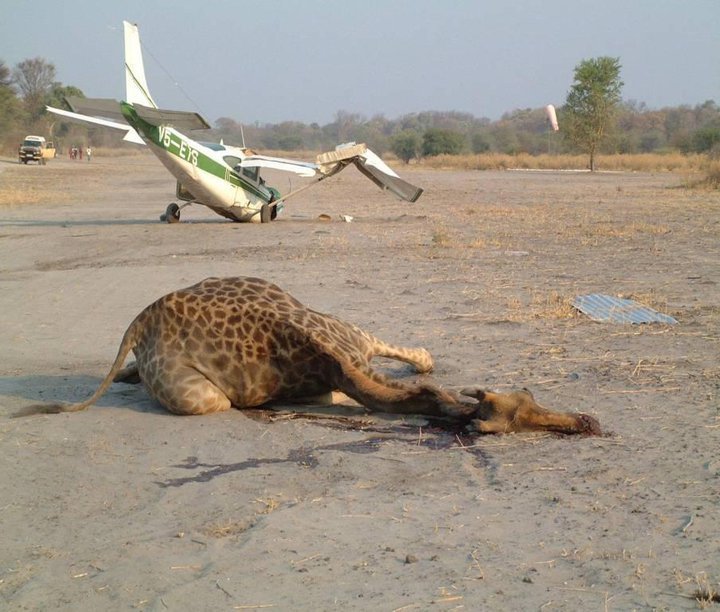
Bet that left a stain... 
Gump
Gump
Fri Dec 30, 2011 3:49 pm
Re: You know you are a pilot when you kill a giraffe
That when you need .50 cal in your wings 
- cstolaircraft offline
- Posts: 523
- Joined: Wed Sep 29, 2010 12:50 pm
- Location: Blackwell, Mo
Mission Pilot in training. C-170B N8098A.
But they that wait upon the Lord shall renew their strength; they shall mount up on wings as eagles... Isaiah 40:31
But they that wait upon the Lord shall renew their strength; they shall mount up on wings as eagles... Isaiah 40:31
Fri Dec 30, 2011 5:01 pm
You know you are a pilot when you kill a giraffe
Giraffe strikes... apparently more common than you think.
Fri Dec 30, 2011 5:29 pm
Re: You know you are a pilot when you kill a giraffe
Great story! I can just hear the German salesman saying with that wink 'zee arkraft ving has aard points' lol
Blessed are the curious, for they shall have great adventures!
DISPLAY OPTIONS
Who is online
Users browsing this forum: No registered users and 0 guests
Latest Features
-
-
Featured Bush Planes
As one of the undisputed legends of bush flying, the Cessna 180 hauls a…Read More -
Aircraft Ownership and Maintenance
9 modification mistakes aircraft owners make when trying to "bush out" their birds—why some…Read More -
Live to Tell
A Minnesota pilot is surprised to learn that the sudden asymmetric drag of an…Read More


Latest Knowledge Base
-
Destinations
Canada offers some of the most spectacular backcountry flying on the continent. Here's what you need to know before you go.Read More -
Safety and Survival
Hope that you never have to use your survival vest but knowing you have it and knowing how to use…Read More -
Destinations
A regional guide with ideas for winter camping destinations in California, Nevada, New Mexico, and Arizona.Read More -
Aircraft
Finding an affordable aircraft that can handle the backcountry for $80K or less? A challenge for sure, but with the…Read More