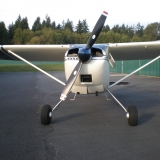
Battson wrote:I dont have time in a L-19 (only 3 or 4 in this country I think) but I do have a question about going around with the barn doors open.
I have only flown aircraft with 30-35 degrees flap max, the new aquisition will do 52 (once finished)...
Everyone says it's tough going around with everything hanging out in the breeze - but how tough is tough, is it actually too much pitching moment to overpower if you wrestle with the stick?
I realise each aircraft is different, but generally speaking - must you partially retract flaps before applying full power, or is it more of a comfort, safety, and control thing? Going around with 30 was never a big deal.
Battson,
As is the case with many things aviation, there is no hard and fast answer to this question. The answer depends on the airplane, the flaps, ESPECIALLY the density altitude and weight of the airplane, and finally the pilot's skill level.
One of the nasty little tricks I always expose a pilot new to Cessna 185s is a full flap go-around at the last moment from idle power, and set up for a three point landing, including trimmed for the full flap setting and idle power glide. THAT can be a deeply moving religious experience the first time you encounter it. The pitch forces are extreme, and retracting the flaps quickly to 30 may not be real practical due to the force you have to apply to the yoke....it takes both hands unless you're built like the Governator.
But, even in that very powerful airplane, if you set yourself up for a full flap go around at a high all up weight, particularly at a high density altitude, it simply may not work, even if you overcome the pitch forces. That's a lot to ask of any airplane and the airplane is very likely to be unable to maintain altitude.
Now, set my 170 or a Super Cub up with full flaps (Cubs had around 44 or so degrees at the full flap setting) on a go around, and the pitch forces aren't much to deal with, but again at a high weight and/or high DA, the airplane may simply not have the performance to maintain altitude until you retract flaps some.
I make students demonstrate full flap go arounds in everything I fly in. And, most times, its no big deal.....level the airplane, apply full power, stop the descent, allow the airplane to accelerate a bit, THEN start gradually retracting the flaps. THEN start climbing.
But, again, it depends on a LOT of variables, both in the airplane and in the ambient conditions.
MTV






 ) that make a go-around a handful-- it's the extreme nose-up trim setting used to make the airplane fly final approach on-speed. For a go-around I cob in about half throttle, retrim like a big dog (here's where a Piper overhead trim crank wold come in handy), then cob in the rest of the throttle & start cleaning up the flaps.