Hi guys I am looking at building a walking beam hydraulic lift trailer (or dolly if you prefer) for our maule and 185 to get them from the water to the hanger. I have seen a few around and I am sure they are everywhere, so I figured getting plans would be a piece of cake........not so much! Google failed me, first time ever I think! The only thing I found was a website called seaplane trailer secrets.com and you had to pay to get the info, which I am ashamed to admit I did......what a waste of money. I know very little about the subject and my 20 bucks earned me no more info, just a vague description and some poor photos of single axle trailers.
I was hoping that I may get some insight and some direction on where I may find some plans for such a trailer. I am a welder and millwright by trade so I can build it, I was just hoping to go with a tried and tested design.
Any input would be great
Thanks
Building a hydraulic lift trailer for a float plane
Thu Oct 30, 2014 9:41 pm
- Steelroamer offline


- Posts: 119
- Joined: Fri May 09, 2014 3:10 pm
- Location: Kenora
- FindMeSpot URL: https://maps.findmespot.com/s/D8VB
- Aircraft: maule M6 on Floats
Thu Oct 30, 2014 10:56 pm
Re: Building a hydraulic lift trailer for a float plane
Is this a walk-behind design like a pallet truck? Or a picker tug like you see built from half a pickup?
- Zzz offline


- Posts: 2855
- Joined: Fri Oct 08, 2004 11:09 pm
- Location: northern
- Aircraft: Swiveling desk chair
Half a century spent proving “it is better to be thought a fool than to open your mouth and remove all doubt.”
Fri Oct 31, 2014 7:40 am
Re: Building a hydraulic lift trailer for a float plane
I've seen them built from a hydraulic car lift mounted to a car carrier ( the kind that has a low shelf to put the front wheels of the car to be dragged behind an RV). The tongue was modified to be a lot longer and to carry a lot of the weight.
Fri Oct 31, 2014 7:44 am
Re: Building a hydraulic lift trailer for a float plane
Pretty simple to construct I would think, but then I am always making or modifying projects to fit my needs. Go look at a pontoon trailer and copy it to fit your dimensions would be the easiest way. Two ways of making it, lifting via the spreader bars or from the keels. I will state that the float trailer I was borrowing used the spreader bars and I personally was a little apprehensive about it. It did use a 2x8 placed under the spreader bars, front and back, to add support but I could see a slight flexing even when they were used. It is also a much less stable transport system, meaning there was a lot of rockin' going on and not the teenage back seat of the car type! 
Next time I go to town I can get a photo of the unit they use at the FBO to lift and transport seaplanes to the lake. It's at Park Rapids, MN if you get down this way. I will eventually build one for myself also. It will lift from the bottom of the floats.
Next time I go to town I can get a photo of the unit they use at the FBO to lift and transport seaplanes to the lake. It's at Park Rapids, MN if you get down this way. I will eventually build one for myself also. It will lift from the bottom of the floats.
Fri Oct 31, 2014 8:58 am
Re: Building a hydraulic lift trailer for a float plane
I haven't been there in quite a while, but there used to be quite a few straight float planes parked on the ramp at Renton WA (KRNT), sitting on lift trailers. I've heard them referred to as alligators. Like lesuther described, some sort of hydraulic lift apparatus mounted to a low trailer. Maybe someone who's handy to a seaplane base like Renton could spot one & take some photos.
Cessna Skywagon -- accept no substitute!
Fri Oct 31, 2014 9:41 am
Re: Building a hydraulic lift trailer for a float plane
There are at least as many designs of float trailers as there are seaplanes.
First, what do you NEED?
Do you need to be able to pick a seaplane out of the water, move it to a hangar or storage on land, drop it there, and pick another? Coming back later to pick up that same plane, and put it in the water? If so, that will indeed require a system that can lift the plane and lower it.
Otherwise, if you can live with a trailer, just to move a plane in and out of the water, build a low deck trailer...simple and cheap.
BUT, assuming you do need to lift and drop, and re-lift:
Obviously, if you need to go this route, lifting via the keels is impossible. So, lifting via the spreaders is required. Problem is, unless you are designing this for only one airplane, you have to accommodate the different widths of spreader bars. You mentioned Cub and 185, for example. The spreaders on those planes are very different lengths. Also, the distance BETWEEN spreader bars differs greatly as well.
As WW noted, using a relatively narrow lifting system on the spreaders places a lot of bending moment on the spreaders....not good. So, making a system that fits several types can be a challenge, and takes some thought.
The system I liked best was a lift system, with an adjustable WIDTH spreader bar lift system. This can be done by setting the portion of the device that actually contacts the spreaders up with a sliding adjustment for width. For the rear spreader lift, a fixed (fore and aft) rail, with sliding channel iron pieces, padded with wood to protect the spreader bar, works well.
The tough one is the front one, which has to be adjustable in both width AND fore and aft. That gets more complicated, but just requires one more "level" of support. Or, you can simply make the lift bar for the front spreader bar long enough fore and aft to accommodate all comers.....or design BOTH spreader lifts wide enough.....potential slipping, however......
All of this mish-mash is then mounted on a parallelogram type hydraulic lift arrangement, with a single lifting ram.
You can mount this on a low trailer chassis, in which case you'll need to ensure that the axle width is narrow enough to fit between the floats of the narrowest plane you plan to lift.
Which, of course, and as WW noted, can make for a pretty wobbly setup, particularly if you have to move over anything other than paved or concrete ramps......
The absolute best of these kinds of systems I've seen are like Burl Rogers uses at Lake Hood Seaplane base in Anchorage. Burl built a system like I have described, but instead of building it on a trailer chassis, he found an old Jeep pickup, and welded the seaplane lifting "trailer" to the front frame rails of the Jeep, so that the "trailer" is now a solid part of the pickup's chassis. He then removed the portion of the Jeep aft of the cab. In other words, he sawed off the Jeep's frame rails just behind the cab, and removed all the drive train components aft of the transfer case. Now, the thing is in four wheel drive all the time, driving only the front wheels, of course, but the Jeep itself stabilizes the lifting system greatly. He can lift (with adjustable spreader lifts, as noted) almost any size seaplane quickly and then set them down in his hangar for maintenance or on the bank for the winter. Then, pick them up from land later, and plunk them in the water.
A nice system, but as you probably have figured, it's "busy", and is going to take some work. Simplest system is to just build a low deck trailer, but then getting planes onto and off the trailer from land is tough.
In any case, if you are a welder and you've got some time, I'd just do some measuring on the planes you want to move, sit down and think about how it'll have to work (two frames, one that has the axles and hydraulics, the other that does the lifting with a scissors or ?) and the spreader bar contact points. Then draw it out, and build it.
If you happen to have an old four wheel drive vehicle around somewhere, and you plan to lift a lot of seaplanes, you might consider the rig like Burl uses. It's really stable. If you can pretty much stay on level surfaces, then a trailer lift system can work as well.
Good luck.
MTV
First, what do you NEED?
Do you need to be able to pick a seaplane out of the water, move it to a hangar or storage on land, drop it there, and pick another? Coming back later to pick up that same plane, and put it in the water? If so, that will indeed require a system that can lift the plane and lower it.
Otherwise, if you can live with a trailer, just to move a plane in and out of the water, build a low deck trailer...simple and cheap.
BUT, assuming you do need to lift and drop, and re-lift:
Obviously, if you need to go this route, lifting via the keels is impossible. So, lifting via the spreaders is required. Problem is, unless you are designing this for only one airplane, you have to accommodate the different widths of spreader bars. You mentioned Cub and 185, for example. The spreaders on those planes are very different lengths. Also, the distance BETWEEN spreader bars differs greatly as well.
As WW noted, using a relatively narrow lifting system on the spreaders places a lot of bending moment on the spreaders....not good. So, making a system that fits several types can be a challenge, and takes some thought.
The system I liked best was a lift system, with an adjustable WIDTH spreader bar lift system. This can be done by setting the portion of the device that actually contacts the spreaders up with a sliding adjustment for width. For the rear spreader lift, a fixed (fore and aft) rail, with sliding channel iron pieces, padded with wood to protect the spreader bar, works well.
The tough one is the front one, which has to be adjustable in both width AND fore and aft. That gets more complicated, but just requires one more "level" of support. Or, you can simply make the lift bar for the front spreader bar long enough fore and aft to accommodate all comers.....or design BOTH spreader lifts wide enough.....potential slipping, however......
All of this mish-mash is then mounted on a parallelogram type hydraulic lift arrangement, with a single lifting ram.
You can mount this on a low trailer chassis, in which case you'll need to ensure that the axle width is narrow enough to fit between the floats of the narrowest plane you plan to lift.
Which, of course, and as WW noted, can make for a pretty wobbly setup, particularly if you have to move over anything other than paved or concrete ramps......
The absolute best of these kinds of systems I've seen are like Burl Rogers uses at Lake Hood Seaplane base in Anchorage. Burl built a system like I have described, but instead of building it on a trailer chassis, he found an old Jeep pickup, and welded the seaplane lifting "trailer" to the front frame rails of the Jeep, so that the "trailer" is now a solid part of the pickup's chassis. He then removed the portion of the Jeep aft of the cab. In other words, he sawed off the Jeep's frame rails just behind the cab, and removed all the drive train components aft of the transfer case. Now, the thing is in four wheel drive all the time, driving only the front wheels, of course, but the Jeep itself stabilizes the lifting system greatly. He can lift (with adjustable spreader lifts, as noted) almost any size seaplane quickly and then set them down in his hangar for maintenance or on the bank for the winter. Then, pick them up from land later, and plunk them in the water.
A nice system, but as you probably have figured, it's "busy", and is going to take some work. Simplest system is to just build a low deck trailer, but then getting planes onto and off the trailer from land is tough.
In any case, if you are a welder and you've got some time, I'd just do some measuring on the planes you want to move, sit down and think about how it'll have to work (two frames, one that has the axles and hydraulics, the other that does the lifting with a scissors or ?) and the spreader bar contact points. Then draw it out, and build it.
If you happen to have an old four wheel drive vehicle around somewhere, and you plan to lift a lot of seaplanes, you might consider the rig like Burl uses. It's really stable. If you can pretty much stay on level surfaces, then a trailer lift system can work as well.
Good luck.
MTV


Fri Oct 31, 2014 10:23 am
Re: Building a hydraulic lift trailer for a float plane
I have drawings, parts list & photo of a hydraulic lift that works very well for a SCub, might want some mods for bigger planes.
Send me your email.
Send me your email.
- NimpoCub offline
- Posts: 487
- Joined: Thu Dec 22, 2011 1:04 pm
- Location: Nimpo Lake, BC 52.22N 125.14W
- FindMeSpot URL: www.tinyurl.com/loganspot
Nimpo Lake Logan... boonie SuperCubber
Fri Oct 31, 2014 4:11 pm
Re: Building a hydraulic lift trailer for a float plane
Steelroamer wrote:Hi guys I am looking at building a walking beam hydraulic lift trailer (or dolly if you prefer) for our maule and 185 to get them from the water to the hanger. I have seen a few around and I am sure they are everywhere, so I figured getting plans would be a piece of cake........not so much! Google failed me, first time ever I think! The only thing I found was a website called seaplane trailer secrets.com and you had to pay to get the info, which I am ashamed to admit I did......what a waste of money. I know very little about the subject and my 20 bucks earned me no more info, just a vague description and some poor photos of single axle trailers.
I was hoping that I may get some insight and some direction on where I may find some plans for such a trailer. I am a welder and millwright by trade so I can build it, I was just hoping to go with a tried and tested design.
Any input would be great
Thanks
I'm going to my hanger tomorrow to move my plane. The airport has one there - I'll try and video the thing and post and if you like it, I can possibly measure it up for you and send you the details. It's moved my old Maule before, 180's, 185's, Cubs, etc., etc. also thinking of getting one built for myself.
Garth
Fri Oct 31, 2014 4:44 pm
Re: Building a hydraulic lift trailer for a float plane
I've looked for the same thing. There isn't much out there being commercially produced, most of the solutions for this problem have come from people that are handy with welders 
This is a pretty slick system here, however:
I can't find anything else about it on the web, so that leads me to think it was a one-off prototype. It has all of the characteristics Mike was talking about in his post above, from what I can see.
This is a pretty slick system here, however:
I can't find anything else about it on the web, so that leads me to think it was a one-off prototype. It has all of the characteristics Mike was talking about in his post above, from what I can see.
- CapnMike offline

- Posts: 842
- Joined: Wed Mar 05, 2014 11:25 am
- Location: Kamas, Utah and Sandpoint, Idaho
"If my wings should fail me Lord, please meet me with another pair" - Led Zeppelin
"It's all going in my report..." - CapnMike
"It's all going in my report..." - CapnMike
Fri Oct 31, 2014 4:53 pm
Re: Building a hydraulic lift trailer for a float plane
They have moved my 185 many times with the one at Park Rapids Mn, when I used to keep it there in the winter, it is the one WWhunter mentioned, I think that one can be improved on, but it is not bad. You are in Thunder Bay, might want to give the people at Sioux Lookout a call, they have one and move planes from their float pond all the time, have seen it from afar, but not up close. Both of these are pull type trailers.
Steve
Steve

Fri Oct 31, 2014 5:11 pm
Re: Building a hydraulic lift trailer for a float plane
We used one at Wipaire (09Y) for a PA18. Wipaire could maybe set you up.

CFII, MEI, CFISES, ATPME, IA/AP, RPPL, Ski&Amphib ops, RHC mechanic cert, RHC SC— 3000TT
Fri Oct 31, 2014 5:35 pm
Re: Building a hydraulic lift trailer for a float plane
You might want to contact these guys: http://www.nwseaplanes.com/contact/ in Renton, WA
They have a bunch of the half truck rigs but probably have a handle on making something more simple and cheaper.
Good guys and probably would point you in the right direction.
TD
They have a bunch of the half truck rigs but probably have a handle on making something more simple and cheaper.
Good guys and probably would point you in the right direction.
TD
Fri Oct 31, 2014 6:16 pm
Re: Building a hydraulic lift trailer for a float plane
Thanks for the input guys. I do need a spreader bar lift style as we move the maule and the 185 from the water to the hanger and back a few times a season, I am going to build a trailer style because the last thing I need is another engine to maintain. My partner has mounted a receiver on the front of his truck which makes it a dream to maneuver. The trailer we have been using is built for much smaller planes, is a single axle and poorly destined, not to mention terrifying with the 185 on it! The ground we need to travel over is gravel and not smooth at all, so the one I build I am going to put what we call a walking beam system under it, not sure if this is the right name or not. A walking beam is essentially a single stub shaft on the frame mounted to a beam (square tubing) about 3 ft long in this case, with a spindle and tire mounted at either end (same thing both sides) this works wonders for uneven or potholed ground. I am going to need it adjustable so as to be able to get as far out as possible on the spreaders bars of the different width planes.
What I was thinking to get around the spreader bar spacing issue is to run the wood covered beams front to back on either side on the adjustable part long enough to reach both spreaders on the 185, that way there will be more than enough for the maule.
The lift I think should be a scissor type as opposed to a cantilever type which is what we have been using.
I am amazed with this many float planes around that there is nobody making these
Nimpocub, sent you a pm curious to see what you got
Thanks again guys
What I was thinking to get around the spreader bar spacing issue is to run the wood covered beams front to back on either side on the adjustable part long enough to reach both spreaders on the 185, that way there will be more than enough for the maule.
The lift I think should be a scissor type as opposed to a cantilever type which is what we have been using.
I am amazed with this many float planes around that there is nobody making these
Nimpocub, sent you a pm curious to see what you got
Thanks again guys
- Steelroamer offline
- Posts: 119
- Joined: Fri May 09, 2014 3:10 pm
- Location: Kenora
- FindMeSpot URL: https://maps.findmespot.com/s/D8VB
- Aircraft: maule M6 on Floats
Fri Oct 31, 2014 7:24 pm
Re: Building a hydraulic lift trailer for a float plane
Pm me and we can talk, my family has exactly what your looking for, it's not for sale but can take pictures and talk you through a few important things
Sat Nov 01, 2014 9:51 am
Re: Building a hydraulic lift trailer for a float plane
So a guy in CdA just told me his cost him about 3000 dollars and 3 or 4 evenings to make, not including a small Honda camping generator he has. He says he did it with very little welding. He uses it a dozen times a year on his Aeronca and another person's 185. He got the idea from something he saw in BC. It is pretty much as described here already.
Sat Nov 01, 2014 3:10 pm
Re: Building a hydraulic lift trailer for a float plane
http://www.youtube.com/watch?v=itlGNdltCHo
holy redneck!!!
this guy has a ton of time on his hands. It's in french but you can still get the idea
holy redneck!!!
this guy has a ton of time on his hands. It's in french but you can still get the idea
- Steelroamer offline
- Posts: 119
- Joined: Fri May 09, 2014 3:10 pm
- Location: Kenora
- FindMeSpot URL: https://maps.findmespot.com/s/D8VB
- Aircraft: maule M6 on Floats
Sat Nov 01, 2014 6:35 pm
Re: Building a hydraulic lift trailer for a float plane
Tres cool....
Sun Nov 02, 2014 4:07 pm
Re: Building a hydraulic lift trailer for a float plane
A couple of years ago when we were at Sydney, BC, I took my first seaplane lesson at Pat Bay Air. They used this thing, made from the front of an Olds Toronado:
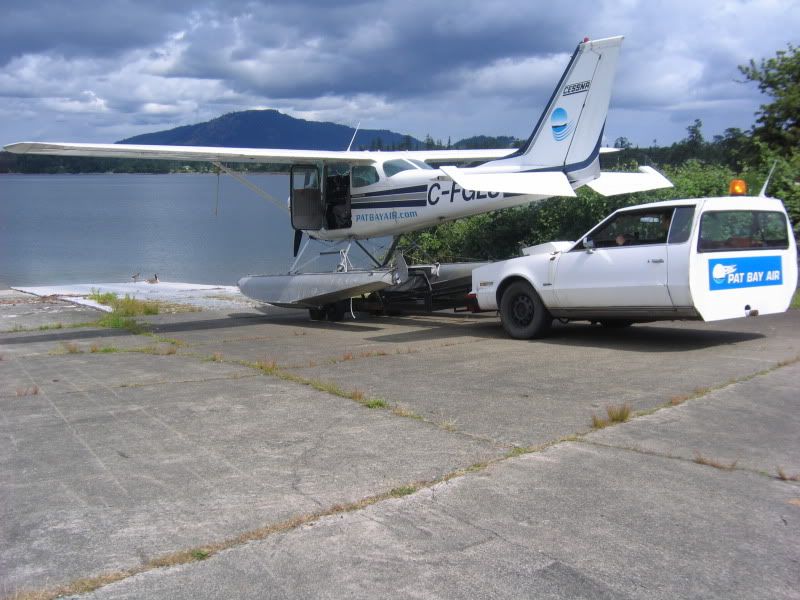
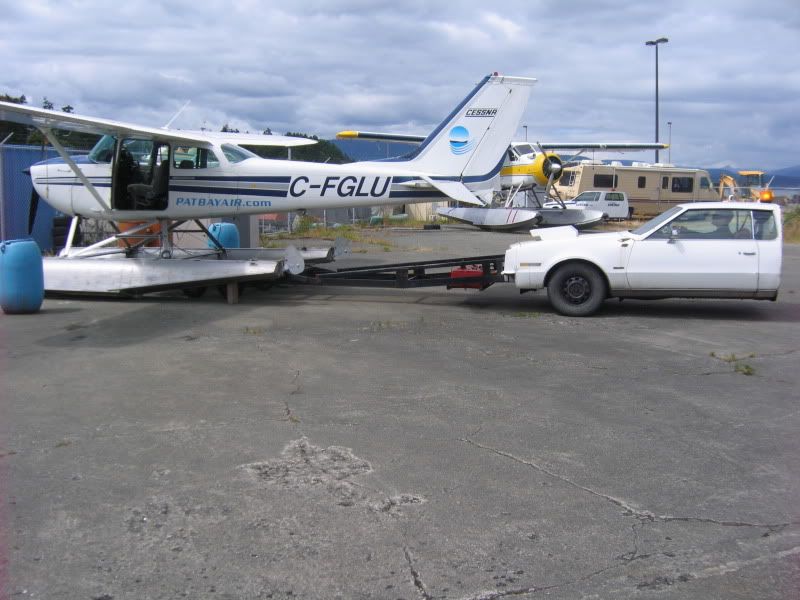
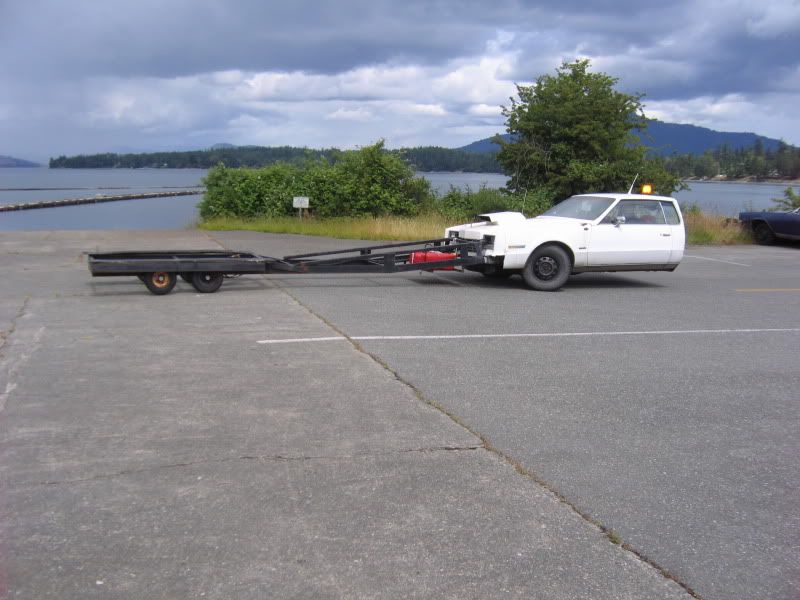
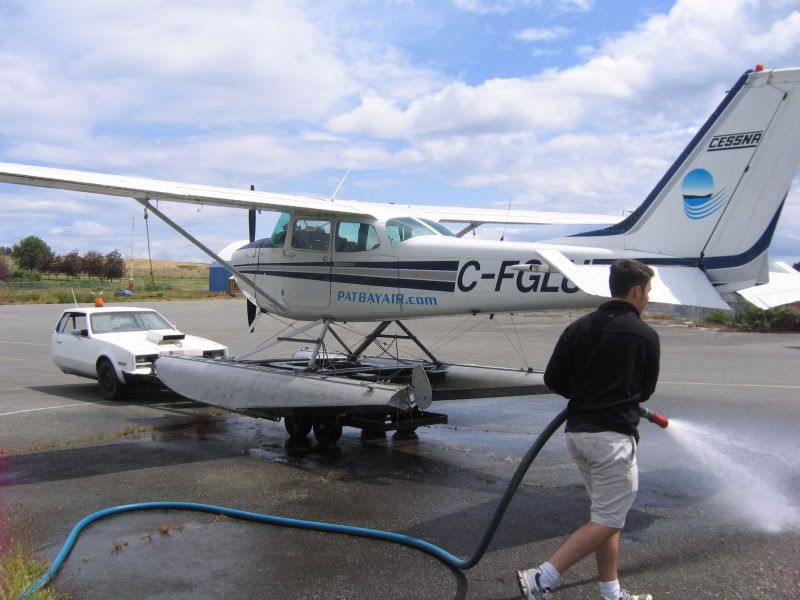
It used some sort of hydraulic mechanism to lift the secondary frame under the spreader bars of the 172. My instructor said that it was hard to get accustomed to the steering, as to go right, the driver turns left, but obviously he had mastered it.
As I looked around, there were several other similar rigs. I remember one was made from half of a VW Rabbit and another was the front half of a Ford 4WD pickup. These were not Pat Bay rigs, as there were several other ops there at Patricia Bay. Pat Bay Air uses only the Toronado, and it's adjustable apparently to handle the 172, the 185, and their website shows pictures of a Beaver, too.
As for "maintaining the engine", I'd have to say that as badly as the Olds was running, they don't. It started, it ran, but it sure wasn't running on all 8--more like 6 1/2. But it only has to go 2 mph, and as long as it can go forward and backward, it's good.
Cary
It used some sort of hydraulic mechanism to lift the secondary frame under the spreader bars of the 172. My instructor said that it was hard to get accustomed to the steering, as to go right, the driver turns left, but obviously he had mastered it.
As I looked around, there were several other similar rigs. I remember one was made from half of a VW Rabbit and another was the front half of a Ford 4WD pickup. These were not Pat Bay rigs, as there were several other ops there at Patricia Bay. Pat Bay Air uses only the Toronado, and it's adjustable apparently to handle the 172, the 185, and their website shows pictures of a Beaver, too.
As for "maintaining the engine", I'd have to say that as badly as the Olds was running, they don't. It started, it ran, but it sure wasn't running on all 8--more like 6 1/2. But it only has to go 2 mph, and as long as it can go forward and backward, it's good.
Cary

"I have slipped the surly bonds of earth..., put out my hand and touched the face of God." J.G. Magee
Fri Jun 10, 2016 9:41 am
Re: Building a hydraulic lift trailer for a float plane
Ok guys, First of all I want to thank you guys for all your input on this a couple of years ago and appologize for the delay in posting the final result. I am happy with the final result and it works better then I expected. I put a launch in front of my house and I can now launch and pull the plane by myself. I did however make a few mistakes. the biggest one is DON'T MODIFY IT IF IT IS NOT RIGHT!!! would have saved me a little money and a sh&%load of time if I would have just started from scratch. anyway here is the final result

the tongue had been damaged so they added the pipe the support it, it works fine but you have to be very mindful of the dock knocker (the lower fin added to Maules for float operation) or it will hit on the pipe if you set the plane to far down on the ramp

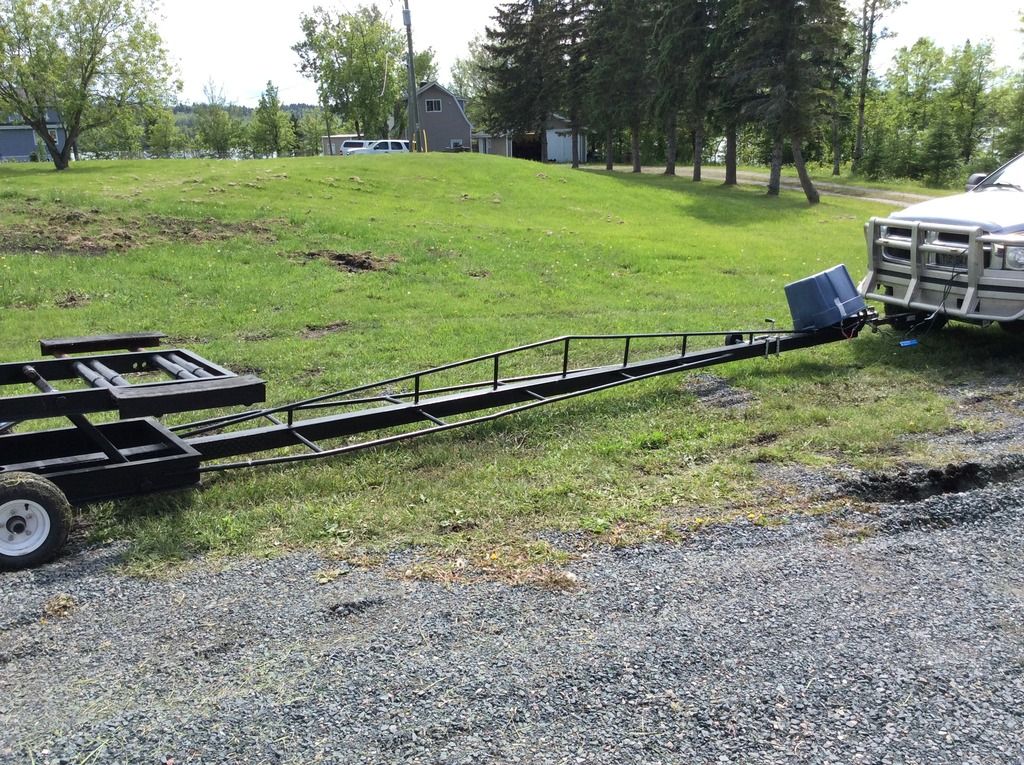


The Walking beam is an absolute must for lifting a plane. I put a single axle under it with a stub shaft welded in and then cut a plate to mount to it with 2 more stub shafts mounted to the plate. this way when 1 tire goes up or down the plane does not rock... at all
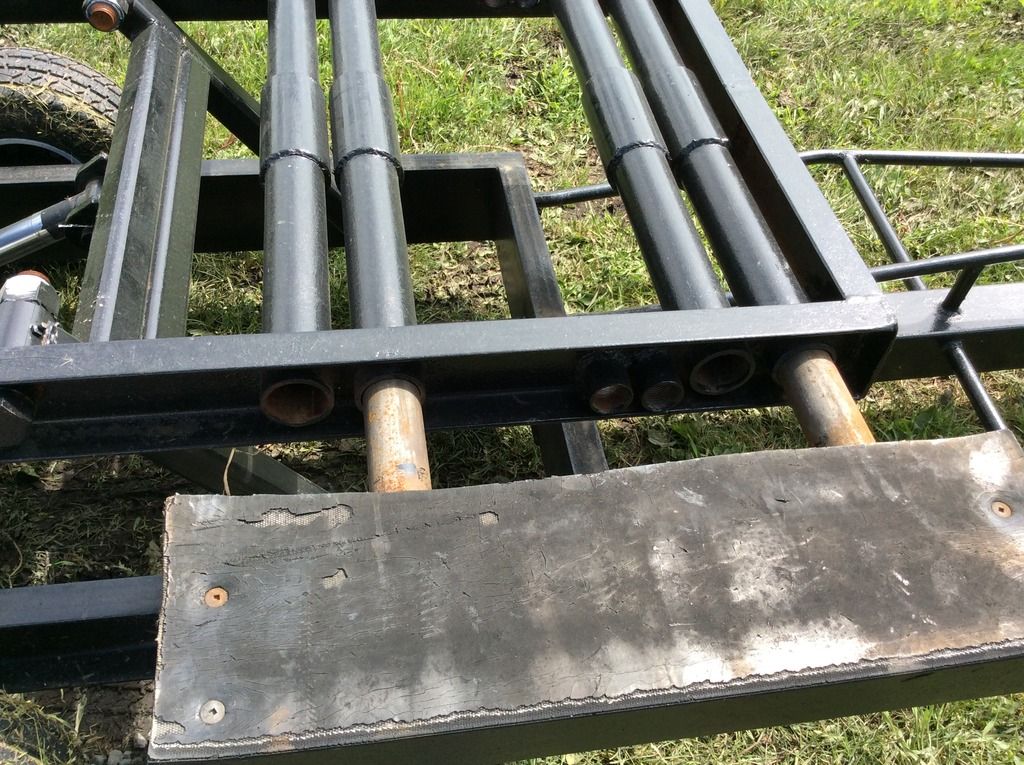
You can see my biggest mistake here, to narrow the trailer I cut it down the center, cut out what I needed and then put it back together with a pipe over the cut for strength. Should have cut everything off of one side. When I was done the adjutable pipes that slide in and out depending on the width of plane I am lifting bind as they get close to center (I know I know, yes I knew better....but I did it anyways)

other than that the slides work perfectly and I can adjust for both the Maule and the 185, which is all I have lifted so far
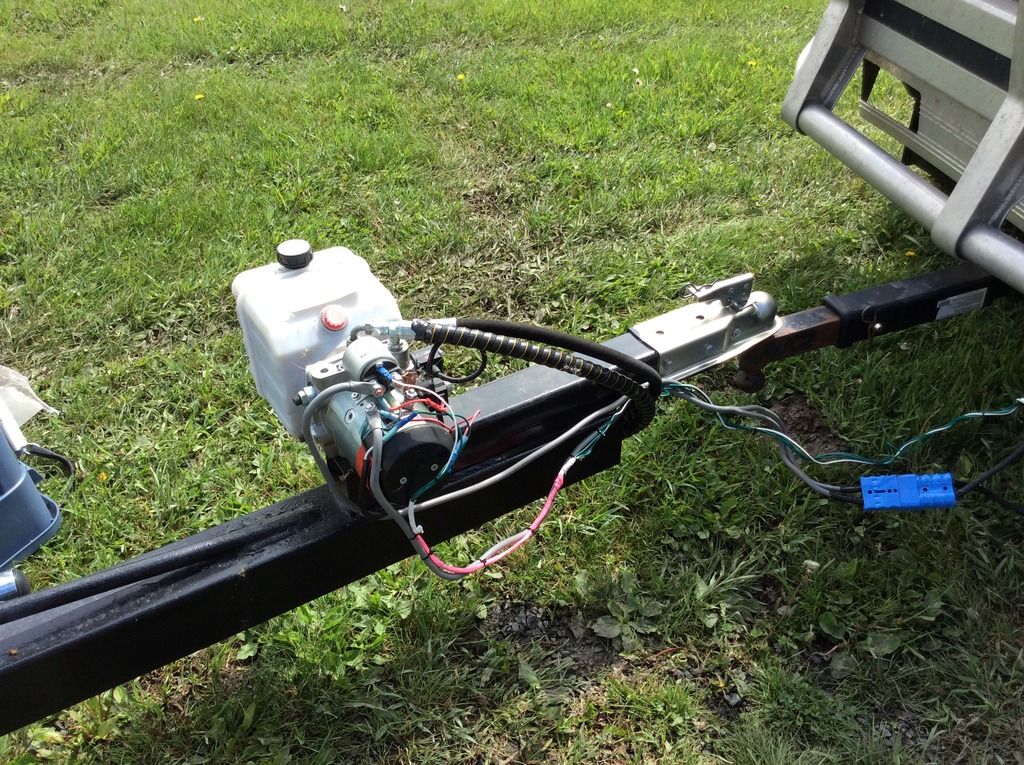
2 things I would recommend, ok 1 is a recommendation and the other is a must. spend the money and get a 12 volt double acting hydraulic pump. the second and don't even bother building one unless you have it is a front mount hitch on whatever you are using as a Tow vehicle. you will destroy your floats if you try to do it on a rear mount hitch!!! mine was less than 300 bucks on ebay
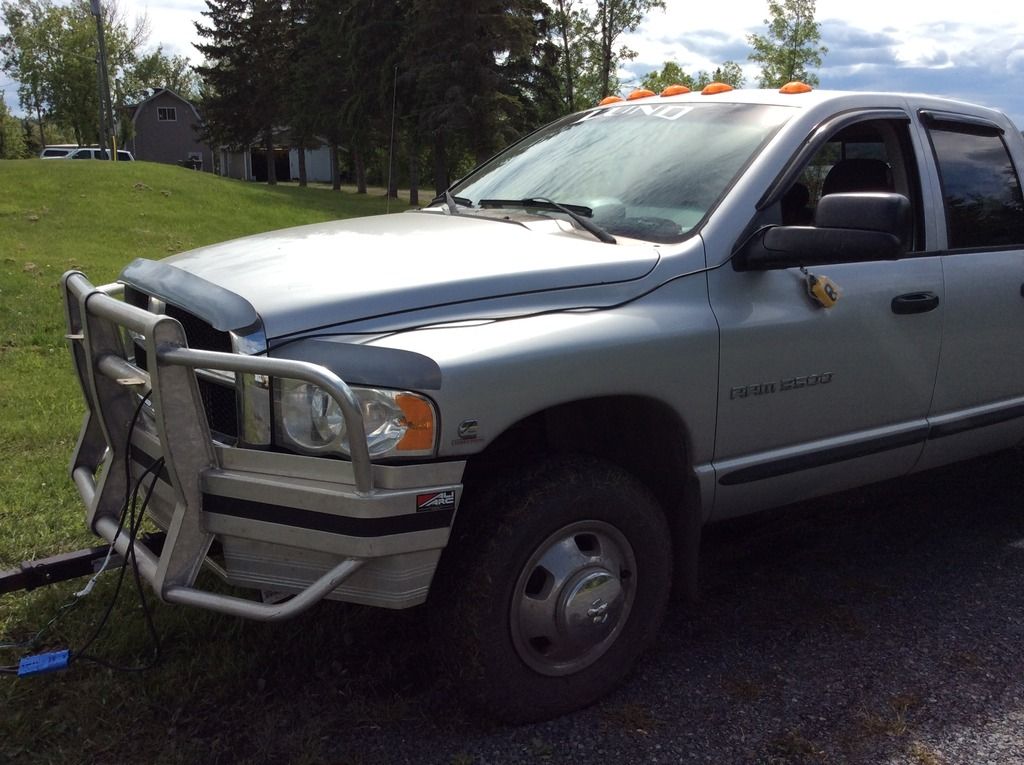
I use My dually to do it and I wired in a heavy plug (purchased at NAPA) so I did not need a seperate battery for the pump, and I extended the wiring so I can run it from the driver seat, it has a magnet on the back of the remote so it sticks nicely to the door.
again guys thanks for all your input. and if anyone is thinking about building one get a hold of me, I have some drawings and some advice!!
Roamer
the tongue had been damaged so they added the pipe the support it, it works fine but you have to be very mindful of the dock knocker (the lower fin added to Maules for float operation) or it will hit on the pipe if you set the plane to far down on the ramp
The Walking beam is an absolute must for lifting a plane. I put a single axle under it with a stub shaft welded in and then cut a plate to mount to it with 2 more stub shafts mounted to the plate. this way when 1 tire goes up or down the plane does not rock... at all
You can see my biggest mistake here, to narrow the trailer I cut it down the center, cut out what I needed and then put it back together with a pipe over the cut for strength. Should have cut everything off of one side. When I was done the adjutable pipes that slide in and out depending on the width of plane I am lifting bind as they get close to center (I know I know, yes I knew better....but I did it anyways)
other than that the slides work perfectly and I can adjust for both the Maule and the 185, which is all I have lifted so far
2 things I would recommend, ok 1 is a recommendation and the other is a must. spend the money and get a 12 volt double acting hydraulic pump. the second and don't even bother building one unless you have it is a front mount hitch on whatever you are using as a Tow vehicle. you will destroy your floats if you try to do it on a rear mount hitch!!! mine was less than 300 bucks on ebay
I use My dually to do it and I wired in a heavy plug (purchased at NAPA) so I did not need a seperate battery for the pump, and I extended the wiring so I can run it from the driver seat, it has a magnet on the back of the remote so it sticks nicely to the door.
again guys thanks for all your input. and if anyone is thinking about building one get a hold of me, I have some drawings and some advice!!
Roamer
- Steelroamer offline
- Posts: 119
- Joined: Fri May 09, 2014 3:10 pm
- Location: Kenora
- FindMeSpot URL: https://maps.findmespot.com/s/D8VB
- Aircraft: maule M6 on Floats
Fri Jun 10, 2016 10:17 am
Re: Building a hydraulic lift trailer for a float plane
here is the first time I used it. I have since reworked the ramp and the approach so the angle is much less and the trailer does not drag!!
https://www.youtube.com/watch?v=FK6UimNwQ8w
Sorry, not sure how to imbed it
Roamer
https://www.youtube.com/watch?v=FK6UimNwQ8w
Sorry, not sure how to imbed it
Roamer
- Steelroamer offline
- Posts: 119
- Joined: Fri May 09, 2014 3:10 pm
- Location: Kenora
- FindMeSpot URL: https://maps.findmespot.com/s/D8VB
- Aircraft: maule M6 on Floats
DISPLAY OPTIONS
Who is online
Users browsing this forum: No registered users and 1 guest
Latest Features
-
Live to Tell
A Minnesota pilot is surprised to learn that the sudden asymmetric drag of an out-of-rig ski can…Read More -
Creators
Working in some of the Yukon's most beautiful and remote environments, photographer Simon Blakesley captures aircraft in…Read More -
Aircraft Ownership and Maintenance
Upgrading to big tires can make a huge difference in backcountry performance, but with those gains come…Read More -
Tales from Yesteryear
In this tale from bush flying yesteryear, Don Cogger signs up to help Atlee Dodge Jr recovery…Read More


Latest Knowledge Base
-
Destinations
A regional guide with ideas for winter camping destinations in California, Nevada, New Mexico, and Arizona.Read More -
Aircraft
Finding an affordable aircraft that can handle the backcountry for $80K or less? A challenge for sure, but with the…Read More -
Aircraft
01.29.2018 - Zane - Updated tire diameter graphic to add 8.50x10 Guide to tires for use in the backcountry and off-airport landing…Read More -
Pilots
12.22.2013 - Initial article format Operating aircraft on skis and negotiating a snow-covered landscape is an entirely unique skillset and environment.…Read More


