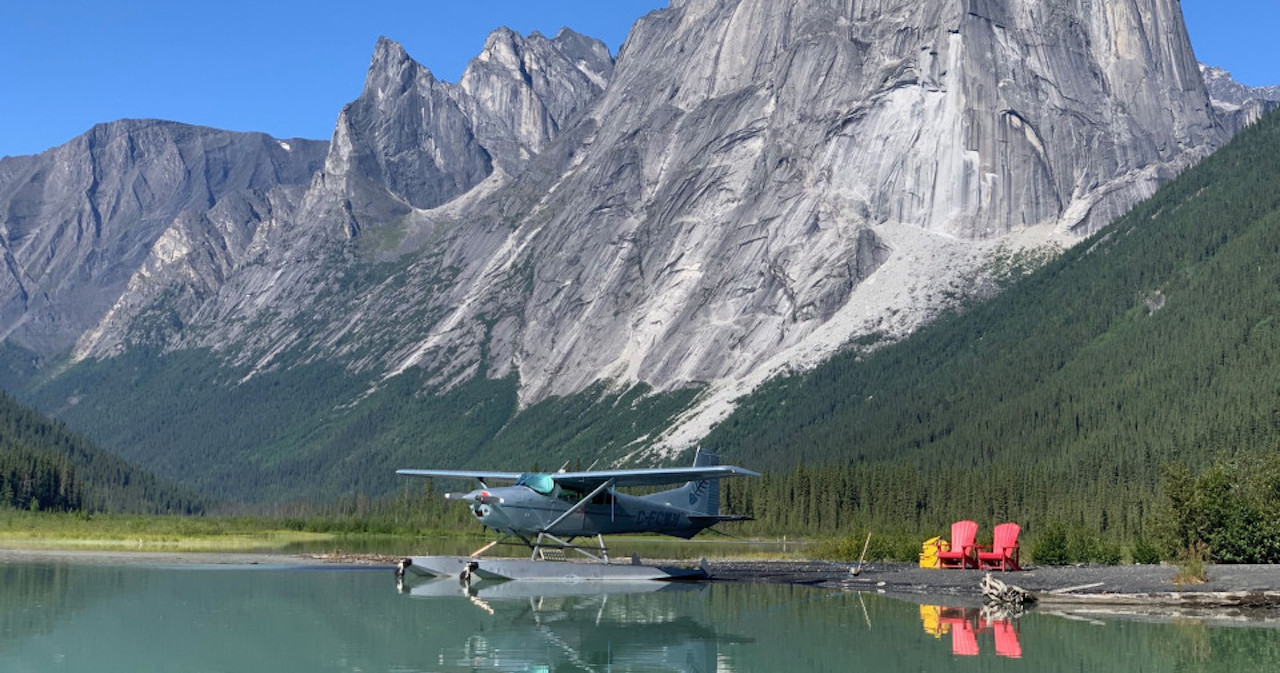
Agreed. The geographic nature of most canyons require a climb to gain room. The intuitive "flow" of canyon navigation is gained like any other flight regime.
Burke's book on seaplane flying has a very substantial primer on mountain/canyon experiences.
Canyon turn practice
Wed Dec 12, 2012 8:40 am

CFII, MEI, CFISES, ATPME, IA/AP, RPPL, Ski&Amphib ops, RHC mechanic cert, RHC SC— 3000TT
Wed Dec 12, 2012 8:48 am
Re: Canyon turn practice
Blu wrote:I think we should clarify what people mean (i hope) when they are advising minimum air speed in a canyon.
In my mind that doesn't mean if your plane stalls at 45 with the flaps out that you tool along at 50-55
I think you will want to be at at least 80-90.
hears why
All canyons get wider as you climb and they all have a top.
If you have some extra speed (not cruise speed but at least twice stall speed) you can often either zoom climb right out or at least get high enough to be where the canyon is quite a bit wider.
Making a tight 180 is not the only danger in a canyon. A big one is downdrafts and mechanical turbulence off the cliffs.
Having some extra speed gives you some reserve to get through the down draft and extra control authority to handle the turbulence.
Once you get slow and close to the ground you really have limited options.
Not trying to lecture anyone. Most guys on here have a lot of experience, but when i reread the thread it seemed like someone just learning might get the wrong idea about what what minium airspeed means in this context.
Wed Dec 12, 2012 8:51 am
Re: Canyon turn practice
Totally.... Speed is life, altitude is options! 
CFII, MEI, CFISES, ATPME, IA/AP, RPPL, Ski&Amphib ops, RHC mechanic cert, RHC SC— 3000TT
Wed Dec 12, 2012 2:05 pm
Re: Canyon turn practice
Load your plane till it is near gross. Then climb up to where you are getting about 200-300 fpm climb at full power (or alternatively climb up to any safe altitude and set the power so your climb at vx is 200 fpm and then don't increase power). Now try your favorite canyon turn maneuver. Don't allow any lost altitude. Use your gps or ground reference if you can to see how much room you need.
- littlewheelinback offline
- Posts: 331
- Joined: Mon Nov 29, 2010 8:03 pm
- Location: Bellingham, WA
Wed Dec 12, 2012 7:49 pm
- blackrock offline
- Posts: 1576
- Joined: Tue Jan 29, 2008 6:54 pm
- Location: Elko, NV
- FindMeSpot URL: http://share.findmespot.com/shared/face ... BFmtASxjeV
- Aircraft: Bearhawk
Wed Dec 12, 2012 8:37 pm
Re: Canyon turn practice
Zzz wrote:exodus wrote:If you let yourself to brain fart and get anywhere near a situation such as , narrow canyon, and for what ever reason Not recognized early that things are looking to go to shit and you let your AIRCRAFT SLOW DOWN NEAR Vs, you have no business being in the mountains in the first place. I bet you that most seasoned bush pilots on this forum, may have only ever got themselves into that predicament once in their early days. It's one situation you will not live long enough to repeat often.
I think everyone here knows that. What is being criticized is the optimism with which maneuvers like this are practiced, the false sense of preparation that may come from doing it in a planned and perfect simulation that can lead to people actually believing that a canyon hammerhead (classic thread) is a practical solution for a scenario that is likely never going to be as ideal as our fantasies.
Blu did a fine example of a minimum radius turn, and it was really fun to watch. Nothing wrong with practicing those, and it's fun to boot. I just don't see it as a practical emergency maneuver.
I remember that thread. I was pretty much a dip-weed that should have kept my mouth shut
 Should have just sat back and learned something. It's all good now So if anybody wants to continue up a canyon that your not too sure about, well that's your business. I'll turn back before I have to even think about a "Emergency Canyon Turn"
Wed Dec 12, 2012 8:48 pm
Re: Canyon turn practice
I agree it's not good judgment to get into a situation that requires even better judgment to get out of.
But I doubt many folks 'plan' on flying into a canyon with no margin. A more likely scenario for me has been flying along in a decent sized valley (in Idaho, for example) where the cloud floor is often right at or a bit above the top of the valley, where a guy can safely fly for 50-100 miles without getting above the canyon edge in changeable, rainy or snowy weather. It makes sense to be aware of and comfortable with making a well-planned return if the clouds take a dip downward in a hurry. There are also power lines that I've double-backed from in some places rather than wonder whether I can barely get over them.
The simple, fun practice makes the issue ho-hum, and also helps raise awareness as I poke around some of the more 'fun' areas.
But I doubt many folks 'plan' on flying into a canyon with no margin. A more likely scenario for me has been flying along in a decent sized valley (in Idaho, for example) where the cloud floor is often right at or a bit above the top of the valley, where a guy can safely fly for 50-100 miles without getting above the canyon edge in changeable, rainy or snowy weather. It makes sense to be aware of and comfortable with making a well-planned return if the clouds take a dip downward in a hurry. There are also power lines that I've double-backed from in some places rather than wonder whether I can barely get over them.
The simple, fun practice makes the issue ho-hum, and also helps raise awareness as I poke around some of the more 'fun' areas.
Wed Dec 12, 2012 9:54 pm
- soyAnarchisto offline

- Posts: 1977
- Joined: Fri Aug 19, 2011 1:23 pm
- Location: Boulder, CO
- Aircraft: 1955 Cessna 180
Fri Jan 11, 2013 9:34 pm
Re: Canyon turn practice
Coordination.
If you're going to practice this "escape maneuver", you should focus your practice on coordinating, like others have said. Also, as others have said, practice in a myriad of scenarios.
Say you're flying up a canyon and you lose a mag? How about practicing those turns at a reduced power? Headed up to the backcountry for a week? Try them out at MGTOW. Or even fully-configured for landing and a yak walks right on the runway? Try them out in the landing configuration.
The key to the maneuver is not having a textbook depiction of how it's executed...it's correlating the concepts of coordination, slow flight, and steep turns, and maximizing the most of the state you're in before, during, and after you have to do the "canyon turn".
Personally, I'll keep my hands off the flap lever. Then again, I don't have any.
If you're going to practice this "escape maneuver", you should focus your practice on coordinating, like others have said. Also, as others have said, practice in a myriad of scenarios.
Say you're flying up a canyon and you lose a mag? How about practicing those turns at a reduced power? Headed up to the backcountry for a week? Try them out at MGTOW. Or even fully-configured for landing and a yak walks right on the runway? Try them out in the landing configuration.
The key to the maneuver is not having a textbook depiction of how it's executed...it's correlating the concepts of coordination, slow flight, and steep turns, and maximizing the most of the state you're in before, during, and after you have to do the "canyon turn".
Personally, I'll keep my hands off the flap lever. Then again, I don't have any.
- PA11 offline
- Posts: 31
- Joined: Sun Dec 30, 2012 8:44 pm
- Location: Salt Lake City
- FindMeSpot URL: https://share.garmin.com/royevansii
- Aircraft: Piper PA-11 Cub Special
Roy Evans II
President, UBCP
Utah Back Country Pilots Association
[email protected]
https://utahbackcountrypilots.org
President, UBCP
Utah Back Country Pilots Association
[email protected]
https://utahbackcountrypilots.org
Fri Jan 11, 2013 10:01 pm
Re: Canyon turn practice
PA11 wrote:Coordination.
If you're going to practice this "escape maneuver", you should focus your practice on coordinating, like others have said. Also, as others have said, practice in a myriad of scenarios.
Say you're flying up a canyon and you lose a mag? How about practicing those turns at a reduced power? Headed up to the backcountry for a week? Try them out at MGTOW. Or even fully-configured for landing and a yak walks right on the runway? Try them out in the landing configuration.
The key to the maneuver is not having a textbook depiction of how it's executed...it's correlating the concepts of coordination, slow flight, and steep turns, and maximizing the most of the state you're in before, during, and after you have to do the "canyon turn".
Personally, I'll keep my hands off the flap lever. Then again, I don't have any.
Shit...looking at your avatar, that's not all your missin.

- Terry offline
- Posts: 1365
- Joined: Sat Nov 10, 2007 9:11 pm
- Location: Willamette Valley
- FindMeSpot URL: http://share.findmespot.com/shared/face ... 4GzPHI6t1d
Fri Apr 12, 2013 11:07 am
Re: Canyon turn practice
Blu performed a good energy management, no load factor, turn. These are normal, at very low altitude, all the time in crop dusting and are useful in both low and high box canyon turnarounds. He had lots of power, but that is not necessary. If both kinetic and gravity energy are managed (traded dynamically,) it is the wing and not the engine that does the work. Yes we want to fly the windward rather than the lee side of the canyon. This will give us ridge lift and will put us into an upwind rather than a downwind turn to reverse course. Ground speed, not airspeed (except to keep flying) is important when we are maneuvering around objects or terrain.
Blu fell off the target (bottom of the canyon going the other way) downwind, pitched up trading cruise kinetic energy of pressure airspeed for potential gravity thrust of altitude. He banked steeply toward the upwind ridge and allowed the nose to fall through (released back pressure) naturally trading the gained gravity thrust of altitude for the kinetic energy of pressure airspeed in the dive to the adequate vertical space of the canyon floor. Upon getting the nose onto the target (canyon floor,) he leveled the wing to prevent graveyard spiral in the pull up. In the pull up, he traded the kinetic energy of pressure airspeed achieved in the dive for the potential gravity thrust of altitude. Now he is at the original altitude going the other way.
This wing over, gun run, crop duster turn, or whatever you want to call it works with all fixed and rotary wings. Power, other than kinetic energy and gravity, is not what makes it happen. Power makes it more impressive, but 65 hp Champs and 145 hp C-172s can do the same thing. A 235 hp Pawnee hauling 140 gallons of spray is not a high power to weight aircraft.
This energy management turns is also the safest way to turn back if unable to make a high pass going west. As we ride the updrafts coming up the ridge on the downwind side of the valley leading up to the pass, we may come to a point of insufficient orographic or hydraulic lift. In little airplanes, engine is always insufficient up very high. The valley is narrowing in, ie. boxed in. Perhaps we were unable to make the jump, into down draft air off the really high peak upwind of the pass, to ground effect energy in the pass. Anyway, we have decided to go back down the valley. Over the upwind ridge, in a shallow bank, would be very unwise because of very strong lee side down drafts up high.
In this situation we have to modify the energy management turn a bit. We are at a very high density altitude. In a little airplane, we couldn't get here except with later in the day high temps which produce high winds. Our nose is already up just to stay level or climb in good air. We are full power and cruising at Vy, if you're an airspeed watcher. We simply turn at whatever bank is necessary to miss the upwind valley ridge and allow the nose to naturally fall into the valley below. Angle of bank has no bearing on performance. We have committed to going back. We no longer need to retain potential gravity thrust of altitude, as in a level turn. The greater the angle of bank, the greater will be the realized gravity thrust of altitude in the dive resulting from the nose falling through naturally. At any bank angle, we can only get load factor or a stall by pulling back. We don't try to stay level in a turn. Power is full so we don't have any more excess engine thrust to counter the extra load. We don't pull back. Trying to maintain altitude where God is greater than our engine/s is the biggest killer in the mountains. The hunters always find the twin crashed on the ridge in a slight turn.
Blu fell off the target (bottom of the canyon going the other way) downwind, pitched up trading cruise kinetic energy of pressure airspeed for potential gravity thrust of altitude. He banked steeply toward the upwind ridge and allowed the nose to fall through (released back pressure) naturally trading the gained gravity thrust of altitude for the kinetic energy of pressure airspeed in the dive to the adequate vertical space of the canyon floor. Upon getting the nose onto the target (canyon floor,) he leveled the wing to prevent graveyard spiral in the pull up. In the pull up, he traded the kinetic energy of pressure airspeed achieved in the dive for the potential gravity thrust of altitude. Now he is at the original altitude going the other way.
This wing over, gun run, crop duster turn, or whatever you want to call it works with all fixed and rotary wings. Power, other than kinetic energy and gravity, is not what makes it happen. Power makes it more impressive, but 65 hp Champs and 145 hp C-172s can do the same thing. A 235 hp Pawnee hauling 140 gallons of spray is not a high power to weight aircraft.
This energy management turns is also the safest way to turn back if unable to make a high pass going west. As we ride the updrafts coming up the ridge on the downwind side of the valley leading up to the pass, we may come to a point of insufficient orographic or hydraulic lift. In little airplanes, engine is always insufficient up very high. The valley is narrowing in, ie. boxed in. Perhaps we were unable to make the jump, into down draft air off the really high peak upwind of the pass, to ground effect energy in the pass. Anyway, we have decided to go back down the valley. Over the upwind ridge, in a shallow bank, would be very unwise because of very strong lee side down drafts up high.
In this situation we have to modify the energy management turn a bit. We are at a very high density altitude. In a little airplane, we couldn't get here except with later in the day high temps which produce high winds. Our nose is already up just to stay level or climb in good air. We are full power and cruising at Vy, if you're an airspeed watcher. We simply turn at whatever bank is necessary to miss the upwind valley ridge and allow the nose to naturally fall into the valley below. Angle of bank has no bearing on performance. We have committed to going back. We no longer need to retain potential gravity thrust of altitude, as in a level turn. The greater the angle of bank, the greater will be the realized gravity thrust of altitude in the dive resulting from the nose falling through naturally. At any bank angle, we can only get load factor or a stall by pulling back. We don't try to stay level in a turn. Power is full so we don't have any more excess engine thrust to counter the extra load. We don't pull back. Trying to maintain altitude where God is greater than our engine/s is the biggest killer in the mountains. The hunters always find the twin crashed on the ridge in a slight turn.
- contactflying offline
- Posts: 4972
- Joined: Wed Apr 03, 2013 7:36 pm
- Location: Aurora, Missouri 2H2
Download my free "https://tinyurl.com/Safe-Maneuvering" e-book.
Fri Apr 12, 2013 6:15 pm
Re: Canyon turn practice
I can't count on both hands the number of pilots I've known who said "Oh, I'll never fly in bad weather/fly down in a canyon/etc." And, many of them wound up doing just that, with grim results.
I teach canyon turns with 45 to 50 degrees bank angle, max LIFT flaps deployed and a hard fast pull with full power. This is a level turn, NOT a climbing turn. As often as not, people in canyons (real canyons that is) tend to gravitate up to the very bottom of the cloud layer as they go up canyon. And, as they mosey up canyon, the bottom of the canyon gets higher. By the time turning around becomes necessary, climbing isn't an option, and if you like, DA can create the very same scenario.
I've done this in Beavers (the VERY notorious BAD turning airplane that someone actually created a NEW WING for, because of it's terrible characteristics in a turn ), Cessnas, Cubs, Huskys, Scouts and several other types. It is a maneuver that MUST be practiced in advance, since a VERY few airplanes don't respond well to this maneuver, in which case, you need to know what bank angle/how much pull to use with THAT airplane.
I enter the maneuver right close to Vy, in other words, slowed down, but not slow. Flaps to max lift, generally half flaps. Initiate a roll, and as you roll through 30 degrees bank angle, push up full power and pull to turn. I have had precisely ONE type airplane stall on me in this 180 degree maneuver. Done properly, it's over in a very few seconds. Yes, the stall horn blares if one's installed.
I first learned this maneuver when I was flying in Kodiak, where there are a LOT of canyons, and some weather occasionally. I was being checked out in the Beaver by a VERY experienced deHavilland pilot. I asked him about the reputation the Beaver has for being a killer in canyons and bad weather. I then demonstrated this maneuver a hundred or so times till I was doing them in my sleep. And, that notoriously dangerous airplane in canyons turned like a Pitts.
Yet, lots of Beaver pilots have died in these airplanes trying to turn around in a canyon. The wreckage is found near the bottom of the canyon, turned about 100 to 120 degrees around the turn, spun in. Why? Because they didn't slow down and CONFIGURE the airplane for the turn.
Anyone who thinks their airplane will stall, come fly with me and let me show you what the airplane can do, and do safely.
This is NOT an everyday maneuver, but it needs to be practiced.
Believe whatever you want to believe, but a year or so after I checked out in that Beaver, I found myself lowering the flaps, slowing it down, and turning in a tight canyon that I almost made it through. I was right at the cloud base, so climbing at all was out of the question. I could ALMOST see through that canyon, right up till I almost got there, then.....turn.
Piece of cake, with good instruction and practice. I perform this with every airplane I fly. The only airplane I've ever found that wouldn't REALLY come around in these was a 7GCBC...it stalled halfway around. So, lighten up the bank a bit and figure out what THAT airplane wants.
Every airplane and every scenario is potentially a little different. Idaho is different from Kodiak, which is different from the Brooks Range, which is different from Colorado. Are you there because you don't have the power to go over, or because the weather is holding you down? Density Altitude makes a difference, no doubt. At high DA, your indicated airspeed will have you flying at a higher true airspeed. That means the radius of your turn will be greater.
Finally, to make this work, you have to learn to use linear control inputs. Roll with coordinated rudder and aileron, neutralize those for a heartbeat, then pull to turn. It's the pull that gets the airplane turning, and it MUST be linear, which takes some practice. Aerobatic training and discipline really helps here.
FWIW,
MTV
I teach canyon turns with 45 to 50 degrees bank angle, max LIFT flaps deployed and a hard fast pull with full power. This is a level turn, NOT a climbing turn. As often as not, people in canyons (real canyons that is) tend to gravitate up to the very bottom of the cloud layer as they go up canyon. And, as they mosey up canyon, the bottom of the canyon gets higher. By the time turning around becomes necessary, climbing isn't an option, and if you like, DA can create the very same scenario.
I've done this in Beavers (the VERY notorious BAD turning airplane that someone actually created a NEW WING for, because of it's terrible characteristics in a turn
), Cessnas, Cubs, Huskys, Scouts and several other types. It is a maneuver that MUST be practiced in advance, since a VERY few airplanes don't respond well to this maneuver, in which case, you need to know what bank angle/how much pull to use with THAT airplane.I enter the maneuver right close to Vy, in other words, slowed down, but not slow. Flaps to max lift, generally half flaps. Initiate a roll, and as you roll through 30 degrees bank angle, push up full power and pull to turn. I have had precisely ONE type airplane stall on me in this 180 degree maneuver. Done properly, it's over in a very few seconds. Yes, the stall horn blares if one's installed.
I first learned this maneuver when I was flying in Kodiak, where there are a LOT of canyons, and some weather occasionally. I was being checked out in the Beaver by a VERY experienced deHavilland pilot. I asked him about the reputation the Beaver has for being a killer in canyons and bad weather. I then demonstrated this maneuver a hundred or so times till I was doing them in my sleep. And, that notoriously dangerous airplane in canyons turned like a Pitts.
Yet, lots of Beaver pilots have died in these airplanes trying to turn around in a canyon. The wreckage is found near the bottom of the canyon, turned about 100 to 120 degrees around the turn, spun in. Why? Because they didn't slow down and CONFIGURE the airplane for the turn.
Anyone who thinks their airplane will stall, come fly with me and let me show you what the airplane can do, and do safely.
This is NOT an everyday maneuver, but it needs to be practiced.
Believe whatever you want to believe, but a year or so after I checked out in that Beaver, I found myself lowering the flaps, slowing it down, and turning in a tight canyon that I almost made it through. I was right at the cloud base, so climbing at all was out of the question. I could ALMOST see through that canyon, right up till I almost got there, then.....turn.
Piece of cake, with good instruction and practice. I perform this with every airplane I fly. The only airplane I've ever found that wouldn't REALLY come around in these was a 7GCBC...it stalled halfway around. So, lighten up the bank a bit and figure out what THAT airplane wants.
Every airplane and every scenario is potentially a little different. Idaho is different from Kodiak, which is different from the Brooks Range, which is different from Colorado. Are you there because you don't have the power to go over, or because the weather is holding you down? Density Altitude makes a difference, no doubt. At high DA, your indicated airspeed will have you flying at a higher true airspeed. That means the radius of your turn will be greater.
Finally, to make this work, you have to learn to use linear control inputs. Roll with coordinated rudder and aileron, neutralize those for a heartbeat, then pull to turn. It's the pull that gets the airplane turning, and it MUST be linear, which takes some practice. Aerobatic training and discipline really helps here.
FWIW,
MTV


Sun Apr 14, 2013 7:15 pm
Re: Canyon turn practice
MTV-There is no need to climb into the clouds either with the low ceiling energy management canyon turn or the high DA energy management turn. It either case, we have more vertical space than horizontal space available. With limited horizontal space, why would we want to use the big radial to stay at the same altitude. The extra power needed to prevent descent, or stall, will cause a greater radius of turn. Why not let the nose fall into the canyon in a steeper banked turn and let gravity thrust more than make up for the lift lost by the steep bank? This will result in a turn of a lesser radius and eliminate worries about stall.
In the high DA energy management turn in a low powered airplane, like most trainers and older tail wheel airplanes, we are at or near ceiling and have no excess engine thrust for climb. If we lose ridge lift, we are going down. The nose is coming down in the turn whether we want it to or not. Why not let it fall through naturally, into the greater vertical distance available. If we have decided we can't make the pass, why would we want to stay level?
As I tell all my students, "power corrupts." But you know that, as you fly little airplanes as well. If we encourage your canyon turnaround technique in little Cessnas and little Pipers, we will have people getting hurt in canyons and in the high valleys prior to high pass crossing. Teddy Roosevelt said, "Do the best you can with what you have where you are." For those of us who cannot afford big engines, we need to learn to fly the wing.
In the high DA energy management turn in a low powered airplane, like most trainers and older tail wheel airplanes, we are at or near ceiling and have no excess engine thrust for climb. If we lose ridge lift, we are going down. The nose is coming down in the turn whether we want it to or not. Why not let it fall through naturally, into the greater vertical distance available. If we have decided we can't make the pass, why would we want to stay level?
As I tell all my students, "power corrupts." But you know that, as you fly little airplanes as well. If we encourage your canyon turnaround technique in little Cessnas and little Pipers, we will have people getting hurt in canyons and in the high valleys prior to high pass crossing. Teddy Roosevelt said, "Do the best you can with what you have where you are." For those of us who cannot afford big engines, we need to learn to fly the wing.
- contactflying offline
- Posts: 4972
- Joined: Wed Apr 03, 2013 7:36 pm
- Location: Aurora, Missouri 2H2
Download my free "https://tinyurl.com/Safe-Maneuvering" e-book.
Sun Apr 14, 2013 8:34 pm
Re: Canyon turn practice
mtv wrote:I can't count on both hands the number of pilots I've known who said "Oh, I'll never fly in bad weather/fly down in a canyon/etc." And, many of them wound up doing just that, with grim results.
I teach canyon turns with 45 to 50 degrees bank angle, max LIFT flaps deployed and a hard fast pull with full power. This is a level turn, NOT a climbing turn. As often as not, people in canyons (real canyons that is) tend to gravitate up to the very bottom of the cloud layer as they go up canyon. And, as they mosey up canyon, the bottom of the canyon gets higher. By the time turning around becomes necessary, climbing isn't an option, and if you like, DA can create the very same scenario.
I've done this in Beavers (the VERY notorious BAD turning airplane that someone actually created a NEW WING for, because of it's terrible characteristics in a turn
I enter the maneuver right close to Vy, in other words, slowed down, but not slow. Flaps to max lift, generally half flaps. Initiate a roll, and as you roll through 30 degrees bank angle, push up full power and pull to turn. I have had precisely ONE type airplane stall on me in this 180 degree maneuver. Done properly, it's over in a very few seconds. Yes, the stall horn blares if one's installed.
I first learned this maneuver when I was flying in Kodiak, where there are a LOT of canyons, and some weather occasionally. I was being checked out in the Beaver by a VERY experienced deHavilland pilot. I asked him about the reputation the Beaver has for being a killer in canyons and bad weather. I then demonstrated this maneuver a hundred or so times till I was doing them in my sleep. And, that notoriously dangerous airplane in canyons turned like a Pitts.
Yet, lots of Beaver pilots have died in these airplanes trying to turn around in a canyon. The wreckage is found near the bottom of the canyon, turned about 100 to 120 degrees around the turn, spun in. Why? Because they didn't slow down and CONFIGURE the airplane for the turn.
Anyone who thinks their airplane will stall, come fly with me and let me show you what the airplane can do, and do safely.
This is NOT an everyday maneuver, but it needs to be practiced.
Believe whatever you want to believe, but a year or so after I checked out in that Beaver, I found myself lowering the flaps, slowing it down, and turning in a tight canyon that I almost made it through. I was right at the cloud base, so climbing at all was out of the question. I could ALMOST see through that canyon, right up till I almost got there, then.....turn.
Piece of cake, with good instruction and practice. I perform this with every airplane I fly. The only airplane I've ever found that wouldn't REALLY come around in these was a 7GCBC...it stalled halfway around. So, lighten up the bank a bit and figure out what THAT airplane wants.
Every airplane and every scenario is potentially a little different. Idaho is different from Kodiak, which is different from the Brooks Range, which is different from Colorado. Are you there because you don't have the power to go over, or because the weather is holding you down? Density Altitude makes a difference, no doubt. At high DA, your indicated airspeed will have you flying at a higher true airspeed. That means the radius of your turn will be greater.
Finally, to make this work, you have to learn to use linear control inputs. Roll with coordinated rudder and aileron, neutralize those for a heartbeat, then pull to turn. It's the pull that gets the airplane turning, and it MUST be linear, which takes some practice. Aerobatic training and discipline really helps here.
FWIW,
MTV
Good description. Do you ever feel like the flaps gobbling up all that air as you're slowing kind of build you a little thermal that you're riding on as you pull?
- Nosedragger offline
- Posts: 975
- Joined: Fri Dec 31, 2010 6:40 am
- Location: SE Idaho
- FindMeSpot URL: http://share.findmespot.com/shared/face ... ACzcbTgqlT
Thu Apr 18, 2013 6:39 pm
Re: Canyon turn practice
Only the pilot can stall the airplane by pulling back. The airplane is designed so that it will not stall unless the pilot pulls back. F-16 pilots can power through, but look at the increased radius and decreased rate of turn. Gravity thrust of altitude is more powerful than any engine, when we allow the nose to fall through naturally in any turn. Level turns are for IMC so we don't get behind the instrument indications. Normal turns, as far as the airplane sees it, are not level unless we have excess engine thrust for climb that can be used to offset the lift that is lost in the turn. If we have the excess engine thrust and we choose to maintain altitude, we have to accept the increased radius and decreased rate of turn. If the upwind ridge or canyon wall is too close and the ceiling is too low, this option is unacceptable.
MTV is right about slowing down. The slower we go, the faster we turn. Slowing down is the purpose of the zoom climb in the energy management turn. When high DA or low ceiling prevents this, we simply roll into whatever bank will prevent collision with the upwind ridge or canyon wall and allow the nose to fall through into the valley naturally. Flaps are good if you have them.
Prior planning prevents piss poor performance. But, I have ended up in too many unplanned places over many years. Ten were engine failures at very low altitude. 17,000 hours at or below 200' makes one always want to know which way is down hill and what one's ground speed (rate of closure) is.
MTV is right about slowing down. The slower we go, the faster we turn. Slowing down is the purpose of the zoom climb in the energy management turn. When high DA or low ceiling prevents this, we simply roll into whatever bank will prevent collision with the upwind ridge or canyon wall and allow the nose to fall through into the valley naturally. Flaps are good if you have them.
Prior planning prevents piss poor performance. But, I have ended up in too many unplanned places over many years. Ten were engine failures at very low altitude. 17,000 hours at or below 200' makes one always want to know which way is down hill and what one's ground speed (rate of closure) is.
- contactflying offline
- Posts: 4972
- Joined: Wed Apr 03, 2013 7:36 pm
- Location: Aurora, Missouri 2H2
Download my free "https://tinyurl.com/Safe-Maneuvering" e-book.
Thu Apr 18, 2013 6:49 pm
Re: Canyon turn practice
The problem with letting the nose fall through, and thus descending is tha MANY canyons have sloping sides, so any advantage you may think you'll gain by descending may well be negated by the canyon becoming narrower.
Further, I have a couple of times got right to the top of a pass, peeked over into the valley below and found "unsuitable" weather conditions. In that scenario, descending will get you killed.
Look, it is absolutely safe and relatively easy to do this maneuver with a little practice, with no climb and no descent....that is, in fact the point of this turn.
MTV
Further, I have a couple of times got right to the top of a pass, peeked over into the valley below and found "unsuitable" weather conditions. In that scenario, descending will get you killed.
Look, it is absolutely safe and relatively easy to do this maneuver with a little practice, with no climb and no descent....that is, in fact the point of this turn.
MTV
Thu Apr 18, 2013 8:05 pm
Re: Canyon turn practice
On the high pass crossing problem, I am going back the way I came. You are right about most canyons, the get smaller as you go down. Without a ceiling, however, you can zoom up to slow, turn back, and regain the altitude in the pull up from the dive.
I teach a lot of guys with less experience than you to spray. They need all the help they can get. With 1,000 turns a day, the load factor an g's can wear you out. The guys with the jets have to slow the slick Air Tractor down to get back into the next swath run. What you do works, but you are on the edge and working the airplane and yourself more than is usually necessary.
I teach a lot of guys with less experience than you to spray. They need all the help they can get. With 1,000 turns a day, the load factor an g's can wear you out. The guys with the jets have to slow the slick Air Tractor down to get back into the next swath run. What you do works, but you are on the edge and working the airplane and yourself more than is usually necessary.
- contactflying offline
- Posts: 4972
- Joined: Wed Apr 03, 2013 7:36 pm
- Location: Aurora, Missouri 2H2
Download my free "https://tinyurl.com/Safe-Maneuvering" e-book.
Fri Apr 19, 2013 4:32 am
Re: Canyon turn practice
Sorry, I thought we were talking turning around in canyons, not spraying 101. You may well be correct when it comes to working a field....but I think that's a different discussion.
MTV
MTV
Fri Apr 19, 2013 5:54 am
Re: Canyon turn practice
The airplane doesn't know the difference. They are designed to fly. Fortunately, Part 23 airplanes are guaranteed to have almost exactly the same control response. Engine power is the only real variable.
Operating near terrain and obstacles, in the field or in mountainous terrain, requires that we understand the vertical and horizontal space we have to work with and how we can best utilize what engine, kinetic wing, wind (ground speed,) thermal, orographic, gravity, ground effect, and any other form of energy we can come up with. Rate and radius of turn and ground speed are critical in not hitting terrain and obstructions during maneuvering flight.
We can all learn from each other. We have all had experiences, good and bad. Knowledge doesn't care from where it came.
Operating near terrain and obstacles, in the field or in mountainous terrain, requires that we understand the vertical and horizontal space we have to work with and how we can best utilize what engine, kinetic wing, wind (ground speed,) thermal, orographic, gravity, ground effect, and any other form of energy we can come up with. Rate and radius of turn and ground speed are critical in not hitting terrain and obstructions during maneuvering flight.
We can all learn from each other. We have all had experiences, good and bad. Knowledge doesn't care from where it came.
- contactflying offline
- Posts: 4972
- Joined: Wed Apr 03, 2013 7:36 pm
- Location: Aurora, Missouri 2H2
Download my free "https://tinyurl.com/Safe-Maneuvering" e-book.
Fri Apr 19, 2013 9:45 am
Re: Canyon turn practice
VERY interesting & thought provoking discussion!
The pearl here (for me) is to learn MikeV's canyon turn. I'm now anxious to get up there & pull flaps, bank, hit power & PULL 'er around. I think that floats will hamper the radius, but it will feel good to do an extremely tight turn. Yep, I'll be waaay up there so I have lots of room to catch 'er.
I've done slow tight turns until I felt sick to my stomach, couldn't hold the nose up, but never thought to add power in mid-turn to tighten the turn & keep the nose up.
Thanks (once again) Mike.
The pearl here (for me) is to learn MikeV's canyon turn. I'm now anxious to get up there & pull flaps, bank, hit power & PULL 'er around. I think that floats will hamper the radius, but it will feel good to do an extremely tight turn. Yep, I'll be waaay up there so I have lots of room to catch 'er.
I've done slow tight turns until I felt sick to my stomach, couldn't hold the nose up, but never thought to add power in mid-turn to tighten the turn & keep the nose up.
Thanks (once again) Mike.
- NimpoCub offline
- Posts: 487
- Joined: Thu Dec 22, 2011 1:04 pm
- Location: Nimpo Lake, BC 52.22N 125.14W
- FindMeSpot URL: www.tinyurl.com/loganspot
Nimpo Lake Logan... boonie SuperCubber
DISPLAY OPTIONS
Who is online
Users browsing this forum: No registered users and 2 guests
Latest Features
-
-
Featured Bush Planes
As one of the undisputed legends of bush flying, the Cessna 180 hauls a…Read More -
Aircraft Ownership and Maintenance
9 modification mistakes aircraft owners make when trying to "bush out" their birds—why some…Read More -
Live to Tell
A Minnesota pilot is surprised to learn that the sudden asymmetric drag of an…Read More


Latest Knowledge Base
-
Destinations
Canada offers some of the most spectacular backcountry flying on the continent. Here's what you need to know before you go.Read More -
Safety and Survival
Hope that you never have to use your survival vest but knowing you have it and knowing how to use…Read More -
Destinations
A regional guide with ideas for winter camping destinations in California, Nevada, New Mexico, and Arizona.Read More -
Aircraft
Finding an affordable aircraft that can handle the backcountry for $80K or less? A challenge for sure, but with the…Read More