Contact flying videos
Wed Mar 22, 2017 1:29 pm
Re: Contact flying videos
That was a good one. No round out and hold off. Yes flair with extra power if still descending. We need to get down without bouncing and to protect the nose gear, as you did. You rolled over some uneven ground after touchdown that couldn't be helped as your rate of closure on short final was fine.
- contactflying offline
- Posts: 4972
- Joined: Wed Apr 03, 2013 7:36 pm
- Location: Aurora, Missouri 2H2
Download my free "https://tinyurl.com/Safe-Maneuvering" e-book.
Wed Mar 22, 2017 1:43 pm
Re: Contact flying videos
In reference to shallow or steep approach, motoadve demonstrated here the correct descent angle. He just cleared the trees with an angle of descent that put him down as near the trees as possible and the angle of descent was the same throughout. Coming in low over the trees and chopping power would have put him much further down the runway and would have been more dangerous because of less control. The hold off, because of less control, would make the FAA sanctioned normal landing dangerous except that the airplane is close to the ground when IT decides to quit flying.
- contactflying offline
- Posts: 4972
- Joined: Wed Apr 03, 2013 7:36 pm
- Location: Aurora, Missouri 2H2
Download my free "https://tinyurl.com/Safe-Maneuvering" e-book.
Fri Mar 24, 2017 7:12 pm
Re: Contact flying videos
I did some flights over the past two days at KCMA and KSZP to practice Jim's techniques. All went reasonably well...
This is the first time I practiced the BWARoC approach with full flaps. Did probably 15 or so approaches/landings and only had one bouncer and some were so smooth I didn't hardly realize that I was on the ground. I am a believer and will continue to land this way. Of course, more practice is necessary. Progress after nearly 37 years of flying!
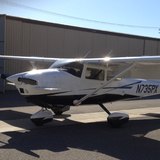
For the record I am flying a Cessna 182 1977Q with Peterson nose canard and 260HP fuel injected engine. I normally fly a pattern at 60 knots, flaps 20. If I don't have to extend downwind, I turn base (1/2 mi.) for a 1/2 mi. final. The technique that works for me is to make sure that flaps 40 are extended on 1/2 mi. final and the plane is at 1.3 Vso (45 knots for N735PX) on quarter mile final when I switch over to BWARoC input only. This may mean going to flaps 40 before turning final depending on the plane's height. If I get a straight in or a long final after an extended downwind, I check the 1 mi. point and make sure not too high; if so, slip; just before 1/2 mi. flaps 40 so they are at 40 when I am at the 1/2 mi. mark and 1/4 mi for final speed check of 1.3 Vso and then on to sighting my target for the BWARoC approach. I found that sighting on the first centerline after the numbers to work better than sighting the numbers. (However I am going to experiment on sighting a vertical line in the numbers although I usually land on 26 or 22 and not too much vertical in those numbers. And of course, power management is key.
Thanks to Jim for this wonderful technique. It is not difficult to learn and I think that it would be easier with an instructor. Comparing to my older landing technique, the landing progression seems to happen more slowly (because it is) and the plane, with power, is more steady and controllable. But I have not met any really adverse wind or other conditions yet. What are the gotchas here?
Blue skies,
Tom
KCMA
This is the first time I practiced the BWARoC approach with full flaps. Did probably 15 or so approaches/landings and only had one bouncer and some were so smooth I didn't hardly realize that I was on the ground. I am a believer and will continue to land this way. Of course, more practice is necessary. Progress after nearly 37 years of flying!
For the record I am flying a Cessna 182 1977Q with Peterson nose canard and 260HP fuel injected engine. I normally fly a pattern at 60 knots, flaps 20. If I don't have to extend downwind, I turn base (1/2 mi.) for a 1/2 mi. final. The technique that works for me is to make sure that flaps 40 are extended on 1/2 mi. final and the plane is at 1.3 Vso (45 knots for N735PX) on quarter mile final when I switch over to BWARoC input only. This may mean going to flaps 40 before turning final depending on the plane's height. If I get a straight in or a long final after an extended downwind, I check the 1 mi. point and make sure not too high; if so, slip; just before 1/2 mi. flaps 40 so they are at 40 when I am at the 1/2 mi. mark and 1/4 mi for final speed check of 1.3 Vso and then on to sighting my target for the BWARoC approach. I found that sighting on the first centerline after the numbers to work better than sighting the numbers. (However I am going to experiment on sighting a vertical line in the numbers although I usually land on 26 or 22 and not too much vertical in those numbers. And of course, power management is key.
Thanks to Jim for this wonderful technique. It is not difficult to learn and I think that it would be easier with an instructor. Comparing to my older landing technique, the landing progression seems to happen more slowly (because it is) and the plane, with power, is more steady and controllable. But I have not met any really adverse wind or other conditions yet. What are the gotchas here?
Blue skies,
Tom
KCMA
Fri Mar 24, 2017 9:17 pm
Re: Contact flying videos
I have always used full flaps on all landings, but Cary and others teach less. Using full flaps with a significant wind and significant gust spread means fully using the throttle as an effective glide angle control. Going faster is fine because the extra headwind keeps the ground speed the same, but it is a different approach and often ends up with increased ground speed.
Keeping full flaps on all landings comes into its real value when there is significant crosswind. Now using full flaps and the apparent brisk walk rate of closure approach , we can safely angle across from the downwind corner to the upwind big airplane touchdown zone marking. The apparent brisk walk rate of closure makes touchdown near the downwind corner a snap. The full flaps now make landing in the thousand feet available with a significant headwind component a snap.
In tailwheel airplanes one can honestly and safely get down in a situation where ground help to taxi is necessary .
Keeping full flaps on all landings comes into its real value when there is significant crosswind. Now using full flaps and the apparent brisk walk rate of closure approach , we can safely angle across from the downwind corner to the upwind big airplane touchdown zone marking. The apparent brisk walk rate of closure makes touchdown near the downwind corner a snap. The full flaps now make landing in the thousand feet available with a significant headwind component a snap.
In tailwheel airplanes one can honestly and safely get down in a situation where ground help to taxi is necessary .
- contactflying offline
- Posts: 4972
- Joined: Wed Apr 03, 2013 7:36 pm
- Location: Aurora, Missouri 2H2
Download my free "https://tinyurl.com/Safe-Maneuvering" e-book.
DISPLAY OPTIONS
Who is online
Users browsing this forum: No registered users and 1 guest
Latest Features
-
-
Featured Bush Planes
As one of the undisputed legends of bush flying, the Cessna 180 hauls a…Read More -
Aircraft Ownership and Maintenance
9 modification mistakes aircraft owners make when trying to "bush out" their birds—why some…Read More -
Live to Tell
A Minnesota pilot is surprised to learn that the sudden asymmetric drag of an…Read More


Latest Knowledge Base
-
Destinations
Canada offers some of the most spectacular backcountry flying on the continent. Here's what you need to know before you go.Read More -
Safety and Survival
Hope that you never have to use your survival vest but knowing you have it and knowing how to use…Read More -
Destinations
A regional guide with ideas for winter camping destinations in California, Nevada, New Mexico, and Arizona.Read More -
Aircraft
Finding an affordable aircraft that can handle the backcountry for $80K or less? A challenge for sure, but with the…Read More