Might have been covered elsewhere or previously but here goes.
In a thread there was mention of retracting flaps after landing to "Kill lift", why?
If your stalled there is no lift anyway? Is it only done if you land too fast and the Aircraft bounces and continues to fly? Why is it so?
"Dumping" flaps.
Sun Sep 30, 2007 2:38 pm
- Student Pilot offline

- Posts: 73
- Joined: Tue Jun 19, 2007 2:29 am
- Location: Strayliya
The older I get the better I used to be
Sun Sep 30, 2007 4:01 pm
Why dump the flaps? Two reasons come to mind. For one, realise that the wings will still develop some lift on the roll out. Retracking the flaps kills some of this lift.
One benefit of killing what little lift there is, is to take more weight off the wings and put it on the wheels for better braking. Second benefit is if its gusty, you'd be less likely to catch an unexpected gust and pick a wing or even ballon back up.
One benefit of killing what little lift there is, is to take more weight off the wings and put it on the wheels for better braking. Second benefit is if its gusty, you'd be less likely to catch an unexpected gust and pick a wing or even ballon back up.
Sun Sep 30, 2007 4:03 pm
My take is that it is done to kill lift, for to put all the weight on the wheels for better braking, and also to reduce the chance of a gust of wind, bump,or whatever making the airplane fly again. I have to say that I don't think I've ever done this flap dumping myself, I'm usually concentrating on keeping the airplane between the ditches at this point. I can think of a couple times when it might have been beneficial.
Eric
Eric

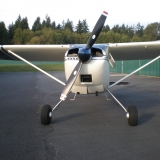
Cessna Skywagon -- accept no substitute!
Sun Sep 30, 2007 4:59 pm
Has anybody actually had some hard data (not hearsay) that putting flaps up shortens your landing run? By putting flaps up you are losing out on the aerodynamic braking effect of the the flaps. Anybody got those hydrolic spoilers fitted?
I go back to my point that if you are fully stalled the Aircraft cannot get airborne again, apart from severe gusts of wind.
I go back to my point that if you are fully stalled the Aircraft cannot get airborne again, apart from severe gusts of wind.
- Student Pilot offline
- Posts: 73
- Joined: Tue Jun 19, 2007 2:29 am
- Location: Strayliya
The older I get the better I used to be
Sun Sep 30, 2007 5:38 pm
Sun Sep 30, 2007 5:47 pm
a64pilot wrote:Why do the big airliners have spoilers that deploy on touchdown?
Why don't big Airliners pull their flaps up after touching down?
- Student Pilot offline
- Posts: 73
- Joined: Tue Jun 19, 2007 2:29 am
- Location: Strayliya
The older I get the better I used to be
Sun Sep 30, 2007 5:49 pm
a64pilot wrote:Student Pilot wrote:I go back to my point that if you are fully stalled the Aircraft cannot get airborne again, apart from severe gusts of wind.
You would be correct if there were such a thing as "fully" stalled, but there isn't
Well then stalled, below flying speed.

- Student Pilot offline
- Posts: 73
- Joined: Tue Jun 19, 2007 2:29 am
- Location: Strayliya
The older I get the better I used to be
Sun Sep 30, 2007 5:52 pm
As in most aviation ideas, "it depends" It gets complicated rather quickly. Let's take some examples:
1 A tailwheel aircraft makes a full stall landing on pavement with full flaps in calm wind. It's true there is very little lift being created, and the speed slows rapidly, and it really is a toss-up whether the roll will be shortened by dumping the flaps. The loss of aerodynamic drag about cancels the increased brakeing effectiveness.
2 Same aircraft, but now just a tail low landing. Aircraft will tend to skip or even bounce. Much more lift is still being created because the wing is not fully stalled. IF you wait until the plane is back on the ground and dump the flaps to zero, the airplane will most likely stay on the ground and allow heavier brakeing without locking tires. Picking up the tail a foot or so will make the brakes even more effective. DON"T OVER DO IT! This is in effect a wheel landing.
Every aircraft will react to these scenarios differently. In a light two place with small and not overly effective flaps, it will make little difference. In a heavy taildragger like a 185 with huge flaps, it makes quite a difference, primarily because getting all the weight on the mains allows very heavy brakeing.
If you have electric flaps and a nose wheel, forget it, because the aircraft will have slowed to a fast taxi by the time the system gets the flaps to zero. With a slow electric system retracting the flaps is about the WORST thing you can do in a short field landing because the lift will actually INCREASE as the flaps go through 20 degrees at the worst possible time in the roll-out.
Losing control of the airplane is in fact a big issue depending on the layout of the flap handle. If I am landing in a gusty crosswind I will NEVER dump the flaps because I have to let go of the throttle to do so. I just use 20 or 30 degrees instead of 40 for a little more aileron and elevator authority and concentrate on keeping her straight. I may need that throttle at the exact instant that my hand has moved to the flap handle.
As a general rule, flap dumping is of little benefit for most pilots and most airplanes. Even in heavy taildraggers with big flaps it will achieve only about 10 % less ground roll over a properly executed full stall landing. It can be VERY useful however in a slightly hotter than normal wheel landing or with not so great surfaces like wet grass. Getting ALL the weight on the mains at the beginning of the ground roll for heavy brakeing will help a lot in this kind of situation. I admit I use the technique a lot in the backcountry, but I have over 1500 hours in my 180, and I have new Clevelands and new tires and can get really good brakeing when I need it. If I don't really need to stop short I generally don't use the technique.
I'm sure other members will have different ideas, this one is good for a lot of hangar flying.
Rocky
1 A tailwheel aircraft makes a full stall landing on pavement with full flaps in calm wind. It's true there is very little lift being created, and the speed slows rapidly, and it really is a toss-up whether the roll will be shortened by dumping the flaps. The loss of aerodynamic drag about cancels the increased brakeing effectiveness.
2 Same aircraft, but now just a tail low landing. Aircraft will tend to skip or even bounce. Much more lift is still being created because the wing is not fully stalled. IF you wait until the plane is back on the ground and dump the flaps to zero, the airplane will most likely stay on the ground and allow heavier brakeing without locking tires. Picking up the tail a foot or so will make the brakes even more effective. DON"T OVER DO IT! This is in effect a wheel landing.
Every aircraft will react to these scenarios differently. In a light two place with small and not overly effective flaps, it will make little difference. In a heavy taildragger like a 185 with huge flaps, it makes quite a difference, primarily because getting all the weight on the mains allows very heavy brakeing.
If you have electric flaps and a nose wheel, forget it, because the aircraft will have slowed to a fast taxi by the time the system gets the flaps to zero. With a slow electric system retracting the flaps is about the WORST thing you can do in a short field landing because the lift will actually INCREASE as the flaps go through 20 degrees at the worst possible time in the roll-out.
Losing control of the airplane is in fact a big issue depending on the layout of the flap handle. If I am landing in a gusty crosswind I will NEVER dump the flaps because I have to let go of the throttle to do so. I just use 20 or 30 degrees instead of 40 for a little more aileron and elevator authority and concentrate on keeping her straight. I may need that throttle at the exact instant that my hand has moved to the flap handle.
As a general rule, flap dumping is of little benefit for most pilots and most airplanes. Even in heavy taildraggers with big flaps it will achieve only about 10 % less ground roll over a properly executed full stall landing. It can be VERY useful however in a slightly hotter than normal wheel landing or with not so great surfaces like wet grass. Getting ALL the weight on the mains at the beginning of the ground roll for heavy brakeing will help a lot in this kind of situation. I admit I use the technique a lot in the backcountry, but I have over 1500 hours in my 180, and I have new Clevelands and new tires and can get really good brakeing when I need it. If I don't really need to stop short I generally don't use the technique.
I'm sure other members will have different ideas, this one is good for a lot of hangar flying.
Rocky

Sun Sep 30, 2007 5:53 pm
Student Pilot wrote:I go back to my point that if you are fully stalled the Aircraft cannot get airborne again, apart from severe gusts of wind.
Not even severe gusts... Work/play with winds 30 KTS to 40 KTS, and it's a fine line between the wing flying and wing not flying just rolling down the runway at a fairly slow groundspeed. Those manual flaps are lifesavers, and Cessna didn't do anyone a favor by going to the electric.
Gump
Sun Sep 30, 2007 6:18 pm
GumpAir wrote:Not even severe gusts... Work/play with winds 30 KTS to 40 KTS, and it's a fine line between the wing flying and wing not flying just rolling down the runway at a fairly slow groundspeed. Those manual flaps are lifesavers, and Cessna didn't do anyone a favor by going to the electric.
Gump
I don't generally work with more than 30 Kts (can't work today because of winds and the country I'm flying in) but every now and then fly in more and don't have trouble with the Aircaft lifting off after touching down.
Iv'e flown with quite a few VERY expirenced pilots and haven't seen any "Dumping" flaps. It maybe a valid technique but so is holding your tongue in your cheek, helps you concentrate.
- Student Pilot offline
- Posts: 73
- Joined: Tue Jun 19, 2007 2:29 am
- Location: Strayliya
The older I get the better I used to be
Sun Sep 30, 2007 7:22 pm
Student Pilot wrote:Iv'e flown with quite a few VERY expirenced pilots and haven't seen any "Dumping" flaps. It maybe a valid technique but so is holding your tongue in your cheek, helps you concentrate.
Most of my flying career was the Arctic coast of Alaska, and it's most always windy. I was taught dumping flaps in Cubs and C180/185's, and just as my usual technique, did, figuring it's was easier and safer to kill as much lift as possible instantly when touching down. And, after 15,000 hours of it, I never put a dent in an airplane. Of course I ALWAYS hold my tongue in my teeth when concentrating hard on a squirrley landing (I do) and that might have been what made things work for me. Hell, I don't know.
Gump
Sun Sep 30, 2007 8:19 pm
I dump flaps all the time. Most of the time just as the mains touch. 
Many times, inches before they touch.
Most of those very experienced pilots were probably taught (Don't touch anything till your off the runway)
The old be afraid of the gear switch teacher.
All the folks I know including myself that use flap dumping in there bag of tricks, have never inadvertently hit a gear switch.
Probably just cuz we hold our tongue right or wrong.
I have met several very experienced non flap dumpers that have hit a gear switch.
Many times, inches before they touch.
Most of those very experienced pilots were probably taught (Don't touch anything till your off the runway)
The old be afraid of the gear switch teacher.
All the folks I know including myself that use flap dumping in there bag of tricks, have never inadvertently hit a gear switch.
Probably just cuz we hold our tongue right or wrong.
I have met several very experienced non flap dumpers that have hit a gear switch.
Sun Sep 30, 2007 8:27 pm
mr scout wrote:Most of those very experienced pilots were probably taught (Don't touch anything till your off the runway)
The old be afraid of the gear switch teacher.
The pilots I mentioned didn't have many hours in retracts, mainly between 20,000 and 30,000 hours in the likes of Beavers and 180's.
- Student Pilot offline
- Posts: 73
- Joined: Tue Jun 19, 2007 2:29 am
- Location: Strayliya
The older I get the better I used to be
Sun Sep 30, 2007 9:20 pm
SP - now I know why I shouldn't have brought this up But I agree with Gump. I hate the feeling of flaps deployed while rolling out in gusty crosswinds or even straight down the landing area, especially in a light Cub/Husky/PA-12 what-have-you. The wing is still developing some lift due to the relative wind and I know it likely saved my butt at least once in a bad situation. With a manual flap airplane I do it as a matter of course but don't touch 'em when they're electric as it's way too distracting. But those are generally heavier/faster airplanes anyway and it doesn't feel as neccessary. Nor am I stuffing heavier airplanes into small areas.
I flew a couple times an engineering mule Super Cub modified with an instant dump switch on the stick (P-51 grip - trigger switch was the flap dump). It was a very cool machine but I was always aware that you didn't want to forget and dump the flaps while you were still flying
But this is a subject we can wrangle about until trumpet sound...
Brad
But I agree with Gump. I hate the feeling of flaps deployed while rolling out in gusty crosswinds or even straight down the landing area, especially in a light Cub/Husky/PA-12 what-have-you. The wing is still developing some lift due to the relative wind and I know it likely saved my butt at least once in a bad situation. With a manual flap airplane I do it as a matter of course but don't touch 'em when they're electric as it's way too distracting. But those are generally heavier/faster airplanes anyway and it doesn't feel as neccessary. Nor am I stuffing heavier airplanes into small areas.
I flew a couple times an engineering mule Super Cub modified with an instant dump switch on the stick (P-51 grip - trigger switch was the flap dump). It was a very cool machine but I was always aware that you didn't want to forget and dump the flaps while you were still flying
But this is a subject we can wrangle about until trumpet sound...
Brad
Sun Sep 30, 2007 10:30 pm
I guess it's one of those things that some do and some don't. I've managed so far without it, maybe I'll try it tommorrow?
- Student Pilot offline
- Posts: 73
- Joined: Tue Jun 19, 2007 2:29 am
- Location: Strayliya
The older I get the better I used to be
Mon Oct 01, 2007 4:42 am
THose who don't raise the flaps on a plane with electric flaps are missing something. While they don't come up as fast as manual flaps, they come up, and toward the end of the landing run is where most nasties occur, not at the beginning, where you have really good control. By the time you're there, the flaps are already up.
No head motion, no big deal--close the throttle, reach over and punch the flap switch to the full up position, hand back to throttle.
Work a 206 in tight spots some (and they are a magnificent airplane for this kind of stuff) and you can get to the point where you hit the flap switch just prior to touch, so as you rotate, the plane is going through the 20 degree range, on its way to zero.
Handy technique, and quickly gets all the weight on the mains.
In a taildragger, I rarely use the technique, EXCEPT in very gusty winds. Too much movement, too much distraction for this kid at a critical time.
MTV
No head motion, no big deal--close the throttle, reach over and punch the flap switch to the full up position, hand back to throttle.
Work a 206 in tight spots some (and they are a magnificent airplane for this kind of stuff) and you can get to the point where you hit the flap switch just prior to touch, so as you rotate, the plane is going through the 20 degree range, on its way to zero.
Handy technique, and quickly gets all the weight on the mains.
In a taildragger, I rarely use the technique, EXCEPT in very gusty winds. Too much movement, too much distraction for this kid at a critical time.
MTV


DISPLAY OPTIONS
Who is online
Users browsing this forum: No registered users and 6 guests
Latest Features
-
Live to Tell
A Minnesota pilot is surprised to learn that the sudden asymmetric drag of an out-of-rig ski can…Read More -
Creators
Working in some of the Yukon's most beautiful and remote environments, photographer Simon Blakesley captures aircraft in…Read More -
Aircraft Ownership and Maintenance
Upgrading to big tires can make a huge difference in backcountry performance, but with those gains come…Read More -
Tales from Yesteryear
In this tale from bush flying yesteryear, Don Cogger signs up to help Atlee Dodge Jr recovery…Read More


Latest Knowledge Base
-
Destinations
A regional guide with ideas for winter camping destinations in California, Nevada, New Mexico, and Arizona.Read More -
Aircraft
Finding an affordable aircraft that can handle the backcountry for $80K or less? A challenge for sure, but with the…Read More -
Aircraft
01.29.2018 - Zane - Updated tire diameter graphic to add 8.50x10 Guide to tires for use in the backcountry and off-airport landing…Read More -
Pilots
12.22.2013 - Initial article format Operating aircraft on skis and negotiating a snow-covered landscape is an entirely unique skillset and environment.…Read More


