I just got back from the Hood River Fly In. Had a great time and what a fantastic museum. My wife and I arrived just a short time after the crash of a PA18. I have a friend that watched it happen. He knew the the reported passenger very well.
https://www.youtube.com/watch?v=KUBZMgfM85w
I was told by my friend that the PA18 lost power after take off. Then they turned back to the airport and the bank became extreme and they hit the ground.
We all know what we are to do in this situation but when faced with it will we do the right thing.
Engine Loss on Take Off and Stall Spin
Sun Sep 08, 2019 4:29 pm
- qmdv offline
- Posts: 3633
- Joined: Wed Feb 15, 2006 10:22 pm
- Location: Payette
- FindMeSpot URL: http://share.findmespot.com/shared/face ... I5tqEOk0rc
- Aircraft: Cessna 182
Sun Sep 08, 2019 5:57 pm
Re: Engine Loss on Take Off and Stall Spin
It’s sad to read about an accident like this one. It’s worse to know people involved.
The take-away I got from reviewing lotsa NTSB accidents is the turn back is a very high risk maneuver compared to a wings level-under control off airport landing. The consensus I have heard in webinars and in person seminars is to practice the turn at altitude (and keep periodically practicing enough to be proficient), then keep it in your pocket, prebriefed for every takeoff... and use it wisely. I.e. not when there’s a nice smooth field or other low risk landing spot off the nose.
The take-away I got from reviewing lotsa NTSB accidents is the turn back is a very high risk maneuver compared to a wings level-under control off airport landing. The consensus I have heard in webinars and in person seminars is to practice the turn at altitude (and keep periodically practicing enough to be proficient), then keep it in your pocket, prebriefed for every takeoff... and use it wisely. I.e. not when there’s a nice smooth field or other low risk landing spot off the nose.
- PapernScissors offline
- Posts: 419
- Joined: Sun Mar 06, 2016 8:49 pm
- Location: Spokane
- Aircraft: Cessna 172
Sun Sep 08, 2019 8:59 pm
Re: Engine Loss on Take Off and Stall Spin
The third option so common in crop dusting and seldom talked about elsewhere is to turn at whatever bank necessary to make a good area using vertical space available. Not pulling back on the stick in a futile effort to maintain some altitude has to be practiced to the point of default muscle memory. Also leveling the wing to prevent hooking a wire or obstruction has to be default. Once we have the nose nearly on target, wings level rudder alignment is all that is necessary.
Engine failure on takeoff is far less common than engine failure while spraying, but the safe landing technique is the same and results in moderate airplane damage and nearly zero injury.
In the interest of safety, low ground effect to establishment zoom reserve even if the engine fails and the energy management turn need to become a part of every pilot's initial, concurrent, and recurrent training.
Because most low level engine failures are crop dusters flown out with engine repair or exchange and unreported, the NTSB misses most of the positive data that supports this safe maneuvering flight technique.
Engine failure on takeoff is far less common than engine failure while spraying, but the safe landing technique is the same and results in moderate airplane damage and nearly zero injury.
In the interest of safety, low ground effect to establishment zoom reserve even if the engine fails and the energy management turn need to become a part of every pilot's initial, concurrent, and recurrent training.
Because most low level engine failures are crop dusters flown out with engine repair or exchange and unreported, the NTSB misses most of the positive data that supports this safe maneuvering flight technique.
- contactflying offline
- Posts: 4972
- Joined: Wed Apr 03, 2013 7:36 pm
- Location: Aurora, Missouri 2H2
Download my free "https://tinyurl.com/Safe-Maneuvering" e-book.
Sun Sep 08, 2019 9:52 pm
Re: Engine Loss on Take Off and Stall Spin
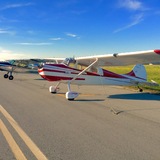
A gal at my airport recently had an engine failure on take off in her Cessna 140.
She tried to turn back. Bad choice for her situation. She barely missed a fence and then cartwheeled the plane.
She's lucky she didn't die.
Here it is in the boneyard of the airport.

She tried to turn back. Bad choice for her situation. She barely missed a fence and then cartwheeled the plane.
She's lucky she didn't die.
Here it is in the boneyard of the airport.
Mon Sep 09, 2019 2:24 am
Re: Engine Loss on Take Off and Stall Spin
We instructors leave a useful tool untaught when we refuse to teach the rudder turn with nose down or in ground effect.. Nose down ie. not pulling back on the stick = no stall.
- contactflying offline
- Posts: 4972
- Joined: Wed Apr 03, 2013 7:36 pm
- Location: Aurora, Missouri 2H2
Download my free "https://tinyurl.com/Safe-Maneuvering" e-book.
Mon Sep 09, 2019 7:47 am
Re: Engine Loss on Take Off and Stall Spin
My primary instructor drilled the fact that the airplane belongs to the insurance company as soon as the fan quits turning. Don’t bother trying to save it, save yourself.
There is a pretty slick turn back YouTube out there that’s recent. Those guys were making it work but they knew it was coming. The human factor was removed. While entertaining, it’s a perfect example of what not to do and I’m sure the fellows who made it would support that.
Lastly I might add that this is not something reserved for low time guys either. 10 years ago a buddy who was the check pilot for a startup air taxi failed 3 out of 5 prospective hire commercial pilots for turning back in the Caravan. Needless to say, although the operation had lots of other problems, the largest one was lack of pilots.
So sad for the families. I was at the WAAM a week before that happened. What a cool place...second visit. Hope this doesn’t discourage them from having the fly in.
There is a pretty slick turn back YouTube out there that’s recent. Those guys were making it work but they knew it was coming. The human factor was removed. While entertaining, it’s a perfect example of what not to do and I’m sure the fellows who made it would support that.
Lastly I might add that this is not something reserved for low time guys either. 10 years ago a buddy who was the check pilot for a startup air taxi failed 3 out of 5 prospective hire commercial pilots for turning back in the Caravan. Needless to say, although the operation had lots of other problems, the largest one was lack of pilots.
So sad for the families. I was at the WAAM a week before that happened. What a cool place...second visit. Hope this doesn’t discourage them from having the fly in.
Mon Sep 09, 2019 7:51 am
Re: Engine Loss on Take Off and Stall Spin
contactflying wrote:We instructors leave a useful tool untaught when we refuse to teach the rudder turn with nose down or in ground effect.. Nose down ie. not pulling back on the stick = no stall.
Agree with that. It saved my hide one day doing something somewhere that I shouldn’t have been.
Mon Sep 09, 2019 11:03 am
Re: Engine Loss on Take Off and Stall Spin
gbflyer wrote:So sad for the families. I was at the WAAM a week before that happened. What a cool place...second visit. Hope this doesn’t discourage them from having the fly in.
I have heard locally that this was a BFR for the PIC, nothing to do with the fly-in. The instructor in the back seat was a highly experienced pilot.
Rod
- Wa180 offline

- Posts: 170
- Joined: Mon Mar 12, 2007 10:45 pm
- Location: Moses Lake
- FindMeSpot URL: https://us0-share.inreach.garmin.com/Fattyreflyer
- Aircraft: SkyWagon 180E
SkyHawk 172K
Sat Sep 14, 2019 9:43 pm
Re: Engine Loss on Take Off and Stall Spin
From taking with 3-4 eyewitnesses, and looking at the crash scene, I'm not certain it was a turning back scenario, although from what I heard it might have been.
What I gathered was the takeoff was at an extremely steep angle, and the plane didn't immediately change pitch at engine failure, which was sudden enough to make people notice and look over there.
Two of the three people I talked to said the plane stalled nose up with the power suddenly cut, rolled to the right and almost straight down. Btw it was gusty when I landed as well: calm with gusts to 15kt.
The plane came to rest just north of the runway centerline near some hangars.
None of this is very clear: the people I talked to "saw" different things, each in agreement with their explanation for what happened. One felt they tried to turn but nose up, the other two thought that they were so deep into the power curve that in the second that the power was gone they didn't pitch down and looked almost as if they did a tail slide...
So it may have been a turn back, but I'm clear as mud.
What's certain for my own learning is I am going to do some training at safe altitudes where I climb at /over attitudes like that of vx and cut power to see what I would be in for...
What's also certain is I will repeatedly chair fly immediately pushing the nose over from a vx attitude if I hear the engine stop or sputter or hiccup.
Only thing certain was we at the fly in had some sobering looks in the mirror and wished the two pilots and their families and friends peace and comfort.
What I gathered was the takeoff was at an extremely steep angle, and the plane didn't immediately change pitch at engine failure, which was sudden enough to make people notice and look over there.
Two of the three people I talked to said the plane stalled nose up with the power suddenly cut, rolled to the right and almost straight down. Btw it was gusty when I landed as well: calm with gusts to 15kt.
The plane came to rest just north of the runway centerline near some hangars.
None of this is very clear: the people I talked to "saw" different things, each in agreement with their explanation for what happened. One felt they tried to turn but nose up, the other two thought that they were so deep into the power curve that in the second that the power was gone they didn't pitch down and looked almost as if they did a tail slide...
So it may have been a turn back, but I'm clear as mud.
What's certain for my own learning is I am going to do some training at safe altitudes where I climb at /over attitudes like that of vx and cut power to see what I would be in for...
What's also certain is I will repeatedly chair fly immediately pushing the nose over from a vx attitude if I hear the engine stop or sputter or hiccup.
Only thing certain was we at the fly in had some sobering looks in the mirror and wished the two pilots and their families and friends peace and comfort.
Sun Sep 15, 2019 6:13 am
Re: Engine Loss on Take Off and Stall Spin
As an FYI, the speed and configuration that Piper suggests for the Super Cub is 45 mph and full flaps.
If you've ever demonstrated that, you'll realize that IF the engine were to fail in that configuration and attitude, you WILL stall.....no matter how fast your reaction time.
In my opinion, actual, no shit Vx climb in a Super Cub is a true emergency procedure, never to be "demonstrated" or practiced close to the ground.
Sad deal, this.
MTV
If you've ever demonstrated that, you'll realize that IF the engine were to fail in that configuration and attitude, you WILL stall.....no matter how fast your reaction time.
In my opinion, actual, no shit Vx climb in a Super Cub is a true emergency procedure, never to be "demonstrated" or practiced close to the ground.
Sad deal, this.
MTV


Sun Sep 15, 2019 6:34 am
Re: Engine Loss on Take Off and Stall Spin
Agree. Also why do we need more than just over the obstacle with as much maneuvering speed as possible?
- contactflying offline
- Posts: 4972
- Joined: Wed Apr 03, 2013 7:36 pm
- Location: Aurora, Missouri 2H2
Download my free "https://tinyurl.com/Safe-Maneuvering" e-book.
Sun Sep 15, 2019 8:10 am
Re: Engine Loss on Take Off and Stall Spin
mtv wrote:As an FYI, the speed and configuration that Piper suggests for the Super Cub is 45 mph and full flaps.
If you've ever demonstrated that, you'll realize that IF the engine were to fail in that configuration and attitude, you WILL stall.....no matter how fast your reaction time.
In my opinion, actual, no shit Vx climb in a Super Cub is a true emergency procedure, never to be "demonstrated" or practiced close to the ground.
Sad deal, this.
MTV
A big mash of the like button on MTV's post! VX low to the ground in most airplanes is a disaster waiting to happen if the engine quits.
Kurt
Mon Sep 16, 2019 5:26 pm
Re: Engine Loss on Take Off and Stall Spin
mtv wrote:As an FYI, the speed and configuration that Piper suggests for the Super Cub is 45 mph and full flaps.
If you've ever demonstrated that, you'll realize that IF the engine were to fail in that configuration and attitude, you WILL stall.....no matter how fast your reaction time.
In my opinion, actual, no shit Vx climb in a Super Cub is a true emergency procedure, never to be "demonstrated" or practiced close to the ground.
Sad deal, this.
MTV
+1
It's posts and conversations like this that demonstrate the high value of discussing possible causes of accidents well before the NTSB makes its stab at the Probable Cause (s)... The discussion is insightful. Then going beyond the 'what might have happened, suggestions, cautions, or options to consider BEFORE pushing the throttle forward are the aviation community at its best. Who knows? The deaths or injuries prevented by these observations and musings might include mine or someone else on forum.
- PapernScissors offline
- Posts: 419
- Joined: Sun Mar 06, 2016 8:49 pm
- Location: Spokane
- Aircraft: Cessna 172
Tue Sep 17, 2019 2:40 pm
Re: Engine Loss on Take Off and Stall Spin
For myself, and the students I taught, I reserve a Vx climb for those rare situations in which it's really necessary to clear an obstacle--and realistically, that happens really, really rarely. Sure, you impress the troops with your incredible steep climb, but what else do you do?
I much prefer a climb out closer to Vy. OK, I won't likely have enough altitude to turn around if the engine quits off a 5000' runway, but I don't expect to. How much altitude do I actually need? Not counting my reaction time, I have tested it over and over in my airplane, and I need a minimum of 670' in my airplane with only me aboard to complete a turn-around which includes an S turn that brings me back to the runway, using a 45 degree bank. If I'm climbing out at somewhere around 85 mph and 500 fpm in a light headwind condition, if I'm climbing straight out, I'll be about 2500' past the end of the runway at that minimum altitude. But I need to be higher than that and farther out, because I will likely take several seconds to react. So my personal rule is that unless I'm at 1000' AGL when the engine quits, I'm not going to try it.
So what are the alternatives? It doesn't have to be straight ahead. At GXY, I usually take off on 10. Early enough, there's a turn to 35. After that, there's a newly constructed nice wide straight highway. Both require a sharp turn, to the left for 35, either way for the highway. There's also the old road that essentially parallels 10/28, although it's kind of hilly. And then there are fields. Any place within the airport environment is likely to be relatively flat, and that's true of many airports. So it's not necessary to make a complete turn around, or to necessarily go "straight out" to make a safe landing.
Unfortunately, the natural tendency when the shtf and the fan stops is to yank back to keep the airplane in the air, just the opposite of what is necessary. That's the same natural reaction when an airplane is rolled inverted by external forces, such as by wake turbulence of another airplane. So it takes a concerted effort to push the yoke/stick to keep the airplane flying, to overcome that natural tendency. That concerted effort comes from practice.
I think every pilot should practice the "improbable turn" to find out what it takes to actually accomplish it--but at a safe altitude, using an artificial hard deck as the virtual runway. For anyone who hasn't tried it, it will be a revelation--it sure was for me.
Cary
- Well, for one, you eliminate the possibility of landing on the remaining runway (unless, of course, it's a pretty short runway to begin with).
For another, you shorten the necessary response time before the airplane stalls (is that 3/4 second, 2 seconds, 3 seconds? Everyone is different in their response to a sudden emergency).
I much prefer a climb out closer to Vy. OK, I won't likely have enough altitude to turn around if the engine quits off a 5000' runway, but I don't expect to. How much altitude do I actually need? Not counting my reaction time, I have tested it over and over in my airplane, and I need a minimum of 670' in my airplane with only me aboard to complete a turn-around which includes an S turn that brings me back to the runway, using a 45 degree bank. If I'm climbing out at somewhere around 85 mph and 500 fpm in a light headwind condition, if I'm climbing straight out, I'll be about 2500' past the end of the runway at that minimum altitude. But I need to be higher than that and farther out, because I will likely take several seconds to react. So my personal rule is that unless I'm at 1000' AGL when the engine quits, I'm not going to try it.
So what are the alternatives? It doesn't have to be straight ahead. At GXY, I usually take off on 10. Early enough, there's a turn to 35. After that, there's a newly constructed nice wide straight highway. Both require a sharp turn, to the left for 35, either way for the highway. There's also the old road that essentially parallels 10/28, although it's kind of hilly. And then there are fields. Any place within the airport environment is likely to be relatively flat, and that's true of many airports. So it's not necessary to make a complete turn around, or to necessarily go "straight out" to make a safe landing.
Unfortunately, the natural tendency when the shtf and the fan stops is to yank back to keep the airplane in the air, just the opposite of what is necessary. That's the same natural reaction when an airplane is rolled inverted by external forces, such as by wake turbulence of another airplane. So it takes a concerted effort to push the yoke/stick to keep the airplane flying, to overcome that natural tendency. That concerted effort comes from practice.
I think every pilot should practice the "improbable turn" to find out what it takes to actually accomplish it--but at a safe altitude, using an artificial hard deck as the virtual runway. For anyone who hasn't tried it, it will be a revelation--it sure was for me.
Cary
"I have slipped the surly bonds of earth..., put out my hand and touched the face of God." J.G. Magee
Sat Sep 21, 2019 8:40 am
Re: Engine Loss on Take Off and Stall Spin
great post Cary
- soaringhiggy offline
- Posts: 711
- Joined: Tue Dec 13, 2005 8:22 pm
- Location: Kimberly, ID
48 Stinson 108-3
Sat Sep 21, 2019 9:28 am
Re: Engine Loss on Take Off and Stall Spin
I found this very informative. Made me think a lot about my headspace as I leave the runway.
- daedaluscan offline

- Posts: 1269
- Joined: Sat Jan 12, 2013 1:06 pm
- Location: Texada BC
Sat Sep 21, 2019 10:35 am
- qmdv offline
- Posts: 3633
- Joined: Wed Feb 15, 2006 10:22 pm
- Location: Payette
- FindMeSpot URL: http://share.findmespot.com/shared/face ... I5tqEOk0rc
- Aircraft: Cessna 182
Sat Sep 21, 2019 7:48 pm
Re: Engine Loss on Take Off and Stall Spin
Very good. Most guys like me should probably do the drills in the video. I'm going to make that a priority.
- OregonMaule offline
- Posts: 6977
- Joined: Fri Sep 01, 2006 9:44 pm
- Location: Orygun
My SPOT page
"They who can give up essential liberty to obtain a little temporary safety, deserve neither liberty nor safety". Ben Franklin
http://en.wikiquote.org/wiki/Benjamin_Franklin
"They who can give up essential liberty to obtain a little temporary safety, deserve neither liberty nor safety". Ben Franklin
http://en.wikiquote.org/wiki/Benjamin_Franklin
Sat Sep 21, 2019 9:24 pm
Re: Engine Loss on Take Off and Stall Spin
Very good video with the right thinking. Along with integration of instruments and Practical Test Standards in the 70s came the requirement to not lose altitude in stall recovery. This was strange to most of us who had been taught to immediately dump the nose as this instructor teaches.
Acceptance of the failure at the beginning of the takeoff roll, also emphasized here, is also very important. Having had more low altitude forced landings than most, I attribute that and the energy management turn to having saved me and my airplane many times.
If we develop as much kinetic energy, rather than potential energy, as possible on takeoff or just working low, the zoom up and energy management turn will get us safely anywhere in the near hemisphere. Anything outside the near hemisphere is not attainable anyway.
I agree that impossible turn evaluation and practice is worthwhile. However, in ten iterations of complete engine failure below 200' AGL, I didn't even consider it because a survivable landing zone in the near hemisphere immediately appeared. In nine of those I used the default zoom reserve from staying in low ground effect to zoom up to what this instructor calls minimum controllable airspeed, banked at whatever bank angle necessary to make the landing zone while releasing all back pressure, evaluated glideslope and obstructions into the landing zone, usually added full flaps and rudder to the stop forward slip, leveled the wing to go over the obstruction wings level, and landed in the beginning of the landing zone. All this took six seconds.
The race to 300' AGL or whatever altitude you need to return is a fools errand. At Vx or even Vy, it takes away the zoom reserve that provides nearly as much altitude but more importantly provides the maneuvering airspeed that makes the short trip to the landing zone a 1g energy management turn.
The important part is covered in the video for those who have not practiced the energy management turn. Push the stick forward and not pull back like when we have developed kinetic energy, that is lots of airspeed. Airspeed, lots of it, can safely be traded for altitude. Not lots of airspeed, push forward on the stick. Works for engine failure at Vx and works for go around at 1.3 Vso or even apparent brisk walk rate of closure. Also, with the nose down or in ground effect, we can safely rudder turn while holding the wing level with aileron to prevent hooking a wire or obstruction with a down wing.
Acceptance of the failure at the beginning of the takeoff roll, also emphasized here, is also very important. Having had more low altitude forced landings than most, I attribute that and the energy management turn to having saved me and my airplane many times.
If we develop as much kinetic energy, rather than potential energy, as possible on takeoff or just working low, the zoom up and energy management turn will get us safely anywhere in the near hemisphere. Anything outside the near hemisphere is not attainable anyway.
I agree that impossible turn evaluation and practice is worthwhile. However, in ten iterations of complete engine failure below 200' AGL, I didn't even consider it because a survivable landing zone in the near hemisphere immediately appeared. In nine of those I used the default zoom reserve from staying in low ground effect to zoom up to what this instructor calls minimum controllable airspeed, banked at whatever bank angle necessary to make the landing zone while releasing all back pressure, evaluated glideslope and obstructions into the landing zone, usually added full flaps and rudder to the stop forward slip, leveled the wing to go over the obstruction wings level, and landed in the beginning of the landing zone. All this took six seconds.
The race to 300' AGL or whatever altitude you need to return is a fools errand. At Vx or even Vy, it takes away the zoom reserve that provides nearly as much altitude but more importantly provides the maneuvering airspeed that makes the short trip to the landing zone a 1g energy management turn.
The important part is covered in the video for those who have not practiced the energy management turn. Push the stick forward and not pull back like when we have developed kinetic energy, that is lots of airspeed. Airspeed, lots of it, can safely be traded for altitude. Not lots of airspeed, push forward on the stick. Works for engine failure at Vx and works for go around at 1.3 Vso or even apparent brisk walk rate of closure. Also, with the nose down or in ground effect, we can safely rudder turn while holding the wing level with aileron to prevent hooking a wire or obstruction with a down wing.
- contactflying offline
- Posts: 4972
- Joined: Wed Apr 03, 2013 7:36 pm
- Location: Aurora, Missouri 2H2
Download my free "https://tinyurl.com/Safe-Maneuvering" e-book.
Sun Sep 22, 2019 7:52 am
Re: Engine Loss on Take Off and Stall Spin
agreed great video, something that we all should practice.
If you happen to be a sailplane pilot this is drilled as part of a rope break or winch malfunction.
If you happen to be a sailplane pilot this is drilled as part of a rope break or winch malfunction.
- soaringhiggy offline
- Posts: 711
- Joined: Tue Dec 13, 2005 8:22 pm
- Location: Kimberly, ID
48 Stinson 108-3
DISPLAY OPTIONS
Who is online
Users browsing this forum: No registered users and 2 guests
Latest Features
-
Live to Tell
A Minnesota pilot is surprised to learn that the sudden asymmetric drag of an out-of-rig ski can…Read More -
Creators
Working in some of the Yukon's most beautiful and remote environments, photographer Simon Blakesley captures aircraft in…Read More -
Aircraft Ownership and Maintenance
Upgrading to big tires can make a huge difference in backcountry performance, but with those gains come…Read More -
Tales from Yesteryear
In this tale from bush flying yesteryear, Don Cogger signs up to help Atlee Dodge Jr recovery…Read More


Latest Knowledge Base
-
Destinations
A regional guide with ideas for winter camping destinations in California, Nevada, New Mexico, and Arizona.Read More -
Aircraft
Finding an affordable aircraft that can handle the backcountry for $80K or less? A challenge for sure, but with the…Read More -
Aircraft
01.29.2018 - Zane - Updated tire diameter graphic to add 8.50x10 Guide to tires for use in the backcountry and off-airport landing…Read More -
Pilots
12.22.2013 - Initial article format Operating aircraft on skis and negotiating a snow-covered landscape is an entirely unique skillset and environment.…Read More


