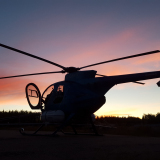
Background: I was trained to land perpendicular to a slope. Preferably right skid uphill (translating tendency) with CCW MR. https://www.faa.gov/regulations_policies/handbooks_manuals/aviation/helicopter_flying_handbook/
Helicopter Handbook, FAA-H-8083-21A, Chapter 10-7 Helicopter Slope Operations states:
Question: I understand landing across the slope and to not land TR uphill. However, looking for reasons not to land TR down slope. Certainly at some point the MR would chop the cabin off or hit the uphill terrain. But, let’s say a 5 degree or less slope pointing the ship upslope?Slope Landing
A pilot usually lands a helicopter across the slope is preferable, rather than with the slope. Landing with the helicopter facing down the slope or downhill is not recommended because of the possibility of striking the tail rotor on the surface.
References:
FAA-H-8083-21A, Chapter 11-3
https://www.faa.gov/regulations_policies/handbooks_manuals/aviation/helicopter_flying_handbook/media/hfh_ch11.pdf
FAA-H-8083-21A, Chapter 11-3Refer to Figure 11-7. The following conditions are most critical for helicopters with counterclockwise rotor rotation:
1. Right side skid or landing wheel down, since translating tendency adds to the rollover force.
2. Right lateral center of gravity (CG).
3. Crosswinds from the left.
4. Left yaw inputs.
Slope Takeoffs and Landings
During slope operations, excessive application of cyclic control into the slope, together with excessive collective pitch control, can result in the downslope skid or landing wheel rising sufficiently to exceed lateral cyclic control limits, and an upslope rolling motion can occur. [Figure 11-8]
When performing slope takeoff and landing maneuvers, follow the published procedures and keep the roll rates small. Slowly raise the downslope skid or wheel to bring the helicopter level, and then lift off. During landing, first touch down on the upslope skid or wheel, then slowly lower the downslope skid or wheel using combined movements of cyclic and collective. If the helicopter rolls approximately 5–8° to the upslope side, decrease collective to correct the bank angle and return to level attitude, then start the landing procedure again