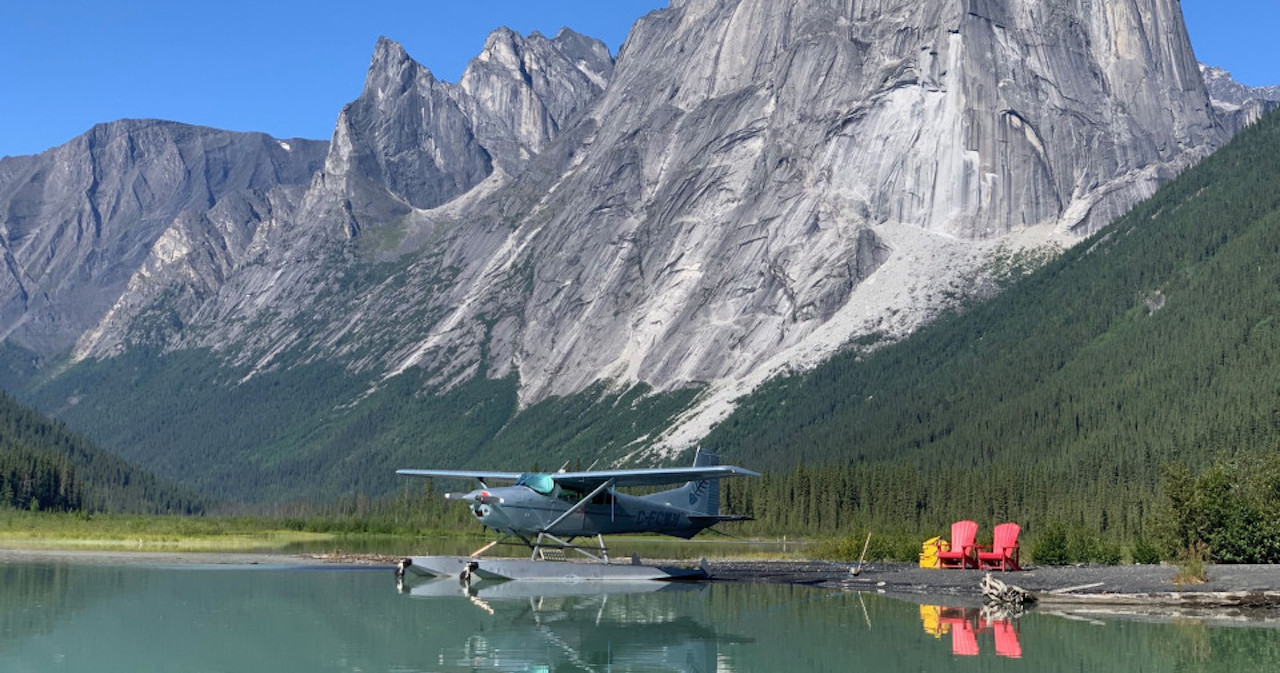
A while back I came across some information regarding the aerodynamics involved with performing forward slips in aircraft. I thought I had posted it but when this subject came up on another thread, I looked and couldn't find it. So, here it is. We've all heard about the warnings about slipping with full flaps (I can tell you with certainty that it can be done at least in 172s and 182s) and I think most people reference the "blanketing of the elevator". So when I read this, I thought it was very interesting. This was the first time I've ever read an explanation of the aerodynamics of what is happening.
Here’s what Bill Thompson, former Manager of Flight Test & Aerodynamics at Cessna, had to say about the issue of slipping with full flaps in the 172 (Cessna — Wings for The World, by William D. Thompson, Maverick Press, 1991, p. 41):
With the advent of the large slotted flaps in the C-170, C-180, and C-172 we encountered a nose down pitch in forward slips with the wing flaps deflected. In some cases it was severe enough to lift the pilot against his seat belt if he was slow in checking the motion. For this reason a caution note was placed in most of the owner’s manuals under “Landings” reading “Slips should be avoided with flap settings greater than 30 deg. due to a downward pitch encountered under certain combinations of airspeed, side-slip angle, and center of gravity loadings”. Since wing-low drift correction in crosswind landings is normally performed with a minimum flap setting (for better rudder control) this limitation did not apply to that maneuver. The cause of the pitching motion is the transition of a strong wing downwash over the tail in straight flight to a lessened downwash angle over part of the horizontal tail caused by the influence of a relative “upwash increment” from the upturned aileron in slipping flight. Although not stated in the owner’s manuals, we privately encouraged flight instructors to explore these effects at high altitude, and to pass on the information to their students. This phenomenon was elusive and sometimes hard to duplicate, but it was thought that a pilot should be aware of its existence and know how to counteract it if it occurs close to the ground.
You'll notice that beginning with the 1972 model year ('73 for European-built models) 172s have a larger dorsal fin. This apparently eliminated the "pitch-down" problem.
However, there is also an unrelated, more benign phenomenon that Thompson described in newer models in full-flap slips: “a mild pitch ‘pumping’ motion resulting from flap outboard-end vortex impingement on the horizontal tail at some combinations of side-slip angle, power, and airspeed.” This really isn't a problem and it's not limited to Cessnas -- my Sport Cub does it, as well, and it doesn't keep me from slipping with full flaps in either airplane.
So although the 172L’s larger dorsal apparently solved the pitch-down issue, they kept the cautionary note in the POH because of the latter phenomenon.
Unfortunately Cessna contributed to the “end of the world” fear of slips with flaps, by not explaining the pitch-down phenomenon in the manuals; and in fact, many earlier C-172 manuals expressly said that slips with full flap were prohibited. I rummaged through my collection of old Cessna owners manuals:
1958 C-172: “prohibited”
1959 C-175: “prohibited”
1966 C-172F: “prohibited”
1972 C-172L (first year of the big dorsal): “should be avoided”
The manuals and TCDS for these older models have been revised since then, and there is now no legal prohibition against slips with flaps -- but that’s what a lot of us old-timers read back then and remember.
And some further clarification:
The pitch-down that might occur with flap-down slips in Cessnas is not from "elevator blanking." Cessna's aerodynamicist and test pilot said, "The cause of the pitching motion is the transition of a strong wing downwash over the tail in straight flight to a lessened downwash angle over part of the horizontal tail caused by the influence of a relative 'upwash increment' from the upturned aileron in slipping flight."
In other words, in extreme slip conditions some of the upwash from the upturned aileron on the lowered wing might hit the horizontal stabilizer. Flaps cause downwash on the horizontal stabilizer -- that's why retrimming is necessary when flaps are extended. When some of that flap downwash is replaced by upwash from the aileron, there is very suddenly too much nose-down trim, and the nose pitches down.
"Elevator blanking" makes it sound as if the elevators lose effectiveness, and that's not what is happening.
The pitch-down is not a consistent phenomenon in 172s; Cessna test pilots found it "elusive and sometimes hard to duplicate." And apparently the larger dorsal fin from 1972 onward prevents the 172 from yawing far enough in a slip to allow aileron upwash to hit the tail, so the issue is moot.
It's interesting that the old (pre-1972) C-172 owners handbooks (which do not carry the force of law) said slips with full flaps were "prohibited" -- while the current version of the TCDS (which is the "law") only calls for placards saying "Avoid slips with flaps down" (172 thru 172E) or "Avoid slips with flaps extended" (172F thru 172N). The old "prohibited" language is nowhere to be found.
There is no caution against slips with flaps in the 172P and newer, in which maximum flap extension is reduced to thirty degrees.
Forward Slips in Cessnas and Other Aircraft
Tue Sep 24, 2013 10:22 pm
- Grassstrippilot offline

- Posts: 3536
- Joined: Wed May 31, 2006 6:17 am
- Location: Syracuse, UT
- FindMeSpot URL: https://share.garmin.com/WolfAdventures
- Aircraft: Cessna 205
Tue Sep 24, 2013 11:13 pm
Re: Forward Slips in Cessnas and Other Aircraft
Great post Grassstrippilot!
This should be filed in the knowledge base, as many models of Cessnas with very similar aerodynamic characteristics seem to be the most ubiquitous of all of general aviation aircraft, and are certainly not uncommon in the back country.
I have played with full flap slips a ton in my 170 and 180. There are definitely periods of brief pitch instability while transitioning in to aggressively uncoordinated flight, but when you grow accustomed to the progression, you sort of learn to predict the event and you can pulse the elevator for nose up and really increase the rate of descent without changing power and a small change in airspeed, and the passengers hardly even notice the weirdness.
Here is an example, though the slip is pretty subtle.
This should be filed in the knowledge base, as many models of Cessnas with very similar aerodynamic characteristics seem to be the most ubiquitous of all of general aviation aircraft, and are certainly not uncommon in the back country.
I have played with full flap slips a ton in my 170 and 180. There are definitely periods of brief pitch instability while transitioning in to aggressively uncoordinated flight, but when you grow accustomed to the progression, you sort of learn to predict the event and you can pulse the elevator for nose up and really increase the rate of descent without changing power and a small change in airspeed, and the passengers hardly even notice the weirdness.
Here is an example, though the slip is pretty subtle.
- Scolopax offline

- Posts: 1718
- Joined: Tue Sep 27, 2005 5:02 pm
- Location: Nottingham
- FindMeSpot URL: http://share.findmespot.com/shared/face ... 4aYqSexnZC
Tue Sep 24, 2013 11:23 pm
Re: Forward Slips in Cessnas and Other Aircraft
Thanks Scolopax. Nice vid! I've found that I'll only get the elevator pulsing in a 182 when I am heavy with a rearward CG. But, as soon as you feel the onset of the pulse, easing off the slip just a little will make it go away and, you can still utilize the amount of the slip you have left. Like it mentions, I think the key is recognizing and understanding. I make it a point to discuss and show this to students, and now I have a better understanding of the why behind it.
- Grassstrippilot offline
- Posts: 3536
- Joined: Wed May 31, 2006 6:17 am
- Location: Syracuse, UT
- FindMeSpot URL: https://share.garmin.com/WolfAdventures
- Aircraft: Cessna 205
Wed Sep 25, 2013 1:11 am
Re: Forward Slips in Cessnas and Other Aircraft
Isn't that why Cessna went to 30 degrees of flaps?
At any rate when that rule came out a few of us young bucks immediately said we gotta see what the big deal is, after all we had been using 40 degrees with a full on slip during landing in order to get to the glider tow position without dragging the rope to much for years. Yeah, you could find that "sweet spot" where the elevator would blank out but you had to try real hard and, as grasstrippilot said, all it took was to recover was backing off the slip just a little. Not something you would want to happen at 30', but eminently recoverable.
At any rate when that rule came out a few of us young bucks immediately said we gotta see what the big deal is, after all we had been using 40 degrees with a full on slip during landing in order to get to the glider tow position without dragging the rope to much for years. Yeah, you could find that "sweet spot" where the elevator would blank out but you had to try real hard and, as grasstrippilot said, all it took was to recover was backing off the slip just a little. Not something you would want to happen at 30', but eminently recoverable.

John
KSBP
KSBP
Wed Sep 25, 2013 4:19 am
Re: Forward Slips in Cessnas and Other Aircraft
I got my private pilot in a 1966 C-172 and did many full flaps forward slips. I just always knew to maintain my relative airspeed and either pitch forward or release...most of the time it was pitch forward to prevent airspeed bleed off. I found forward slips very fun and handy!
- xcalibursword offline
- Posts: 142
- Joined: Thu Dec 20, 2012 10:26 am
- Location: Ava
Wed Sep 25, 2013 8:24 am
Re: Forward Slips in Cessnas and Other Aircraft
i have done many full flap slips in a 170B and never had a problem with it yes at first it takes a bit to get use to. I found that if I carried a few extra rpms while in the slip that I had much better rudder and elevator authority while still being able to drop like a rock. I have also done full flap landings with 45 deg x winds at 20g25 or so. but lets not go there. 
- cstolaircraft offline
- Posts: 523
- Joined: Wed Sep 29, 2010 12:50 pm
- Location: Blackwell, Mo
Mission Pilot in training. C-170B N8098A.
But they that wait upon the Lord shall renew their strength; they shall mount up on wings as eagles... Isaiah 40:31
But they that wait upon the Lord shall renew their strength; they shall mount up on wings as eagles... Isaiah 40:31
Wed Sep 25, 2013 8:35 am
Re: Forward Slips in Cessnas and Other Aircraft
I've found you have to get really aggressive, as others have said, to provoke it. Even then, it's easy in my 180 to feel it coming and adjust. The Cessna designs really are amazingly free of aerodynamic quirks.

Wed Sep 25, 2013 8:53 am
Re: Forward Slips in Cessnas and Other Aircraft
Eons ago I had been told by several instructors not to do forward slips with full (40) flaps in 172s, although my first instructor hadn't said anything about it in 150s or the 172s we had at the EDF Aeroclub--just never did one with full flaps that I can remember. So although I had obtained my commercial in 172s and my IR in 182s, I had studiously avoided 40 flaps through and including getting to my CFI checkride.
Then during that checkride, the Inspector wanted me to hold altitude on final enough that a full 40 flap forward slip was necessary to get down. When I protested, he assured me that it was discouraged by the Cessna manual but not prohibited, and that the airplane wouldn't fall out of control. So my very first full 40 flap forward slip was into 30 at Casper for a landing.
What I experienced was exactly the worst that happens, a pitch oscillation which somewhat resembles a phugoid stall, and close to the ground it is a little disconcerting--but totally manageable. Just as soon as the rudder is relaxed a little, it stops. The extended dorsal fin on newer models eliminates it--that may be why a previous owner of my '63 P172D installed an extended dorsal fin. But in any event, it's not a serious phenomenon that should keep anyone from using a full flap forward slip if necessary, on any Cessna single.
Of course, there are those who would argue that the best reason to avoid forward slips is that there are only a couple of attach bolts holding the rudder on!
Cary
Then during that checkride, the Inspector wanted me to hold altitude on final enough that a full 40 flap forward slip was necessary to get down. When I protested, he assured me that it was discouraged by the Cessna manual but not prohibited, and that the airplane wouldn't fall out of control. So my very first full 40 flap forward slip was into 30 at Casper for a landing.
What I experienced was exactly the worst that happens, a pitch oscillation which somewhat resembles a phugoid stall, and close to the ground it is a little disconcerting--but totally manageable. Just as soon as the rudder is relaxed a little, it stops. The extended dorsal fin on newer models eliminates it--that may be why a previous owner of my '63 P172D installed an extended dorsal fin. But in any event, it's not a serious phenomenon that should keep anyone from using a full flap forward slip if necessary, on any Cessna single.
Of course, there are those who would argue that the best reason to avoid forward slips is that there are only a couple of attach bolts holding the rudder on!
Cary
"I have slipped the surly bonds of earth..., put out my hand and touched the face of God." J.G. Magee
Wed Sep 25, 2013 8:57 am
Re: Forward Slips in Cessnas and Other Aircraft
porterjet wrote:Isn't that why Cessna went to 30 degrees of flaps?
.
Cessna restricted flap travel in an attempt to prevent numb nuts pilots from killing themselves and their passengers during a full flap go around at max gross and full flap.
MTV

Wed Sep 25, 2013 8:58 am
Re: Forward Slips in Cessnas and Other Aircraft
This shows a real dirty airframe in a real full controlled slip right down to the ground.
There is some buffeting and other stuff going on but I think that happens when you turn almost any airplane as far side ways as you can with the rudder at the stop!
Elevator and aileron controls most of the burbles and pitch changes, but in a full slip to use it to it's most value, you need to keep the rudder against the stop. That gives you 1 less variable to deal with. Keep the engine at idle, that takes away another variable also! You don't need the power or you would not be slipping this way!
This one shows how quickly you can loose altitude in a hurry.
You can fall right out of the sky, in a full stall slip that when you get to ground affect and turn it back straight, it gains so much lift that it will arrest most all of your sink.
Scolopax video showed the slip head on very well.
This is over some real tall trees (80'+) 1800' elevation and 1200' strip.
Landing is at about 1:02
Work on this at altitude, and be safe.
Learning a good rudder to the stop slip is a great thing to have in your bag if you ever need it!!
Most of all, Have Fun!!
Again advice from me is worth what you paid!!
There is some buffeting and other stuff going on but I think that happens when you turn almost any airplane as far side ways as you can with the rudder at the stop!
Elevator and aileron controls most of the burbles and pitch changes, but in a full slip to use it to it's most value, you need to keep the rudder against the stop. That gives you 1 less variable to deal with. Keep the engine at idle, that takes away another variable also! You don't need the power or you would not be slipping this way!
This one shows how quickly you can loose altitude in a hurry.
You can fall right out of the sky, in a full stall slip that when you get to ground affect and turn it back straight, it gains so much lift that it will arrest most all of your sink.
Scolopax video showed the slip head on very well.
This is over some real tall trees (80'+) 1800' elevation and 1200' strip.
Landing is at about 1:02
Work on this at altitude, and be safe.
Learning a good rudder to the stop slip is a great thing to have in your bag if you ever need it!!
Most of all, Have Fun!!
Again advice from me is worth what you paid!!
- M6RV6 offline
- Posts: 2313
- Joined: Mon Feb 25, 2008 5:52 pm
- Location: Rice Wa. 82WN Magee Creek AERODROME
- FindMeSpot URL: http://share.findmespot.com/shared/face ... sWKXuhKlg2
Have as much Fun as is Safe, and Keep SMILIN! GT,
Wed Sep 25, 2013 10:21 am
Re: Forward Slips in Cessnas and Other Aircraft
The CFI's and high-timers can feel free to correct me on this, but if you throw a (fixed tail) Cessna 170 or 172 with the Fowler flaps at max deflection into a hard slip, you will have a very very steep approach angle, which is wonderful.
But you will also have a very large rate of descent. At forward CG and slow speed, these airplanes have not a whole lot of pitch authority... so when you go to flare, you don't change direction (in the vertical plane) very well.
This means that you can put your airplane into the ground a lot harder than you wanted to, with the yoke full aft, the pilot screaming "oh shit", and the VSI still reading several hundred feet per minute down.
With just my fat ass in the older 172, power-off and full flaps, I have enough trouble flaring the airplane as-is. Doubling the rate of descent would be a high risk of pranging my propeller or worse.
But you will also have a very large rate of descent. At forward CG and slow speed, these airplanes have not a whole lot of pitch authority... so when you go to flare, you don't change direction (in the vertical plane) very well.
This means that you can put your airplane into the ground a lot harder than you wanted to, with the yoke full aft, the pilot screaming "oh shit", and the VSI still reading several hundred feet per minute down.
With just my fat ass in the older 172, power-off and full flaps, I have enough trouble flaring the airplane as-is. Doubling the rate of descent would be a high risk of pranging my propeller or worse.

.
Wed Sep 25, 2013 11:16 am
Re: Forward Slips in Cessnas and Other Aircraft
EZFlap wrote:
This means that you can put your airplane into the ground a lot harder than you wanted to, with the yoke full aft, the pilot screaming "oh shit", and the VSI still reading several hundred feet per minute down.
With just my fat ass in the older 172, power-off and full flaps, I have enough trouble flaring the airplane as-is. Doubling the rate of descent would be a high risk of pranging my propeller or worse.
Why do you have the yolk pulled all the way back? Especially on the flare after a full slip? You want to fly the airplane onto the ground, not stall it to the ground.
It's been awhile since I was in a 172, but this is how I usually land my ol 210 on the gravel just to keep it short and the prop out of the gravel.
- M6RV6 offline
- Posts: 2313
- Joined: Mon Feb 25, 2008 5:52 pm
- Location: Rice Wa. 82WN Magee Creek AERODROME
- FindMeSpot URL: http://share.findmespot.com/shared/face ... sWKXuhKlg2
Have as much Fun as is Safe, and Keep SMILIN! GT,
Wed Sep 25, 2013 5:06 pm
Re: Forward Slips in Cessnas and Other Aircraft
I think we instructors should teach students that full flaps and full slip (rudder on the stop) is safe with Cessna airplanes with 40 degrees of Fowler flaps. There are times, like forced landings, where the technique can be life saving. Excess zoom reserve in the form of airspeed and in the form of altitude causes 75% of forced landings touching down beyond the halfway point in the selected landing zone. Full flaps and full forward slip can quickly help reduce airspeed and altitude in a power off situation. Neither a forward nor a side slip causes the airplane to drop in or hit hard. Teaching full flap and full slip, as needed, to achieve spot landings on the numbers should mitigate this forced landing problem. I used the technique with most of my ten engine failures and never touched down beyond the very beginning of the landing zone.
- contactflying offline
- Posts: 4972
- Joined: Wed Apr 03, 2013 7:36 pm
- Location: Aurora, Missouri 2H2
Download my free "https://tinyurl.com/Safe-Maneuvering" e-book.
Wed Sep 25, 2013 9:36 pm
Re: Forward Slips in Cessnas and Other Aircraft
Had the 170 (RobW's) do that on me once. If I remember correctly I was in a significant slip in a significant crosswind and applied the flaps while in the slip. It pitched down suddenly, but I still had my hand on the flap lever and let them up to probably 30, and it promptly straightened up. At least thats what I remember. It was a long time ago. And no, I don't usually fly an approach that way.
Airspeed, Altitude, Brains. You need 2 of the 3!
The Oldtech
The Oldtech
Wed Sep 25, 2013 9:49 pm
Re: Forward Slips in Cessnas and Other Aircraft
Great subject corey for sure. I learned more on this subject with Mark Heiner in Afton during a BFR than ever before...
While we did slips in every configuration in my 182T, it was quite clear slips at a 20 deg setting worked best for me for sure...with Marks help, i could really hone in on short no go-around slips with tons of control...
While we did slips in every configuration in my 182T, it was quite clear slips at a 20 deg setting worked best for me for sure...with Marks help, i could really hone in on short no go-around slips with tons of control...

jomac
Thu Sep 26, 2013 1:05 am
Re: Forward Slips in Cessnas and Other Aircraft
M6RV6 wrote:
Why do you have the yolk pulled all the way back? Especially on the flare after a full slip? You want to fly the airplane onto the ground, not stall it to the ground.
If you are doing a forward slip, you are creating a lot of extra drag intentionally, trying to increase the rate of descent . In order to maintain the same airspeed as you had before the slip, your nose should be further below the horizon. Otherwise the increased drag from flying cross-controlled would slow the airplane down too much. So a forward slip maneuver allows you to dive the airplane towards the ground at both a greater rate of descent, and also steeper nose-down angle. But without the increase in airspeed and subsequent float. Regardless of the "deck angle" of the airplane, the vertical speed is greatly increased... you are descending rapidly.
In order to arrest that rate of descent (so you don't crash), you have to create more lift. You can do this by adding power, but that defeats the whole purpose of using a forward slip to make a steeper approach. So all you're left with is raising the nose, to increase the AoA, to increase lift, to stop the descent rate for a soft landing. In order to accomplish this when you already have the flaps out at 40, you have to pull the yoke back.
My limited experience in a 172, flying solo, is that you are using most all of the elevator authority (aft yoke) to balance the nose-down pitching moment from the flaps, which leaves not a whole lot of excess pitch authority for raising the nose.
Not wanting to stall it into the ground of course, but also not wanting to make a Navy carrier controlled crash that bends the airframe... I have had the yoke on the stop any time I'm trying to land slowly when flying solo.
.
Thu Sep 26, 2013 6:50 am
Re: Forward Slips in Cessnas and Other Aircraft
EZFlap wrote:M6RV6 wrote:
Why do you have the yolk pulled all the way back? Especially on the flare after a full slip? You want to fly the airplane onto the ground, not stall it to the ground.
In order to arrest that rate of descent (so you don't crash), you have to create more lift. You can do this by adding power, but that defeats the whole purpose of using a forward slip to make a steeper approach. So all you're left with is raising the nose, to increase the AoA, to increase lift, to stop the descent rate for a soft landing. In order to accomplish this when you already have the flaps out at 40, you have to pull the yoke back.
I might be reading this wrong so correct me if I am, but when I do forward slips in the 172, after setting up cross control I adjust airspeed by nose up or down depending on what I need, then as I reach the altitude I desire I simply neutralize the controls. This arrests the rapid decent (within 50' or so) and the trimmed decent begins again. I keep an eye on the airspeed then flair when its time by pulling back on the yoke. With full flaps, I had to maintain yoke forward pressure to maintain speed until I was ready to flair.
So I am not sure if I just restated above or not, but I thought I would interject.
- xcalibursword offline
- Posts: 142
- Joined: Thu Dec 20, 2012 10:26 am
- Location: Ava
Thu Sep 26, 2013 7:55 am
Re: Forward Slips in Cessnas and Other Aircraft
Recovering from a slip at the bottom isn't so much an exercise in creating more lift....it's a matter of reducing that massive DRAG that the slip induced.
Of course, throughout the approach, the wise pilot will manage airspeed as appropriate, but there's no reason you'd need more elevator authority at the bottom of a slip UNLESS you mismanaged your airspeed IN the slip, or you're in a far forward CG condition. But that has nothing to do with a slip.
MTV
Of course, throughout the approach, the wise pilot will manage airspeed as appropriate, but there's no reason you'd need more elevator authority at the bottom of a slip UNLESS you mismanaged your airspeed IN the slip, or you're in a far forward CG condition. But that has nothing to do with a slip.
MTV
Thu Sep 26, 2013 8:10 am
Re: Forward Slips in Cessnas and Other Aircraft
+1
Relax the crossed controls in a light airplane like a C172, and you're back to where you're trimmed in a matter of a second or two, if that.
Gump
Relax the crossed controls in a light airplane like a C172, and you're back to where you're trimmed in a matter of a second or two, if that.
Gump
Thu Sep 26, 2013 8:15 am
Re: Forward Slips in Cessnas and Other Aircraft
GumpAir wrote:+1
Relax the crossed controls in a light airplane like a C172, and you're back to where you're trimmed in a matter of a second or two, if that.
Gump
+1
- xcalibursword offline
- Posts: 142
- Joined: Thu Dec 20, 2012 10:26 am
- Location: Ava
DISPLAY OPTIONS
Who is online
Users browsing this forum: No registered users and 1 guest
Latest Features
-
-
Featured Bush Planes
As one of the undisputed legends of bush flying, the Cessna 180 hauls a…Read More -
Aircraft Ownership and Maintenance
9 modification mistakes aircraft owners make when trying to "bush out" their birds—why some…Read More -
Live to Tell
A Minnesota pilot is surprised to learn that the sudden asymmetric drag of an…Read More


Latest Knowledge Base
-
Destinations
Canada offers some of the most spectacular backcountry flying on the continent. Here's what you need to know before you go.Read More -
Safety and Survival
Hope that you never have to use your survival vest but knowing you have it and knowing how to use…Read More -
Destinations
A regional guide with ideas for winter camping destinations in California, Nevada, New Mexico, and Arizona.Read More -
Aircraft
Finding an affordable aircraft that can handle the backcountry for $80K or less? A challenge for sure, but with the…Read More