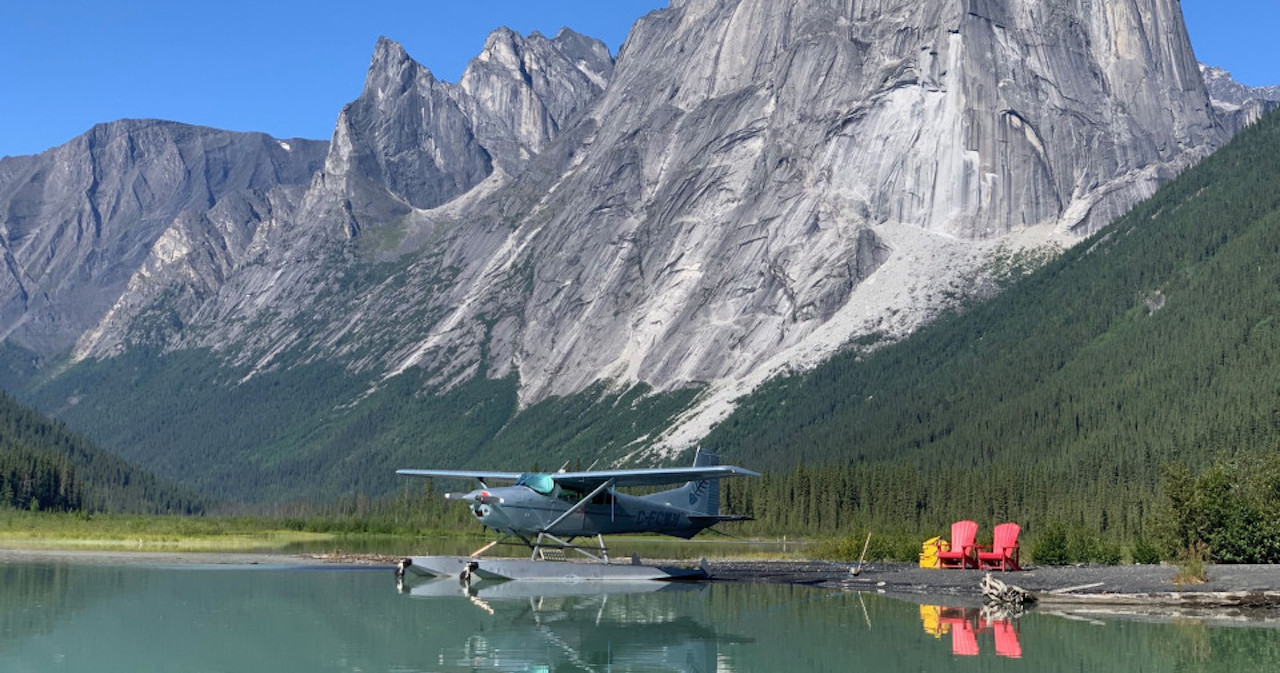
I have posted before that I am a run tank dry sort of guy. I would recommend before anyone tried it for the first time you do it at altitude over a runway. My cub and pacer would both cough and I had fuel switch literally in 1-2 sec. Motor never stopped turning full power back in a few sec. YOUR PLANE SHOULD BUT MAY NOT DO THIS!! So know how yours will react some may take a little longer to smooth out, not a big deal just know what to expect. I will tell you that you must pay attention when you use this method!! This year due to my technique had plans to change to full tank on landing, but did not!! Cough came at about 45 mph, 20 feet AGL, 1600 rpm, changed tanks and landed without problem (even hit my spot) passenger did not even realize event happened. Second time was on takeoff dropping off moose camp. Cough came at 10 ft AGL 2500 RPM just clear of runway and no good place to land, Once again not a problem came right back to full power. Sounds crazy to cough a tank, but you do get used to it like mike said. Just try not to repeat my stupidity!!
SAFTY DRIFT
Lots of things pop into your head when the pilot cooler wants to stop. One of the first ones should be "MOMMA GETS A NEW PLANE!!!" Don't try to save anything but your ass!!! Figure you need some time to find a new one so lots of time to do any paperwork/checkride with the FAA. I know several pilots that have walked away from crashes because they flew it all the way to the ground.!!
DENNY
Fuel tank and reserve management
Wed Jan 11, 2017 3:19 pm
DENNY
Wed Jan 11, 2017 4:09 pm
Re: Fuel tank and reserve management
I think whether a successful landing off-airport can be made requires 2 things, a suitable place to set down and a reasonably skilled pilot. There are a lot of the first, but sometimes the second just isn't up to par. Perhaps it's the adrenaline taking over and panic setting in, but some of the most potentially successful outlandings seem to go to pot due to some not-so-bright piloting. Things like trying to stretch glides, changing plans at the last second, or simply failing to fly the airplane turn scary events into disasters.
Last year, a Bonanza pilot tried to land in a field north of the Greeley airport, resulting in 2 fatalities. I drove by the site a couple days later, and the condition of that field looked for all the world like the field I put my airplane into a dozen years ago, without any damage to the airplane at all, other than some cracking to the wheel pants.
Yet there are examples of really good piloting in which the pilots set down in barely suitable landing spots, minimizing damage and injuries. Some time ago a BCP member managed to stuff a 206 into a way too short 2 track, running out of room way before the airplane was stopped. As I recall, the wings were ripped off, but the fuselage remained intact and no one was hurt.
Just the other day, a pilot set an SR22 onto a mesa in deep snow, with nary more than a bruise to his wife's pinky, and whatever damage was done to the airplane appeared minimal from the photos.
An acquaintance instructing a new T210 owner was able to set the airplane onto the top of a clear cut west of Fort Collins near the Continental Divide. No injuries, relatively minor damage to the airplane, just enough that it had to be reported to the NTSB. More severe damage was done to the airplane later, after it had been repaired from the off-airport landing, when the low time owner forgot to lower the gear before landing at an airport.
Like most of us, when I fly in and around the rocks, I constantly look for that magic place if I have to set down. I agree that there aren't too many in which I could count on not damaging the airplane, but I see many which look like the set-down (I hate the word "crash") would be survivable, if I were to do my job correctly.
Cary
Last year, a Bonanza pilot tried to land in a field north of the Greeley airport, resulting in 2 fatalities. I drove by the site a couple days later, and the condition of that field looked for all the world like the field I put my airplane into a dozen years ago, without any damage to the airplane at all, other than some cracking to the wheel pants.
Yet there are examples of really good piloting in which the pilots set down in barely suitable landing spots, minimizing damage and injuries. Some time ago a BCP member managed to stuff a 206 into a way too short 2 track, running out of room way before the airplane was stopped. As I recall, the wings were ripped off, but the fuselage remained intact and no one was hurt.
Just the other day, a pilot set an SR22 onto a mesa in deep snow, with nary more than a bruise to his wife's pinky, and whatever damage was done to the airplane appeared minimal from the photos.
An acquaintance instructing a new T210 owner was able to set the airplane onto the top of a clear cut west of Fort Collins near the Continental Divide. No injuries, relatively minor damage to the airplane, just enough that it had to be reported to the NTSB. More severe damage was done to the airplane later, after it had been repaired from the off-airport landing, when the low time owner forgot to lower the gear before landing at an airport.
Like most of us, when I fly in and around the rocks, I constantly look for that magic place if I have to set down. I agree that there aren't too many in which I could count on not damaging the airplane, but I see many which look like the set-down (I hate the word "crash") would be survivable, if I were to do my job correctly.
Cary
"I have slipped the surly bonds of earth..., put out my hand and touched the face of God." J.G. Magee
Wed Jan 11, 2017 4:32 pm
Re: Fuel tank and reserve management
Denny,
I see that you are good at multi tasking. I have forgot and had to change in the field a time or two as well. I just want your orientation to be I am going to land or crash there real soon, like you mentioned in the second paragraph. You are already ahead of the aircraft because most pilots take two of those six seconds just accepting that the engine has quit.
Neither the this can't be happening to me nor the we're going to die orientation is useful.
Stay loose,
Contact
Cary,
A lot of survivability in mountains has to do with airspeed and groundspeed (wind) management. We have the better machine to crash in and don't double the impact force as do autos. And, like you said, there are good spots. If we hug the ridge, we generally have lots of vertical space to provide gravity thrust and more time to find a better spot if not glide to a park or desert. We have wings to absorb energy if we use the rudder to put the nose between two trees.
Contact
I see that you are good at multi tasking. I have forgot and had to change in the field a time or two as well. I just want your orientation to be I am going to land or crash there real soon, like you mentioned in the second paragraph. You are already ahead of the aircraft because most pilots take two of those six seconds just accepting that the engine has quit.
Neither the this can't be happening to me nor the we're going to die orientation is useful.
Stay loose,
Contact
Cary,
A lot of survivability in mountains has to do with airspeed and groundspeed (wind) management. We have the better machine to crash in and don't double the impact force as do autos. And, like you said, there are good spots. If we hug the ridge, we generally have lots of vertical space to provide gravity thrust and more time to find a better spot if not glide to a park or desert. We have wings to absorb energy if we use the rudder to put the nose between two trees.
Contact
- contactflying offline
- Posts: 4972
- Joined: Wed Apr 03, 2013 7:36 pm
- Location: Aurora, Missouri 2H2
Download my free "https://tinyurl.com/Safe-Maneuvering" e-book.
DISPLAY OPTIONS
Who is online
Users browsing this forum: No registered users and 2 guests
Latest Features
-
-
Featured Bush Planes
As one of the undisputed legends of bush flying, the Cessna 180 hauls a…Read More -
Aircraft Ownership and Maintenance
9 modification mistakes aircraft owners make when trying to "bush out" their birds—why some…Read More -
Live to Tell
A Minnesota pilot is surprised to learn that the sudden asymmetric drag of an…Read More


Latest Knowledge Base
-
Destinations
Canada offers some of the most spectacular backcountry flying on the continent. Here's what you need to know before you go.Read More -
Safety and Survival
Hope that you never have to use your survival vest but knowing you have it and knowing how to use…Read More -
Destinations
A regional guide with ideas for winter camping destinations in California, Nevada, New Mexico, and Arizona.Read More -
Aircraft
Finding an affordable aircraft that can handle the backcountry for $80K or less? A challenge for sure, but with the…Read More