I have tried both in the backcountry strips in Washington where there are tall trees at the end.
VX left me high over the trees sooner at slower speed , and with the plane moving all over because of the change of winds from runway to above the trees wind and turbulence.
Ground effect allowed me to accelerate and then punch above the trees with lots of energy, this method seems more effective but , doesnt leave you options in case of an engine problem.
Which is the preferred method? Im new to the area so want to hear what techniques are used by more experience pilots .
Ground effect or VX with tall trees?
Fri Aug 05, 2016 5:15 pm
Fri Aug 05, 2016 5:30 pm
Re: Ground effect or VX with tall trees?
motoadve wrote:I have tried both in the backcountry strips in Washington where there are tall trees at the end.
VX left me high over the trees sooner at slower speed , and with the plane moving all over because of the change of winds from runway to above the trees wind and turbulence.
Ground effect allowed me to accelerate and then punch above the trees with lots of energy, this method seems more effective but , doesnt leave you options in case of an engine problem.
Which is the preferred method? Im new to the area so want to hear what techniques are used by more experience pilots .
So climbing at VX with engine problem is worse than zooming at the trees Either way engine problem will be a problem!!
I would think a stall spin at VX would be more likely than with a zoom,
At VX you have to be hair trigger to get the nose down!!
IMHO which is just mine FWIW!!
- M6RV6 offline
- Posts: 2313
- Joined: Mon Feb 25, 2008 5:52 pm
- Location: Rice Wa. 82WN Magee Creek AERODROME
- FindMeSpot URL: http://share.findmespot.com/shared/face ... sWKXuhKlg2
Have as much Fun as is Safe, and Keep SMILIN! GT,
Fri Aug 05, 2016 5:32 pm
Re: Ground effect or VX with tall trees?
In a gutless airplane, neither technique leaves much room for error in case of engine failure.
Nose high, minimal airspeed at vx, if the fan quits and you're not instantly slamming forward on the yoke you got a big problem as in a stall about to happen.
More airspeed and zoom climb out of low ground effect, you're still screwed, but probably have a little more time to go "oh shit" as the speed bleeds off.
Gump
Nose high, minimal airspeed at vx, if the fan quits and you're not instantly slamming forward on the yoke you got a big problem as in a stall about to happen.
More airspeed and zoom climb out of low ground effect, you're still screwed, but probably have a little more time to go "oh shit" as the speed bleeds off.
Gump
Fri Aug 05, 2016 5:59 pm
Re: Ground effect or VX with tall trees?
If I want to climb, induced drag (lift vector) is a much better use of thrust (horsepower) than parasitic drag (hull speed).

CFII, MEI, CFISES, ATPME, IA/AP, RPPL, Ski&Amphib ops, RHC mechanic cert, RHC SC— 3000TT
Fri Aug 05, 2016 7:01 pm
Re: Ground effect or VX with tall trees?
Often there is wind shear at the top of the trees when climbing out from a tree-walled strip. I prefer to build speed so I can climb through the shear zone quickly with more positive control. Remaining in ground effect is a good way to achieve that.
As others have pointed out, if the engine quits, just clearing trees with minimal altitude at the end of a strip a bad place to be regardless which method is used. Reducing weight, or waiting for it to cool off are other methods I've used to keep from scarring the shit out of myself.
As others have pointed out, if the engine quits, just clearing trees with minimal altitude at the end of a strip a bad place to be regardless which method is used. Reducing weight, or waiting for it to cool off are other methods I've used to keep from scarring the shit out of myself.
- blackrock offline
- Posts: 1576
- Joined: Tue Jan 29, 2008 6:54 pm
- Location: Elko, NV
- FindMeSpot URL: http://share.findmespot.com/shared/face ... BFmtASxjeV
- Aircraft: Bearhawk
Fri Aug 05, 2016 8:05 pm
Re: Ground effect or VX with tall trees?
The basic low ground effect takeoff is the most energy efficient because it provides both excess engine thrust for climb, if available at our DA, and extra kinetic energy of pressure airspeed (Wolfgang's zoom reserve) over what could be developed OGE. As MTV said somewhere else, a really tight field give us less seconds of low ground effect. An advantage, for those of us who use low ground effect on all takeoffs, except ITO, is that the length of time in low ground effect, or lack thereof, gives us a good gauge for how we are doing. Once near the trees, Vx if close or Vy if room is available is fine, but the energy wise object is to just clear. Speed deals with rough better than slowness at altitude. Speed deals with stall/spin better than slowness at altitude. If we use it often, and get comfortable with it, the low ground effect takeoff will become the takeoff of choice for most pilots.
All but three of the twelve or thirteen engine failures I have had began below 200' AGL. All these low forced landings were during a low ground effect takeoff or a low ground effect spray run or from 200' while cruising on a pipeline. They were all scary enough, but none cause me to come unglued because I had maneuvering speed in all. Maneuvering speed allowed me to make an energy management turn to a near LZ in the hemisphere to my front. It is a six second deal. One has to be spring loaded to the failure to prevent losing two or three of these six seconds. In almost all I had to use full flaps and full (rudder to the stop) forward slip in the nose down portion of the energy management turn in order to make the beginning of the LZ. Only close stuff works safely. This usually requires a very steep bank in the energy management turn. From the field or even at 200.' we don't see much at a distance (allowing a shallow turn) anyway.
In all of the above I damaged one airplane and one shot up helicopter. Only in the Cobra crash was I hurt in any way. The ultralight that hurt me badly had a working engine but full aileron and full rudder did not bring the wing back up before contact with a harvested corn field. Sure didn't crash as well as a cart wheeled CallAir. Piece of junk.
All but three of the twelve or thirteen engine failures I have had began below 200' AGL. All these low forced landings were during a low ground effect takeoff or a low ground effect spray run or from 200' while cruising on a pipeline. They were all scary enough, but none cause me to come unglued because I had maneuvering speed in all. Maneuvering speed allowed me to make an energy management turn to a near LZ in the hemisphere to my front. It is a six second deal. One has to be spring loaded to the failure to prevent losing two or three of these six seconds. In almost all I had to use full flaps and full (rudder to the stop) forward slip in the nose down portion of the energy management turn in order to make the beginning of the LZ. Only close stuff works safely. This usually requires a very steep bank in the energy management turn. From the field or even at 200.' we don't see much at a distance (allowing a shallow turn) anyway.
In all of the above I damaged one airplane and one shot up helicopter. Only in the Cobra crash was I hurt in any way. The ultralight that hurt me badly had a working engine but full aileron and full rudder did not bring the wing back up before contact with a harvested corn field. Sure didn't crash as well as a cart wheeled CallAir. Piece of junk.
- contactflying offline
- Posts: 4972
- Joined: Wed Apr 03, 2013 7:36 pm
- Location: Aurora, Missouri 2H2
Download my free "https://tinyurl.com/Safe-Maneuvering" e-book.
Sat Aug 06, 2016 12:18 am
Re: Ground effect or VX with tall trees?
Moto: I will shorten up the second 2 lines of your opening post. Believe you embedded the answer there.
VX left me high over the trees with the plane moving all over because of turbulence.
Most of the replies above seem to support the same.
I have only flown VX take offs when it was required for a check ride.
"Preferred Method" can be highly subjective.
A / The prevailing procedure could more objectively determined.
Maybe just subjective semantics on my part.
My preferred method is a blending of three "phases."
I will first get the plane LOW ground effect and focus on/near the base of the trees while accelerating. Second phase is when I know I have enough airspeed to establish a climb I will smoothly raise the nose and slide my focus up the trees till I see the tops. After that it is a simple matter of watching my rates of closure and shift to left side peripheral vision for insurance / assurance.
I just like to see my enemy as long as possible, and don't mind ruffling his hair.
Hope it helps
Chris C
VX left me high over the trees with the plane moving all over because of turbulence.
Most of the replies above seem to support the same.
I have only flown VX take offs when it was required for a check ride.
"Preferred Method" can be highly subjective.
A / The prevailing procedure could more objectively determined.
Maybe just subjective semantics on my part.
My preferred method is a blending of three "phases."
I will first get the plane LOW ground effect and focus on/near the base of the trees while accelerating. Second phase is when I know I have enough airspeed to establish a climb I will smoothly raise the nose and slide my focus up the trees till I see the tops. After that it is a simple matter of watching my rates of closure and shift to left side peripheral vision for insurance / assurance.
I just like to see my enemy as long as possible, and don't mind ruffling his hair.
Hope it helps
Chris C
53 C-170-B+
It is better to be late in this world, than early in the next.
It is better to be late in this world, than early in the next.
Sat Aug 06, 2016 7:07 am
Re: Ground effect or VX with tall trees?
I rack my brain, when thinking about engine failure and crashes. I generally forget something. I turned a Pawnee over in tall cotton after an engine failure.
- contactflying offline
- Posts: 4972
- Joined: Wed Apr 03, 2013 7:36 pm
- Location: Aurora, Missouri 2H2
Download my free "https://tinyurl.com/Safe-Maneuvering" e-book.
Mon Aug 08, 2016 2:04 pm
Re: Ground effect or VX with tall trees?
Wannabe,
You have it under control because you have maneuvering speed. The ability to maneuver, rather than just hang on and hope, gladdens the heart. This is true even when the engine quits and we have to accept difficult options. With maneuvering speed, we at least have options.
Contact
You have it under control because you have maneuvering speed. The ability to maneuver, rather than just hang on and hope, gladdens the heart. This is true even when the engine quits and we have to accept difficult options. With maneuvering speed, we at least have options.
Contact
- contactflying offline
- Posts: 4972
- Joined: Wed Apr 03, 2013 7:36 pm
- Location: Aurora, Missouri 2H2
Download my free "https://tinyurl.com/Safe-Maneuvering" e-book.
Mon Aug 08, 2016 2:28 pm
Re: Ground effect or VX with tall trees?
Contactflying mentioned something that should be discussed further IMHO. If the "zoom" takeoff from low ground effect allows your engine to develop more power, then you are adding energy into the system. This is probably far more of a difference in a fixed pitch situation, and further assumes that you have a propeller that is not twisted so hard that you are already redlined at Vx.
So for the average Cessna 172 with a "halfway" propeller, I can imagine there being a measurable difference in engine thrust being maximized in low ground effect, because you are allowing the engine to spool up to 2750 or whatever instead of 2550.
For the Vx climbout, there is also a possibility that a slight amount of pilot error or miscalculation can put the airplane on the back side of the L/D curve (closer to a mushing climb). For example, the maximum Vx speed is probably a lot lower for a light airplane than a heavy airplane. Accidentally using the "light airplane" Vx when the airplane is actually a little heavier can easily result in this phenomenon, and the airplane does not achieve the climb angle to clear the trees.
The smoothness of the runway and the tire diameter/inflation are also a variable here. Hauling the airplane up off the ground as soon as possible uses all the available lift, which creates far more drag than the same airplane rolling on smooth ground (no induced drag). On the other hand, soft grass, mud, or other surfaces can cause a lot of rolling drag, so there are times when the rolling friction needs to be gotten rid of as soon as possible, because the rolling drag is higher than the induced draft of keeping the airplane airborne.
So for the average Cessna 172 with a "halfway" propeller, I can imagine there being a measurable difference in engine thrust being maximized in low ground effect, because you are allowing the engine to spool up to 2750 or whatever instead of 2550.
For the Vx climbout, there is also a possibility that a slight amount of pilot error or miscalculation can put the airplane on the back side of the L/D curve (closer to a mushing climb). For example, the maximum Vx speed is probably a lot lower for a light airplane than a heavy airplane. Accidentally using the "light airplane" Vx when the airplane is actually a little heavier can easily result in this phenomenon, and the airplane does not achieve the climb angle to clear the trees.
The smoothness of the runway and the tire diameter/inflation are also a variable here. Hauling the airplane up off the ground as soon as possible uses all the available lift, which creates far more drag than the same airplane rolling on smooth ground (no induced drag). On the other hand, soft grass, mud, or other surfaces can cause a lot of rolling drag, so there are times when the rolling friction needs to be gotten rid of as soon as possible, because the rolling drag is higher than the induced draft of keeping the airplane airborne.
.
Mon Aug 08, 2016 4:55 pm
Re: Ground effect or VX with tall trees?
EZ Flap,
I hadn't considered the extra engine RPM sooner in low ground effect. Good point.
As far as the comparison between tire friction with the surface and induced drag in the lift to haul the airplane into low ground effect as soon as it will fly in low ground effect, I expect you are right for many of the soft field and ground effect takeoffs I see. Those, however, are waiting too long to pull off as evidenced by their gaining five to ten ten feet ground effect with the nose still pitched up trying for higher ground effect. Not getting the nose down quickly to stay in low ground effect (6" to 1') makes a world of difference in the induced lift drag. Inducing too much lift while too slow requires a too high pitch attitude and is very inefficient. Inducing just enough to get the airplane to fly in six inch ground effect, or at least pitching level quickly and returning to low ground effect, is very efficient.
I don't have the math, but flying boat guys do. All I know, as a poor 235 hp Pawnee pilot trying to get off La Plata Airport near Durango with a hundred and twenty gallons in the hopper and forty in the gas tank, I really got worried about the number of seconds I had to roll before I could get the tail up and finally pull it off into a two inch ground effect. Rolling on the concrete or hard sand/grass beside the runway did not produce the rapid acceleration I was yearning for.
The short field takeoff school solution, for many years, was roll on the ground until Vx or Vy on the airspeed indicator. That didn't keep piston heavies and crop dusters from taking advantage of low ground effect. Now at least the school solution has become "accelerate in ground effect until Vx or Vy as appropriate." That is for all takeoffs on all surfaces.
Contact
I hadn't considered the extra engine RPM sooner in low ground effect. Good point.
As far as the comparison between tire friction with the surface and induced drag in the lift to haul the airplane into low ground effect as soon as it will fly in low ground effect, I expect you are right for many of the soft field and ground effect takeoffs I see. Those, however, are waiting too long to pull off as evidenced by their gaining five to ten ten feet ground effect with the nose still pitched up trying for higher ground effect. Not getting the nose down quickly to stay in low ground effect (6" to 1') makes a world of difference in the induced lift drag. Inducing too much lift while too slow requires a too high pitch attitude and is very inefficient. Inducing just enough to get the airplane to fly in six inch ground effect, or at least pitching level quickly and returning to low ground effect, is very efficient.
I don't have the math, but flying boat guys do. All I know, as a poor 235 hp Pawnee pilot trying to get off La Plata Airport near Durango with a hundred and twenty gallons in the hopper and forty in the gas tank, I really got worried about the number of seconds I had to roll before I could get the tail up and finally pull it off into a two inch ground effect. Rolling on the concrete or hard sand/grass beside the runway did not produce the rapid acceleration I was yearning for.
The short field takeoff school solution, for many years, was roll on the ground until Vx or Vy on the airspeed indicator. That didn't keep piston heavies and crop dusters from taking advantage of low ground effect. Now at least the school solution has become "accelerate in ground effect until Vx or Vy as appropriate." That is for all takeoffs on all surfaces.
Contact
- contactflying offline
- Posts: 4972
- Joined: Wed Apr 03, 2013 7:36 pm
- Location: Aurora, Missouri 2H2
Download my free "https://tinyurl.com/Safe-Maneuvering" e-book.
Wed Aug 10, 2016 11:47 am
Re: Ground effect or VX with tall trees?
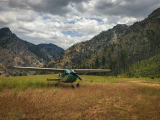
Here's a ground effect takeoff from this past weekend at FARMAULE's strip in WV. WV68- Taylors
- Crzyivan13 offline
- Posts: 1811
- Joined: Sat Nov 24, 2012 9:50 pm
- Location: Ohio- OI27 Checkpoint Charlie
- FindMeSpot URL: https://share.delorme.com/EvanDavis
- Aircraft: 1957 Cessna 182A
Wed Aug 10, 2016 1:28 pm
Re: Ground effect or VX with tall trees?
motoadve wrote:I have tried both in the backcountry strips in Washington where there are tall trees at the end.
VX left me high over the trees sooner at slower speed , and with the plane moving all over because of the change of winds from runway to above the trees wind and turbulence.
Ground effect allowed me to accelerate and then punch above the trees with lots of energy, this method seems more effective but , doesnt leave you options in case of an engine problem.
Which is the preferred method? Im new to the area so want to hear what techniques are used by more experience pilots .
In this case, you are comparing apples to oranges, as the saying goes. If Vx in fact "left me high over the trees sooner at slower speed", then there was certainly no need to use Vx. Why would you use Vx if it weren't in fact needed?
That is the simple answer to your question. I would never use a pure Vx climb in a situation where it wasn't really necessary, for the reason you point out, and reasons that others have noted.
On the other hand, if you had in fact been in a place that was ACTUALLY tight, a Vx climb may be the only safe way out of there. Doesn't mean you don't accelerate in ground effect....TO Vx, at which point you climb at Vx.
In the example you offered, I'd be climbing at Vy or even higher speed. All you have to do is MISS the trees, you don't have to be 100 feet above the trees.
And, if you're worried about an engine failure coming out of a tree lined airstrip, don't land in tree lined airstrips. An engine failure on takeoff from almost any of those that aren't super long (like the one in the video from Farmaule's) is going to put you in the trees anyway.
But, to me, while Vx isn't exactly an emergency maneuver, a Vx climb is something I only use when it is in fact necessary. And, in most of the instances where I've had to use it, I probably shouldn't have been there in the first place.
In your examples, it certainly wasn't necessary.
Safe aviation involves good risk management. Vx is a performance maneuver, but it does involve slightly higher risk. Well flown, it is perfectly safe, however.
If you're really worried about engine failures, you shouldn't be flying over all those trees in the first place, or you need to find a more reliable airplane.
MTV


Wed Aug 10, 2016 9:02 pm
Re: Ground effect or VX with tall trees?
MTV I do this for fun, dont need to be at any of this places, l think most of the guys here in the forums also do it for fun.
Im always training and looking for improvement though.
As why I doing a Vx over the tall trees? to experiment how it works compared to ground effect.
Im preferring ground effect.
Never had a backcountry instructor, I taught myself , practiced a lot and asked a lot (you are one who has given great advice , along with many other pilots in here)
About engine trouble , agreed with you 100%,and actually there are some urban airports that are a lot worse than any backcountry strip.
Im always training and looking for improvement though.
As why I doing a Vx over the tall trees? to experiment how it works compared to ground effect.
Im preferring ground effect.
Never had a backcountry instructor, I taught myself , practiced a lot and asked a lot (you are one who has given great advice , along with many other pilots in here)
About engine trouble , agreed with you 100%,and actually there are some urban airports that are a lot worse than any backcountry strip.
Wed Aug 10, 2016 9:06 pm
Re: Ground effect or VX with tall trees?
motoadve wrote:About engine trouble , agreed with you 100%,and actually there are some urban airports that are a lot worse than any backcountry strip.
Amen on that comment.
Gump
Sent from my iPad using Tapatalk
Thu Aug 11, 2016 3:15 pm
Re: Ground effect or VX with tall trees?
motoadve wrote:MTV I do this for fun, dont need to be at any of this places, l think most of the guys here in the forums also do it for fun.
Im always training and looking for improvement though.
As why I doing a Vx over the tall trees? to experiment how it works compared to ground effect.
Im preferring ground effect.
Never had a backcountry instructor, I taught myself , practiced a lot and asked a lot (you are one who has given great advice , along with many other pilots in here)
About engine trouble , agreed with you 100%,and actually there are some urban airports that are a lot worse than any backcountry strip.
Moto,
I wasn't questioning your motives. My point was that a Vx climb is, in my opinion, a poor choice unless you really NEED it to get out of somewhere. So, my point was and is, that the videos you posted obviously had lots of room to depart without using a Vx climb. So, the obvious choice would be something other than a Vx climb in those instances.....at least in my opinion.
Or, to put it another way, make yourself happy....
 But, I sure wouldn't use a Vx climb in those situations.
MTV
Thu Aug 11, 2016 5:50 pm
Re: Ground effect or VX with tall trees?
I agree. Potential extra seconds of low ground rejected by an early climb out of ground effect is energy inefficient. I understand you were looking for a comparison,but that research should be conducted in a safer environment.
- contactflying offline
- Posts: 4972
- Joined: Wed Apr 03, 2013 7:36 pm
- Location: Aurora, Missouri 2H2
Download my free "https://tinyurl.com/Safe-Maneuvering" e-book.
Sat Aug 13, 2016 4:54 pm
Re: Ground effect or VX with tall trees?
So, after reading a LOT of information on the topic, I went out a couple of days ago and experimented with MY plane (a 1965 Champion 7ECA with 100 HP C-100 on "regular" tires). It should be noted that there is no POH for this exact aircraft - the closest is the one published by Bellanca when they took over manufacture in 1967, but that POH is for the O-235 powered 7ECA (115 vs my 100 hp). So I don't really have any "book specs" to compare my current performance against. But since the airframes are identical (only the engine and oleo landing gear differ on my plane), I figure that's the "book" to use...
My instructor and I both observed that my 7ECA accelerates pretty slowly while the wheels are on the ground. Before starting this session, I made sure all three tires were filled to the middle of the POH recommended range.
Previous testing had convinced me that raising the tail as soon as possible (POH procedure) is really necessary, as trying to accelerate in a 3-point attitude takes FAR more distance to get to flying speed. (And here I'm talking maybe DOUBLE the ground roll!) So for the testing described below, I brought the tail up as soon as I could. Then I went out and did 8 takeoffs: 4 using the "Vx technique" and 4 doing the "ground effect" technique.
Weather for the test: There was a 10-15 knot wind about 20* right of the runway heading. It remained consistent for this experiment. The temperature was about 95* F, resulting in a DA of about 3,000 feet. Book figures for the Bellanca 7ECA (115 HP) show Vx as 58 mph, Vy as 69 mph, and Vs as 51 mph. On a previous flight, power-on stall speed was observed to be 43 mph IAS, while power-off stall occurred at a lower airspeed (ASI was bouncing between 0 and 45, so totally useless).
Vx Technique:
For short field takeoff, the book calls for liftoff between 50-55 mph, and climbout at 58 mph (Vx). Using this technique, I consistently saw ground rolls of about 500 feet, crossing abeam the control tower even with the top of the tower (~50' AGL). Once abeam the tower, I'd lower the nose slightly, accelerate to Vy (69 mph) and continue the climb. I noted my altitude at the end of the 7000' runway, which was a pretty consistent 800 feet MSL.
Results -- Vx technique:
* Takeoff ground roll ~ 500 feet
* Altitude at runway mid-point (3500 feet) ~ 50 feet AGL (630 feet MSL)
* Altitude at runway end (7000 feet) ~ 220 feet AGL (800 feet MSL)
Using the "low ground effect" technique, I accelerated to 40-45 mph IAS, and eased the stick back to break the ground, immediately leveling off at 1-2 feet AGL. The ground roll was significantly shorter (300-350 ft). Once in low ground effect, I allowed the plane to accelerate to 65-70 mph, and initiated a "zoom climb." Interestingly, I found the aircraft initially continued to accelerate (probably meaning that the ASI lagged slightly behind actual airspeed). I continued the zoom climb until the airspeed started to drop, and tried to maintain exactly at 69 mph (Vy). Interestingly enough (and I believe confirming Jim's point about low ground-effect takeoffs), I was consistently well above the tower's elevation before I crossed abeam the tower. By the time I actually was abeam the tower, I was roughly 50 feet above the tower (100' AGL), and by the time I got to the end of the runway, I was at 900' MSL.
Results -- Low Ground Effect technique:
* Takeoff ground roll ~ 300-350 feet
* Altitude at runway mid-point (3500 feet) ~ 100 feet AGL (680 feet MSL)
* Altitude at runway end (7000 feet) ~ 320 feet AGL (900 feet MSL)
I need lots more practice to see if I can improve on these performance numbers, but am happy with the progress I'm making after only 22 hours of tailwheel time!
My instructor and I both observed that my 7ECA accelerates pretty slowly while the wheels are on the ground. Before starting this session, I made sure all three tires were filled to the middle of the POH recommended range.
Previous testing had convinced me that raising the tail as soon as possible (POH procedure) is really necessary, as trying to accelerate in a 3-point attitude takes FAR more distance to get to flying speed. (And here I'm talking maybe DOUBLE the ground roll!) So for the testing described below, I brought the tail up as soon as I could. Then I went out and did 8 takeoffs: 4 using the "Vx technique" and 4 doing the "ground effect" technique.
Weather for the test: There was a 10-15 knot wind about 20* right of the runway heading. It remained consistent for this experiment. The temperature was about 95* F, resulting in a DA of about 3,000 feet. Book figures for the Bellanca 7ECA (115 HP) show Vx as 58 mph, Vy as 69 mph, and Vs as 51 mph. On a previous flight, power-on stall speed was observed to be 43 mph IAS, while power-off stall occurred at a lower airspeed (ASI was bouncing between 0 and 45, so totally useless).
Vx Technique:
For short field takeoff, the book calls for liftoff between 50-55 mph, and climbout at 58 mph (Vx). Using this technique, I consistently saw ground rolls of about 500 feet, crossing abeam the control tower even with the top of the tower (~50' AGL). Once abeam the tower, I'd lower the nose slightly, accelerate to Vy (69 mph) and continue the climb. I noted my altitude at the end of the 7000' runway, which was a pretty consistent 800 feet MSL.
Results -- Vx technique:
* Takeoff ground roll ~ 500 feet
* Altitude at runway mid-point (3500 feet) ~ 50 feet AGL (630 feet MSL)
* Altitude at runway end (7000 feet) ~ 220 feet AGL (800 feet MSL)
Using the "low ground effect" technique, I accelerated to 40-45 mph IAS, and eased the stick back to break the ground, immediately leveling off at 1-2 feet AGL. The ground roll was significantly shorter (300-350 ft). Once in low ground effect, I allowed the plane to accelerate to 65-70 mph, and initiated a "zoom climb." Interestingly, I found the aircraft initially continued to accelerate (probably meaning that the ASI lagged slightly behind actual airspeed). I continued the zoom climb until the airspeed started to drop, and tried to maintain exactly at 69 mph (Vy). Interestingly enough (and I believe confirming Jim's point about low ground-effect takeoffs), I was consistently well above the tower's elevation before I crossed abeam the tower. By the time I actually was abeam the tower, I was roughly 50 feet above the tower (100' AGL), and by the time I got to the end of the runway, I was at 900' MSL.
Results -- Low Ground Effect technique:
* Takeoff ground roll ~ 300-350 feet
* Altitude at runway mid-point (3500 feet) ~ 100 feet AGL (680 feet MSL)
* Altitude at runway end (7000 feet) ~ 320 feet AGL (900 feet MSL)
I need lots more practice to see if I can improve on these performance numbers, but am happy with the progress I'm making after only 22 hours of tailwheel time!


Sat Aug 13, 2016 5:42 pm
Re: Ground effect or VX with tall trees?
JP256,
Very good. Thanks for the data. In 17,000 hours, I never took any data.
Jim
Very good. Thanks for the data. In 17,000 hours, I never took any data.
Jim
- contactflying offline
- Posts: 4972
- Joined: Wed Apr 03, 2013 7:36 pm
- Location: Aurora, Missouri 2H2
Download my free "https://tinyurl.com/Safe-Maneuvering" e-book.
Sat Aug 13, 2016 7:45 pm
Re: Ground effect or VX with tall trees?
Either VX climb or zoom zoom hop over, will leave you a worthless bag of shit if the engine pukes... so let's call that a wash and move on.
VX climb,
A factory guaranteed number that assures you obstacle clearance at gross weight, in a bone stock airplane when perfectly executed ...
Anyone on this forum fly as good as the test pilot in an aircraft as described?
Zoom zoom hop... ground effect, whatever you want to call it....
An exercise in energy management that when mastered will work every time regardless of aircraft configuration, loading, or relation to external conditions.
Either of these works, but the exercise in energy management lets the simpleton in me, allow mother nature and the wing take the guess work out of things
Take care, Rob
VX climb,
A factory guaranteed number that assures you obstacle clearance at gross weight, in a bone stock airplane when perfectly executed ...
Anyone on this forum fly as good as the test pilot in an aircraft as described?
Zoom zoom hop... ground effect, whatever you want to call it....
An exercise in energy management that when mastered will work every time regardless of aircraft configuration, loading, or relation to external conditions.
Either of these works, but the exercise in energy management lets the simpleton in me, allow mother nature and the wing take the guess work out of things
Take care, Rob

DISPLAY OPTIONS
Who is online
Users browsing this forum: No registered users and 1 guest
Latest Features
-
Live to Tell
A Minnesota pilot is surprised to learn that the sudden asymmetric drag of an out-of-rig ski can…Read More -
Creators
Working in some of the Yukon's most beautiful and remote environments, photographer Simon Blakesley captures aircraft in…Read More -
Aircraft Ownership and Maintenance
Upgrading to big tires can make a huge difference in backcountry performance, but with those gains come…Read More -
Tales from Yesteryear
In this tale from bush flying yesteryear, Don Cogger signs up to help Atlee Dodge Jr recovery…Read More


Latest Knowledge Base
-
Destinations
A regional guide with ideas for winter camping destinations in California, Nevada, New Mexico, and Arizona.Read More -
Aircraft
Finding an affordable aircraft that can handle the backcountry for $80K or less? A challenge for sure, but with the…Read More -
Aircraft
01.29.2018 - Zane - Updated tire diameter graphic to add 8.50x10 Guide to tires for use in the backcountry and off-airport landing…Read More -
Pilots
12.22.2013 - Initial article format Operating aircraft on skis and negotiating a snow-covered landscape is an entirely unique skillset and environment.…Read More


