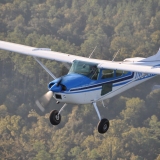
JP256 wrote:So, after reading a LOT of information on the topic, I went out a couple of days ago and experimented with MY plane (a 1965 Champion 7ECA with 100 HP C-100 on "regular" tires). It should be noted that there is no POH for this exact aircraft - the closest is the one published by Bellanca when they took over manufacture in 1967, but that POH is for the O-235 powered 7ECA (115 vs my 100 hp). So I don't really have any "book specs" to compare my current performance against. But since the airframes are identical (only the engine and oleo landing gear differ on my plane), I figure that's the "book" to use...
My instructor and I both observed that my 7ECA accelerates pretty slowly while the wheels are on the ground. Before starting this session, I made sure all three tires were filled to the middle of the POH recommended range.
Previous testing had convinced me that raising the tail as soon as possible (POH procedure) is really necessary, as trying to accelerate in a 3-point attitude takes FAR more distance to get to flying speed. (And here I'm talking maybe DOUBLE the ground roll!) So for the testing described below, I brought the tail up as soon as I could. Then I went out and did 8 takeoffs: 4 using the "Vx technique" and 4 doing the "ground effect" technique.
Weather for the test: There was a 10-15 knot wind about 20* right of the runway heading. It remained consistent for this experiment. The temperature was about 95* F, resulting in a DA of about 3,000 feet. Book figures for the Bellanca 7ECA (115 HP) show Vx as 58 mph, Vy as 69 mph, and Vs as 51 mph. On a previous flight, power-on stall speed was observed to be 43 mph IAS, while power-off stall occurred at a lower airspeed (ASI was bouncing between 0 and 45, so totally useless).
Vx Technique:
For short field takeoff, the book calls for liftoff between 50-55 mph, and climbout at 58 mph (Vx). Using this technique, I consistently saw ground rolls of about 500 feet, crossing abeam the control tower even with the top of the tower (~50' AGL). Once abeam the tower, I'd lower the nose slightly, accelerate to Vy (69 mph) and continue the climb. I noted my altitude at the end of the 7000' runway, which was a pretty consistent 800 feet MSL.
Results -- Vx technique:
* Takeoff ground roll ~ 500 feet
* Altitude at runway mid-point (3500 feet) ~ 50 feet AGL (630 feet MSL)
* Altitude at runway end (7000 feet) ~ 220 feet AGL (800 feet MSL)
Using the "low ground effect" technique, I accelerated to 40-45 mph IAS, and eased the stick back to break the ground, immediately leveling off at 1-2 feet AGL. The ground roll was significantly shorter (300-350 ft). Once in low ground effect, I allowed the plane to accelerate to 65-70 mph, and initiated a "zoom climb." Interestingly, I found the aircraft initially continued to accelerate (probably meaning that the ASI lagged slightly behind actual airspeed). I continued the zoom climb until the airspeed started to drop, and tried to maintain exactly at 69 mph (Vy). Interestingly enough (and I believe confirming Jim's point about low ground-effect takeoffs), I was consistently well above the tower's elevation before I crossed abeam the tower. By the time I actually was abeam the tower, I was roughly 50 feet above the tower (100' AGL), and by the time I got to the end of the runway, I was at 900' MSL.
Results -- Low Ground Effect technique:
* Takeoff ground roll ~ 300-350 feet
* Altitude at runway mid-point (3500 feet) ~ 100 feet AGL (680 feet MSL)
* Altitude at runway end (7000 feet) ~ 320 feet AGL (900 feet MSL)
I need lots more practice to see if I can improve on these performance numbers, but am happy with the progress I'm making after only 22 hours of tailwheel time!
Good for you for trying to figure out what works for your airplane. That said, there are a couple of serious flaws in your approach.
First, your assumption that the Vx speed for your airplane is the same as for an airplane that has somewhat more (like 15 %) horsepower, not to mention that the Lycoming powered model 7 is a lot more nose heavy. What you should test FIRST is to go out and find out what the actual Vx speed is for YOUR airplane. This is the case for any of the older airplanes that don't provide that information in a flight manual, and also for any airplanes that have been significantly modified (larger engine, STOL kit, etc). Once you have that number, then you can start a valid evaluation of climb methodology.
Second, this entire discussion has been about CLIMB. Why did you use a different TAKEOFF procedure for the two different tests? Now you're comparing apples to oranges again, and in the process, you invalidate any data gathered. I can't imagine why you'd use a "known" longer takeoff run for one or the other procedure. Again, this is a discussion about climb performance. Obviously, if you're in a tight spot, you're going to use the TAKEOFF procedure that gets you airborne as short as possible.
Third, you changed the climb from Vx to something else when you passed through ~ 50 feet. So, anything after that really doesn't represent a Vx climb.
Fourth, there's something amiss in your stall speed figures. You noted that "On a previous flight, power-on stall speed was observed to be 43 mph IAS, while power-off stall occurred at a lower airspeed (ASI was bouncing between 0 and 45, so totally useless), yet the flight manual lists stall speed for your airplane (Vs) as 51 mph. How do you explain the large difference in Vs between book and what you're seeing? Also, you state that stall speed power off (Vs) is lower than the power on stall speed. There's something wrong there....I've never met an airplane that stalled at a higher speed power on than with power off.
Finally, what weight and balance were you using for the tests? Exact same fuel load/CG? The factory uses maximum gross weight, and typically tries to get the CG as far aft as practical within the limits for the aircraft. Weight and and CG is important primarily in the context of trying to put your tests into the real world of flying.
I appreciate the fact that you are trying to actually test the performance of your plane, but if you're going to do that, you need to do it right, and there are far too many flaws in this "test" to suggest anything about performance.
MTV