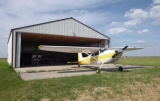
I’ve got five different tents, two tarps and a jungle hammock that I use when I’m alone. Last year after long consideration I pulled the trigger on a floor-less teepee tent and titanium stove combination. My thinking was to have a dry, heated base camp at the airplane…a bit of luxury and comfort waiting for us when we come in soaking wet from a backpacking trip and the weather holds us down for a couple more days, or when the Middle Fork is still snow-free in February and the weather lets us in.
After a week of slogging through soaking wet brush the thought of a heated spot back at the airfield is pretty appealing.

I’ve been using floor-less tents for years, mostly as ultralight backpacking and kayaking shelters. One of the advantages is you can cook in them when the weather is nasty.

Even a small alcohol stove will dramatically warm the air inside a tent, though without a chimney you need to leave the doors open.

Several manufactures make the teepee tents and titanium stoves. I went with Seek Outside because I thought they offered the best features. I have no affiliation with Seek Outside and paid full retail for my tent and stove, so this isn’t a plug.
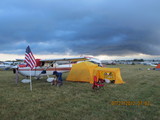
Early March at 5,000 feet. Rather cool mornings. Sitting around a campfire is great but when the wind picks up or it starts raining/snowing it doesn't work that well anymore.


Quality wise I’m happy with the product, and I’m rather particular. My only grudge is that they don’t seam seal their products at the factory, so you have to do that yourself. It’s not difficult, but it takes time.
I opted for the eight-person tent and “large” stove for my wife and I. Eight-person is really a best-case measurement with no stove, no gear, and people who really get along well, but it’s fantastic for two people with a stove and firewood storage and all our gear spread out. With the stove and stove pipe it still weighs less than 10 pounds, which is less than our North Face three person tent.
Floor-less, single-wall tents are not for everyone or for everywhere. For starters, you’re going to be closer to nature than you will be in a floored tent. The way the Seek Outside tent is designed it’s pretty mosquito proof depending on where you get to pitch it, but whatever bugs are still hatching out of the ground are coming right inside. Rodents can also get in, and if you cook inside the tent for any length of time, they will.
A properly pitched floor-less tent will keep the mosquitos out, but crawling bugs can find their way in.


The single-wall construction means there’s going to be condensation inside the tent. You can buy a liner that ties inside the tent but I didn’t bother as it seemed like a lot of hassle, so I can’t say whether they work well or not. Once the fire is lit the condensation goes away pretty fast anyway.
One of the many reasons I chose Seek Outside is because they offer two ground-to-peak doors with (optional) bug netting. That means you can have cross ventilation and still keep the mosquitos at bay. I’ve been camping in bugs bad enough that I seriously considered starting up the plane so I could sit in the prop wash, so this feature was appealing to me. It works pretty well, though if the tent is in the sun it’s going to get warm in there, ventilation or not.
But it’s the ability to heat the tent that really sets it apart. We recently spent four days camped in the rain. Wind, temps in the 40’s, just flat out wet and cold day after day. Our biggest problem was keeping cool enough once the stove was lit. We’d lounge around in our underwear sipping rum and lemonade, sprawled out in thermarest chairs and playing cribbage while the rain pissed down and the stove dried out our wet pants from the mornings’ hike. It was the difference between enduring four days and flat out enjoying them. In fact, the rainy days were the favorite days of our trip.
Getting soaking wet while hiking or fishing just isn’t a big deal when you know you have a hot stove and a large dry patch of real estate to hang out in afterward. The stove has a spark arrestor, and I’ve never gotten a burn hole no matter how pitchy the wood is.


Pitching a tarp like a porch helps immensely in constant rain, regardless of the tent design. Note the sleeping bags hanging up and drying out after the dampness of three days of rain.


Pretty common for the whole stove and half the pipe to be glowing red-hot. There is a door for the stove that’s not shown. Drying out clothing, bedding, rifles, etc. is a real bonus when you're out for a long time.


Pitching a teepee tent isn’t quite as easy as pitching a floored tent. I highly recommend doing it at home a few times till you get the hang of it. Once you figure it out it’s fine, but it takes some practice to get the tension right on all sides. Measuring the peg distances on a proper pitch and then making a ruler out of cord help immensely. If you pitch it correctly it will withstand an astounding amount of wind. One nice feature is there are two sets of tie downs on each tent, so an 8-person tent can be pitched as a 6-person if that’s all the space you have to work with.
Some things to keep in mind if you look at going this route: The floor space is just that…floor space. A sitting, kneeling or standing person is restricted to a much smaller area inside the tent, and the stove takes up some room, too. The eight person is great for two people and would be great for three. Four people inside the tent would easily work, but they wouldn’t be quite as happy as we were after four days of rain. On the other hand, the bigger the tent, the bigger a space you need to pitch it. Small children or dogs could potentially be disastrous with the wood stove. At less than three pounds, it would’t take much to kick it over.
Seek Outside offers two weights of fabric. I went with the lightest even though I plan to use the tent primarily out of the plane. I just wanted the option to pack it if I so chose. The stoves are really quite small but they heat the tent up incredibly well. Just remember that the smaller the stove, the smaller you have to cut your firewood. You can’t just stuff pieces in like with a cast iron stove…they have to fit easily or you’re going to damage the stove.
They also make a “nest”, which is an enclosed sleeping area you can pitch inside the main tent. I got one and I’ve used it but I’m not entirely sold on it. I’m 6’5” and while there’s enough floor space, the tapered walls are a bit tight for me.
Seek Outside doesn’t give these away, but neither do any of the other companies that make them. The single wall tent material is inherently expensive and there’s a lot of sewing. It’s good value for money if you’re serious about quality gear and this design fits your needs.
In summary, this style tent is a real game changer for cold or wet weather camping. It’ll increase your comfort several hundred percent, and the worse the weather the more you’ll love it. If you just do summer trips in good weather then it’s overkill. If the occasional rodent running across your sleeping bag is completely unacceptable then this isn’t the right design for you, either. I would have concerns using it in heavy snake country, especially for extended periods that would allow snakes to crawl into sleeping bags, wood piles, etc.. Of course if snakes are out and about, you really don’t need a heated tent anyway. You can use the tent without the stove of course, but it’s the stove that really makes this system shine.